2022 HONDA CRV app
[x] Cancel search: appPage 53 of 692
51
uuSeat Belts uFastening a Seat Belt
Continued
Safe Driving
Fastening a Seat Belt
After adjusting a front seat to the proper position, and while sitting upright and well
back in the seat:
2 Seats P. 208
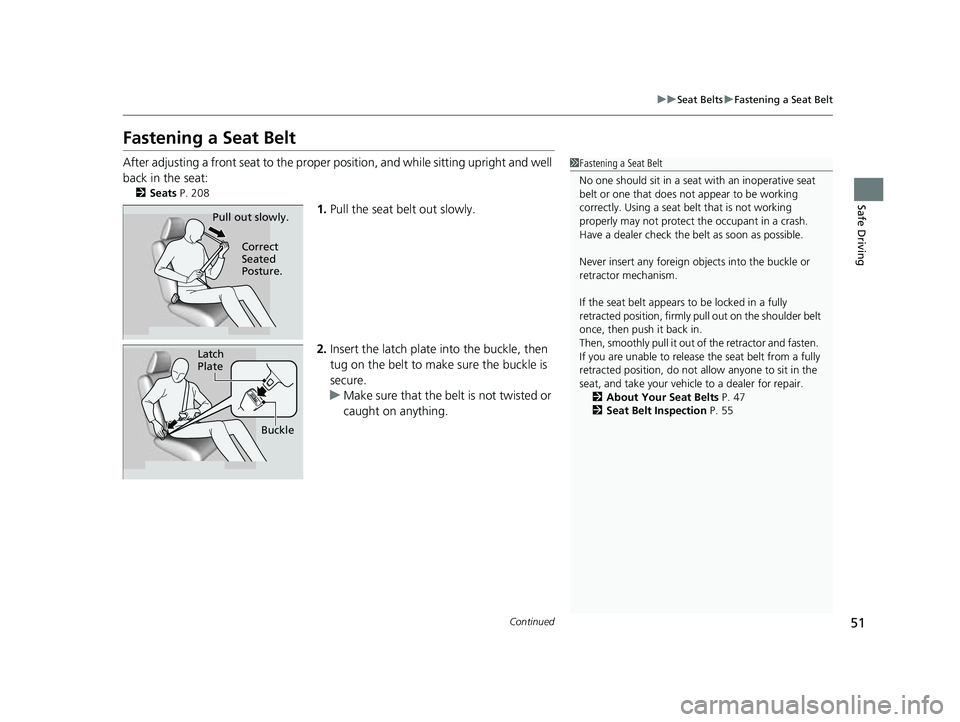
1.Pull the seat belt out slowly.
2. Insert the latch plate into the buckle, then
tug on the belt to make sure the buckle is
secure.
u Make sure that the belt is not twisted or
caught on anything.
1Fastening a Seat Belt
No one should sit in a seat with an inoperative seat
belt or one that does not appear to be working
correctly. Using a seat be lt that is not working
properly may not protect the occupant in a crash.
Have a dealer check the belt as soon as possible.
Never insert any foreign obj ects into the buckle or
retractor mechanism.
If the seat belt appears to be locked in a fully
retracted position, firmly pull out on the shoulder belt
once, then push it back in.
Then, smoothly pull it out of the retractor and fasten.
If you are unable to release the seat belt from a fully
retracted position, do not allow anyone to sit in the
seat, and take your vehicle to a dealer for repair.
2 About Your Seat Belts P. 47
2 Seat Belt Inspection P. 55
Pull out slowly.
Correct
Seated
Posture.
Latch
Plate
Buckle
22 CR-V HEV ELP-31TPG6200.book 51 ページ 2021年6月30日 水曜日 午前11時6分
Page 62 of 692

uuAirbags uFront Airbags (SRS)
60
Safe DrivingFront airbags are designed to inflate du ring moderate-to-severe frontal collisions.
When the vehicle decelerates suddenly, the sensors send information to the control
unit which signals one or both front airbags to inflate.
A frontal collision can be either head-on or angled between two vehicles, or when a
vehicle crashes into a stationary object, such as a concrete wall.
While your seat belt restrains your torso, the
front airbag provides supplemental protection
for your head and chest.
The front airbags deflate immediately so that
they won’t interfere with the driver’s visibility
or the ability to steer or operate other
controls.
The total time for inflation and deflation is so fast that most occupants are not
aware that the airbags deployed until th ey see them lying in front of them.
■Operation
■How the Front Airbags Work1How the Front Airbags Work
Although the driver’s and fr ont passenger’s airbags
normally inflate within a spli t second of each other, it
is possible for only one airbag to deploy. This can
happen if the severity of a collision is at the margin,
or threshold that determines whether or not the
airbags will deploy. In such cases, the seat belt will
provide sufficient protec tion, and the supplemental
protection offered by the airbag would be minimal.
22 CR-V HEV ELP-31TPG6200.book 60 ページ 2021年6月30日 水曜日 午前11時6分
Page 63 of 692

61
uuAirbags uFront Airbags (SRS)
Continued
Safe Driving
■When front airbags should not deploy
Minor frontal crashes: Front airbags were designed to supplement seat belts and
help save lives, not to prevent minor scra pes, or even broken bones that might occur
during a less than moderate-to-severe frontal crash.
Side impacts: Front airbags can provide protection when a sudden deceleration
causes a driver or front passenger to move toward the front of the vehicle. Side
airbags and side curtain airbags have been specifically designed to help reduce the
severity of injuries that can occur during a moderate-to-severe side impact which
can cause the driver or passenger to move toward the side of the vehicle.
Rear impacts: Head restraints and seat belts ar e your best protection during a rear
impact. Front airbags cannot provide any significant protection and are not designed
to deploy in such collisions.
Rollovers: In a rollover, your best form of protection is a seat belt or, if your vehicle
is equipped with a rollover sensor, both a seat belt and a side curtain airbag. Front
airbags, however, are not designed to depl oy in a rollover as they would provide
little if any protection.
■When front airbags deploy with little or no visible damage
Because the airbag system senses sudden deceleration, a strong impact to the
vehicle framework or suspension might caus e one or more of the airbags to deploy.
Examples include running into a curb, the edge of a hole, or other low fixed object
that causes a sudden deceleration in th e vehicle chassis. Since the impact is
underneath the vehicle, damage may not be readily apparent.
■When front airbags may not depl oy, even though exterior damage
appears severe
Since crushable body parts absorb crash energy during an impact, the amount of
visible damage does not always indicate proper airbag operation. In fact, some
collisions can result in severe damage but no airbag deployment because the airbags
would not have been needed or would not have provided protection even if they
had deployed.
22 CR-V HEV ELP-31TPG6200.book 61 ページ 2021年6月30日 水曜日 午前11時6分
Page 67 of 692

65
uuAirbags uSide Airbags
Safe Driving
■When a side airbag deploys with little or no visible damage
Because the airbag system senses sudden acceleration, a strong impact to the side
of the vehicle’s framework can cause a side airbag to deploy. In such cases, there
may be little or no damage, but the side impact sensors detected a severe enough
impact to deploy the airbag.
■When a side airbag may not deploy, even though visible damage appears
severe
It is possible for a side airbag not to deploy during an impact that results in
apparently severe damage. This can occur when the point of impact was toward the
far front or rear of the vehicle, or when the vehicle’s crushable body parts absorbed
most of the crash energy. In either case , the side airbag would not have been
needed nor provided protection even if it had deployed.
22 CR-V HEV ELP-31TPG6200.book 65 ページ 2021年6月30日 水曜日 午前11時6分
Page 70 of 692
68
uuAirbags uAirbag System Indicators
Safe Driving
Airbag System Indicators
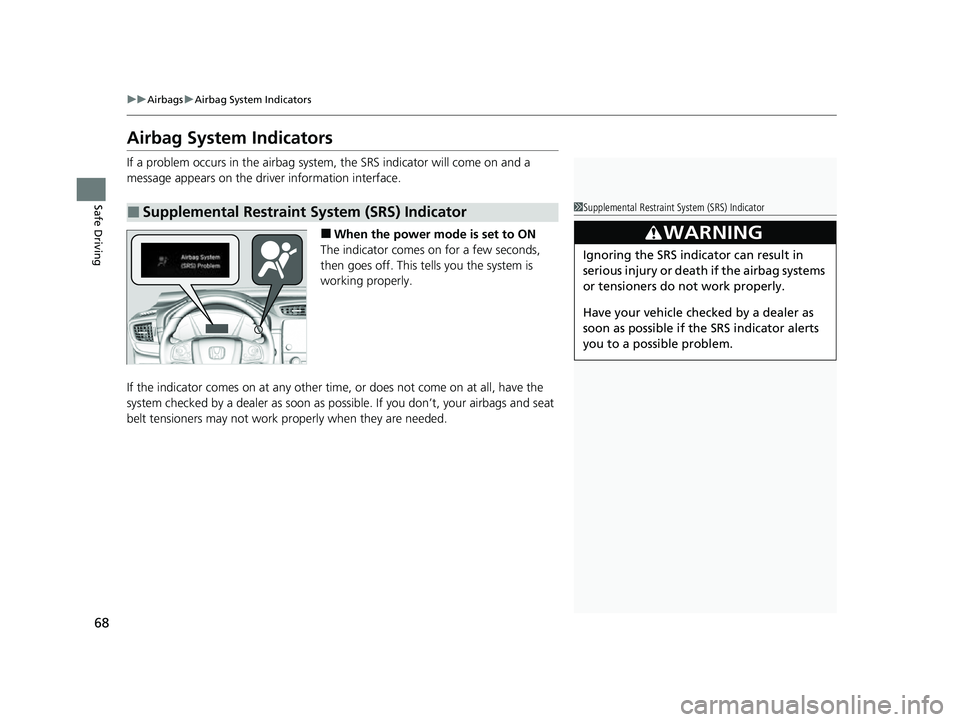
If a problem occurs in the airbag syst em, the SRS indicator will come on and a
message appears on the driver information interface.
■When the power mo de is set to ON
The indicator comes on for a few seconds,
then goes off. This tells you the system is
working properly.
If the indicator comes on at any other time, or does not come on at all, have the
system checked by a dealer as soon as po ssible. If you don’t, your airbags and seat
belt tensioners may not work properly when they are needed.
■Supplemental Restraint System (SRS) Indicator1 Supplemental Restraint Sy stem (SRS) Indicator
3WARNING
Ignoring the SRS indicator can result in
serious injury or death if the airbag systems
or tensioners do not work properly.
Have your vehicle checked by a dealer as
soon as possible if th e SRS indicator alerts
you to a possible problem.
22 CR-V HEV ELP-31TPG6200.book 68 ページ 2021年6月30日 水曜日 午前11時6分
Page 75 of 692

73
uuChild Safety uProtecting Child Passengers
Safe Driving
• Never hold a child on your lap because it is impossible to protect them in the
event of a collision.
• Never put a seat belt over yourself and a child. During a crash, the belt would
likely press deep into the child and cause serious or fatal injuries.
• Never let two children use the same seat belt. Both children could be very
seriously injured in a crash.
• Any child who is too small to wear a seat belt correctly must be restrained in an
approved child seat that is properly secu red to the vehicle using either the seat
belt or the lower anchors of the LATCH system.
• Do not allow children to operate the doors, windows or seat adjustments.
• Do not leave children in the vehicle unattended, especially in hot weather when
the inside of the vehicle can get hot enough to kill them. They could also activate
vehicle controls causing it to move unexpectedly.1Protecting Child Passengers
To deactivate a lockable retractor, release the buckle
and allow the seat belt to wind up all the way.
To remind you of the pa ssenger’s front airbag
hazards and child safety, your vehicle has warning
labels on the dashboard and on the front visors.
Please read and follow the instructions on these
labels.
2 Safety Labels P. 87
3WARNING
Allowing a child to play with a seat belt or
wrap one around their neck can result in
serious injury or death.
Instruct children not to play with any seat
belt and make sure any unused seat belt a
child can reach is buckled, fully retracted,
and locked.
22 CR-V HEV ELP-31TPG6200.book 73 ページ 2021年6月30日 水曜日 午前11時6分
Page 76 of 692

74
uuChild Safety uSafety of Infants and Small Children
Safe Driving
Safety of Infants and Small Children
An infant must be properly restrained in a rear-facing child seat until the infant
reaches the seat manufacturer’s weig ht or height limit for the seat.
■Positioning a rear-facing child seat
Child seats must be placed and secured in a
rear seating position.
When properly installed, a rear-facing child seat may prevent the driver or a front
passenger from moving their seat all the way back, or from locking their seat-back
in the desired position. Make sure that th ere is no contact between the child seat
and the seat in front of it.
It can also interfere with pr oper operation of the passenger’s advanced front airbag
system.
2 Airbags P. 56
If this occurs, we recommend that you install the child seat directly behind the front
passenger’s seat, move the seat as far fo rward as needed, and leave it unoccupied.
Or, you may wish to get a sm aller rear-facing child seat.
■Protecting Infants1Protecting Infants
Experts recommend use of a rear-facing seat for a
child so long as the child’ s height and weight are
appropriate for a rear-facing seat.
Infants should never be s eated in a forward-facing
position.
Always refer to the child seat manufacturer’s
instructions before installation.
Do not allow a front seat to rest against a child seat
installed in a rear seating position.
The weight sensor in the fr ont seat may not correctly
detect the actual weight of the occupant.
3WARNING
Placing a rear-facing child seat in the front
seat can result in serious injury or death
during a crash.
Always place a rear-fac ing child seat in the
rear seat, not the front.
22 CR-V HEV ELP-31TPG6200.book 74 ページ 2021年6月30日 水曜日 午前11時6分
Page 93 of 692
91
uuIndicators u
Continued
Instrument Panel
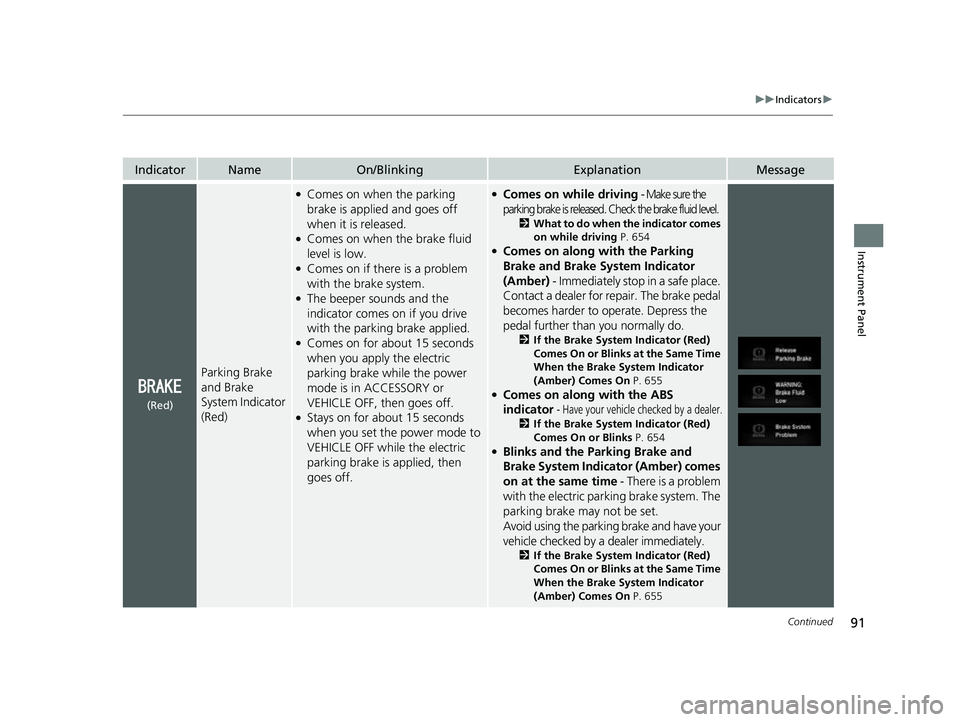
IndicatorNameOn/BlinkingExplanationMessage
Parking Brake
and Brake
System Indicator
(Red)
●Comes on when the parking
brake is applied and goes off
when it is released.
●Comes on when the brake fluid
level is low.
●Comes on if there is a problem
with the brake system.
●The beeper sounds and the
indicator comes on if you drive
with the parking brake applied.
●Comes on for about 15 seconds
when you apply the electric
parking brake while the power
mode is in ACCESSORY or
VEHICLE OFF, then goes off.
●Stays on for about 15 seconds
when you set the power mode to
VEHICLE OFF while the electric
parking brake is applied, then
goes off.
●Comes on while driving - Make sure the
parking brake is released. Check the brake fluid level.
2 What to do when the indicator comes
on while driving P. 654
●Comes on along with the Parking
Brake and Brake System Indicator
(Amber) - Immediately stop in a safe place.
Contact a dealer for repair. The brake pedal
becomes harder to operate. Depress the
pedal further than you normally do.
2If the Brake System Indicator (Red)
Comes On or Blinks at the Same Time
When the Brake System Indicator
(Amber) Comes On P. 655
●Comes on along with the ABS
indicator
- Have your vehicle checked by a dealer.
2 If the Brake System Indicator (Red)
Comes On or Blinks P. 654
●Blinks and the Parking Brake and
Brake System Indicator (Amber) comes
on at the same time - There is a problem
with the electric parking brake system. The
parking brake may not be set.
Avoid using the parking brake and have your
vehicle checked by a dealer immediately.
2 If the Brake System Indicator (Red)
Comes On or Blinks at the Same Time
When the Brake System Indicator
(Amber) Comes On P. 655
(Red)
22 CR-V HEV ELP-31TPG6200.book 91 ページ 2021年6月30日 水曜日 午前11時6分