Page 308 of 585
Note:If your vehicle gets stuck in mud, it
could be rocked out by shifting between
forward and reverse gears, stopping
between shifts in a steady pattern. Press
lightly on the accelerator in each gear.
Note: Do not rock your vehicle if the engine
is not at normal operating temperature, as
damage to the transmission could occur.
Note: Do not rock your vehicle for more
than a minute, as damage to the
transmission and tires could occur or the
engine could overheat.
Wa t e r
If you must drive though deep water, drive
slowly. The water could limit traction or
brake capability. See Driving Through
Shallow Water (page 306).
When driving though water, determine the
depth and avoid water higher than the
center of the wheel.
Once through water, always try the brakes.
Wet brakes do not stop your vehicle as
quickly as dry brakes. Apply light pressure
to the brake pedal while slowly moving the
vehicle to dry the brakes.
Note: Driving through deep water could
cause damage to the transmission. If the
front or rear axle is submerged in water,
have the axle lubricant and power transfer
unit lubricant checked and changed if
necessary.
DRIVING ON HILLY OR SLOPING
TERRAIN
WARNING: Extreme care should
be used when steering the vehicle in
reverse down a slope so as not to cause
the vehicle to swerve out of control. Although natural obstacles could make it
necessary to travel diagonally up or down
a hill or steep incline, you should try to drive
straight up or straight down.
Note:
Avoid turning on steep slopes or hills.
A danger lies in losing traction, slipping
sideways and possible vehicle roll over.
Whenever driving on a hill, determine
beforehand the route you can use. Do not
drive over the crest of a hill without seeing
what conditions are on the other side. Do
not drive in reverse over a hill without the
aid of an observer.
Apply just enough power to the wheels to
climb the hill. Too much power causes the
tires to slip, spin or lose traction, and you
could lose control of your vehicle. When
descending a steep hill, do not descend
the hill in neutral. Avoid sudden hard
braking to keep the front wheels rolling and
to maintain your vehicle's steering.
Note: Your vehicle has anti-lock brakes,
apply the brakes steadily. Do not pump the
brakes.
Note: If your vehicle gets stuck driving on
hilly or sloping terrain, it could be rocked out
by shifting between forward and reverse
gears, stopping between shifts in a steady
pattern. Press lightly on the accelerator in
each gear.
Note: Do not rock your vehicle if the engine
is not at normal operating temperature, as
damage to the transmission could occur.
Note: Do not rock your vehicle for more
than a minute, as damage to the
transmission and tires could occur or the
engine could overheat.
305
Driving Hints
Page 311 of 585

ROADSIDE ASSISTANCE
Vehicles Sold in the United States:
Getting Roadside Assistance
To fully assist you should you have a
vehicle concern, Ford Motor Company
offers a complimentary roadside
assistance program. This program is
separate from the New Vehicle Limited
Warranty.
The service is available:
• 24 hours a day, seven days a week.
• For the coverage period supplied withyour vehicle.
Roadside Assistance covers:
• A flat tire change with a good spare (except vehicles supplied with a tire
inflation kit).
• Battery jump start.
• Lock-out assistance (key replacement cost is the customer's responsibility).
• Fuel delivery — independent service contractors, if not prohibited by state,
local or municipal law, shall deliver up
to 2 gal (8 L) of gasoline or 5 gal (20 L)
of diesel fuel to a disabled vehicle.
Roadside assistance limits fuel delivery
service to two no-charge occurrences
within a 12-month period.
• Winch out — available within 100 ft (30 m) of a paved or county
maintained road, no recoveries. • Towing — independent service
contractors, if not prohibited by state,
local or municipal law, shall tow Ford
eligible vehicles to an authorized dealer
within 35 mi (56 km) of the
disablement location or to the nearest
authorized dealer. If a member
requests a tow to an authorized dealer
that is more than 35 mi (56 km) from
the disablement location, the member
shall be responsible for any mileage
costs in excess of 35 mi (56 km).
• Roadside Assistance includes up to $200 for a towed trailer if the disabled
eligible vehicle requires service at the
nearest authorized dealer. If the towing
vehicle is operational but the trailer is
not, then the trailer does not qualify for
any roadside services.
Vehicles Sold in the United States:
Using Roadside Assistance
Complete the roadside assistance
identification card and place it in your
wallet for quick reference. This card is in
the Owner's Manual kit.
United States vehicle customers who
require Roadside Assistance, call
1-800-241-3673.
If you need to arrange roadside assistance
for yourself, Ford Motor Company
reimburses a reasonable amount for
towing to the nearest dealership within
35 mi (56 km). To obtain reimbursement
information, United States vehicle
customers call 1-800-241-3673.
Customers need to submit their original
receipts.
308
Crash and Breakdown Information
Page 331 of 585

MAINTENANCE PRECAUTIONS
Service your vehicle regularly to help
maintain its roadworthiness and resale
value. There is a large network of
authorized dealers that are there to help
you with their professional servicing
expertise. We believe that their specially
trained technicians are best qualified to
service your vehicle properly and expertly.
They are supported by a wide range of
highly specialized tools developed
specifically for servicing your vehicle.
If your vehicle requires professional service,
an authorized dealer can provide the
necessary parts and service. Check your
warranty information to find out which
parts and services are covered.
Use only recommended fuels, lubricants,
fluids and service parts conforming to
specifications.
• Do not work on a hot engine.
• Make sure that nothing gets caught inmoving parts.
• Do not work on a vehicle with the engine running in an enclosed space,
unless you are sure you have enough
ventilation.
• Keep all open flames and other burning material, such as cigarettes, away from
the battery and all fuel related parts.
• Set the parking brake, shift the transmission to park (P) and block the
wheels.
OPENING AND CLOSING THE
HOOD
Opening the Hood
E263274
1. Open the left-hand front door.
2. Fully pull the hood release lever andlet it completely retract.
Note: This action releases the hood latch.
3. Fully pull the hood release lever for a second time.
Note: This action fully releases the hood.
4. Open the hood.
Note: There is no secondary hood release
under the hood.
328
Maintenance
Page 332 of 585
E193263
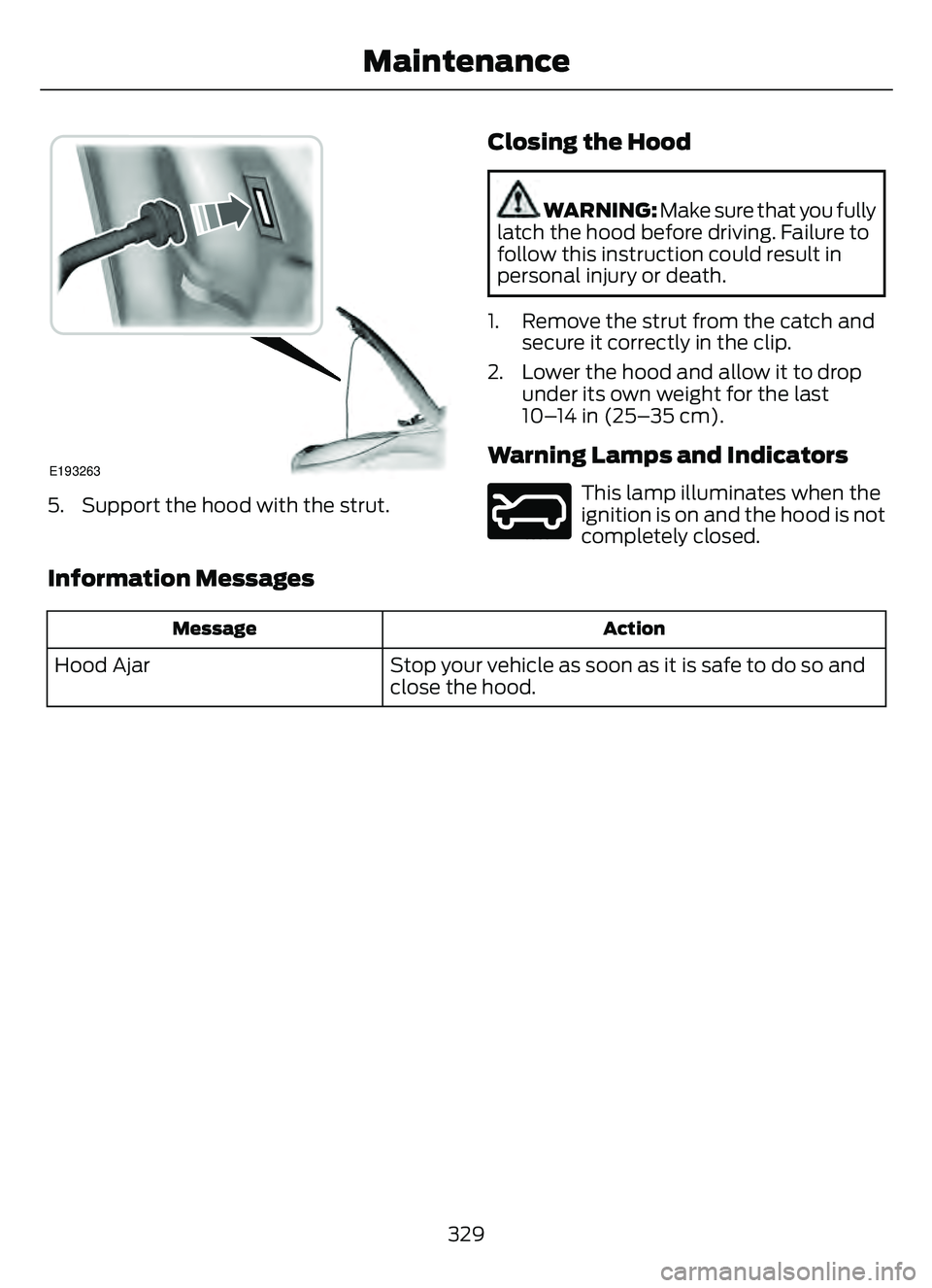
5. Support the hood with the strut.
Closing the Hood
WARNING: Make sure that you fully
latch the hood before driving. Failure to
follow this instruction could result in
personal injury or death.
1. Remove the strut from the catch and secure it correctly in the clip.
2. Lower the hood and allow it to drop under its own weight for the last
10–14 in (25–35 cm).
Warning Lamps and Indicators
E246598
This lamp illuminates when the
ignition is on and the hood is not
completely closed.
Information Messages
Action
Message
Stop your vehicle as soon as it is safe to do so and
close the hood.
Hood Ajar
329
Maintenance
Page 333 of 585
UNDER HOOD OVERVIEW - 1.5L ECOBOOST™
308 93E308193
Windshield washer fluid. See Adding Washer Fluid (page 96).
A
Engine coolant reservoir. See Checking the Coolant (page 334).
B
Engine oil dipstick. See Engine Oil Dipstick Overview (page 333).
C
Engine oil filler cap. See Adding Engine Oil (page 333).
D
Brake fluid reservoir. See Locating the Brake Fluid Reservoir (page 218).
E
Battery. See Changing the 12V Battery (page 343).
F
Engine compartment fuse box. See Fuses (page 319).
G
Air filter. See Changing the Engine Air Filter (page 338).
H
330
Maintenance
Page 334 of 585
UNDER HOOD OVERVIEW - 2.0L ECOBOOST™
30 05E307705
Windshield washer fluid reservoir. See Adding Washer Fluid (page 96).
A
Engine coolant reservoir. See Checking the Coolant (page 334).
B
Engine oil dipstick. See Engine Oil Dipstick Overview (page 333).
C
Engine oil filler cap. See Adding Engine Oil (page 333).
D
Brake fluid reservoir. See Locating the Brake Fluid Reservoir (page 218).
E
Battery. See Changing the 12V Battery (page 343).
F
Engine compartment fuse box. See Fuses (page 319).
G
Air filter assembly. See Changing the Engine Air Filter (page 338).
H
331
Maintenance
Page 335 of 585
UNDER HOOD OVERVIEW - HYBRID ELECTRIC VEHICLE (HEV)
E337414E337414
Windshield washer fluid reservoir: See Adding Washer Fluid (page 96).
A
Low temperature coolant cap: See Checking the Coolant (page 334).
B
High temperature coolant cap: See Checking the Coolant (page 334).
C
Engine oil filler cap: See Adding Engine Oil (page 333).
D
Engine oil dipstick: See Engine Oil Dipstick Overview (page 333).
E
Brake fluid reservoir: See Checking the Brake Fluid (page 218).
F
Power distribution box: See Under Hood Fuse Box (page 320).
G
Air filter assembly: See Changing the Engine Air Filter (page 339).
H
332
Maintenance
Page 336 of 585

ENGINE OIL
ENGINE OIL DIPSTICK OVERVIEW
- 1.5L ECOBOOST (132KW/180PS)
– I3 (Y1)
AB
E264320
Minimum.
A
Maximum.
B
ENGINE OIL DIPSTICK OVERVIEW
- 2.0L ECOBOOST (177KW/240PS)
– MI4/2.5L DURATEC – HYBRID
(121KW/164PS) (BG)
E225040
Minimum.
A
Fill Level.
B
Maximum.
C
CHECKING THE ENGINE OIL LEVEL
1. Make sure that your vehicle is on level
ground.
2. Check the oil level before starting the engine, or switch the engine off after
warming up and wait 10 minutes for
the oil to drain into the oil pan.
3. Remove the dipstick and wipe it with a clean, lint-free cloth.
4. Reinstall the dipstick and make sure it is fully seated.
5. Remove the dipstick again to check the oil level.
Note: If the oil level is between the
maximum and minimum marks, the oil level
is acceptable. Do not add oil.
6. If the oil level is at the minimum mark, immediately add oil.
7. Reinstall the dipstick. Make sure it is fully seated.
Note: The oil consumption of new engines
reaches its normal level after approximately
3,000 mi (5,000 km).
ADDING ENGINE OIL
WARNING: Do not remove the filler
cap when the engine is running.
WARNING: Do not add engine oil
when the engine is hot. Failure to follow
this instruction could result in personal
injury.
Do not use supplemental engine oil
additives because they are unnecessary
and could lead to engine damage that the
vehicle warranty may not cover.
1. Clean the area surrounding the engine oil filler cap before you remove it.
2. Remove the engine oil filler cap.
333
Maintenance