2022 ALFA ROMEO GIULIA oil additives
[x] Cancel search: oil additivesPage 194 of 248

SERVICING AND MAINTENANCE
192
The vehicle is equipped with an IBS (Intelligent
Battery Sensor), which is able to measure the
charge and discharge voltage and calculate the
charge level and the general condition of the
battery. The sensor is placed next to the negative
terminal (-) of the battery.
For a correct charge/discharge procedure, the
charge voltage must go through the IBS sensor.
1. Turn the charger on and follow the instruc-
tions on the user's manual to completely
recharge the battery.
2. When the battery is charged, turn the charger off before disconnecting it from the battery.
3. Disconnect the black cable terminal of the battery charger and then the red cable
terminal.
4. Refit the protective cover of the positive terminal of the battery and the access cover
to the battery compartment.
NOTE:
If a “quick-type” battery charger is used with the
battery fitted on the vehicle, before connecting it
disconnect both cables of the battery itself. Do
not use a “quick-type” battery charger to provide
the starting voltage.
VEHICLE MAINTENANCE
The following pages contain instructions on the
required maintenance from the technical
personnel who designed the vehicle.
In addition to these specific maintenance
instructions specified for routine scheduled
servicing, there are other components which may
require periodic maintenance or replacement
over the vehicle’s life cycle.
ENGINE OIL
Engine Oil Level Check
To ensure correct engine lubrication, the oil must
always be kept at the appropriate level.
Check the oil level at regular intervals, for
example every 1,864 miles (3,000 km).
It must be checked once full operating
temperature is reached.
The vehicle must also be parked on as level a
surface as possible.
The engine oil level can be checked using the
Information and Entertainment system. To
access the function, activate the main menu
(MENU button) and select the following options in
sequence: “Vehicle Information”; “Engine Oil”.
Changing The Engine Oil
For the correct servicing intervals
Ú
page 182.
Choice Of Engine Oil Type
To ensure optimal performance and maximum
protection in all operating conditions, it is
advisable to only use certified engine oils
Ú
page 233.
Additives For Engine Oil
It is strongly recommended not to use additives
(other than leak detection dyes) with the engine
oil.
The engine oil is a product designed especially for
the vehicle and its performance may be deteri -
orated through the use of further additives.
Disposal Of Used Engine Oil And Filters
For disposal of used engine oil and filters, consult
the appropriate local regulations.
NOTE:
Inappropriate disposal of used engine oil may
seriously harm the environment.
ENGINE OIL FILTER
The engine oil filter should be replaced with a
new filter at every engine oil change.
Engine Oil Filter Selection
A full-flow type disposable oil filter should be used
for replacement. The quality of replacement
filters varies considerably. Only high quality
Mopar® certified filters should be used.
ENGINE AIR CLEANER
Engine Air Cleaner Filter Selection
The quality of replacement filters varies consid -
erably. Only high quality Mopar® certified filters
should be used.
AIR CONDITIONING SYSTEM
M
AINTENANCE
To ensure the best possible performance, the air
conditioning system must be checked and
undergo maintenance at an authorized dealer at
the beginning of the summer.
CAUTION!
Do not use chemicals to clean the air
conditioning system, since the internal
components may be damaged. This kind of
damage is not covered by warranty.
22_GA_OM_EN_USC_t.book Page 192
Page 198 of 248
SERVICING AND MAINTENANCE
196
(Continued)
Engine Cooling/Intercooler System Cap
To prevent loss of engine coolant, make sure that
the expansion tank cap is closed. If it is open,
screw it completely until you reach/hear the click.
Periodically check the cap and clean it from any
foreign bodies that may have deposited on the
external surface.
Disposal Of Used Coolant
Disposal of engine/intercooler coolant is subject
to legal requirements: consult the appropriate
local regulations.
NOTE:
To prevent the fluid from being ingested by
children or animals, do not keep it in open
containers or pour it on the ground. If ingested,
contact a doctor immediately. Eliminate any
traces of fluid from the ground immediately.
When the vehicle stops after a short trip,
steam may be seen coming out from front of
the hood. This is a normal phenomenon which
is due to the presence of rain, snow or a lot of
moisture on the surface of the radiator.
With engine and system cold, do not top up
with coolant beyond the maximum level
indicated on the reservoir in the engine
compartment.
BRAKING SYSTEM
In order to guarantee the efficiency of the braking
system, periodically check its components; for
this operation, contact an authorized dealer.
For the correct servicing intervals
Ú
page 182.
NOTE:
Driving with your foot resting on the brake pedal
may compromise its efficiency, increasing the
risk of accidents. When driving, never keep your
foot on the brake pedal and don’t put unneces
-
sary strain on it to prevent the brakes from over -
heating: excess pad wear may cause damage to
the braking system.
When an insufficient oil level is detected,
contact an authorized dealer to have the
system checked.
Always keep the cap of the brake fluid
reservoir (in the engine compartment)
completely closed.
AUTOMATIC TRANSMISSION
Use only a transmission oil with the same charac -
teristics as those indicated on
Ú
page 234.
Special Additives
Do not use any type of additive with the
automatic transmission oil. The automatic
transmission oil is a product designed especially
for this vehicle and its performance may be
compromised through the use of further
additives.
WARNING!
Never add coolant with the engine hot or
overheated.
Do not attempt to cool an overheated engine
by loosening or removing the cap. The heat
causes a considerable increase in pressure
in the cooling system.
To prevent damage to the engine, only use
the engine cooling circuit caps provided.
WARNING!
Use only the manufacturer recommended
brake fluid
Ú
page 234. Using the wrong
type of brake fluid can severely damage your
brake system and/or impair its performance.
The proper type of brake fluid for your vehicle
is also identified on the original factory
installed hydraulic master cylinder reservoir.
To avoid contamination from foreign matter
or moisture, use only new brake fluid or fluid
that has been in a tightly closed container.
Keep the master cylinder reservoir cap
secured at all times. Brake fluid in an open
container absorbs moisture from the air
resulting in a lower boiling point. This may
cause it to boil unexpectedly during hard or
prolonged braking, resulting in sudden brake
failure. This could result in a collision.
Overfilling the brake fluid reservoir can result
in spilling brake fluid on hot engine parts,
causing the brake fluid to catch fire. Brake
fluid can also damage painted and vinyl
surfaces, care should be taken to avoid its
contact with these surfaces.
Do not allow petroleum-based fluid to
contaminate the brake fluid. Brake seal
components could be damaged, causing
partial or complete brake failure. This could
result in a collision.
WARNING!
22_GA_OM_EN_USC_t.book Page 196
Page 233 of 248
231
FUEL SYSTEM CAUTIONS
NOTE:
Intentional tampering with the emissions control system can result in civil penalties being assessed against you.
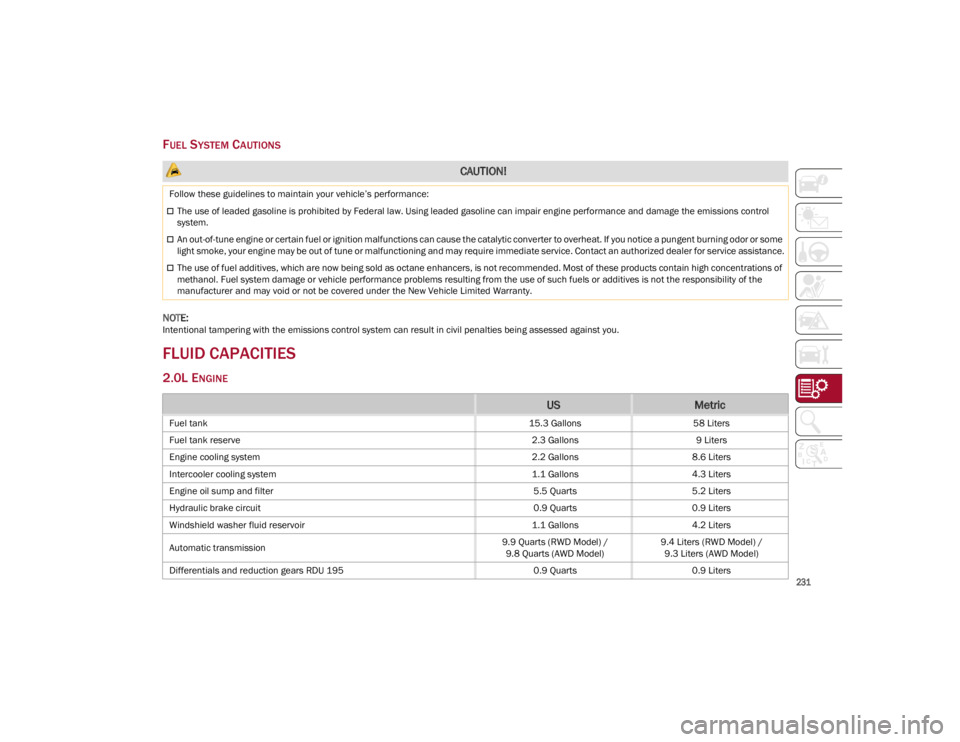
FLUID CAPACITIES
2.0L ENGINE
CAUTION!
Follow these guidelines to maintain your vehicle’s performance:
The use of leaded gasoline is prohibited by Federal law. Using leaded gasoline can impair engine performance and damage the emissions control
system.
An out-of-tune engine or certain fuel or ignition malfunctions can cause the catalytic converter to overheat. If you notice a pungent burning odor or some
light smoke, your engine may be out of tune or malfunctioning and may require immediate service. Contact an authorized dealer for service assistance.
The use of fuel additives, which are now being sold as octane enhancers, is not recommended. Most of these products contain high concentrations of
methanol. Fuel system damage or vehicle performance problems resulting from the use of such fuels or additives is not the responsibility of the
manufacturer and may void or not be covered under the New Vehicle Limited Warranty.
USMetric
Fuel tank15.3 Gallons58 Liters
Fuel tank reserve 2.3 Gallons9 Liters
Engine cooling system 2.2 Gallons8.6 Liters
Intercooler cooling system 1.1 Gallons4.3 Liters
Engine oil sump and filter 5.5 Quarts5.2 Liters
Hydraulic brake circuit 0.9 Quarts0.9 Liters
Windshield washer fluid reservoir 1.1 Gallons4.2 Liters
Automatic transmission 9.9 Quarts (RWD Model) /
9.8 Quarts (AWD Model) 9.4 Liters (RWD Model) /
9.3 Liters (AWD Model)
Differentials and reduction gears RDU 195 0.9 Quarts0.9 Liters
22_GA_OM_EN_USC_t.book Page 231
Page 242 of 248

240
INDEX
Dimmer SwitchHeadlight .................................................. 46
Door Ajar ................................................ 74, 76
Door Ajar Light ....................................... 74, 76
Door Locks Automatic ................................................. 27
Door Opener, Garage ................................... 39
Drive Train Control (DTC) System ..............130
Driving Modes .............................................. 92
Dynamic Steering Torque (DST) System ... 130
E
Electric Park Brake....................................... 84
Electronic Speed Control (Cruise Control) .. 97
Electronic Stability Control (ESC)
System ........................................................130
Electronic Throttle Control Warning Light... 75
Emergency In Case Of ......................................169, 171
SOS Emergency Call .............................. 169
Emergency, In Case Of Jump Starting .........................................175
Overheating ............................................ 178
Tow Hooks ..............................................180
Towing.....................................................179
Emission Control System Maintenance...... 80
Engine ......................................................... 224 Block Heater............................................. 83
Engine Coolant Level .............................190
Exhaust Gas Caution ....................167, 168
Fuel Requirements ................................ 230Jump Starting .........................................177
Overheating ............................................ 178 Engine Compartment ................................ 187
Engine Compartment (Washing) .............. 222
Engine Oil
Level Check ........................................... 188
Enhanced Accident Response
Feature .............................................. 155, 181
Ethanol ....................................................... 230
Exhaust Gas Cautions ...................... 167, 168 Exhaust System ......................................... 167
Exterior Lights .............................42, 167, 204
F
Flashers Turn Signals .....................................74, 167
Fluid Leaks ................................................. 167
Fog Lights, Rear ............................................44
Forward Collision Warning ........................ 138
Fuel Additives ................................................ 230
Clean Air................................................. 230
Ethanol ................................................... 230
Light ..........................................................76
Materials Added .................................... 230
Methanol................................................ 230
Fuses ................................................. 197, 198
G
Garage Door Opener (HomeLink) ................39
Gasoline, Clean Air .................................... 230
Gasoline, Reformulated ............................ 230
Gauges Engine Oil Temperature ...........................65
Fuel ...........................................................66 Speedometer ........................................... 66
Tachometer .............................................. 65
Glove Compartment Storage ...................... 55
GVWR .......................................................... 125
H
Hazard Warning Flashers .......................... 169
Head Restraints ........................................... 35
Head Rests ................................................... 35
Headlights .................................................... 42 Automatic ................................................. 43
Delay......................................................... 44
High Beam ............................................... 42
Switch ....................................................... 42
Headlights (Cleaning) ................................ 222
Heated Mirrors ............................................. 38
Heated Seats ............................................... 35
Heated Steering Wheel ............................... 29
Heater, Engine Block ................................... 83
Hill Start Assist (HSA) System ................... 131
HomeLink (Garage Door Opener) ............... 39
Hood Closing ...................................................... 60Opening .................................................... 60
Hood Release ............................................... 60
I
Ignition .......................................................... 22 Switch ....................................................... 22
Immobilizer (Sentry Key) ............................. 21
In Case Of Emergency ............................... 169
Installing Electrical/Electronic Devices ......... 3
22_GA_OM_EN_USC_t.book Page 240