Page 444 of 546
4428-2. Steps to take in an emergency
AYGO_OM_Europe_OM9A012E
If your vehicle needs to be towed
If towing is necessary, we recommend having your vehicle
towed by any authorized Toyota retailer or Toyota authorized
repairer, or any reliable repairer or commercial towing service,
using a wheel-lift type truck or flatbed truck.
Use a safety chain system for all towing, and abide by all state/
provincial and local laws.
WARNING
Observe the following precautions.
Failure to do so may result in death or serious injury.
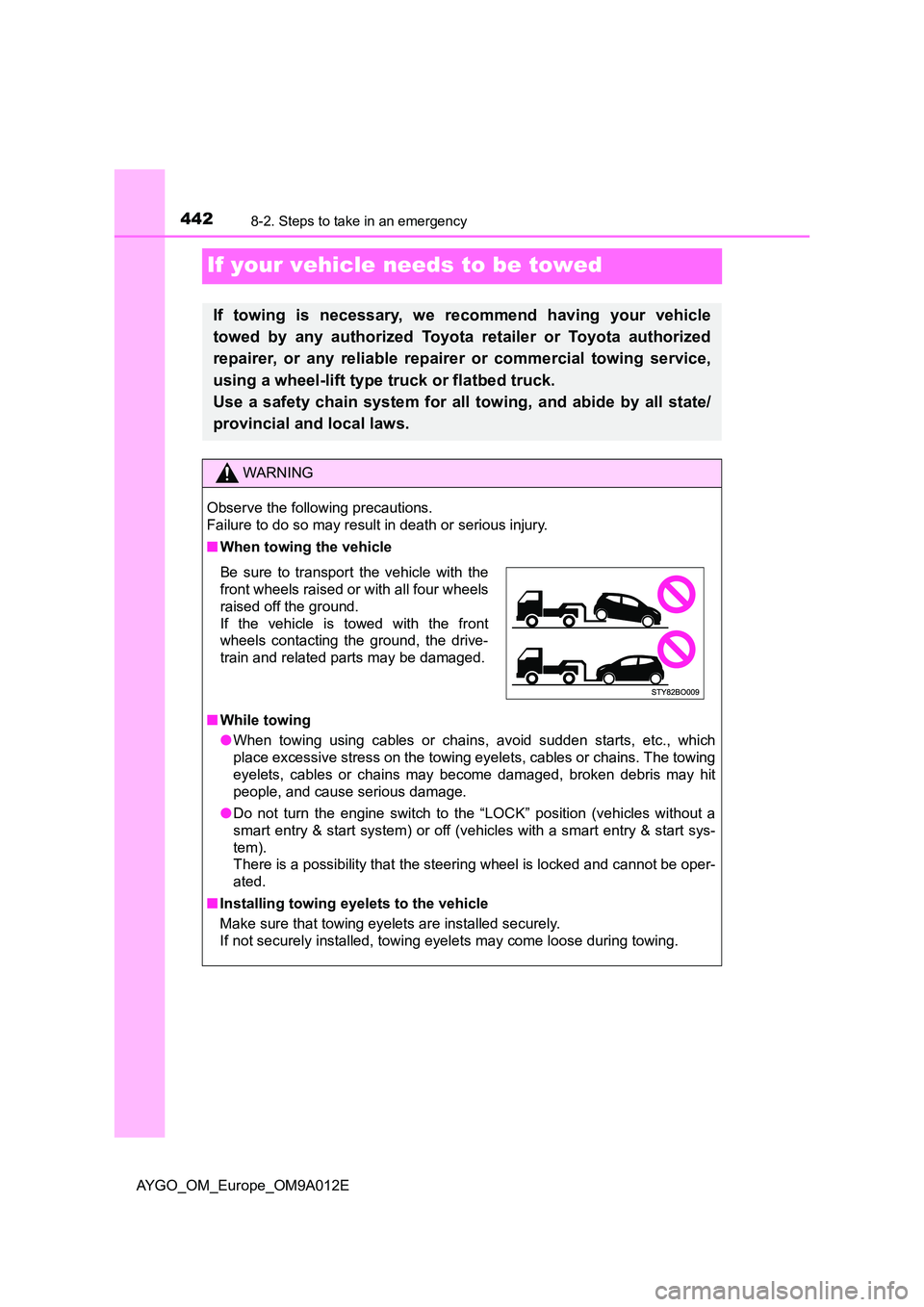
■ When towing the vehicle
■ While towing
● When towing using cables or chains, avoid sudden starts, etc., which
place excessive stress on the towing eyelets, cables or chains. The towing
eyelets, cables or chains may become damaged, broken debris may hit
people, and cause serious damage.
● Do not turn the engine switch to the “LOCK” position (vehicles without a
smart entry & start system) or off (vehicles with a smart entry & start sys-
tem).
There is a possibility that the steering wheel is locked and cannot be oper-
ated.
■ Installing towing eyelets to the vehicle
Make sure that towing eyelets are installed securely.
If not securely installed, towing eyelets may come loose during towing.
Be sure to transport the vehicle with the
front wheels raised or with all four wheels
raised off the ground.
If the vehicle is towed with the front
wheels contacting the ground, the drive-
train and related parts may be damaged.
Page 445 of 546
4438-2. Steps to take in an emergency
8
When trouble arises
AYGO_OM_Europe_OM9A012E
The following may indicate a problem with your transmission. Contact
any authorized Toyota retailer or Toyota authorized repairer, or any
reliable repairer or commercial towing service before towing.
● The engine is running but the vehicle does not move.
● The vehicle makes an abnormal sound.
NOTICE
■To prevent damage to the vehicle when towing using a wheel-lift type
truck
● Vehicles without a smart entry & start system: Do not tow the vehicle from
the rear when the engine switch is in the “LOCK” position or the key is
removed.
The steering lock mechanism is not strong enough to hold the front wheels
straight.
● Vehicles with a smart entry & start system: Do not tow the vehicle from the
rear when the engine switch is off. The steering lock mechanism is not
strong enough to hold the front wheels straight.
● When raising the vehicle, ensure adequate ground clearance for towing at
the opposite end of the raised vehicle. Without adequate clearance, the
vehicle could be damaged while being towed.
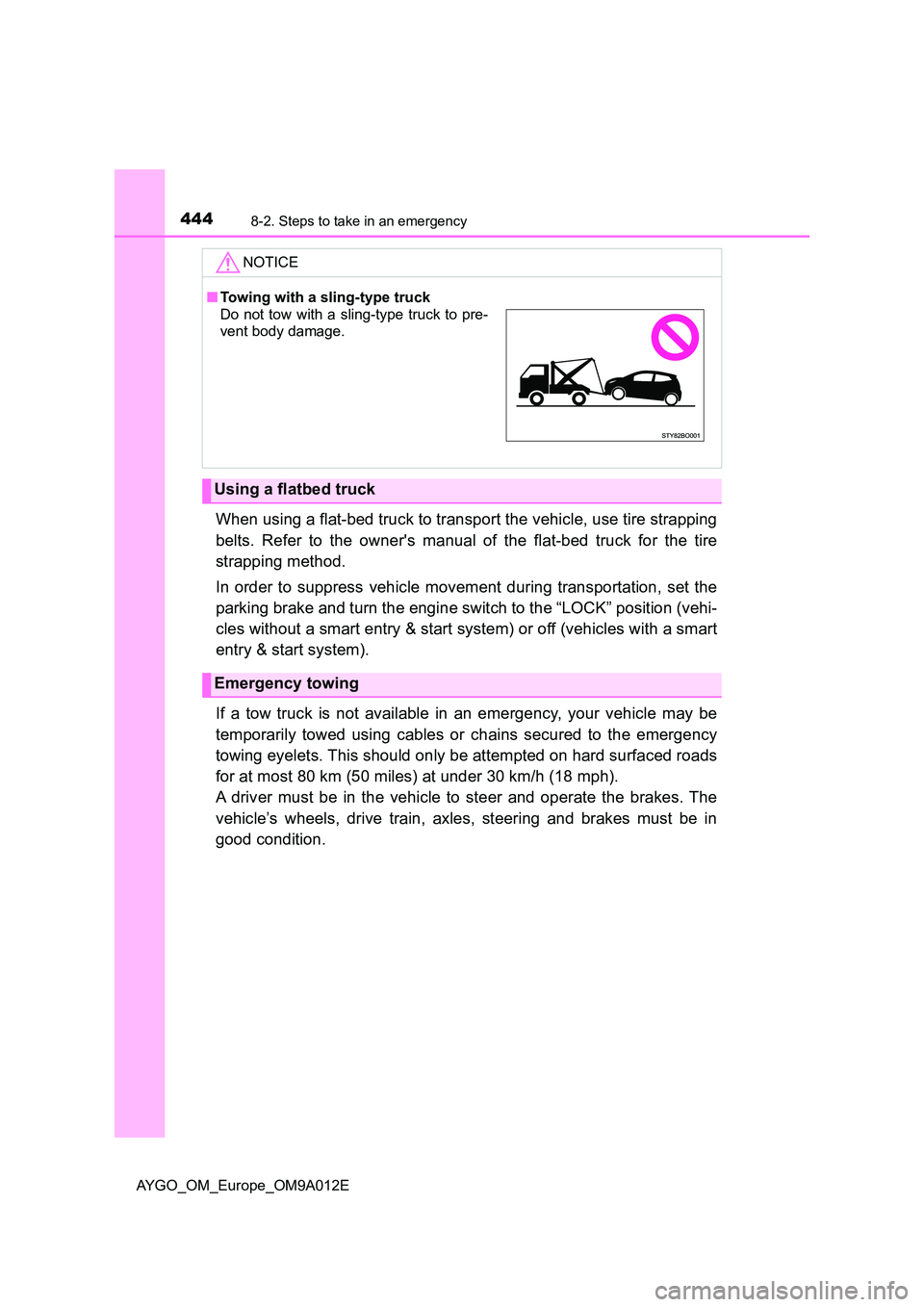
■ To prevent damage to the vehicle when towing with a sling-type truck
Do not tow with a sling-type truck, either from the front or rear.
■ To prevent damage to the vehicle during emergency towing
Do not secure cables or chains to the suspension components.
Situations when it is necessary to contact dealers before towing
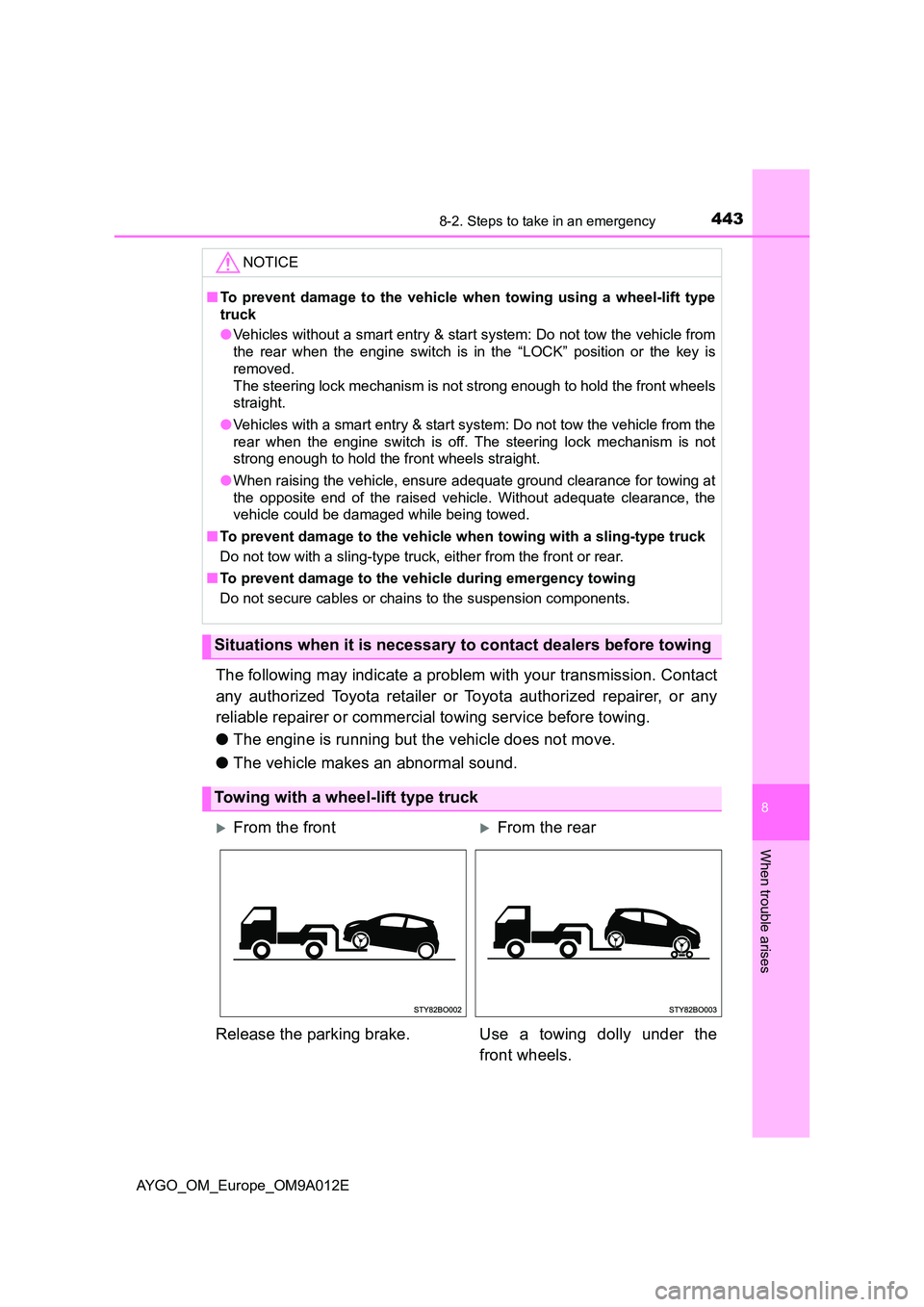
Towing with a wheel-lift type truck
From the frontFrom the rear
Release the parking brake. Use a towing dolly under the
front wheels.
Page 446 of 546
4448-2. Steps to take in an emergency
AYGO_OM_Europe_OM9A012E
When using a flat-bed truck to transport the vehicle, use tire strapping
belts. Refer to the owner's manual of the flat-bed truck for the tire
strapping method.
In order to suppress vehicle movement during transportation, set the
parking brake and turn the engine switch to the “LOCK” position (vehi-
cles without a smart entry & start system) or off (vehicles with a smart
entry & start system).
If a tow truck is not available in an emergency, your vehicle may be
temporarily towed using cables or chains secured to the emergency
towing eyelets. This should only be attempted on hard surfaced roads
for at most 80 km (50 miles) at under 30 km/h (18 mph).
A driver must be in the vehicle to steer and operate the brakes. The
vehicle’s wheels, drive train, axles, steering and brakes must be in
good condition.
NOTICE
■ Towing with a sling-type truck
Using a flatbed truck
Emergency towing
Do not tow with a sling-type truck to pre-
vent body damage.
Page 450 of 546
4488-2. Steps to take in an emergency
AYGO_OM_Europe_OM9A012E
Fuel pump shut off system
Follow the procedure below to restart the engine after the system is
activated.
Vehicles without a smart entry & start system
Turn the engine switch to the “ACC” or “LOCK” position.
Restart the engine.
Vehicles with a smart entry & start system
Turn the engine switch to ACCESSORY mode or turn it off.
Restart the engine.
To minimize the risk of fuel leakage when the engine stalls or
when an airbag inflates upon collision, the fuel pump shut off
system stops the supply of fuel to the engine.
NOTICE
■ Before starting the engine
Inspect the ground under the vehicle.
If you find that fuel has leaked onto the ground, the fuel system has been
damaged and is in need of repair. Do not restart the engine.
Page 460 of 546
4588-2. Steps to take in an emergency
AYGO_OM_Europe_OM9A012E
Once(Flashes in yellow for 15 seconds.)
Smart entry & start system indicator light
Indicates that the electronic key battery is
low.
Replace the battery. (P. 416)
Once(Flashes quickly in green for 15 seconds.)
Smart entry & start system indicator light
Indicates that the steering lock has not
been released.
Release the steering lock. (P. 220)
Once(Flashes in yellow for 60 seconds.)
Smart entry & start system indicator light
• When the doors were unlocked with the
mechanical key and then the engine
switch was pressed, the electronic key
could not be detected in the vehicle.
• The electronic key could not be detected
in the vehicle even after the engine switch
was pressed two consecutive times.
Touch the electronic key to the engine
switch while depressing the brake
pedal.
Interior
buzzer
Exterior
buzzer
Warning
lightWarning light/Details/Actions
Page 468 of 546
4668-2. Steps to take in an emergency
AYGO_OM_Europe_OM9A012E
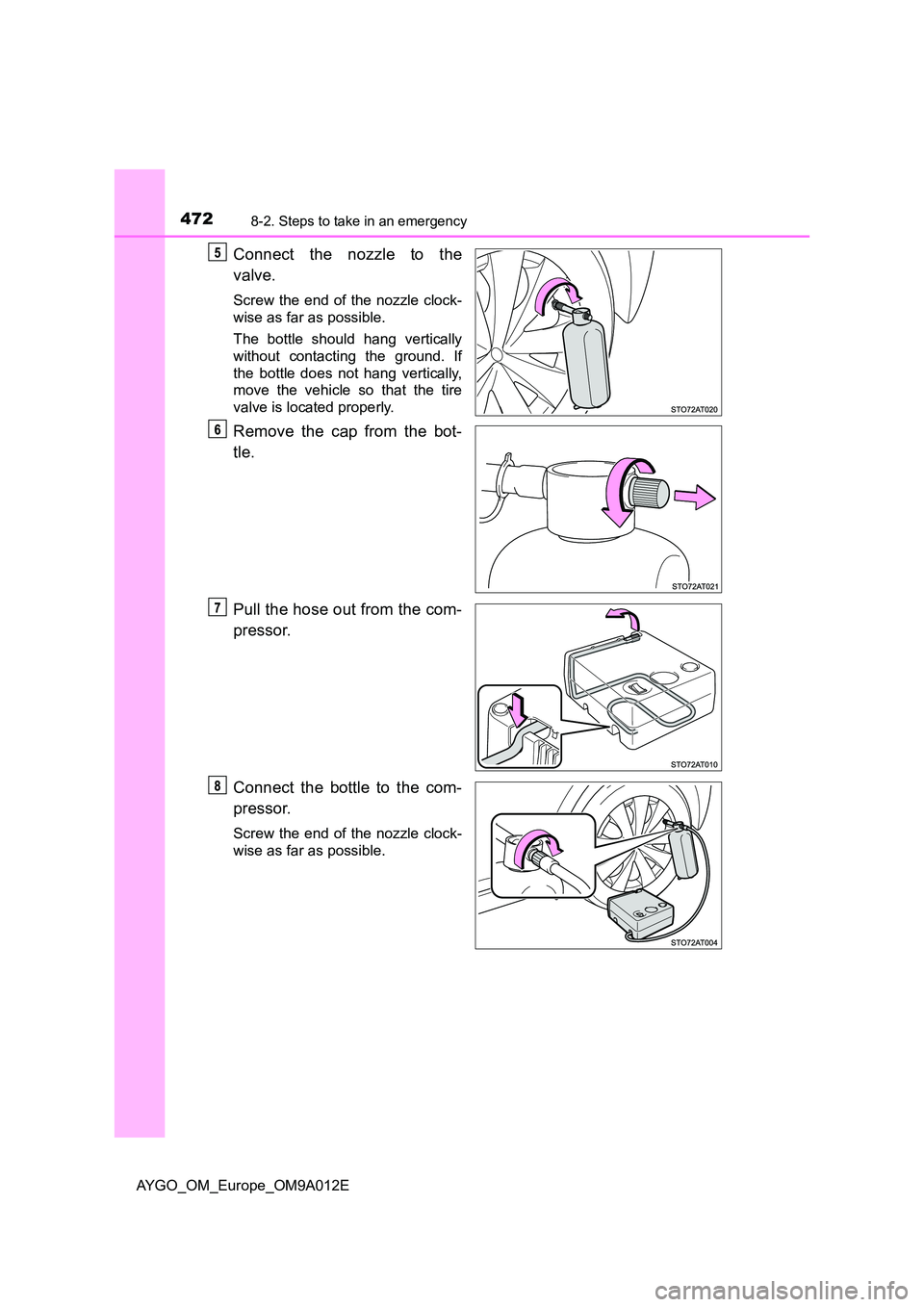
Connect the nozzle to the
valve.
Screw the end of the nozzle clock-
wise as far as possible.
The bottle should hang vertically
without contacting the ground. If
the bottle does not hang vertically,
move the vehicle so that the tire
valve is located properly.
Remove the cap from the bot-
tle.
Pull the hose out from the com-
pressor.
Connect the bottle to the com-
pressor.
Screw the end of the nozzle clock-
wise as far as possible.
Page 474 of 546
4728-2. Steps to take in an emergency
AYGO_OM_Europe_OM9A012E
Connect the nozzle to the
valve.
Screw the end of the nozzle clock-
wise as far as possible.
The bottle should hang vertically
without contacting the ground. If
the bottle does not hang vertically,
move the vehicle so that the tire
valve is located properly.
Remove the cap from the bot-
tle.
Pull the hose out from the com-
pressor.
Connect the bottle to the com-
pressor.
Screw the end of the nozzle clock-
wise as far as possible.
Page 485 of 546

4838-2. Steps to take in an emergency
8
When trouble arises
AYGO_OM_Europe_OM9A012E
WARNING
■Using the tire jack
Observe the following precautions.
Improper use of the tire jack may cause the vehicle to suddenly fall off the
jack, leading to death or serious injury.
● Do not use the tire jack for any purpose other than replacing tires or install-
ing and removing tire chains.
● Only use the tire jack that comes with this vehicle for replacing a flat tire.
Do not use it on other vehicles, and do not use other tire jacks for replac-
ing tires on this vehicle.
● Put the jack properly in its jack point.
● Do not put any part of your body under the vehicle while it is supported by
the jack.
● Do not start the engine or drive the vehicle while the vehicle is supported
by the jack.
● Do not raise the vehicle while someone is inside.
● When raising the vehicle, do not put an object on or under the jack.
● Do not raise the vehicle to a height greater than that required to replace
the tire.
● Use a jack stand if it is necessary to get under the vehicle.
● Stop the vehicle on firm, flat and level ground, firmly set the parking brake
and shift the shift lever to E, M or R (multi-mode manual transmission) or R
(manual transmission). Block the wheel diagonally opposite to the one
being changed if necessary.
● When lowering the vehicle, make sure that there is no-one near the vehi-
cle. If there are people nearby, warn them vocally before lowering.