2021 NISSAN TITAN stop
[x] Cancel search: stopPage 25 of 638
CAUTION
When adjusting the seat positions, be
sure not to contact any moving parts to
avoid possible injuries and/or damage.
FRONT MANUAL BENCH SEAT
ADJUSTMENT (if so equipped)
Your vehicle seats can be adjusted manu-
ally. For additional information about ad-
justing the seats, refer to the steps outlined
in this section.
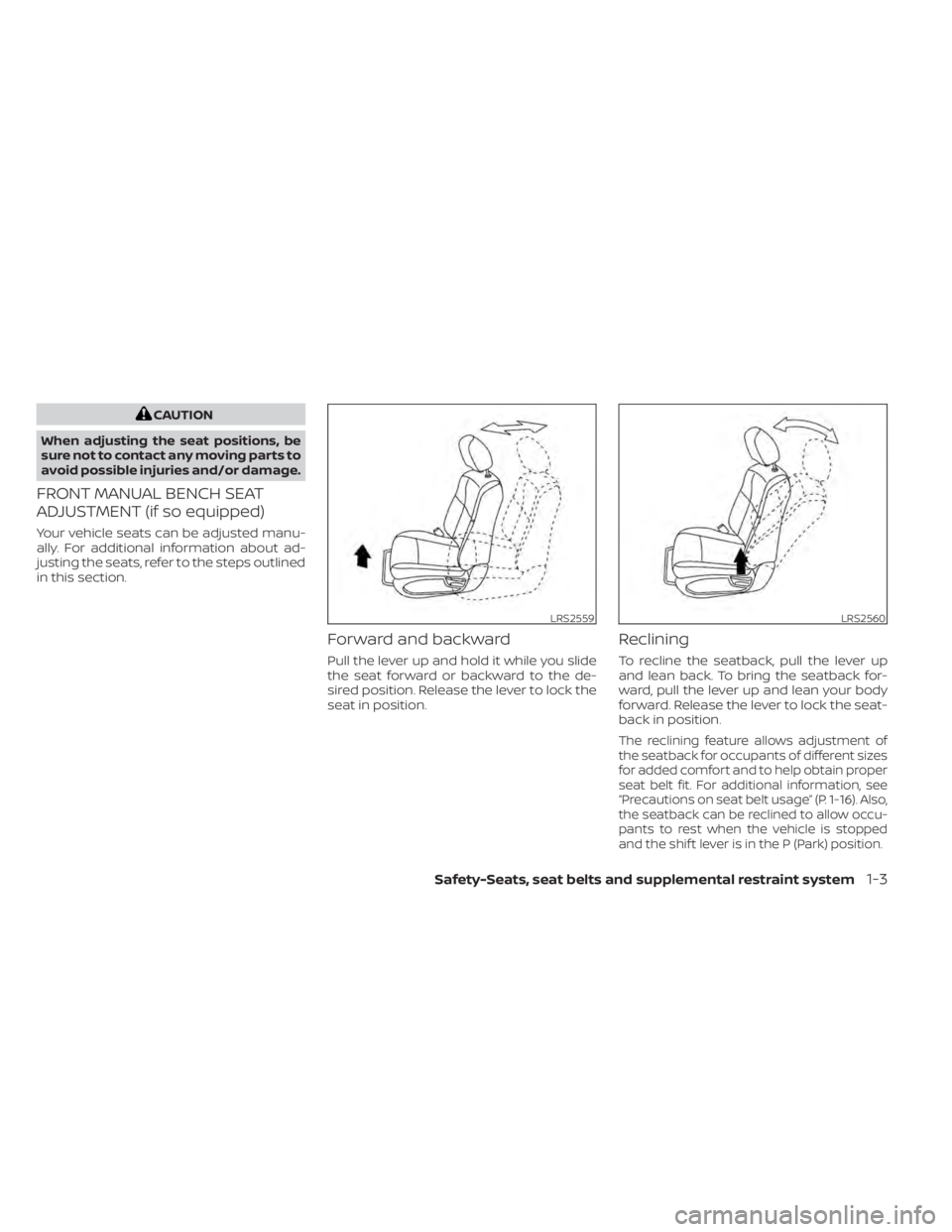
Forward and backward
Pull the lever up and hold it while you slide
the seat forward or backward to the de-
sired position. Release the lever to lock the
seat in position.
Reclining
To recline the seatback, pull the lever up
and lean back. To bring the seatback for-
ward, pull the lever up and lean your body
forward. Release the lever to lock the seat-
back in position.
The reclining feature allows adjustment of
the seatback for occupants of different sizes
for added comfort and to help obtain proper
seat belt fit. For additional information, see
“Precautions on seat belt usage” (P. 1-16). Also,
the seatback can be reclined to allow occu-
pants to rest when the vehicle is stopped
and the shif t lever is in the P (Park) position.
LRS2559LRS2560
Safety-Seats, seat belts and supplemental restraint system1-3
Page 27 of 638
Reclining
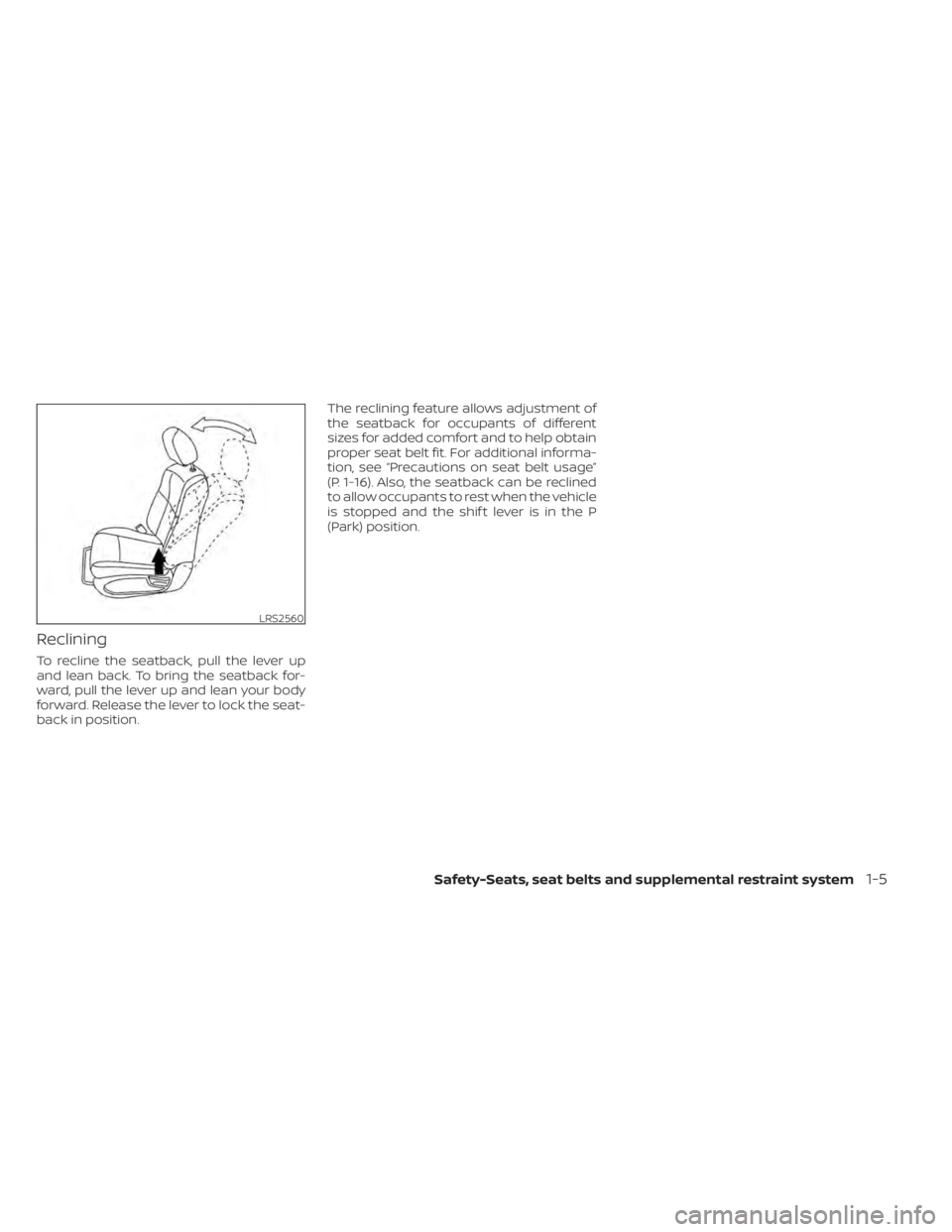
To recline the seatback, pull the lever up
and lean back. To bring the seatback for-
ward, pull the lever up and lean your body
forward. Release the lever to lock the seat-
back in position.The reclining feature allows adjustment of
the seatback for occupants of different
sizes for added comfort and to help obtain
proper seat belt fit. For additional informa-
tion, see “Precautions on seat belt usage”
(P. 1-16). Also, the seatback can be reclined
to allow occupants to rest when the vehicle
is stopped and the shif t lever is in the P
(Park) position.
LRS2560
Safety-Seats, seat belts and supplemental restraint system1-5
Page 28 of 638

FRONT POWER CAPTAIN’S CHAIR
SEAT ADJUSTMENT (if so
equipped)
Operating tips
• The power seat motor has an auto-resetoverload protection circuit. If the motor
stops during operation, wait 30 seconds
then reactivate the switch.
• Do not operate the power seat switch for a long period of time when the engine is
off. This will discharge the battery.
For additional information, see “Memory
seat(s)” (P. 3-40).
Forward and backward
Moving the switch as shown will slide the
seat forward or backward to the desired
position.
Reclining
Move the recline switch as shown until the
desired angle is obtained. The reclining feature allows adjustment of
the seatback for occupants of different
sizes for added comfort and to help obtain
proper seat belt fit. For additional informa-
tion, see “Precautions on seat belt usage”
(P. 1-16). Also, the seatback can be reclined
to allow occupants to rest when the vehicle
is stopped and the shif t lever is in P (Park).
LRS2743
1-6Safety-Seats, seat belts and supplemental restraint system
Page 30 of 638

REAR ARMRESTS (if so equipped)
To use the center armrest on the bench
seats, pull on the tab in the center of the
seat and fold it down as shown.
FLEXIBLE SEATING
WARNING
• Never allow anyone to ride in the
cargo area or on the rear seats when
they are in the fold-down position. In
a collision, people riding in these ar-
eas without proper restraints are
more likely to be seriously injured or
killed.
• Do not allow people to ride in any
area of your vehicle that is not
equipped with seats and seat belts.
Be sure everyone in your vehicle is in
a seat and using a seat belt properly.
• Do not allow more than one person
to use the same seat belt.
• Do not fold down the rear seats when
occupants are in the rear seat area or
any luggage is on the rear seats.
– Make sure that the seat path is
clear before moving the seat.
– Be careful not to allow hands or
feet to get caught or pinched in
the seat. •
Head restraints/headrests should be
adjusted properly as they may pro-
vide significant protection against
injury in an accident. Always replace
and adjust them properly if they have
been removed for any reason.
• If the head restraints/headrests are
removed for any reason, they should
be securely stored to prevent them
from causing injury to passengers or
damage to the vehicle in case of sud-
den braking or an accident.
• When returning the seatbacks to the
upright position, be certain they are
completely secured in the latched
position. If they are not completely
secured, passengers may be injured
in an accident or sudden stop.
• Properly secure all cargo to help pre-
vent it from sliding or shif ting. Do not
place cargo higher than the seat-
backs. In a sudden stop or collision,
unsecured cargo could cause per-
sonal injury.
LRS2748
1-8Safety-Seats, seat belts and supplemental restraint system
Page 32 of 638
WARNING
• When the vehicle is being used to
carry cargo, properly secure all cargo
to help prevent it from sliding or
shif ting. Do not place cargo higher
than the seatbacks. In a sudden stop
or collision, unsecured cargo could
cause personal injury.
• Do not allow people to ride in any
area of your vehicle that is not
equipped with seats and seat belts.
Be sure everyone in your vehicle is in
a seat and using a seat belt properly.
Never ride in the rear seat unless the
seat bottom cushions are in place.
• When returning the seatbacks to the
upright position, be certain they are
completely secured in the latched
position. If they are not completely
secured, passengers may be injured
in an accident or sudden stop.
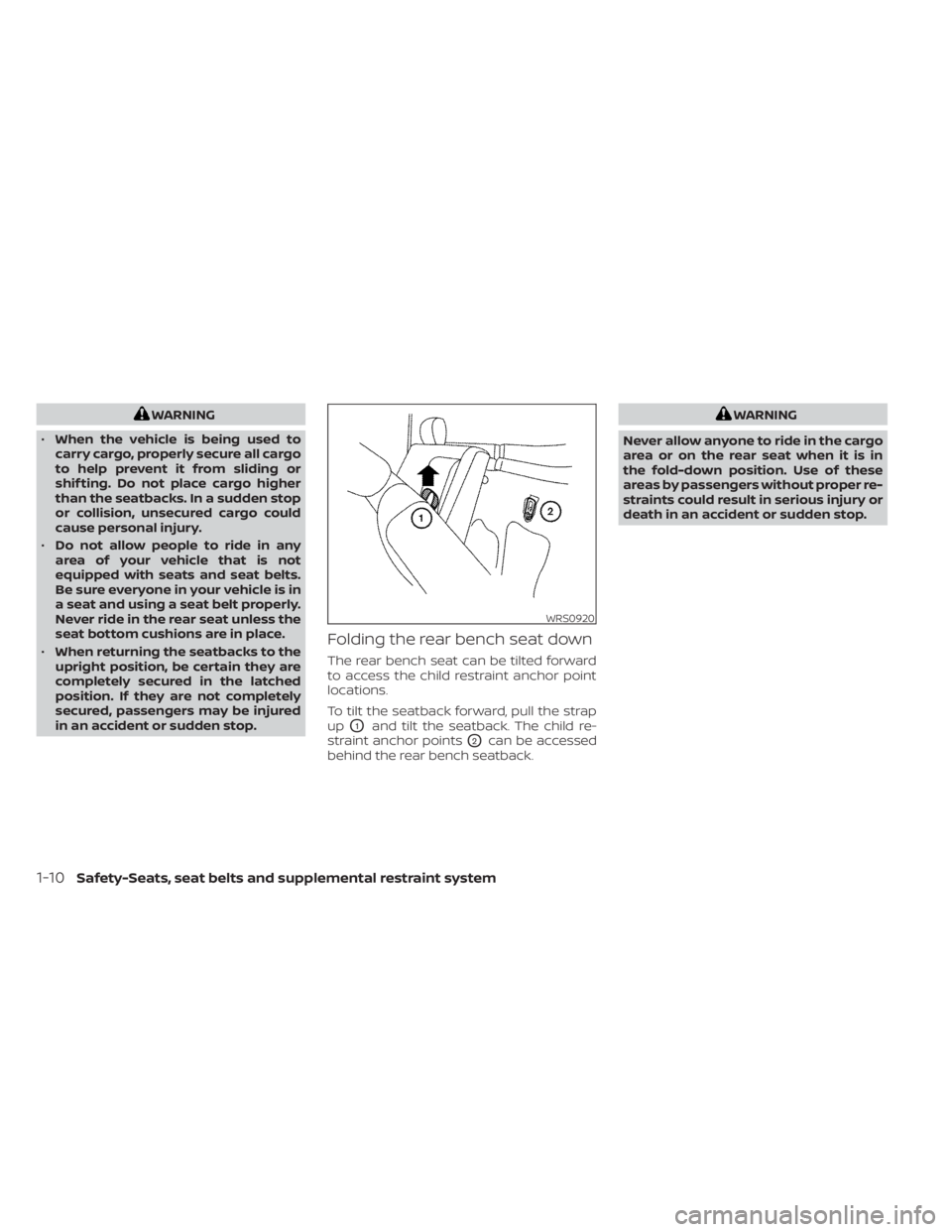
Folding the rear bench seat down
The rear bench seat can be tilted forward
to access the child restraint anchor point
locations.
To tilt the seatback forward, pull the strap
up
O1and tilt the seatback. The child re-
straint anchor points
O2can be accessed
behind the rear bench seatback.
WARNING
Never allow anyone to ride in the cargo
area or on the rear seat when it is in
the fold-down position. Use of these
areas by passengers without proper re-
straints could result in serious injury or
death in an accident or sudden stop.
WRS0920
1-10Safety-Seats, seat belts and supplemental restraint system
Page 43 of 638
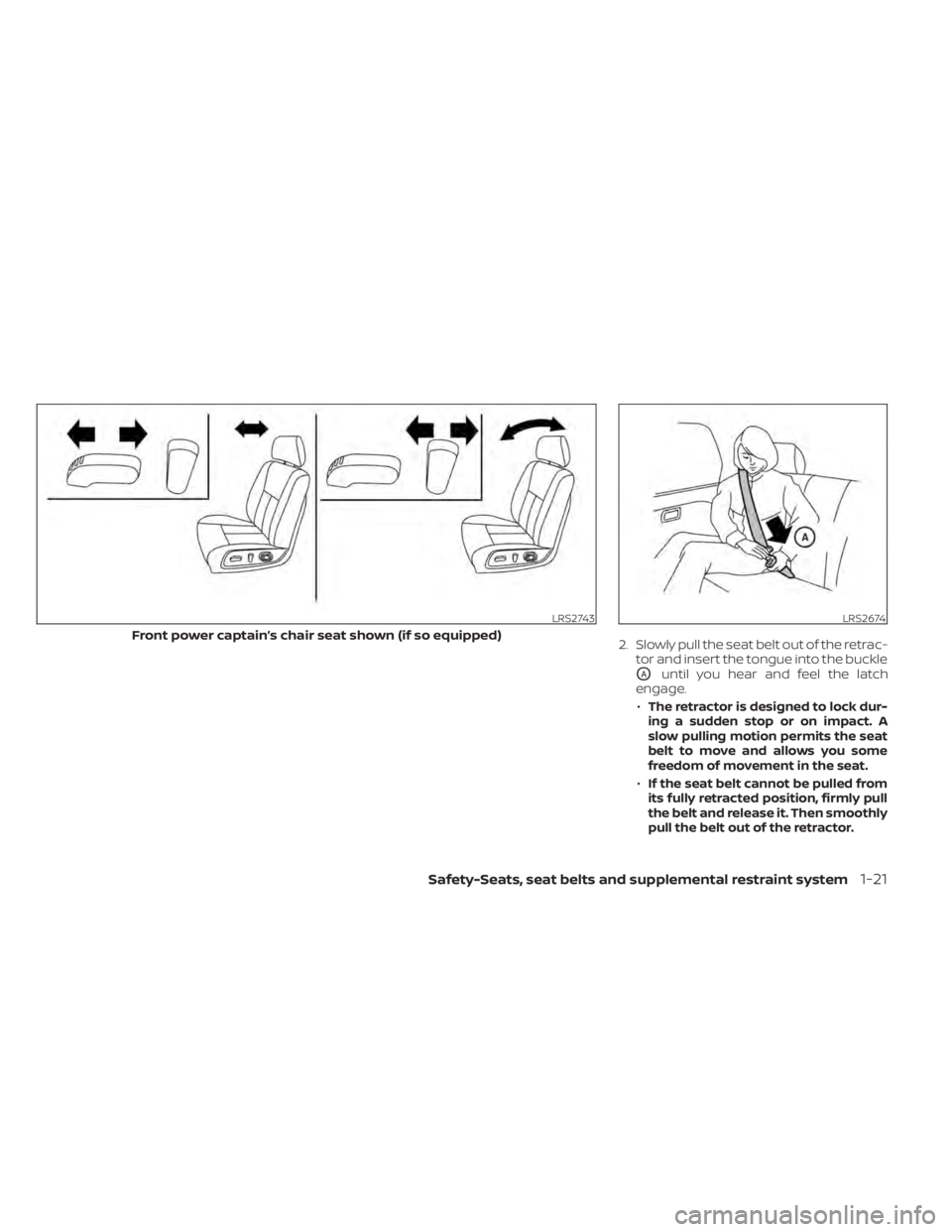
2. Slowly pull the seat belt out of the retrac-tor and insert the tongue into the buckle
OAuntil you hear and feel the latch
engage.
•
The retractor is designed to lock dur-
ingasuddenstoporonimpact.A
slow pulling motion permits the seat
belt to move and allows you some
freedom of movement in the seat.
•If the seat belt cannot be pulled from
its fully retracted position, firmly pull
the belt and release it. Then smoothly
pull the belt out of the retractor.
LRS2743
Front power captain’s chair seat shown (if so equipped)
LRS2674
Safety-Seats, seat belts and supplemental restraint system1-21
Page 44 of 638
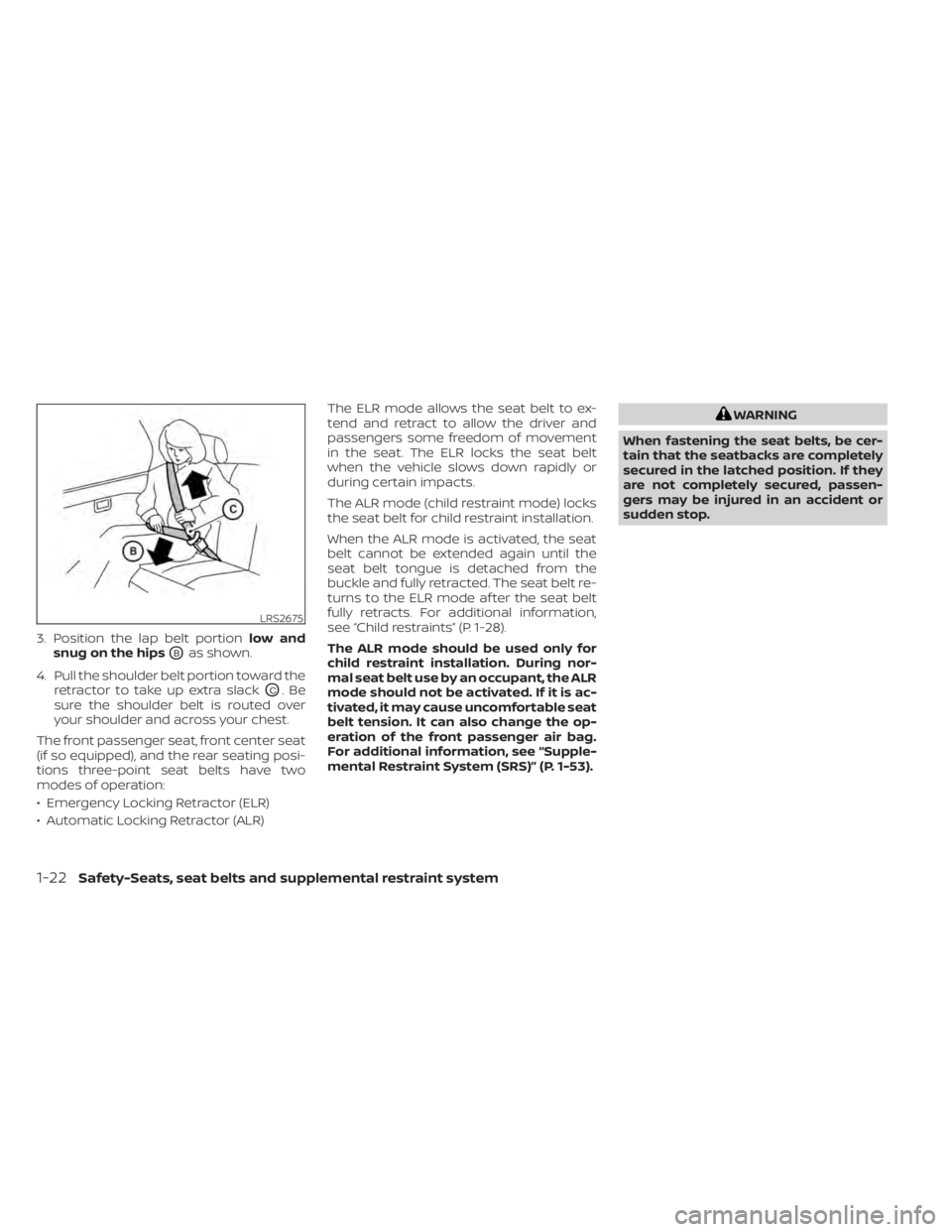
3. Position the lap belt portionlow and
snug on the hips
OBas shown.
4. Pull the shoulder belt portion toward the retractor to take up extra slack
OC.Be
sure the shoulder belt is routed over
your shoulder and across your chest.
The front passenger seat, front center seat
(if so equipped), and the rear seating posi-
tions three-point seat belts have two
modes of operation:
• Emergency Locking Retractor (ELR)
• Automatic Locking Retractor (ALR) The ELR mode allows the seat belt to ex-
tend and retract to allow the driver and
passengers some freedom of movement
in the seat. The ELR locks the seat belt
when the vehicle slows down rapidly or
during certain impacts.
The ALR mode (child restraint mode) locks
the seat belt for child restraint installation.
When the ALR mode is activated, the seat
belt cannot be extended again until the
seat belt tongue is detached from the
buckle and fully retracted. The seat belt re-
turns to the ELR mode af ter the seat belt
fully retracts. For additional information,
see “Child restraints” (P. 1-28).
The ALR mode should be used only for
child restraint installation. During nor-
mal seat belt use by an occupant, the ALR
mode should not be activated. If it is ac-
tivated, it may cause uncomfortable seat
belt tension. It can also change the op-
eration of the front passenger air bag.
For additional information, see “Supple-
mental Restraint System (SRS)” (P. 1-53).
WARNING
When fastening the seat belts, be cer-
tain that the seatbacks are completely
secured in the latched position. If they
are not completely secured, passen-
gers may be injured in an accident or
sudden stop.
LRS2675
1-22Safety-Seats, seat belts and supplemental restraint system
Page 46 of 638

Shoulder belt height adjustment
(front seats)
The shoulder belt anchor height should be
adjusted to the position best for you. For
additional information, see “Precautions on
seat belt usage” (P. 1-16). To adjust, pull out
the adjustment button
O1and move the
shoulder belt anchor to the desired posi-
tion
O2, so the belt passes over the center
of the shoulder. The belt should be away
from your face and neck, but not falling off
your shoulder. Release the adjustment but-
ton to lock the shoulder belt anchor into
position.
WARNING
• Af ter adjustment, release the adjust-
ment button and try to move the
shoulder belt anchor up and down to
make sure it is securely fixed in
position.
• The shoulder belt anchor height
should be adjusted to the position
best for you. Failure to do so may re-
duce the effectiveness of the entire
restraint system and increase the
chance or severity of injury in an
accident.
SEAT BELT EXTENDERS
If, because of body size or driving position, it
is not possible to properly fit the lap/
shoulder belt and fasten it, an extender
that is compatible with the installed seat
belts is available for purchase. The ex-
tender adds approximately 8 in (200 mm)
of length and may be used for either the
driver or front passenger seating position.
It is recommended that you visit a NISSAN
dealer for assistance with purchasing an
extender if an extender is required.
WARNING
• Only NISSAN seat belt extenders,
made by the same company which
made the original equipment seat
belts, should be used with NISSAN
seat belts.
• Adults and children who can use the
standard seat belt should not use an
extender. Such unnecessary use
could result in serious personal injury
in the event of an accident.
• Never use seat belt extenders to in-
stall child restraints. If the child re-
straint is not secured properly, the
child could be seriously injured or
killed in a collision or a sudden stop.
SEAT BELT MAINTENANCE
• To clean the seat belt webbing, apply a
mild soap solution or any solution rec-
ommended for cleaning upholstery or
carpet. Then wipe with a cloth and allow
the seat belts to dry in the shade. Do not
allow the seat belts to retract until they
are completely dry.
• If dirt builds up in the shoulder belt
guide of the seat belt anchors, the seat
belts may retract slowly. Wipe the shoul-
der belt guide with a clean, dry cloth.
LRS0242
1-24Safety-Seats, seat belts and supplemental restraint system