2021 Lexus LC500C window
[x] Cancel search: windowPage 128 of 410
1263-6. Opening and closing the soft top roof
3-6.Opening and closing the soft top roof
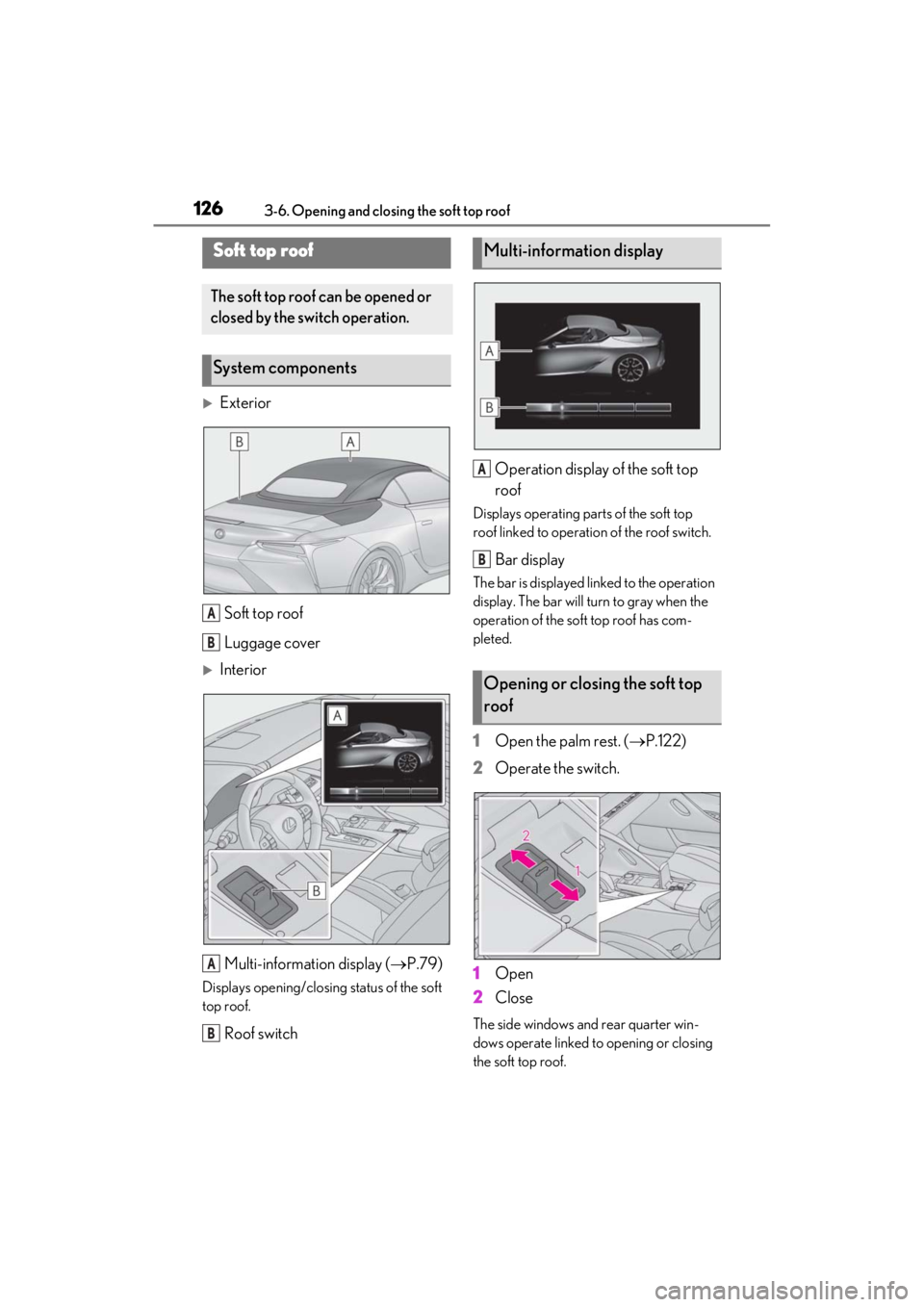
ExteriorSoft top roof
Luggage cover
Interior
Multi-information display ( P.79)
Displays opening/closing status of the soft
top roof.
Roof switch Operation display of the soft top
roof
Displays operating parts of the soft top
roof linked to operatio
n of the roof switch.
Bar display
The bar is displayed linked to the operation
display. The bar will turn to gray when the
operation of the soft top roof has com-
pleted.
1 Open the palm rest. ( P.122)
2 Operate the switch.
1 Open
2 Close
The side windows and rear quarter win-
dows operate linked to opening or closing
the soft top roof.
Soft top roof
The soft top roof can be opened or
closed by the switch operation.
System components
A
B
A
B
Multi-information display
Opening or closing the soft top
roof
A
B
Page 129 of 410

1273-6. Opening and closing the soft top roof
3
Before driving
Opening/closing status of the soft top roof
will be displayed on the multi-information
display.
When the operation of the soft top roof has
completed, the bar will turn to gray and the
buzzer will sound.
To close the side windows and rear quarter
windows, press the power window switch.
( P.122)
■Operational conditions
●The vehicle speed is less than approxi-
mately 31 mph (50 km/h) (However, it is
recommended that the soft top roof is
opened or closed when the vehicle is
stopped.)
●The engine is running (The soft top roof
can operate with the engine switch in
ON, however, in order to prevent battery
discharge, it is recommended to start the
engine.)
●The trunk lid is closed
■Situations in which the soft top roof
operation stops partway
In the following situation, operation of the
soft top roof stops partway.
●When releasing the roof switch while the
soft top roof is operating
●The vehicle speed is approximately 31
mph (50 km/h) or higher.
●If there is a malfunction in the system
●When operate the soft top roof repeat-
edly in a short period of time
●If the battery is discharged
■Situations in which the soft top roof may
not operate properly
In the following situation, the soft top roof
may not operate properly.
●When the jam protection function or
catch protection function of the power
windows operates
●When starting the en gine while operating
the roof switch (The so ft top roof that is
operating stops partway or returns to the
previous position.)
●If the roof switch has not been operated
for a long period of time during the oper-
ation of the soft top roof. (“Soft Top
Operation Not Completed Soft Top Will
Move Soon” is displayed on the multi-
information display for approximately 10
seconds, and then the soft top will move
slowly.)
●When the roof switch is operated on a
steep incline or large step
●When driving on uneven road surfaces
●In strong wind
■Switch operation when the operational
conditions are not met
If the soft top roof is fully closed and the
vehicle is stopped, continuously operating
the roof switch can operate the side win-
dows and rear quarter windows only even if
the operational conditions of the soft top
roof are not met
■While the soft top roof is operating
●The trunk opener switch cannot be oper-
ated. Press the switch after the operation
of the soft top roof has been completed.
( P.101)
●The side windows and rear quarter win-
dows cannot be operated using the
power window switch or all window con-
trol switch. They can be operated when
the soft top roof operation partway stops,
however, they cannot be fully closed.
■If water splashes on the soft top roof,
such as in the rain or in a car wash
Wipe away any water before opening the
soft top roof. To prevent wrinkles, it is rec-
ommended to open the soft top roof after it
has completely dried.
■Soft top roof open warning buzzer
A buzzer sounds if opening or closing the
soft top roof is not completed. Open or
close the soft top roof as soon as possible.
■If a battery terminal has been discon-
nected and reconnected
If “Soft Top Operation Not Completed” is
displayed on the multi-information display
after the engine has been started, perform
the following procedure.
Page 130 of 410

1283-6. Opening and closing the soft top roof
When the soft top roof of the rear win-
dow side stops near the fully closing posi-
tion.
1 Operate the roof switch to open the
soft top roof, and release the switch with
the luggage cover opened.
2 Operate the roof switch to fully close
the soft top roof.
When the rear soft top roof stops near
the fully opening position.
Operate the roof switch to fully close the soft top roof.
If the luggage cover does not operate by
performing the procedure above, check
that a warning message is displayed on the
multi-information display or the operational
conditions are met. If
the luggage cover still
does not operate, have the vehicle
inspected by your Lexus dealer.
■If the soft top roof cannot be operated properly when the roof switch is operated
In the following situations, perform the actions specified in the table, and then operate the
switch again.
●Soft top roof operation stops partway
SituationWarning messageAction
The engine switch is
turned to OFF or
ACC while the soft
top roof is operating.
-Start the engine, or turn the engine switch
to ON, and then operate the roof switch.
The vehicle speed
exceeds approxi-
mately 31 mph (50
km/h) while the soft
top roof is operating.
“SLOW DOWN to
Compelete Soft Top
Operation”Decelerate to approximately 31 mph (50
km/h), and then operate the roof switch.
The trunk lid is
opened using the
mechanical key while
the soft top roof is
operating.
-Close the trunk lid, and then operate the
roof switch.
A collision is
detected.-Contact your Lexus dealer.
The catch protection
function of a power
window is activated.
- P.123
The soft top roof is
operated manually.
“SLOW DOWN to
Compelete Soft Top
Operation”
“Soft Top Operation
Not Completed”Manually return the soft top roof to the
previous position. If the soft top roof cannot
be operated, repeat opening and closing
operations several times.
Page 132 of 410
1303-6. Opening and closing the soft top roof
The soft top roof is
operated repeatedly
in a short period of
time.
“Opening Function
Unavailable System
Overheated”
“Function Temporar-
ily Unavailable Sys-
tem Overheated”Wait for a while and then operate the roof
switch. Depending on the situation, “Soft
Top System Available” is displayed on the
multi-information disp lay indicating that
the roof switch can be operated. If the roof
switch cannot be operated, operate the
soft top roof manually ( P.338) or have
the vehicle inspected by your Lexus dealer.
The roof switch is
operated while the
luggage cover lock is
operating.
-Operate the roof switch again.
The jam protection
function or catch pro-
tection function of a
power windows is
activated.
- P.122
The soft top roof is
operated manually.
“SLOW DOWN to
Compelete Soft Top
Operation”
“Soft Top Operation
Not Completed”Manually return the soft top roof to the
previous position. If the soft top roof cannot
be operated, repeat opening and closing
operations several times.
SituationWarning messageAction
Page 135 of 410

1333-6. Opening and closing the soft top roof
3
Before driving
WARNING
●When exiting the vehicle, turn the
engine switch off, carry the key and
exit the vehicle along with the child.
There may be accidental operation,
due to mischief, etc., that may possibly
lead to an accident.
■While the vehicle is driven
Observe the following precautions.
Failure to do so may result in serious
injury or an accident.
●Do not operate the soft top roof more
than necessary.
●Do not drive the vehicle with the soft
top roof half-opened.
●Do not stand on the seat, sit on the
package tray ( P.40), or lean out of
the vehicle.
■When a child is in the vehicle
Observe the following precautions.
Failure to do so may result in death or
serious injury.
●Do not allow a child operate the soft
top roof.
●Never let a child sit in the storing
space of the soft top roof.
●Keep children away from the movable
range of the soft top roof.
NOTICE
■To prevent damage to the soft top
roof
●Make sure that ther e is no obstacle
within a height of 25.6 in. (65 cm)
from the soft top roof.
Also, be careful when passing a place
with height restriction, such as a tunnel
or underground passage.
●Do not put anything in the storing
space of the soft top roof.
●Do not sit on or put luggage on the soft
top roof or luggage cover.
●When there is snow or luggage on the
soft top roof or luggage cover, remove
it before operating the roof switch.
●Do not open or close the soft top roof
when anything is put on the trunk lid.
●Do not close the soft top roof when
anything is put on the upper part of the
windshield frame.
●Do not open or close the soft top roof
when the outside temperature is
23.0°F (-5°C) or lower or the side
windows and rear quarter windows
are frozen.
●Do not leave the soft top roof not fully
opened or closed for a long period of
time.
●Do not leave the soft top roof opened
for a long period of time. The soft top
roof may have wrinkles or deteriorate.
●When opening the trunk lid using the
mechanical key, full y open or close the
soft top roof.
●Do not install a roof luggage carrier to
the soft top roof.
●Do not operate the soft top roof manu-
ally except in an emergency.
( P.338)
Page 138 of 410

1364-1. Before driving
4-1.Before driving
■Starting the engine
P.146
■Driving
1 With the brake pedal depressed,
shift the shift position to D.
(P.152)
Check that the shift position indicator
shows D.
2 If the parking brake is in manual
mode, release the parking brake.
(P.157)
3 Gradually release the brake pedal
and gently depress the accelerator
pedal to accelerate the vehicle.
■Stopping
1 With the shift position in D, depress
the brake pedal.
2 If necessary, set the parking brake.
If the vehicle is to be stopped for an
extended period of time, shift the shift posi-
tion to P. ( P.152)
■Parking the vehicle
1 Stop the vehicle completely.
2 If the parking brake is in manual
mode, set the parking brake.
(P.157)
3 Shift the shift position to P.
(P.152)
Check that the shift position indicator
shows P.
4 Press the engine switch to stop the
engine.
5 Slowly release the brake pedal.
6 Lock the door, making sure that
you have the electronic key on your
person.
If parking on a hill, block the wheels as
needed.
■Starting off on a steep uphill
1 Firmly depress the brake pedal and
shift the shift position to D.
The hill-start assist control will be activated.
( P.219)
2 Set the parking brake. ( P.157)
3 Release the brake pedal and gently
depress the accelerator pedal to
accelerate the vehicle.
4 Release the parking brake.
(P.157)
■When parking the vehicle
In order to prevent theft or effect of the
weather on the environment of the vehicle
cabin, close the soft top roof when parking
the vehicle.
■Driving in the rain
●Drive carefully when it is raining, because
visibility will be reduced, the windows
may become fogged-up, and the road
will be slippery.
●Drive carefully when it starts to rain,
because the road surface will be espe-
cially slippery.
●Refrain from high speeds when driving on
an expressway in the rain, because there
may be a layer of wa ter between the tires
and the road surface, preventing the
steering and brakes from operating
properly.
■Engine speed while driving
In the following conditions, the engine
speed may become high while driving. This
Driving the vehicle
The following procedures should be
observed to ensure safe driving:
Driving procedure
Page 142 of 410

1404-1. Before driving
WARNING
●Do not leave cigarette lighters in the
vehicle. If a cigarette lighter is in a
place such as the glove box or on the
floor, it may be lit accidentally when
luggage is loaded or the seat is
adjusted, causing a fire.
●Do not attach adhesive discs to the
windshield or windows. Do not place
containers such as air fresheners on
the instrument panel or dashboard.
Adhesive discs or containers may act
as lenses, causing a fire in the vehicle.
●Do not leave a door or window open if
the curved glass is coated with a met-
allized film such as a silver-colored
one. Reflected sunlight may cause the
glass to act as a lens, causing a fire.
●Always apply the parking brake, shift
the shift position to P, stop the engine
and lock the vehicle.
Do not leave the vehicle unattended
while the engine is running.
If the vehicle is parked with the shift
position in P but the parking brake is
not set, the vehicle may start to move,
possibly leading to an accident.
●Do not touch the exhaust pipes while
the engine is running or immediately
after turning the engine off.
Doing so may cause burns.
■When taking a nap in the vehicle
Always turn the engine off. Otherwise, if
you accidentally move the shift lever or
depress the accelerator pedal, this could
cause an accident or fire due to engine
overheating. Additionally, if the vehicle is
parked in a poorly ventilated area,
exhaust gases may collect and enter the
vehicle, leading to death or a serious
health hazard.
■When braking
●When the brakes are wet, drive more
cautiously.
Braking distance in creases when the
brakes are wet, and this may cause
one side of the vehicle to brake differ-
ently than the other side. Also, the
parking brake may not securely hold
the vehicle.
●If the electronically controlled brake
system does not operate, do not follow
other vehicles closely and avoid hills or
sharp turns that require braking.
In this case, braking is still possible, but
the brake pedal should be depressed
more firmly than usual. Also, the brak-
ing distance will increase. Have your
brakes fixed immediately.
●The brake system consists of 2 or
more individual hydraulic systems; if
one of the systems fails, the other(s)
will still operate. In this case, the brake
pedal should be depressed more
firmly than usual and the braking dis-
tance will increase. Have your brakes
fixed immediately.
NOTICE
■When driving the vehicle
●Do not depress the accelerator and
brake pedals at th e same time while
driving, as this may restrain the engine
output.
●Do not use the accelerator pedal or
depress the accelerator and brake
pedals at the same time to hold the
vehicle on a hill.
■Avoiding damage to vehicle parts
●Do not turn the steering wheel fully in
either direction and hold it there for an
extended period of time.
Doing so may damage the power
steering motor.
Page 173 of 410
1714-4. Refueling
4
Driving
4-4.Refueling
Turn the engine switch off.
When closing the soft top roof,
ensure that both side doors, side
windows and rear quarter windows
are closed.
Confirm the type of fuel.
■Fuel types
P.357
■Fuel tank opening for unleaded gasoline
To help prevent incorrect fueling, your vehi-
cle has a fuel tank opening that only accom-
modates the special nozzle on unleaded
fuel pumps.
■If the malfunction indicator lamp illumi-
nates
The malfunction indicator lamp may illumi-
nate erroneously if refueling is performed
repeatedly when the fuel tank is nearly full.
Opening the fuel tank cap
Before refueling the vehicle
WARNING
■When refueling the vehicle
Observe the following precautions while
refueling the vehicle. Failure to do so
may result in death or serious injury.
●After exiting the vehicle and before
opening the fuel door, touch an
unpainted metal surface to discharge
any static electricity. It is important to
discharge static electricity before refu-
eling because sparks resulting from
static electricity can cause fuel vapors
to ignite while refueling.
●Always hold the grips on the fuel tank
cap and turn it slowly to remove it.
A whooshing sound may be heard
when the fuel tank cap is loosened.
Wait until the sound cannot be heard
before fully removing the cap. In hot
weather, pressurized fuel may spray
out the filler neck and cause injury.
●Do not allow anyone that has not dis-
charged static electricity from their
body to come close to an open fuel
tank.
●Do not inhale vaporized fuel.
Fuel contains substances that are
harmful if inhaled.
●Do not smoke while refueling the vehi-
cle.
Doing so may cause the fuel to ignite
and cause a fire.
●Do not return to the vehicle or touch
any person or object that is statically
charged.
This may cause static electricity to
build up, resulting in a possible ignition
hazard.
■When refueling
Observe the following precautions to
prevent fuel overflowing from the fuel
tank:
●Securely insert the fuel nozzle into the
fuel filler neck.
●Stop filling the tank after the fuel noz-
zle automatically clicks off.
●Do not top off the fuel tank.
NOTICE
■Refueling
Do not spill fuel during refueling.
Doing so may damage the vehicle, such
as causing the emission control system to
operate abnormally or damaging fuel
system components or the vehicle’s
painted surface.