2021 LEXUS ES350 spare tire location
[x] Cancel search: spare tire locationPage 109 of 464

1093-2. Opening, closing and locking the doors and trunk
3
Before driving
●When the lock operation is performed
using the lock sensor, recognition signals
will be shown up to two consecutive
times. After this, no recognition signals
will be given.
●Unlocking the vehicle may take more
time if another electronic key is within the
effective range.
●If the door handle becomes wet while the
electronic key is within the effective
range, the door may lock and unlock
repeatedly. In this case, follow the follow-
ing correction procedures to wash the
vehicle:
• Place the electronic key in a location 6 ft. (2 m) or more away from the vehicle.
(Take care to ensure that the key is not
stolen.)
• Set the electronic key to battery-saving
mode to disable the smart access system
with push-button start. ( P.107)
●If the electronic key is inside the vehicle
and a door handle becomes wet during a
car wash, a message may be shown on
the multi-information display and a
buzzer will sound outside the vehicle. To
turn off the alarm, lock all the doors.
●The lock sensor may not work properly if
it comes into contact with ice, snow, mud,
etc.
Clean the lock sensor and attempt to
operate it again.
●A sudden approach to the effective
range or door handle may prevent the
doors from being unlocked. In this case,
return the door handle to the original
position and check that the doors unlock
before pulling the door handle again.
■When the vehicle is not driven for
extended periods
●To prevent theft of the vehicle, do not
leave the electronic key within 6 ft. (2 m)
of the vehicle.
●The smart access syst em with push-but-
ton start can be deactivated in advance.
●Battery-saving mode can reduce the
power consumption of electronic keys.
( P.107)
■To operate the system properly
●Make sure to carry the electronic key
when operating the system. Do not get
the electronic key too close to the vehicle
when operating the system from the out-
side of the vehicle.
Depending on the position and holding
condition of the elec tronic key, the key
may not be detected correctly and the
system may not operate properly. (The
alarm may go off accidentally, or the door
lock prevention function may not oper-
ate.)
●Do not leave the electr onic key inside the
trunk.
The key confinement prevention function
may not operate, depending on the loca-
tion of the key (close to a spare tire, the
inside edge of the trunk), conditions
(inside a metal bag, close to metallic
objects) and the radio waves in the sur-
rounding area. ( P.103)
■If an electronic key does not work prop-
erly
●If the doors cannot be locked or
unlocked and the trunk cannot be
opened, perform the following.
• Bring the electronic key close to the door
handle and perform a lock or unlock
operation.
• Bring the electronic key close to the but-
ton on the trunk ( P.101) and press the
button.
• Use the wireless remote control.
If the doors cannot be locked or unlocked
by perform the above, use the mechanical
key. ( P.387)
For Canada: However, if the mechanical
key is used while the al arm system is set, the
warning will sound. ( P.63)
●If the engine cannot be started, refer to
P.388
■Customization
Settings (e. g. smart access system with
push-button start) can be changed.
(Customizable features: P.419)
If the smart access system with push-button
start has been deactivated in a customized
setting, refer to the explanations for the fol-
Page 326 of 464
3266-3. Do-it-yourself maintenance
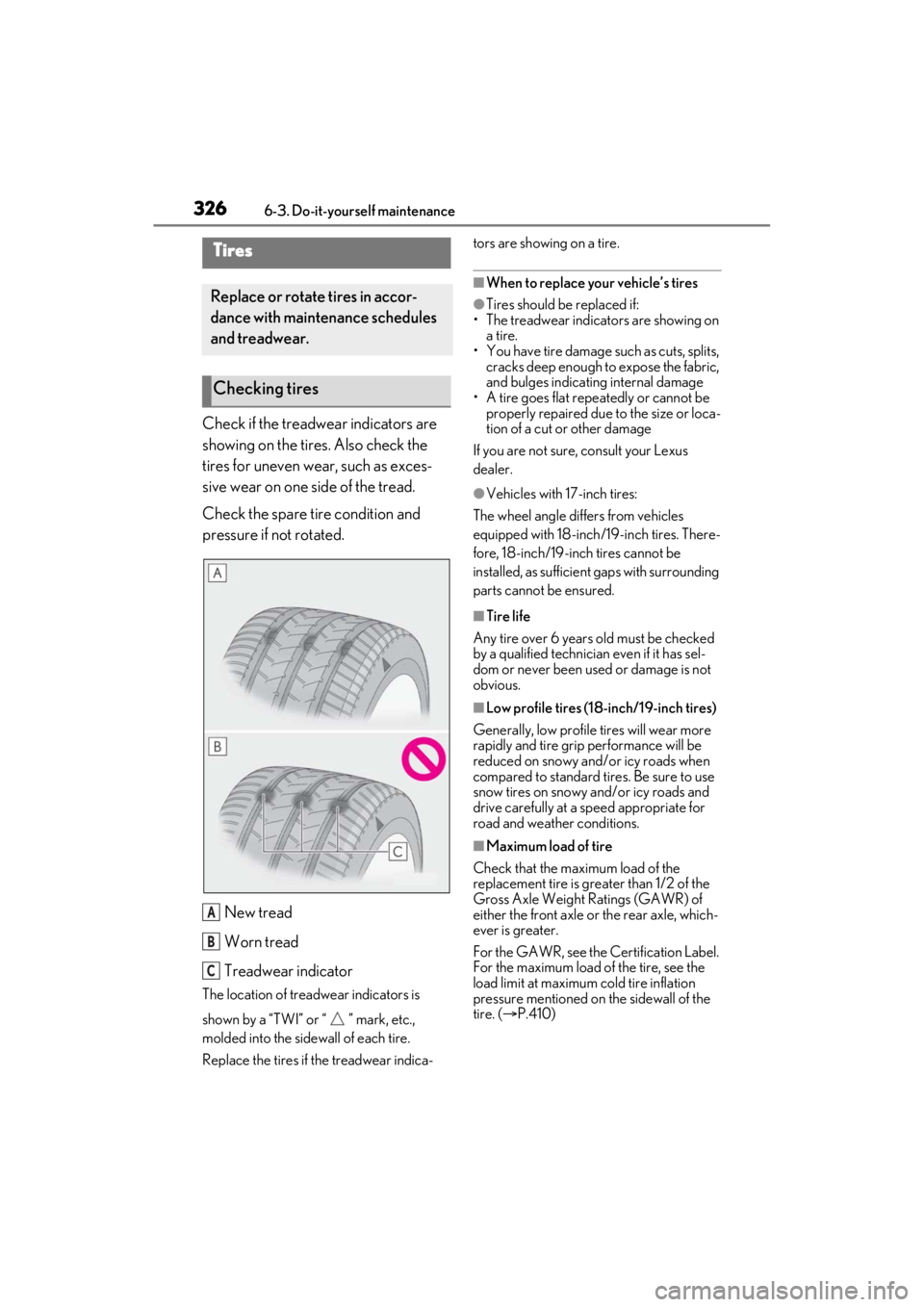
Check if the treadwear indicators are
showing on the tires. Also check the
tires for uneven wear, such as exces-
sive wear on one side of the tread.
Check the spare tire condition and
pressure if not rotated.New tread
Worn tread
Treadwear indicator
The location of treadwear indicators is
shown by a “TWI” or “ ” mark, etc.,
molded into the sidewall of each tire.
Replace the tires if the treadwear indica- tors are showing on a tire.
■When to replace your vehicle’s tires
●Tires should be replaced if:
• The treadwear indicators are showing on a tire.
• You have tire damage such as cuts, splits,
cracks deep enough to expose the fabric,
and bulges indicating internal damage
• A tire goes flat repeatedly or cannot be
properly repaired due to the size or loca-
tion of a cut or other damage
If you are not sure, consult your Lexus
dealer.
●Vehicles with 17-inch tires:
The wheel angle differs from vehicles
equipped with 18-inch/19-inch tires. There-
fore, 18-inch/19-inch tires cannot be
installed, as sufficient gaps with surrounding
parts cannot be ensured.
■Tire life
Any tire over 6 years old must be checked
by a qualified technician even if it has sel-
dom or never been used or damage is not
obvious.
■Low profile tires (18-inch/19-inch tires)
Generally, low profile tires will wear more
rapidly and tire grip performance will be
reduced on snowy and/or icy roads when
compared to standard tires. Be sure to use
snow tires on snowy and/or icy roads and
drive carefully at a speed appropriate for
road and weather conditions.
■Maximum load of tire
Check that the maximum load of the
replacement tire is greater than 1/2 of the
Gross Axle Weight Ratings (GAWR) of
either the front axle or the rear axle, which-
ever is greater.
For the GAWR, see the Certification Label.
For the maximum load of the tire, see the
load limit at maximum cold tire inflation
pressure mentioned on the sidewall of the
tire. ( P.410)
Tires
Replace or rotate tires in accor-
dance with maintenance schedules
and treadwear.
Checking tires
A
B
C
Page 376 of 464

3767-2. Steps to take in an emergency
Type AWheel nut wrench
Wheel lock key
* (if equipped)
Jack
Jack handle
Spare tire
Towing eyelet (if equipped)
*: Documentation relating to the wheel lock key, such as the registration and I.D. card, is
inside the glove box.
Location of the spare tire, jack and tools
A
B
C
D
E
F
Page 383 of 464

3837-2. Steps to take in an emergency
7
When trouble arises
1Replace a rear tire with the compact
spare tire.
2 Replace the flat front tire with the tire
removed from the rear of the vehicle.
3 Fit tire chains to the front tires.
WARNING
■When using the compact spare tire
●Remember that the compact spare tire
provided is specifically designed for
use with your vehicle. Do not use your
compact spare tire on another vehicle.
●Do not use more than one compact
spare tire simultaneously.
●Replace the compact spare tire with a
standard tire as soon as possible.
●Avoid sudden acceleration, abrupt
steering, sudden braking and shifting
operations that cause sudden engine
braking.
■When the compact spare tire is
attached
The vehicle speed may not be correctly
detected, and the following systems may
not operate correctly:
• ABS & Brake assist
•VSC
•TRAC
• Dynamic radar cruise control with full- speed range
• PCS (Pre-Collision System)
•EPS
• LTA (Lane Tracing Assist)
• Panoramic view monitor (if equipped)
• Lexus parking assist monitor (if equipped)
• Intuitive parking assist (if equipped)
• Navigation system (if equipped)
• BSM (Blind spot monitor) (if equipped)
• Automatic high Beam
Also, not only can the following system
not be utilized fully, bu t it may even nega-
tively affect the drive-train components:
• AWD system (if equipped)
■Speed limit when using the compact
spare tire
Do not drive at speeds in excess of 50
mph (80 km/h) when a compact spare
tire is installed on the vehicle.
The compact spare tire is not designed
for driving at high speeds. Failure to
observe this precaution may lead to an
accident causing death or serious injury.
■After using the tools and jack
Before driving, make sure all the tools
and jack are securely in place in their
storage location to reduce the possibility
of personal injury during a collision or
sudden braking.
NOTICE
■Be careful when driving over bumps
with the compact spare tire installed
on the vehicle
The vehicle becomes lower when driving
with the compact spar e tire compared to
when driving with standard tires. Be
careful when driving over uneven road
surfaces.
■Driving with tire chains and the com-
pact spare tire
Do not fit tire chains to the compact
spare tire.
Tire chains may damage the vehicle
body and adversely affect driving perfor-
mance.
Page 411 of 464
4118-1. Specifications
8
Vehicle specifications
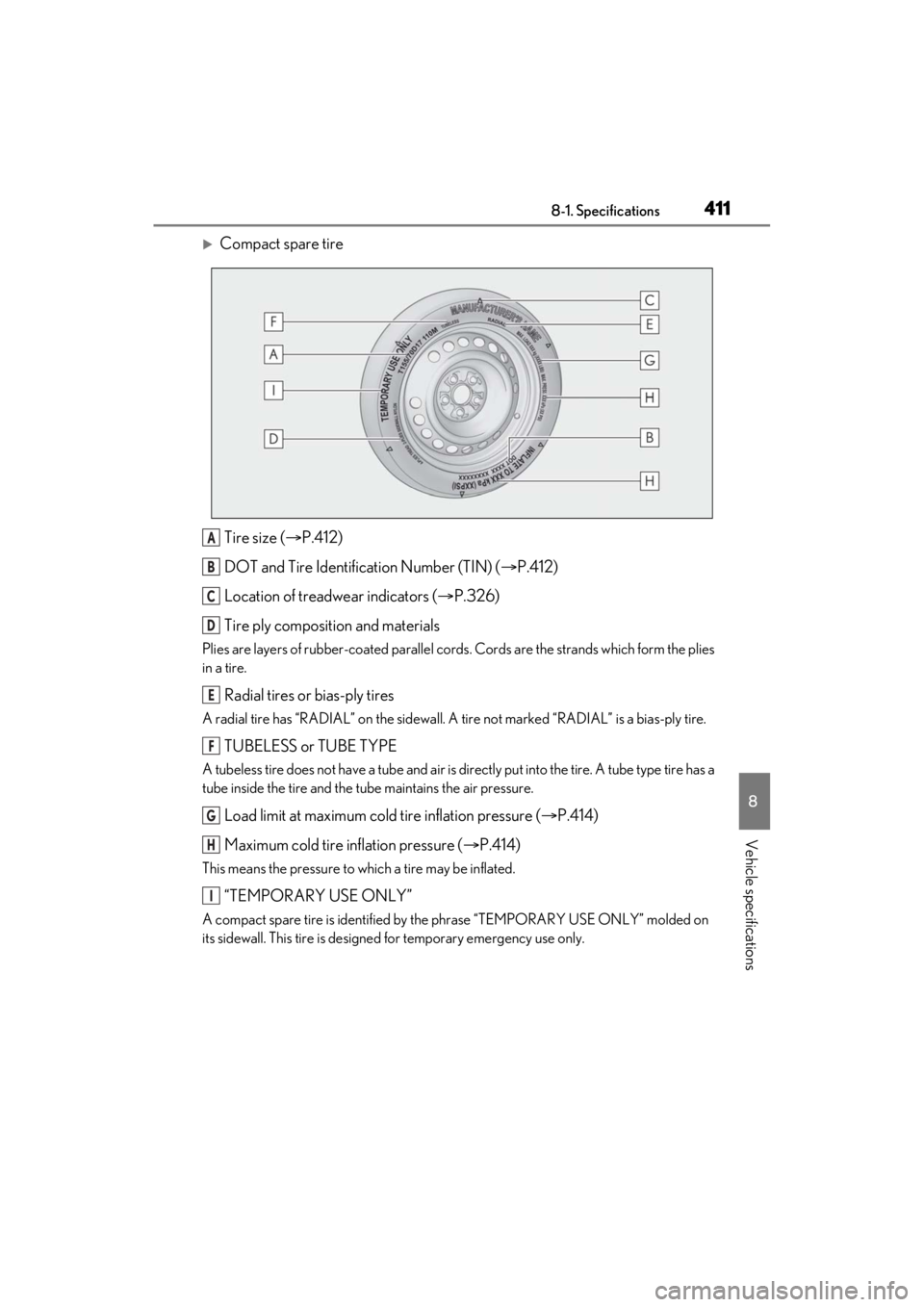
Compact spare tireTire size ( P.412)
DOT and Tire Identification Number (TIN) ( P.412)
Location of treadwear indicators ( P.326)
Tire ply composition and materials
Plies are layers of rubber-coated parallel cords. Cords are the strands which form the plies
in a tire.
Radial tires or bias-ply tires
A radial tire has “RADIAL” on the sidewall. A tire not marked “RADIAL” is a bias-ply tire.
TUBELESS or TUBE TYPE
A tubeless tire does not have a tube and air is directly put into the tire. A tube type tire has a
tube inside the tire and the tube maintains the air pressure.
Load limit at maximum cold tire inflation pressure ( P.414)
Maximum cold tire inflation pressure ( P.414)
This means the pressure to which a tire may be inflated.
“TEMPORARY USE ONLY”
A compact spare tire is identified by th e phrase “TEMPORARY USE ONLY” molded on
its sidewall. This tire is designed for temporary emergency use only.
A
B
C
D
E
F
G
H
I
Page 457 of 464

Alphabetical index457
Seat belt reminder light............................. 364
Seat belts............................................................ 24 Adjusting the seat belt................................ 26
Automatic Locking Retractor ................ 26
Child restraint system installation ......... 44
Cleaning and maintaining the seat belt......................................................................... 307
Emergency Locking Retractor .............. 26
How to wear your seat belt ..................... 25
How your child should wear the seat belt ............................................................................ 25
Pregnant women, proper seat belt use .............................................................................24
Reminder light and buzzer ................... 364
Seat belt extender ........................................ 25
Seat belt pretensioners ...............................27
SRS warning light ...................................... 362
Seat heaters ................................................... 270
Seating capacity.............................................. 141
Seat position memory................................... 114
Seats..................................................................... 113 Adjustment precautions ............................ 113
Adjustment....................................................... 113
Child seats/child restraint system instal-lation................................................................. 43
Cleaning......................................................... 307
Driving position memory...........................114
Head restraints ...............................................117
Power easy access system .......................114
Properly sitting in the seat .........................23
Seat heaters .................................................. 270
Seat position memory .................................114
Seat ventilators............................................ 270
Seat ventilators ............................................. 270
Secondary Collision Brake (SCB) ....... 246
Sensor Automatic headlight system.................. 158
Automatic High Beam system............... 161
Inside rear view mirror................................121
Intuitive parking assist................................ 213
LTA (Lane Tracing Assist)..................... 184
Parking Support Brake function (rear- crossing vehicles)...................................239
Parking Support Brake function (static objects) ........................................................ 234
Radar sensor ........ ............................... 171, 207
Rain-sensing windshield wipers .......... 166
RCTA................................................................. 221
Service reminder message ..................... 309
Shift lever Automatic transmission ........................... 149
Shift lever light ...............................................274
Shift lock system............................................ 150
Side airbags ...................................................... 28
Side marker lights......................................... 158 Light switch .................................................... 158
Side mirrors ...................................................... 121 Adjustment ....................................................... 121
BSM (Blind Spot Monitor)................... 205
Folding............................................................... 122
Linked mirror functi on when reversing
............................................................................123
Mirror position memory ............................ 121
RCTA function ............................................220
Side turn signal lights ...................................153 Replacing light bulbs ................................346
Turn signal lever .......................................... 153
Side windows .................................................. 124
Smart access system with push-button start.................................................................. 106Antenna location ......................................... 106
Entry functions .......................................95, 101
Starting the engine ......................................144
Snow tires .........................................................251
Spare tire Storage location ......................................... 376
Spark plug ...................................................... 403
Specifications ................................................ 398
Speedometer ........................................... 70, 73
Sport mode ......................................................210
Steering lock Column lock release ................................. 145
Steering lock system warning message........................................................................... 145