Page 40 of 598
Vehicle Information, Consumer Information and Reporting Safety Defects
2-12
To help achieve proper engine and powertrain performance and durability, use only
lubricants of the proper quality. The correct lubricants also help promote engine
efficiency that results in improved fuel economy.
These lubricants and fluids are recommended for use in your vehicle.
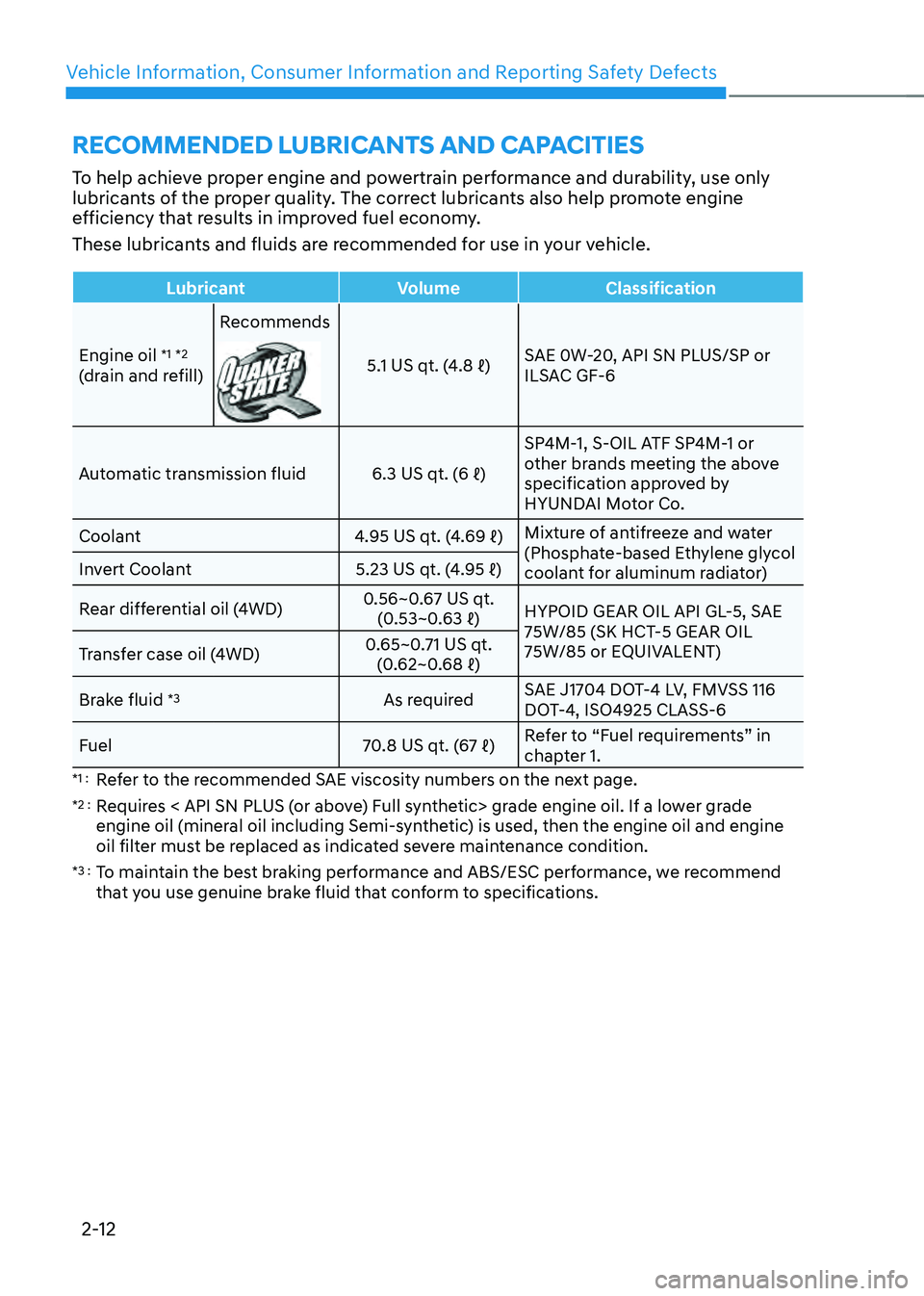
LubricantVolumeClassification
Engine oil
*1 *2
(drain and refill) Recommends5.1 US qt. (4.8 ℓ)SAE 0W-20, API SN PLUS/SP or
ILSAC GF-6
Automatic transmission fluid6.3 US qt. (6 ℓ)
SP4M-1, S-OIL ATF SP4M-1 or
other brands meeting the above
specification approved by
HYUNDAI Motor Co.
Coolant
4.95 US qt. (4.69 ℓ)Mixture of antifreeze and water
(Phosphate-based Ethylene glycol
coolant for aluminum radiator)
Invert Coolant
5.23 US qt. (4.95 ℓ)
Rear differential oil (4WD) 0.56~0.67 US qt. (0.53~0.63 ℓ)HYPOID GEAR OIL API GL-5, SAE
75W/85 (SK HCT-5 GEAR OIL
75W/85 or EQUIVALENT)
Transfer case oil (4WD) 0.65~0.71 US qt.
(0.62~0.68 ℓ)
Brake fluid *3As required SAE J1704 DOT-4 LV, FMVSS 116
DOT-4, ISO4925 CLASS-6
Fuel
70.8 US qt. (67 ℓ)Refer to “Fuel requirements” in
chapter 1.
*1 : Refer to the recommended SAE viscosity numbers on the next page.
*2 : Requires < API SN PLUS (or above) Full synthetic> grade engine oil. If a lower grade
engine oil (mineral oil including Semi-synthetic) is used, then the engine oil and engine
oil filter must be replaced as indicated severe maintenance condition.
*3 : To maintain the best braking performance and ABS/ESC performance, we recommend
that you use genuine brake fluid that conform to specifications.
RECOMMENDED LUBRICANTS AND CAPACITIES
Page 326 of 598
Driving your vehicle
6-42
WARNING
Do not drive across the contour of steep
hills. A slight change in the wheel angle
can destabilize the vehicle, or a stable
vehicle may lose stability if the vehicle
stops its forward motion. Your vehicle
may roll over and lead to a serious injury
or death.
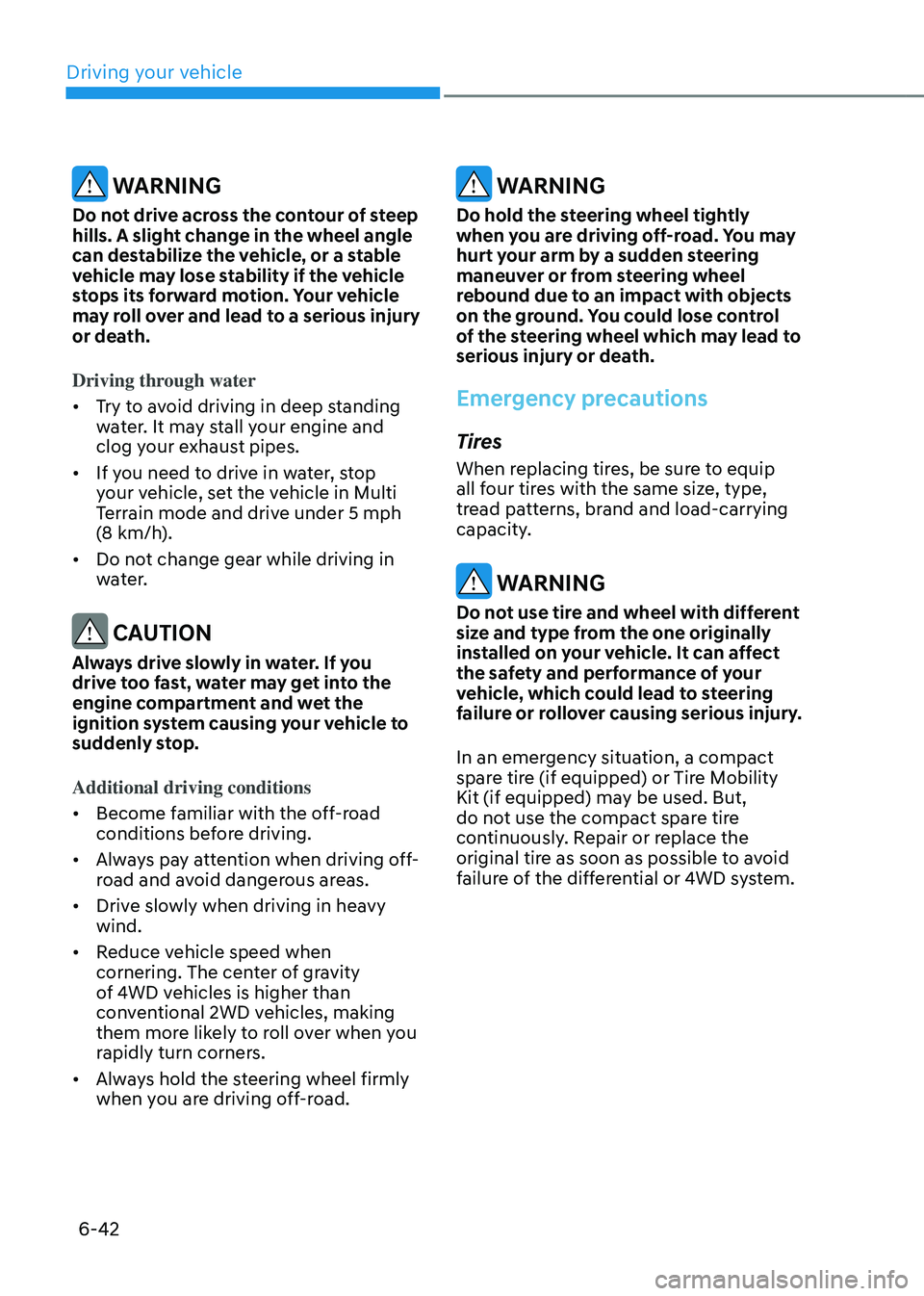
Driving through water
• Try to avoid driving in deep standing
water. It may stall your engine and
clog your exhaust pipes.
• If you need to drive in water, stop
your vehicle, set the vehicle in Multi
Terrain mode and drive under 5 mph
(8 km/h).
• Do not change gear while driving in
water.
CAUTION
Always drive slowly in water. If you
drive too fast, water may get into the
engine compartment and wet the
ignition system causing your vehicle to
suddenly stop.
Additional driving conditions
• Become familiar with the off-road
conditions before driving.
• Always pay attention when driving off-
road and avoid dangerous areas.
• Drive slowly when driving in heavy
wind.
• Reduce vehicle speed when
cornering. The center of gravity
of 4WD vehicles is higher than
conventional 2WD vehicles, making
them more likely to roll over when you
rapidly turn corners.
• Always hold the steering wheel firmly
when you are driving off-road.
WARNING
Do hold the steering wheel tightly
when you are driving off-road. You may
hurt your arm by a sudden steering
maneuver or from steering wheel
rebound due to an impact with objects
on the ground. You could lose control
of the steering wheel which may lead to
serious injury or death.
Emergency precautions
Tires
When replacing tires, be sure to equip
all four tires with the same size, type,
tread patterns, brand and load-carrying
capacity.
WARNING
Do not use tire and wheel with different
size and type from the one originally
installed on your vehicle. It can affect
the safety and performance of your
vehicle, which could lead to steering
failure or rollover causing serious injury.
In an emergency situation, a compact
spare tire (if equipped) or Tire Mobility
Kit (if equipped) may be used. But,
do not use the compact spare tire
continuously. Repair or replace the
original tire as soon as possible to avoid
failure of the differential or 4WD system.
Page 525 of 598
Maintenance
9-10
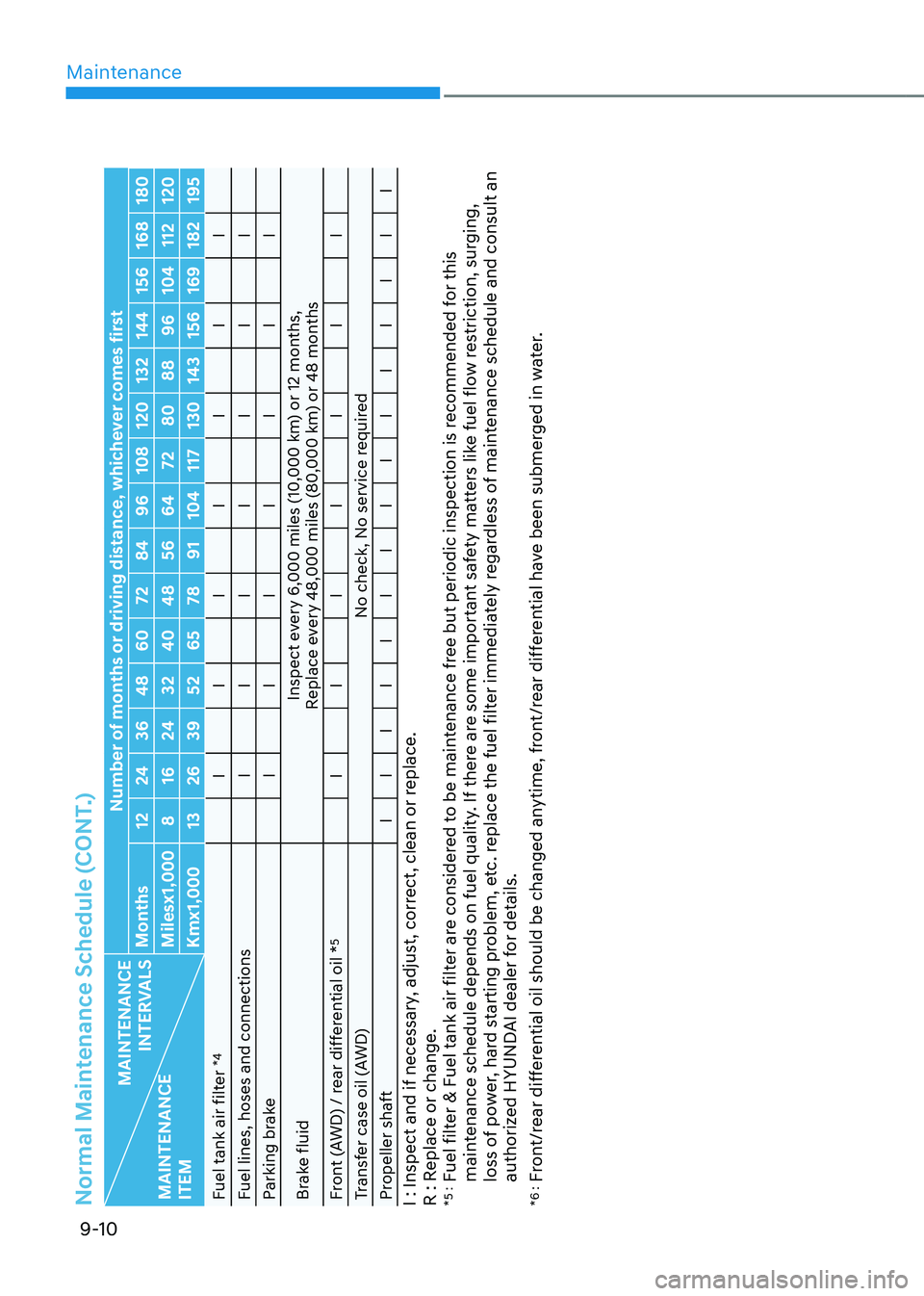
MAINTENANCE
INTERVALS
MAINTENANCE
ITEM Number of months or driving distance, whichever comes first
Months 1224 3648 60 7284 96108 120 132144 156168 180
Milesx1,000 816 24 3240 48 5664 7280 8896104 112120
Kmx1,000 1326 39 5265 78 91104 117130 143156169 182195
Fuel tank air filter
*4
I IIIIII
Fuel lines, hoses and connections IIIIIII
Parking brake IIIIIII
Brake fluid Inspect every 6,000 miles (10,000 km) or 12 months,
Replace every 48,000 miles (80,000 km) or 48 months
Front (AWD) / rear differential oil *
5
I IIIIII
Transfer case oil (AWD) No check, No service required
Propeller shaft IIIIIIIIIIIIIII
I : Inspect and if necessary, adjust, correct, clean or replace.
R : Replace or change.*5 : Fuel filter & Fuel tank air filter are considered to be maintenance free but periodic inspection is recommended for this
maintenance schedule depends on fuel quality. If there are some important safety matters like fuel flow restriction, surging,
loss of power, hard starting problem, etc. replace the fuel filter immediately regardless of maintenance schedule and consult an
authorized HYUNDAI dealer for details.
*6 : Front/rear differential oil should be changed anytime, front/rear differential have been submerged in water.
Normal Maintenance Schedule (CONT.)
Page 527 of 598
Maintenance
9-12
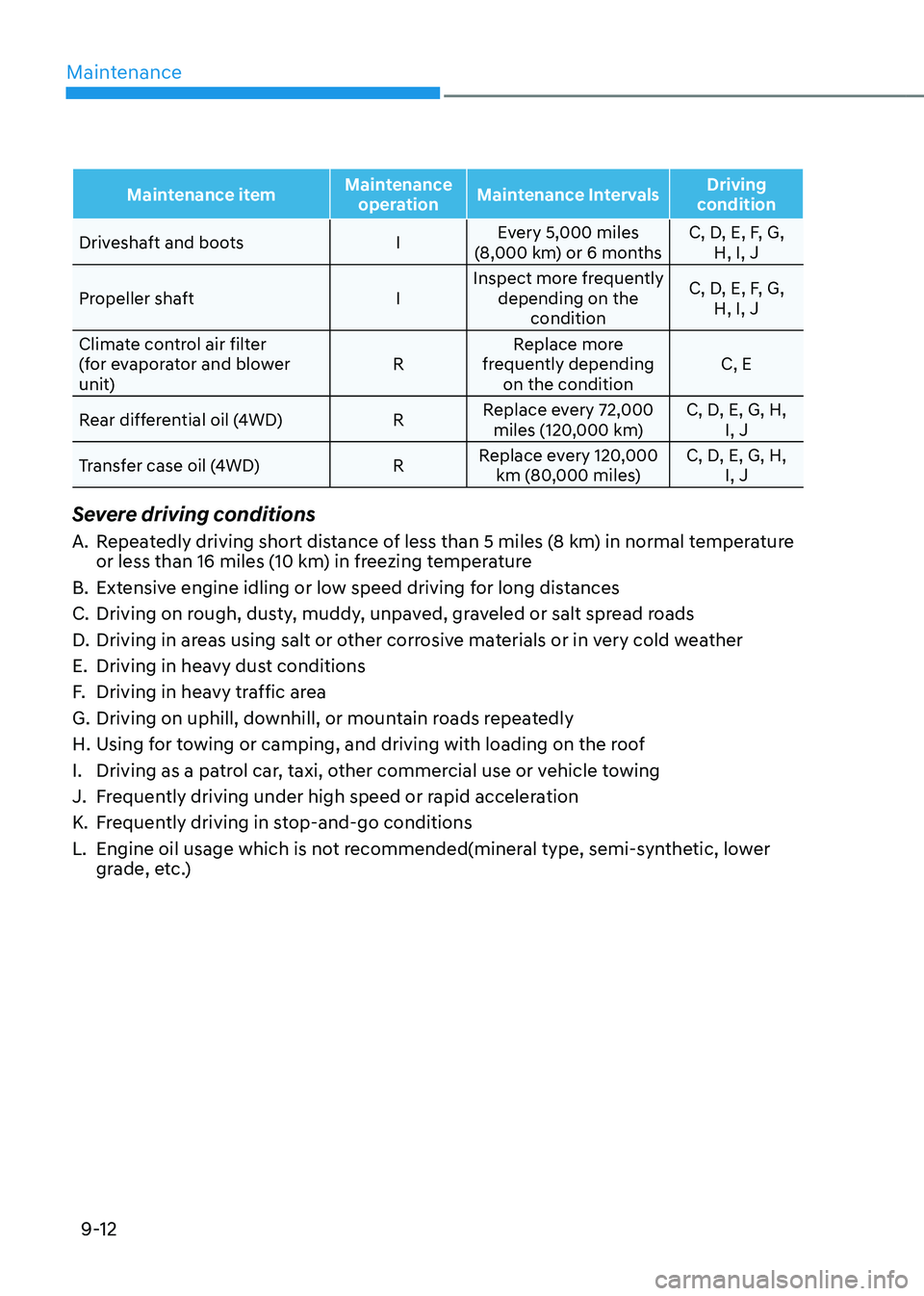
Maintenance itemMaintenance
operation Maintenance Intervals Driving
condition
Driveshaft and boots IEvery 5,000 miles
(8,000 km) or 6 months C, D, E, F, G,
H, I, J
Propeller shaft IInspect more frequently
depending on the condition C, D, E, F, G,
H, I, J
Climate control air filter
(for evaporator and blower
unit) RReplace more
frequently depending on the condition C, E
Rear differential oil (4WD) RReplace every 72,000
miles (120,000 km) C, D, E, G, H,
I, J
Transfer case oil (4WD) RReplace every 120,000
km (80,000 miles) C, D, E, G, H,
I, J
Severe driving conditions
A. Repeatedly driving short distance of less than 5 miles (8 km) in normal temperature
or less than 16 miles (10 km) in freezing temperature
B. Extensive engine idling or low speed driving for long distances
C. Driving on rough, dusty, muddy, unpaved, graveled or salt spread roads
D. Driving in areas using salt or other corrosive materials or in very cold weather
E. Driving in heavy dust conditions
F. Driving in heavy traffic area
G. Driving on uphill, downhill, or mountain roads repeatedly
H. Using for towing or camping, and driving with loading on the roof
I. Driving as a patrol car, taxi, other commercial use or vehicle towing
J. Frequently driving under high speed or rapid acceleration
K. Frequently driving in stop-and-go conditions
L. Engine oil usage which is not recommended(mineral type, semi-synthetic, lower
grade, etc.)