2021 HYUNDAI SANTA FE HYBRID jump start
[x] Cancel search: jump startPage 15 of 598
01
1-11
When the hybrid system is turned ON,
the gasoline engine may run or may not.
In this situation, you may feel a vibration.
This does not indicate a malfunction.
When the “
” indicator illuminates, the
hybrid system is ready to begin driving.
Even if the engine is off, you can operate
the vehicle as long as the “
” indicator
is illuminated.
NOTICE
The hybrid system contains many
electronic components. High voltage
components, such as cables and other
parts, may emit electromagnetic waves.
Even when the electromagnetic cover
blocks electromagnetic emissions,
electromagnetic waves may have an
effect on electronic devices. When your
vehicle is not used for a long period of
time, the hybrid system will discharge.
You need to drive the vehicle several
times a month. We recommend driving
at least for 1 hour or 10 miles. When the
hybrid battery is discharged, or when it
is impossible to jump start the vehicle,
we recommend that you contact your
authorized HYUNDAI dealer.
WARNING
• When you start the hybrid system
with the shift button in P (Parking),
the “
” indicator illuminates on
the instrument cluster. The driver
can drive the vehicle, even when the
gasoline engine is off.
• When you leave the vehicle, you
should turn OFF the hybrid system
or locate the shift button in P (Park).
When you depress the accelerator
pedal by mistake, or when the shift
button is not in P (Park), the vehicle
will abruptly move, possibly resulting
in serious injury or death.
Virtual Engine Sound System (VESS)
The Virtual Engine Sound System
generates engine sound for pedestrians
to hear vehicle sound because there is
limited sound while motor power is used.
• When the engine is running, the gear
shift button is not in P (Park), the VESS
will operate.
• When the gear is shifted to R
(Reverse), an additional warning
sound will be heard.
What does regenerative braking do?
It uses an electric motor when
decelerating and when braking and
transforms kinetic energy to electrical
energy in order to charge the high
voltage battery.
Battery
• The vehicle is composed of a high
voltage battery that drives the motor
and air conditioner, and an integrated
12V lead battery with the HEV battery
that drives the lamps, wipers, and
audio system.
• The integrated 12V battery is
automatically charged when the
vehicle is in the ready (
) mode.
Page 28 of 598
Foreword / Hybrid System Overview
1-24
WARNING
If a fire occurs:
• If a small scale fire occurs, use a fire
extinguisher (ABC, BC) that is meant
for electrical fires.
If it is impossible to extinguish
the fire in the early stage, remain
a safe distance from the vehicle
and immediately call your local
fire emergency responders. Also,
advise them that a hybrid vehicle is
involved.
If the fire spreads to the high voltage
battery, large amount of water is
needed to put out the fire.
Using small amount of water or
fire extinguishers not meant for
electrical fires could cause serious
injury or death from electrical
shocks.
• Upon witnessing any sparks, gases,
flames, or fuel leakage of your
vehicle, immediately call emergency
services or contact an authorized
HYUNDAI dealer. Also, advise them
that a hybrid vehicle is involved.
WARNING
When a submersion in water occurs:
When your vehicle is flooded in water, a
high-voltage battery may cause shock
or fires. Thus, turn the hybrid system
OFF, take the key in your possession and
escape to a safe place. Never attempt
physical contact with your flooded
vehicle.
Immediately contact an authorized
HYUNDAI dealer and advise them that a
hybrid vehicle is involved.
When the hybrid vehicle shuts
off
When the high voltage battery or 12 volt
battery is discharged, or when the fuel
tank is empty, the hybrid system may
not operate while driving. When the
Hybrid system does not operate, do the
following:
1. Gradually reduce the vehicle speed.
Pull over your vehicle off the road in a
safe area.
2. Make sure the shift button is in P
(Park).
3. Turn ON the hazard warning flashers.
4. Turn OFF the vehicle, and try to
start the hybrid system again, while
depressing the brake pedal and
turning on the ignition switch.
5. When the hybrid system still does
not operate, refer to “Jump starting”
section in chapter 8.
Before jump-starting the vehicle,
check the fuel level and the exact
procedure to jump start. For further
details, refer to “Jump starting”
section in chapter 8. When the fuel
level is low, do not attempt to drive
the vehicle only with the battery
power. The high voltage battery may
be discharged, and the hybrid system
will turn OFF.
Page 297 of 598
06
6-13
5. When the message ‘Vehicle will stay in
(N). Change gear to cancel’ (or ‘N will
stay engaged when the vehicle is Off’)
appears on the cluster LCD display,
press the Engine Start/Stop button
while depressing the brake pedal.
However, if you open the driver’s or
front passenger’s door, the gear will
automatically shift to P (Park) and the
Engine Start/ Stop button will change to
the OFF position.
When the battery is discharged:
You cannot shift the shift button, when
the battery is discharged.
In emergencies, do the following to
move the shift button to N (Neutral) on a
level ground.
1. Connect the battery cables from
another vehicle or from another
battery.
For more details, refer to “Jump
Starting” in chapter 8.
2. Release the parking brake with the
Engine Start/Stop button in the ON
position.
3. Shift the gear to the N(Neutral)
position refer to the “Stay in Neutral
when vehicle is Off” in this chapter.
Parking
Always come to a complete stop and
continue to depress the brake pedal.
Move the shift button into the P (Park)
position, apply the parking brake, and
place the ignition switch in the LOCK/
OFF position. Take the Key with you
when exiting the vehicle.
• The gear is shifted to P (Park) position
automatically for safety under the
following conditions.
-When the driver unfastens the
seat belt and opens the driver’s
door in the “Stay in Neutral when
the ignition is in the ON or OFF
condition
-When turning off the engine in the
R (Reverse) / D (Drive) or N (Neutral)
position
This is supplemental function for safety.
Always check the P (Park) position is
shifted.
WARNING
When you stay in the vehicle with
the engine running, be careful not to
depress the accelerator pedal for a long
period of time. The engine or exhaust
system may overheat and start a fire.
The exhaust gas and the exhaust system
are very hot. Keep away from the
exhaust system components.
Do not stop or park over flammable
materials, such as dry grass, paper or
leaves. They may ignite and cause a fire.
Page 312 of 598
Driving your vehicle
6-28
WARNING
If the ABS warning light () is on and
stays on, you may have a problem with
the ABS. Your power brakes will work
normally. To reduce the risk of serious
injury or death, contact your HYUNDAI
dealer as soon as possible.
NOTICE
When you drive on a road having poor
traction, such as an icy road, and apply
your brakes continuously, the ABS will
be active continuously and the ABS
warning light (
) may illuminate. Pull
your vehicle over to a safe place and
turn the vehicle off.
Restart the vehicle. If the ABS warning
light is off, then your ABS system is
normal.
Otherwise, you may have a problem
with your ABS system. We recommend
that you contact an authorized
HYUNDAI dealer as soon as possible.
Information
When you jump start your vehicle because
of a drained battery, the ABS warning
light (
) may turn on at the same
time. This happens because of the low
battery voltage. It does not mean your
ABS is malfunctioning. Have the battery
recharged before driving the vehicle.
Electronic Stability Control (ESC)
OTM060013
The Electronic Stability Control (ESC)
system helps to stabilize the vehicle
during cornering maneuvers.
ESC checks where you are steering and
where the vehicle is actually going. ESC
applies braking pressure to any one of
the vehicle's brakes and intervenes in the
engine management system to assist the
driver with keeping the vehicle on the
intended path. It is not a substitute for
safe driving practices. Always adjust your
speed and driving to the road conditions.
WARNING
Never drive too fast for the road
conditions when cornering. The ESC
system will not prevent accidents.
Excessive speed in turns, abrupt
maneuvers, and hydroplaning on wet
surfaces can result in severe accidents.
Page 327 of 598
06
6-43
WARNING
Never start or run the engine while
an 4WD vehicle is raised on a jack.
The vehicle can slip or roll off of a jack
causing serious injury or death to you or
those nearby.
Towing
4WD vehicles must be towed with
a wheel lift and dollies or flatbed
equipment with all the wheels off the
ground. For more details, refer to
"Towing" section in chapter 8.
Vehicle inspection
• If the vehicle needs to be operated on
a vehicle lift do not attempt to stop
any of the four wheels from turning.
This could damage the 4WD system.
• Never engage the parking brake while
running the engine on a car lift. This
may damage the 4WD system.
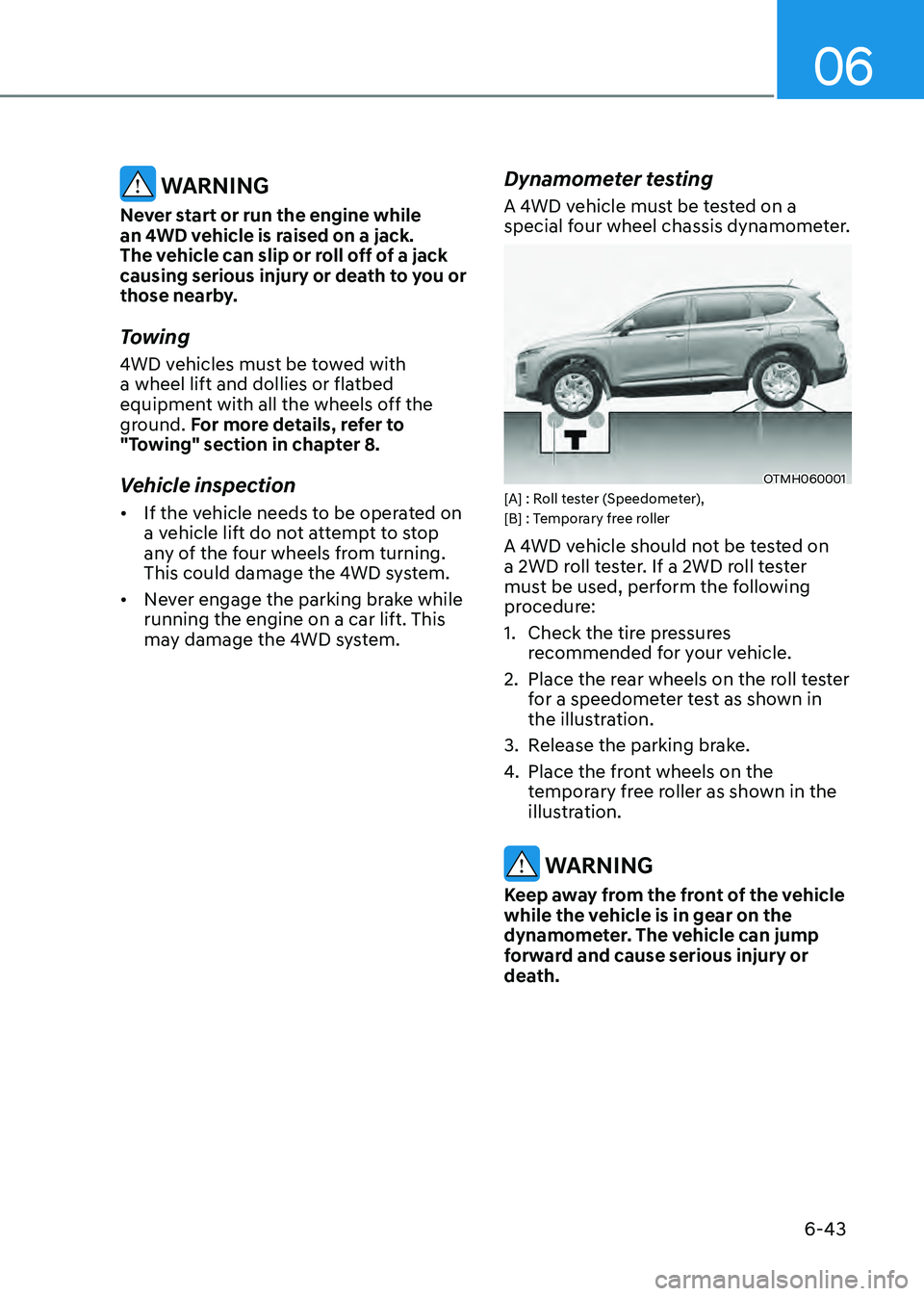
Dynamometer testing
A 4WD vehicle must be tested on a
special four wheel chassis dynamometer.
OTMH060001[A] : Roll tester (Speedometer),
[B] : Temporary free roller
A 4WD vehicle should not be tested on
a 2WD roll tester. If a 2WD roll tester
must be used, perform the following
procedure:
1. Check the tire pressures
recommended for your vehicle.
2. Place the rear wheels on the roll tester
for a speedometer test as shown in
the illustration.
3. Release the parking brake.
4. Place the front wheels on the
temporary free roller as shown in the
illustration.
WARNING
Keep away from the front of the vehicle
while the vehicle is in gear on the
dynamometer. The vehicle can jump
forward and cause serious injury or
death.
Page 328 of 598
Driving your vehicle
6-44
Reducing the risk of a rollover
Your multi-purpose passenger vehicle is
defined as a Sports Utility Vehicle (SUV).
SUV’s have higher ground clearance
and a narrower track to make them
capable of performing in a wide variety
of off-road applications. The specific
design characteristics give them a higher
center of gravity than ordinary vehicles
making them more likely to roll over if
you make abrupt turns. Utility vehicles
have a significantly higher rollover rate
than other types of vehicles. Due to this
risk, driver and passengers are strongly
recommended to buckle their seat belts.
In a rollover crash, an unbelted person
is significantly more likely to die than a
person wearing a seat belt.
WARNING
Rollover
As with other Sports Utility Vehicle
(SUV), failure to operate this vehicle
correctly may result in loss of control,
an accident or vehicle rollover.
• Utility vehicles have a significantly
higher rollover rate than other types
of vehicles.
• Specific design characteristics
(higher ground clearance, narrower
track, etc.) give this vehicle a higher
center of gravity than ordinary
vehicles.
• A SUV is not designed for cornering
at the same speeds as conventional
vehicles.
• Avoid sharp turns or abrupt
maneuvers.
• In a rollover crash, an unbelted
person is significantly more likely to
die than a person wearing a seat belt.
Make sure everyone in the vehicle is
properly buckled up.
WARNING
Your vehicle is equipped with tires
designed to provide safe ride and
handling capability. Do not use a size
and type of tire and wheel that is
different from the one that is originally
installed on your vehicle. It can affect
the safety and performance of your
vehicle, which could lead to steering
failure or rollover and serious injury.
When replacing the tires, be sure to
equip all four tires with the tire and
wheel of the same size, type, tread,
brand and load-carrying capacity.
If you nevertheless decide to equip
your vehicle with any tire/wheel
combination not recommended by
HYUNDAI for off road driving, you
should not use these tires for highway
driving.
WARNING
Jacked vehicle
While a full-time 4WD vehicle is being
raised on a jack, never start the engine
or cause the tires to rotate.
There is a danger that rotating tires
touching the ground could cause the
vehicle to fall off the jack and to jump
forward or rearward.
Page 491 of 598

8. Emergency situations
Hazard warning flasher........................................................................\
............. 8-2
In case of an emergency while driving
............................................................8-2If the engine stalls while driving ........................................................................\
.........8-2
If the engine stalls at a crossroad or crossing ............................................................8-2
If you have a flat tire while driving ........................................................................\
......8-3
If the engine will not start ........................................................................\
........8-3
Jump starting
........................................................................\
............................8-4
If the engine overheats
........................................................................\
..............8 -7
Tire Pressure Monitoring System (TPMS)
........................................................8-9Check tire pressure ........................................................................\
.............................8-9
Tire pressure monitoring system ........................................................................\
.......8-10
Low tire pressure warning light ........................................................................\
..........8-11
Low tire pressure position and tire pressure telltale .................................................8-11
TPMS (Tire Pressure Monitoring System) malfunction indicator ............................8-12
Changing a tire with TPMS ........................................................................\
................8-12
If you have a flat tire (with spare tire) .............................................................8-14Jack and tools ........................................................................\
..................................... 8-14
Removing and storing the spare tire ........................................................................\
. 8-14
Changing tires
........................................................................\
....................................8-16
Jack label ........................................................................\
...........................................8-20
Towing ........................................................................\
......................................8-21Towing service ........................................................................\
....................................8-21
Removable towing hook ........................................................................\
....................8-22
Emergency towing ........................................................................\
.............................8-23
Emergency commodity ........................................................................\
..........8-25Fire extinguisher ........................................................................\
.................................8-25
First aid kit ........................................................................\
..........................................8-25
Triangle reflector ........................................................................\
................................8-25
Tire pressure gauge ........................................................................\
............................8-25
Emergency situations
8
Page 493 of 598
08
8-3
If you have a flat tire while
driving
If a tire goes flat while you are driving:
• Take your foot off the accelerator
pedal and let the vehicle slow down
while driving straight ahead. Do not
apply the brakes immediately or
attempt to pull off the road as this
may cause loss of vehicle control
resulting in an accident. When the
vehicle has slowed to such a speed
that it is safe to do so, brake carefully
and pull off the road. Drive off the
road as far as possible and park on
firm, level ground. If you are on a
divided highway, do not park in the
median area between the two traffic
lanes.
• When the vehicle is stopped, press the
hazard warning flasher button, move
the shift button into P (Park), apply the
parking brake, and place the ignition
switch in the LOCK/OFF position.
• Have all passengers get out of the
vehicle. Be sure they all get out on the
side of the vehicle that is away from
traffic.
• When changing a flat tire, follow the
instructions provided later in this
chapter.
IF THE ENGINE WILL NOT
S TA RT
• Be sure to shift the gear to N (Neutral)
or P (Park). The engine starts only
when the gear is in N (Neutral) or P
(Park).
• Turn on the interior light. If the light
dims or goes out when you operate
the starter, the battery is drained.
See instructions for “Jump Starting”
provided in this chapter.
• Check the fuel level and add fuel if
necessary.
If the vehicle still does not start, we
recommend that you call an authorized
HYUNDAI dealer for assistance.
NOTICE
Push or pull starting the vehicle may
cause the catalytic converter to
overload which can lead to damage to
the emission control system.