2021 HYUNDAI SANTA FE HYBRID water pump
[x] Cancel search: water pumpPage 302 of 598
Driving your vehicle
6-18
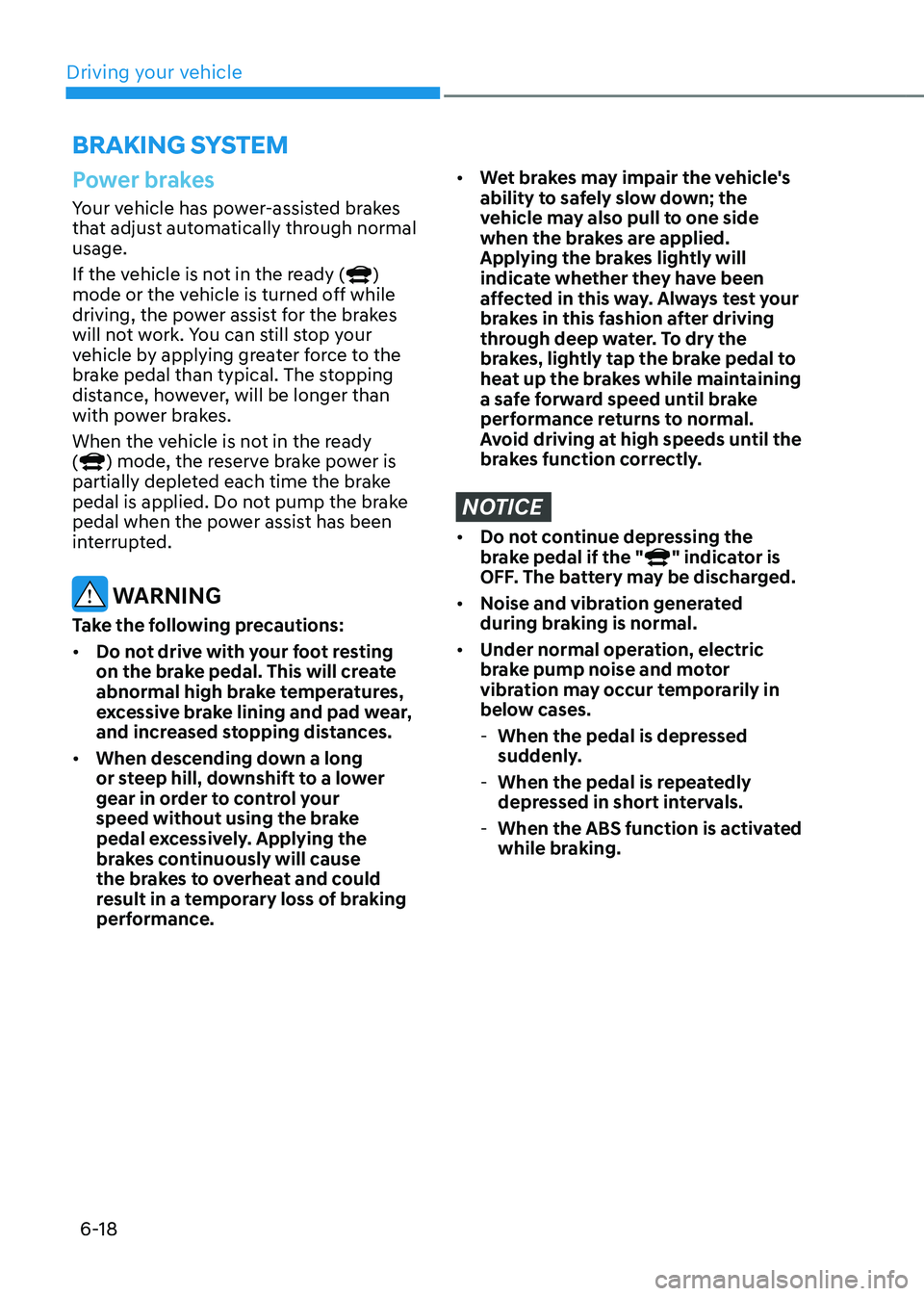
Power brakes
Your vehicle has power-assisted brakes
that adjust automatically through normal
usage.
If the vehicle is not in the ready (
)
mode or the vehicle is turned off while
driving, the power assist for the brakes
will not work. You can still stop your
vehicle by applying greater force to the
brake pedal than typical. The stopping
distance, however, will be longer than
with power brakes.
When the vehicle is not in the ready
(
) mode, the reserve brake power is
partially depleted each time the brake
pedal is applied. Do not pump the brake
pedal when the power assist has been
interrupted.
WARNING
Take the following precautions:
• Do not drive with your foot resting
on the brake pedal. This will create
abnormal high brake temperatures,
excessive brake lining and pad wear,
and increased stopping distances.
• When descending down a long
or steep hill, downshift to a lower
gear in order to control your
speed without using the brake
pedal excessively. Applying the
brakes continuously will cause
the brakes to overheat and could
result in a temporary loss of braking
performance.
• Wet brakes may impair the vehicle's
ability to safely slow down; the
vehicle may also pull to one side
when the brakes are applied.
Applying the brakes lightly will
indicate whether they have been
affected in this way. Always test your
brakes in this fashion after driving
through deep water. To dry the
brakes, lightly tap the brake pedal to
heat up the brakes while maintaining
a safe forward speed until brake
performance returns to normal.
Avoid driving at high speeds until the
brakes function correctly.
NOTICE
• Do not continue depressing the
brake pedal if the "" indicator is OFF. The battery may be discharged.
• Noise and vibration generated
during braking is normal.
• Under normal operation, electric
brake pump noise and motor
vibration may occur temporarily in
below cases.
-When the pedal is depressed
suddenly.
-When the pedal is repeatedly
depressed in short intervals.
-When the ABS function is activated
while braking.
BRAKING SYSTEM
Page 338 of 598
Driving your vehicle
6-54
Chain Installation
When installing tire chains, follow the
manufacturer’s instructions and mount
them as tightly possible. Drive slowly
(less than 20 mph (30 km/h)) with
chains installed. If you hear the chains
contacting the body or chassis, stop and
tighten them. If they still make contact,
slow down until the noise stops. Remove
the tire chains as soon as you begin
driving on cleared roads.
When mounting snow chains, park the
vehicle on level ground away from traffic.
Turn on the vehicle Hazard Warning
Flasher and place a triangular emergency
warning device behind the vehicle (if
available). Always place the vehicle in P
(Park), apply the parking brake and turn
off the engine before installing snow
chains.
NOTICE
When using tire chains:
• Wrong size chains or improperly
installed chains can damage your
vehicle’s brake lines, suspension,
body and wheels.
• Use SAE “S” class or wire chains.
• If you hear noise caused by chains
contacting the body, retighten the
chain to prevent contact with the
vehicle body.
• To prevent body damage, retighten
the chains after driving 0.3~0.6 miles
(0.5~1.0 km).
• Do not use tire chains on vehicles
equipped with aluminum wheels. If
unavoidable, use a wire type chain.
• Use wire chains less than 0.47 in.
(12 mm) thick or fabric-type chain
to prevent damage to the chain’s
connection.
• Fabric-type chains must be used on
vehicles equipped with 19/20” tires.
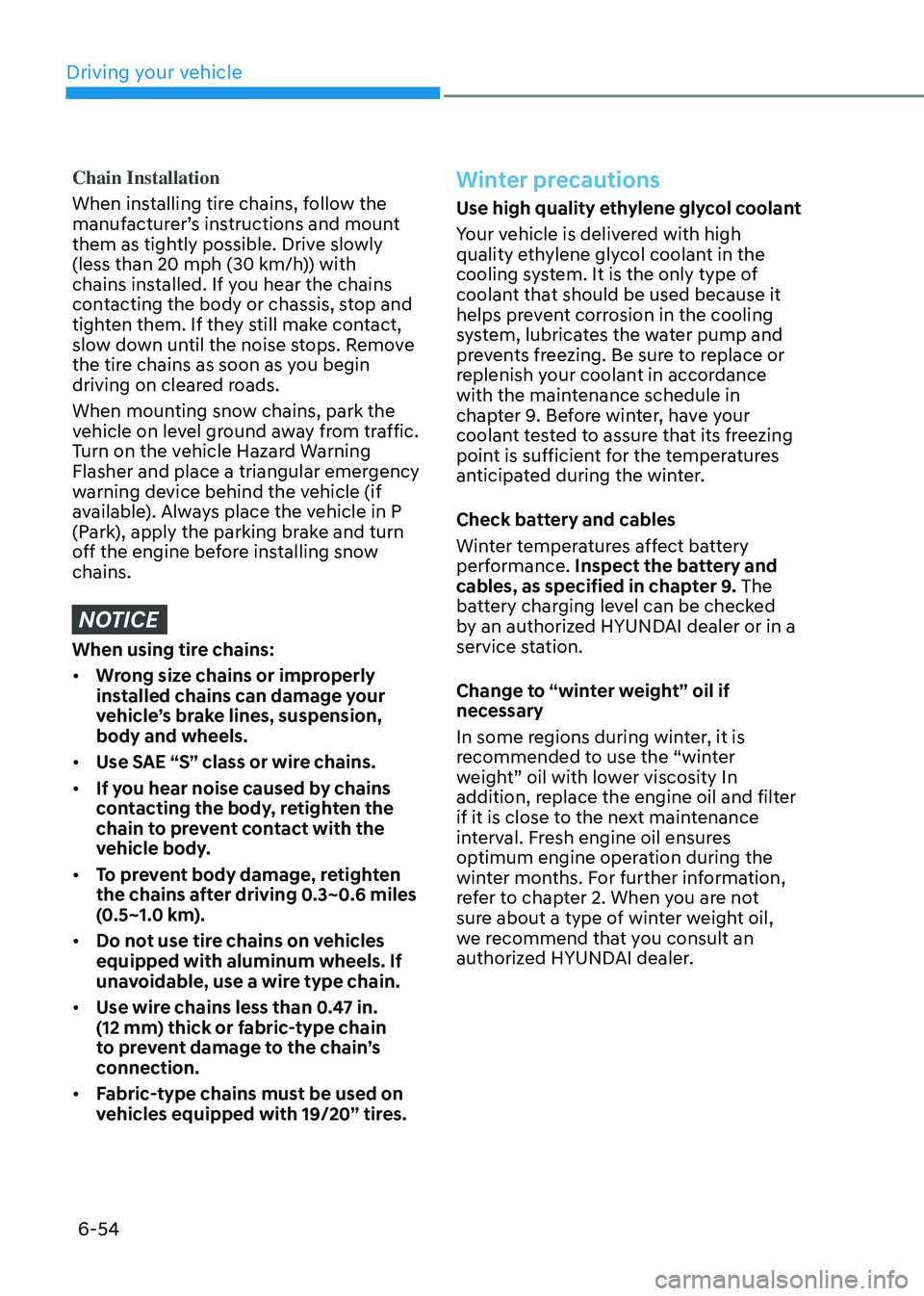
Winter precautions
Use high quality ethylene glycol coolant
Your vehicle is delivered with high
quality ethylene glycol coolant in the
cooling system. It is the only type of
coolant that should be used because it
helps prevent corrosion in the cooling
system, lubricates the water pump and
prevents freezing. Be sure to replace or
replenish your coolant in accordance
with the maintenance schedule in
chapter 9. Before winter, have your
coolant tested to assure that its freezing
point is sufficient for the temperatures
anticipated during the winter.
Check battery and cables
Winter temperatures affect battery
performance. Inspect the battery and
cables, as specified in chapter 9. The
battery charging level can be checked
by an authorized HYUNDAI dealer or in a
service station.
Change to “winter weight” oil if
necessary
In some regions during winter, it is
recommended to use the “winter
weight” oil with lower viscosity In
addition, replace the engine oil and filter
if it is close to the next maintenance
interval. Fresh engine oil ensures
optimum engine operation during the
winter months. For further information,
refer to chapter 2. When you are not
sure about a type of winter weight oil,
we recommend that you consult an
authorized HYUNDAI dealer.
Page 497 of 598
08
8 -7
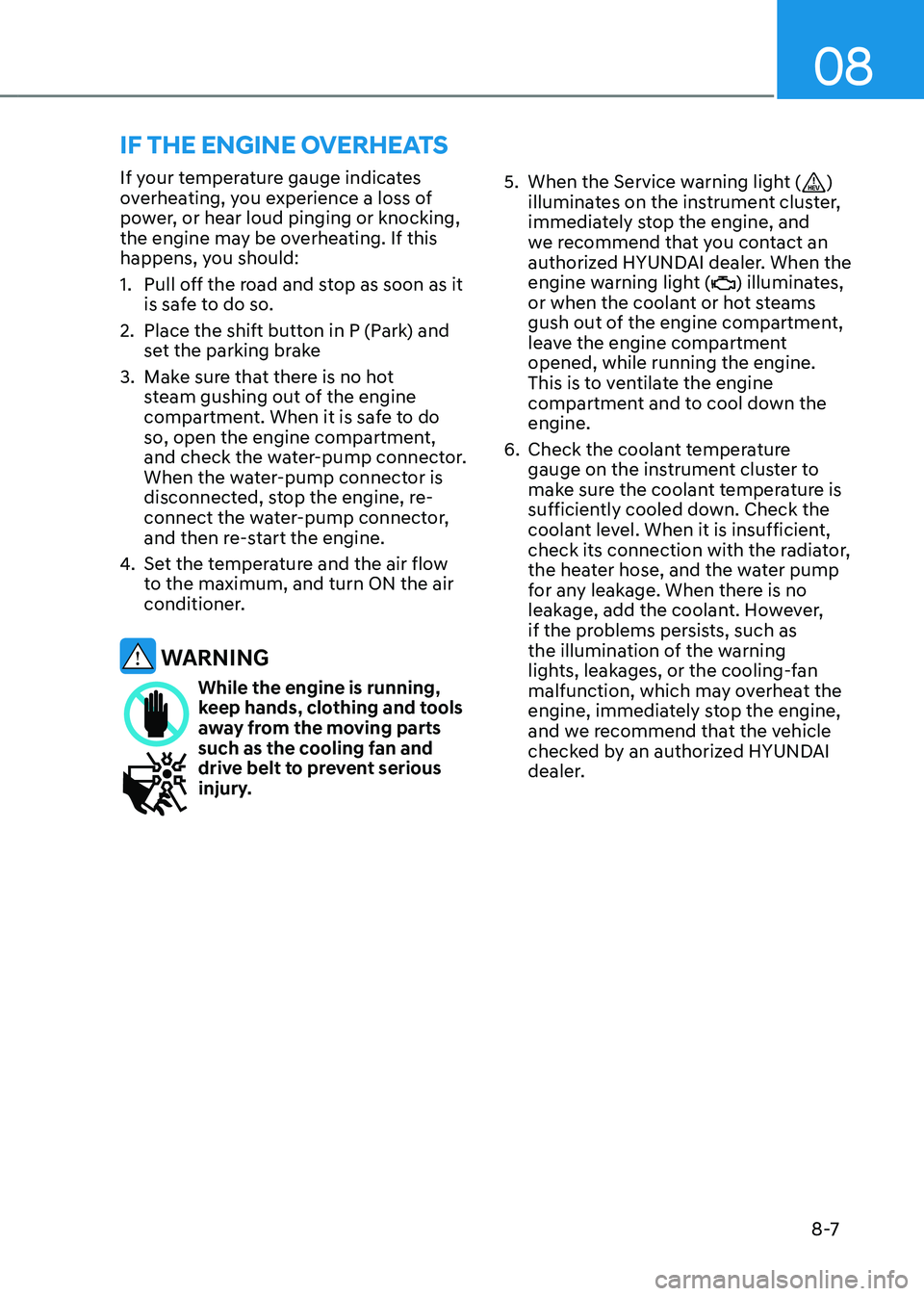
If your temperature gauge indicates
overheating, you experience a loss of
power, or hear loud pinging or knocking,
the engine may be overheating. If this
happens, you should:
1. Pull off the road and stop as soon as it
is safe to do so.
2. Place the shift button in P (Park) and
set the parking brake
3. Make sure that there is no hot
steam gushing out of the engine
compartment. When it is safe to do
so, open the engine compartment,
and check the water-pump connector.
When the water-pump connector is
disconnected, stop the engine, re-
connect the water-pump connector,
and then re-start the engine.
4. Set the temperature and the air flow
to the maximum, and turn ON the air
conditioner.
WARNING
While the engine is running, keep hands, clothing and tools
away from the moving parts
such as the cooling fan and
drive belt to prevent serious
injury.
5. When the Service warning light ()
illuminates on the instrument cluster,
immediately stop the engine, and
we recommend that you contact an
authorized HYUNDAI dealer. When the
engine warning light (
) illuminates,
or when the coolant or hot steams
gush out of the engine compartment,
leave the engine compartment
opened, while running the engine.
This is to ventilate the engine
compartment and to cool down the
engine.
6. Check the coolant temperature
gauge on the instrument cluster to
make sure the coolant temperature is
sufficiently cooled down. Check the
coolant level. When it is insufficient,
check its connection with the radiator,
the heater hose, and the water pump
for any leakage. When there is no
leakage, add the coolant. However,
if the problems persists, such as
the illumination of the warning
lights, leakages, or the cooling-fan
malfunction, which may overheat the
engine, immediately stop the engine,
and we recommend that the vehicle
checked by an authorized HYUNDAI
dealer.
IF THE ENGINE OVERHEATS
Page 564 of 598
09
9-49
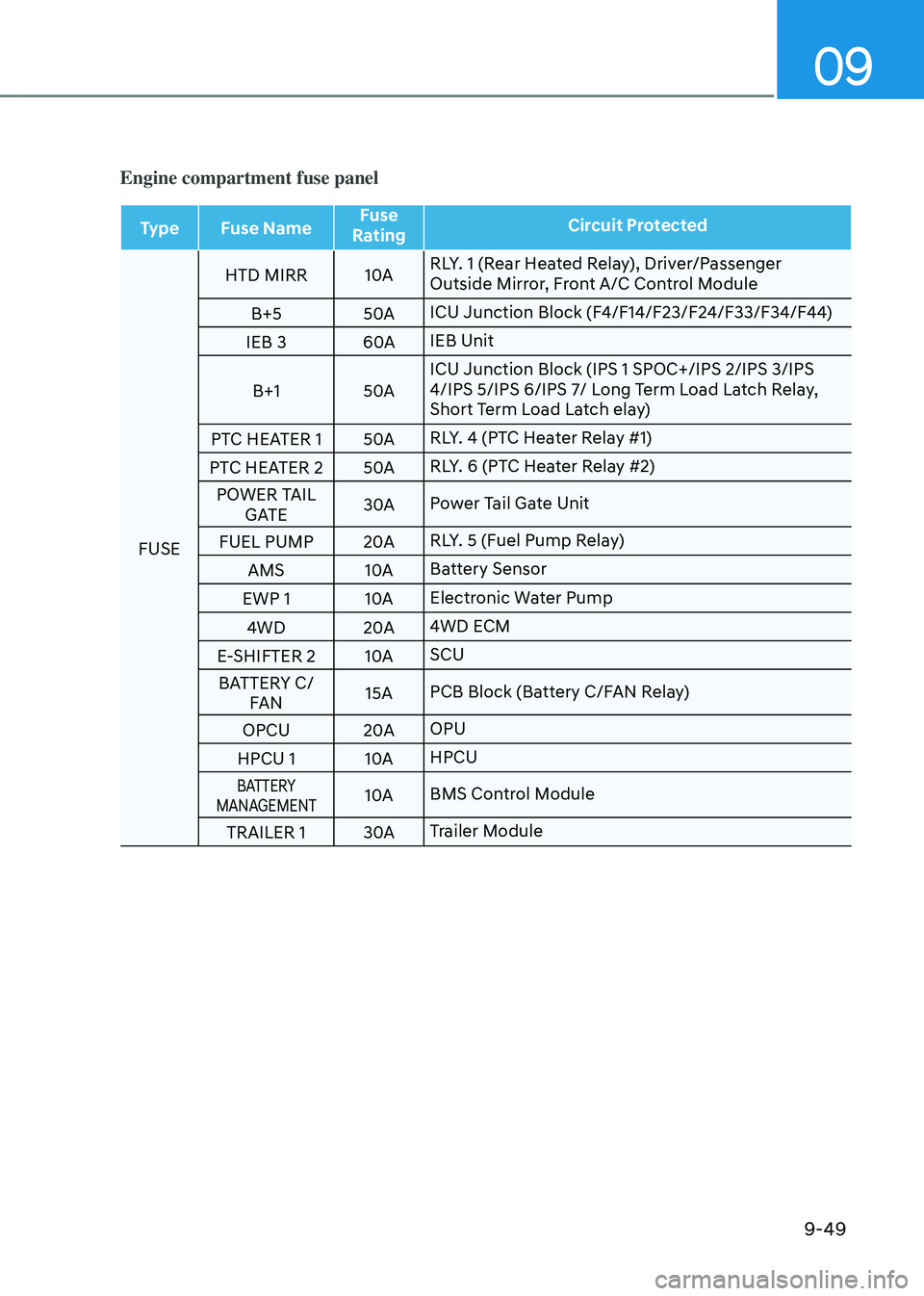
Engine compartment fuse panel
TypeFuse Name Fuse
Rating Circuit Protected
FUSE HTD MIRR
10ARLY. 1 (Rear Heated Relay), Driver/Passenger
Outside Mirror, Front A/C Control Module
B+5 50AICU Junction Block (F4/F14/F23/F24/F33/F34/F44)
IEB 3 60AIEB Unit
B+1 50AICU Junction Block (IPS 1 SPOC+/IPS 2/IPS 3/IPS
4/IPS 5/IPS 6/IPS 7/ Long Term Load Latch Relay,
Short Term Load Latch elay)
PTC HEATER 1 50ARLY. 4 (PTC Heater Relay #1)
PTC HEATER 2 50ARLY. 6 (PTC Heater Relay #2)
POWER TAIL GATE 30A
Power Tail Gate Unit
FUEL PUMP 20ARLY. 5 (Fuel Pump Relay)
AMS 10ABattery Sensor
EWP 1 10AElectronic Water Pump
4WD 20A4WD ECM
E-SHIFTER 2 10ASCU
BATTERY C/ FAN 15A
PCB Block (Battery C/FAN Relay)
OPCU 20AOPU
HPCU 1 10AHPCU
BATTERY
MANAGEMENT10A BMS Control Module
TRAILER 1 30ATrailer Module
Page 565 of 598
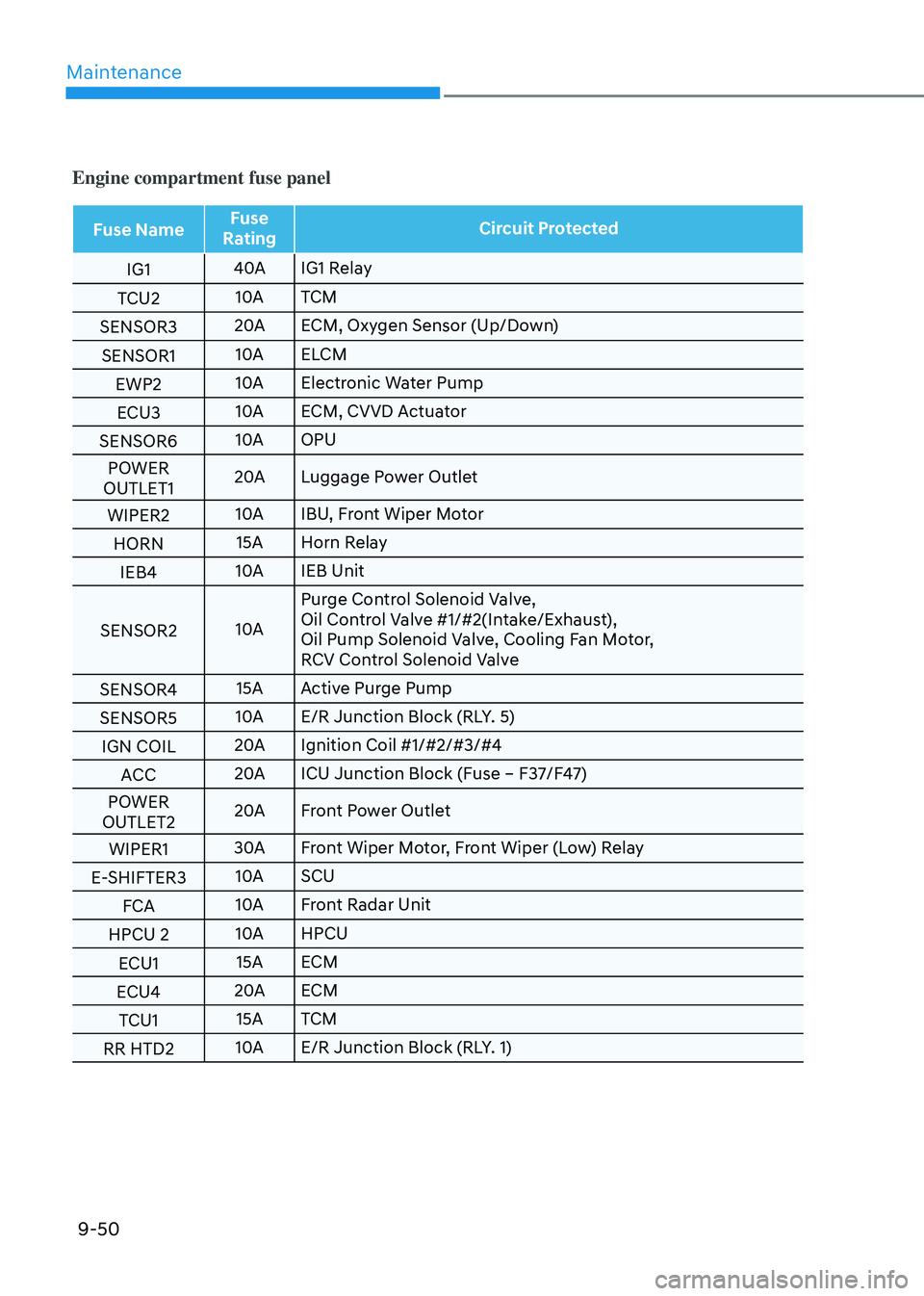
Maintenance
9-50
Engine compartment fuse panel
Fuse NameFuse
Rating Circuit Protected
IG1 40A
IG1 Relay
TCU2 10A
TCM
SENSOR3 20A
ECM, Oxygen Sensor (Up/Down)
SENSOR1 10A
ELCM
EWP2 10A
Electronic Water Pump
ECU3 10A
ECM, CVVD Actuator
SENSOR6 10A
OPU
POWER
OUTLET1 20A
Luggage Power Outlet
WIPER2 10A
IBU, Front Wiper Motor
HORN 15A
Horn Relay
IEB4 10A
IEB Unit
SENSOR2 10APurge Control Solenoid Valve,
Oil Control Valve #1/#2(Intake/Exhaust),
Oil Pump Solenoid Valve, Cooling Fan Motor,
RCV Control Solenoid Valve
SENSOR4 15A
Active Purge Pump
SENSOR5 10A
E/R Junction Block (RLY. 5)
IGN COIL 20A
Ignition Coil #1/#2/#3/#4
ACC 20A
ICU Junction Block (Fuse – F37/F47)
POWER
OUTLET2 20A
Front Power Outlet
WIPER1 30A
Front Wiper Motor, Front Wiper (Low) Relay
E-SHIFTER3 10A
SCU
FCA 10A
Front Radar Unit
HPCU 2 10A
HPCU
ECU1 15A
ECM
ECU4 20A
ECM
TCU1 15A
TCM
RR HTD2 10A
E/R Junction Block (RLY. 1)