2021 HYUNDAI SANTA FE HYBRID engine overheat
[x] Cancel search: engine overheatPage 498 of 598
Emergency situations
8-8
WARNING
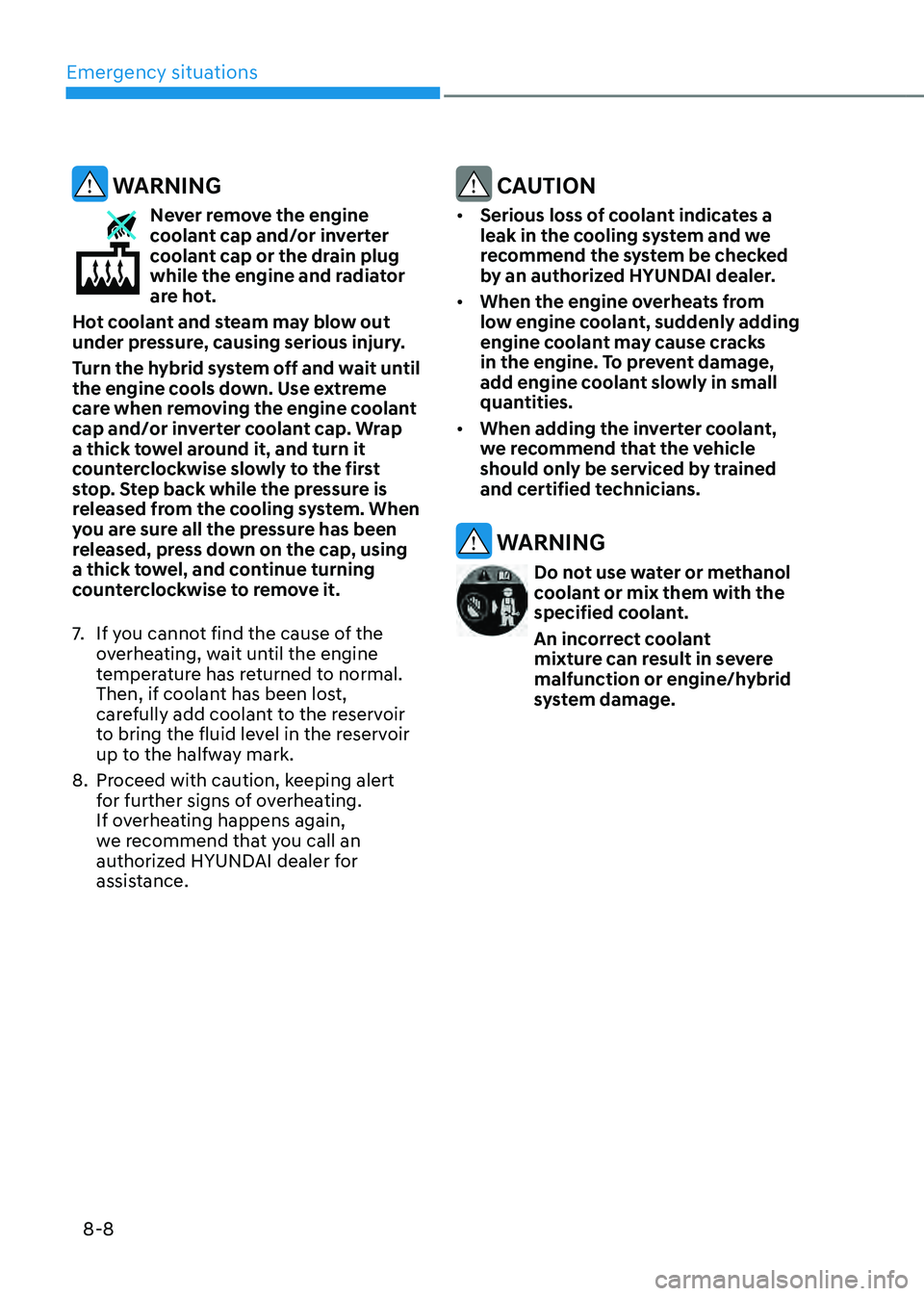
Never remove the engine coolant cap and/or inverter
coolant cap or the drain plug
while the engine and radiator
are hot.
Hot coolant and steam may blow out
under pressure, causing serious injury.
Turn the hybrid system off and wait until
the engine cools down. Use extreme
care when removing the engine coolant
cap and/or inverter coolant cap. Wrap
a thick towel around it, and turn it
counterclockwise slowly to the first
stop. Step back while the pressure is
released from the cooling system. When
you are sure all the pressure has been
released, press down on the cap, using
a thick towel, and continue turning
counterclockwise to remove it.
7. If you cannot find the cause of the
overheating, wait until the engine
temperature has returned to normal.
Then, if coolant has been lost,
carefully add coolant to the reservoir
to bring the fluid level in the reservoir
up to the halfway mark.
8. Proceed with caution, keeping alert
for further signs of overheating.
If overheating happens again,
we recommend that you call an
authorized HYUNDAI dealer for
assistance.
CAUTION
• Serious loss of coolant indicates a
leak in the cooling system and we
recommend the system be checked
by an authorized HYUNDAI dealer.
• When the engine overheats from
low engine coolant, suddenly adding
engine coolant may cause cracks
in the engine. To prevent damage,
add engine coolant slowly in small
quantities.
• When adding the inverter coolant,
we recommend that the vehicle
should only be serviced by trained
and certified technicians.
WARNING
Do not use water or methanol coolant or mix them with the
specified coolant.
An incorrect coolant
mixture can result in severe
malfunction or engine/hybrid
system damage.
Page 500 of 598
Emergency situations
8-10
Tire pressure monitoring system
WARNING
Over-inflation or under-inflation can
reduce tire life, adversely affect vehicle
handling, and lead to sudden tire failure
that may cause loss of vehicle control
resulting in an accident.
Each tire, including the spare (if
provided), should be checked monthly
when cold and inflated to the inflation
pressure recommended by the vehicle
manufacturer on the vehicle placard
or tire inflation pressure label. (If your
vehicle has tires of a different size than
the size indicated on the vehicle placard
or tire inflation pressure label, you should
determine the proper tire inflation
pressure for those tires.)
As an added safety feature, your
vehicle has been equipped with a tire
pressure monitoring system (TPMS)
that illuminates a low tire pressure
telltale when one or more of your tires is
significantly under-inflated. Accordingly,
when the low tire pressure telltale
illuminates, you should stop and check
your tires as soon as possible, and inflate
them to the proper pressure. Driving on
a significantly under-inflated tire causes
the tire to overheat and can lead to tire
failure.
Under-inflation also reduces fuel
efficiency and tire tread life, and may
affect the vehicle’s handling and
stopping ability.
Please note that the TPMS is not a
substitute for proper tire maintenance,
and it is the driver’s responsibility to
maintain correct tire pressure, even if
under-inflation has not reached the level
to trigger illumination of the TPMS low
tire pressure telltale.
Your vehicle has also been equipped with
a TPMS malfunction indicator to indicate
when the system is not operating
properly. The TPMS malfunction
indicator is combined with the low
tire pressure telltale. When the system
detects a malfunction, the telltale will
flash for approximately one minute and
then remain continuously illuminated.
This sequence will continue upon
subsequent vehicle start-ups as long as
the malfunction exists.
When the malfunction indicator is
illuminated, the system may not be able
to detect or signal low tire pressure as
intended. TPMS malfunctions may occur
for a variety of reasons, including the
installation of replacement or alternate
tires or wheels on the vehicle that
prevent the TPMS from functioning
properly.
Always check the TPMS malfunction
telltale after replacing one or more tires
or wheels on your vehicle to ensure that
the replacement or alternate tires and
wheels allow the TPMS to continue to
function properly.
NOTICE
If any of the below happens, we
recommend that you have the system
checked by an authorized HYUNDAI
dealer.
1. The Low Tire Pressure Telltale/TPMS
Malfunction Indicator does not
illuminate for 3 seconds when the
Engine Start/Stop button is pressed
to the ON position or when the
engine is running.
2. The TPMS Malfunction Indicator
remains illuminated after blinking for
approximately 1 minute.
3. The Low Tire Pressure Position
Telltale remains illuminated.
Page 533 of 598
Maintenance
9-18
Turn the vehicle off and wait until the
engine cools down. Use extreme care
when removing the engine coolant
cap and/or inverter coolant cap. Wrap
a thick towel around it, and turn it
counterclockwise slowly to the first
stop. Step back while the pressure is
released from the cooling system. When
you are sure all the pressure has been
released, press down on the cap, using
a thick towel, and continue turning
counterclockwise to remove it.
Information
The engine coolant and/or inverter coolant
level is influenced by the hybrid system
temperature. Before checking or refilling
the engine coolant and/or inverter coolant,
turn the hybrid vehicle off.
WARNING
The electric motor for the cooling fan may continue to operate or start up
when the engine is not running and
can cause serious injury. Keep hands,
clothing and tools away from the
rotating fan blades of the cooling fan.
Always turn off the vehicle unless the
vehicle has to be inspected with the
engine on. Be cautious as the cooling
fan may operate if the negative (-)
battery terminal is not disconnected.
WARNING
Make sure the coolant cap is properly
closed after refilling coolant. Otherwise
the engine could be overheated while
driving.
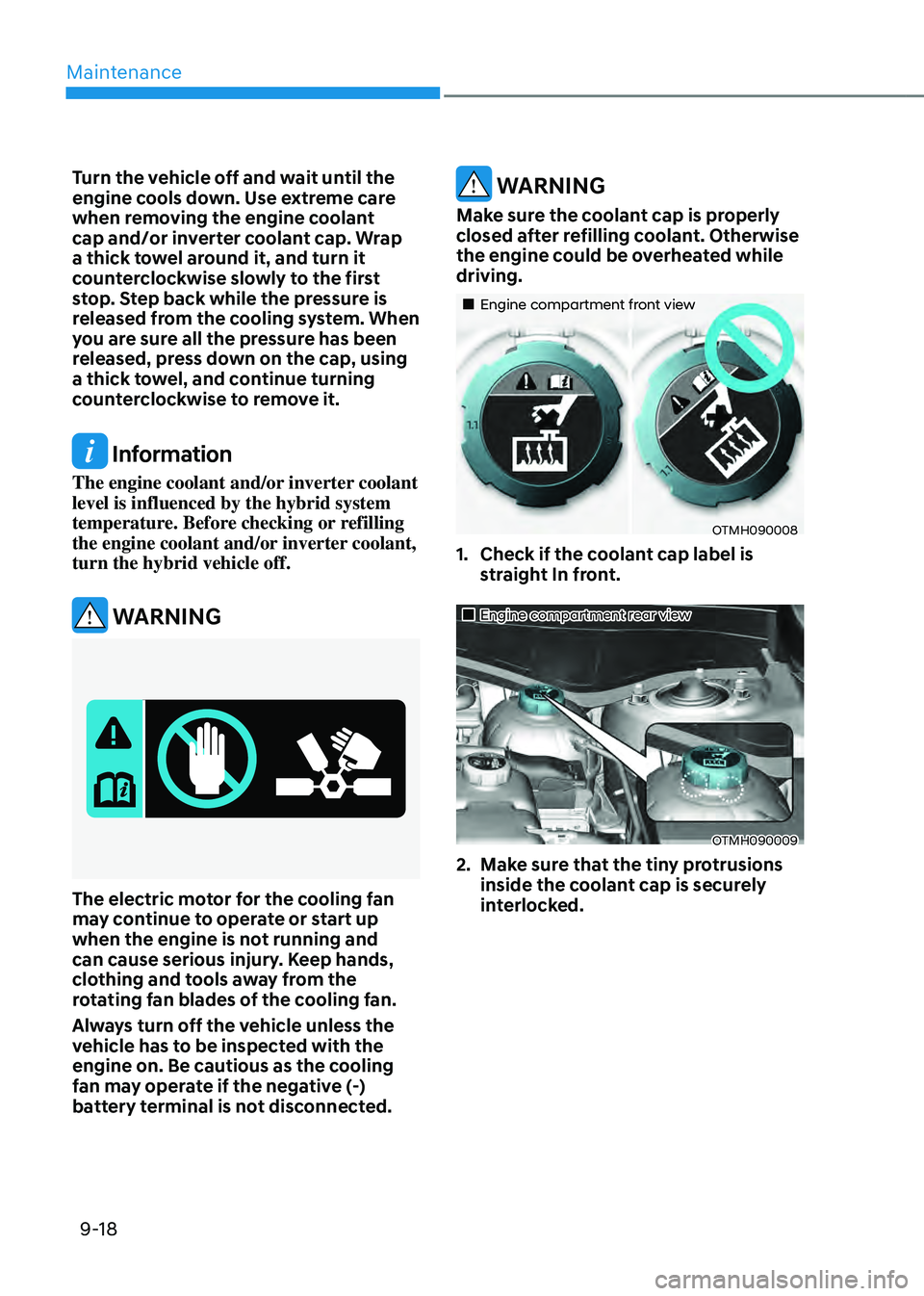
„„Engine compartment front view
OTMH090008
1. Check if the coolant cap label is
straight In front.
„„Engine compartment rear view
OTMH090009
2. Make sure that the tiny protrusions
inside the coolant cap is securely
interlocked.
Page 535 of 598
Maintenance
9-20
Checking the Hybrid Starter &
Generator (HSG) belt
We recommend that you have the
Hybrid Starter & Generator (HSG) belt
inspected or replaced according to the
Maintenance Schedule in this chapter by
an authorized HYUNDAI dealer.
CAUTION
When the HSG belt is worn out or
damaged, replace the belt.
Otherwise, it may cause engine
overheating or battery discharge.
WARNING
• Turn the vehicle off while you inspect
the engine or Hybrid Starter &
Generator (HSG) belt. Otherwise it
may result in serious injury.
• Keep hands, clothing etc. away from
the Hybrid Starter & Generator (HSG)
belt.
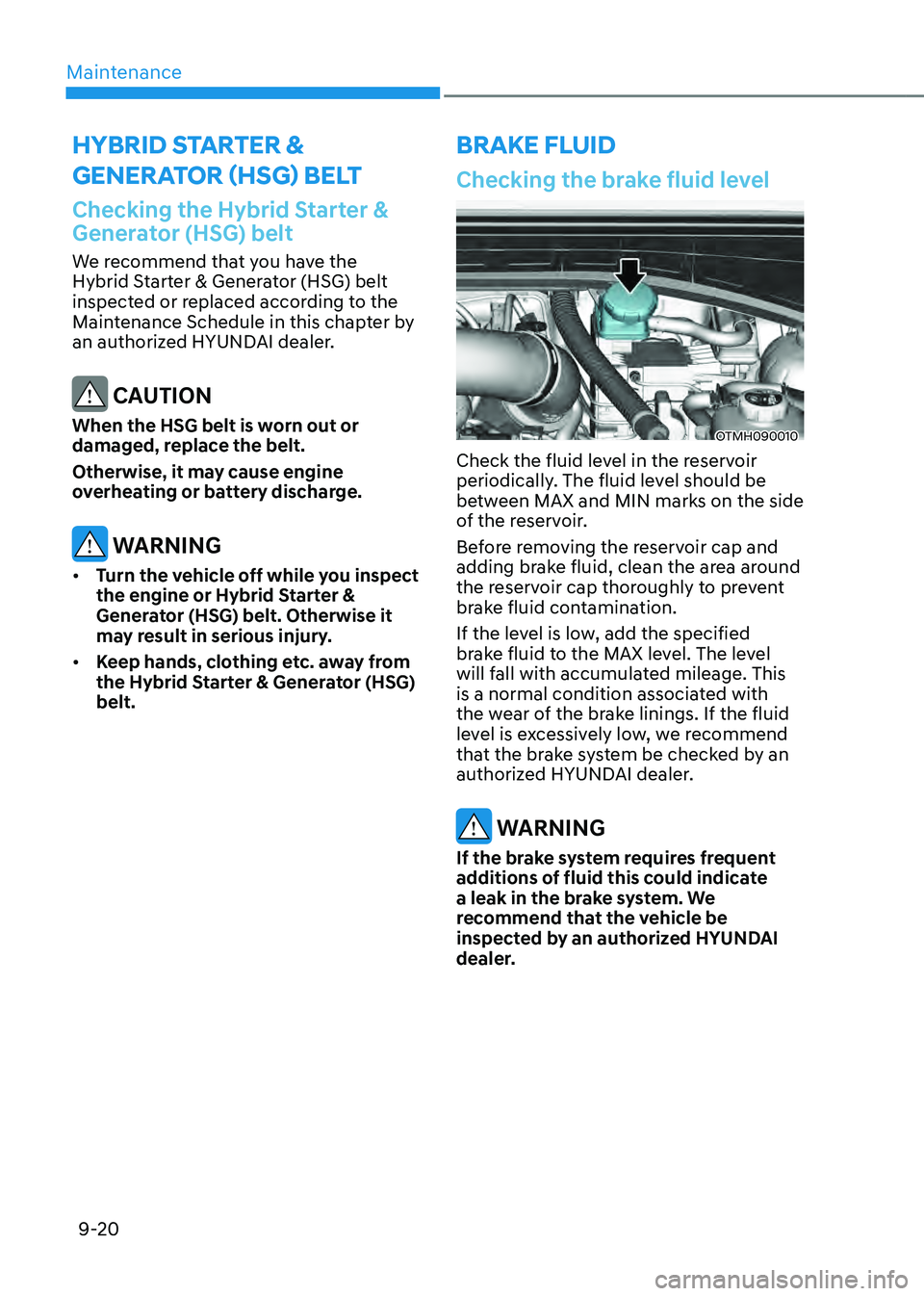
Checking the brake fluid level
OTMH090010
Check the fluid level in the reservoir
periodically. The fluid level should be
between MAX and MIN marks on the side
of the reservoir.
Before removing the reservoir cap and
adding brake fluid, clean the area around
the reservoir cap thoroughly to prevent
brake fluid contamination.
If the level is low, add the specified
brake fluid to the MAX level. The level
will fall with accumulated mileage. This
is a normal condition associated with
the wear of the brake linings. If the fluid
level is excessively low, we recommend
that the brake system be checked by an
authorized HYUNDAI dealer.
WARNING
If the brake system requires frequent
additions of fluid this could indicate
a leak in the brake system. We
recommend that the vehicle be
inspected by an authorized HYUNDAI
dealer.
HYBRID STARTER &
GENERATOR (HSG) BELT BRAKE FLUID
Page 591 of 598
 ........................................................................\
.............6-37
Emergency precautions ...................................................")
Index
I-6
Four wheel drive (4WD) ........................................................................\
.............6-37
Emergency precautions ........................................................................\
............6-42
Four Wheel Drive (4WD) operation ................................................................6-38
Reducing the risk of a rollover ........................................................................\
.6-44
Fuses
........................................................................\
............................................9-40
Engine compartment panel fuse replacement ...................................................9-42
Fuse/relay panel description ........................................................................\
.....9-43
Instrument panel fuse replacement ...................................................................9-41
H
Hazard warning flasher
........................................................................\
..................8-2
Head-Up Display (HUD)
........................................................................\
............5-76
Head-up display information ........................................................................\
....5-76
Head-up display settings ........................................................................\
..........5-76
Precautions while using the head-up display ...................................................5-77
High Beam Assist (HBA)
........................................................................\
...........5-82
System malfunction and limitations .................................................................5-83
System operation ........................................................................\
......................5-83
System settings ........................................................................\
.........................5-82
Highway Driving Assist (HDA)
........................................................................\
.7-81
System malfunction and limitations .................................................................7-85
System operation ........................................................................\
......................7-83
System settings ........................................................................\
.........................7-82
Hybrid Starter & Generator (HSG) belt ............................................................... 9-20
Checking the Hybrid Starter & Generator (HSG) belt .....................................9-20
I
If the engine overheats
........................................................................\
...................8-7
If the engine will not start
........................................................................\
..............8-3
If you have a flat tire (with spare tire)
.................................................................8-14
Changing tires ........................................................................\
..........................8-16
Jack and tools ........................................................................\
...........................8-14
Jack label ........................................................................\
..................................8-20
Removing and storing the spare tire .................................................................8-14
Ignition switch
........................................................................\
...............................6-5
Engine Start/Stop button ........................................................................\
............6-5
Remote start ........................................................................\
................................6-9