2021 HYUNDAI KONA EV Cold
[x] Cancel search: ColdPage 417 of 478
7-35
7
Maintenance
Maximum Inflation Pressure
The maximum air pressure to which
a cold tire may be inflated. The max-
imum air pressure is molded onto the
sidewall.
Maximum Load Rating
The load rating for a tire at the maxi-
mum permissible inflation pressure
for that tire.
Maximum Loaded Vehicle
Weight
The sum of curb weight; accessory
weight; vehicle capacity weight; and
production options weight.
Normal Occupant Weight
The number of occupants a vehicle
is designed to seat multiplied by 150
pounds (68 kg).
Occupant Distribution
Designated seating positions.
Outward Facing Sidewall
An asymmetrical tire has a particular
side that faces outward when mount-
ed on a vehicle. The outward facing
sidewall bears white lettering or
bears manufacturer, brand, and/or
model name molding that is higher or
deeper than the same moldings on
the inner facing sidewall.
Passenger (P-Metric) tire
A tire used on passenger cars and
some light duty trucks and multipur-
pose vehicles.
Ply
A layer of rubber-coated parallel
cords.
Pneumatic tire
A mechanical device made of rubber,
chemicals, fabric and steel or other
materials, that, when mounted on an
automotive wheel provides the trac-
tion and contains the gas or fluid that
sustains the load.
Pneumatic options weight
The combined weight of installed
regular production options weighing
over 5 lb. (2.3 kg) in excess of the
standard items which they replace,
not previously considered in curb
weight or accessory weight, includ-
ing heavy duty breaks, ride levelers,
roof rack, heavy duty battery, and
special trim.
Recommended Inflation
Pressure
Vehicle manufacturer's recommend-
ed tire inflation pressure as shown
on the tire placard.
Page 445 of 478
7-63
7
Maintenance
A AP
PP
PE
EA
AR
RA
AN
NC
CE
E
C
CA
AR
RE
E
Exterior Care
Exterior general caution
It is very important to follow the label
directions when using any chemical
cleaner or polish. Read all warning
and caution statements that appear
on the label.
High-pressure washing
When using high-pressure wash-
ers, make sure to maintain suffi-
cient distance from the vehicle.
Insufficient clearance or excessive
pressure can lead to component
damage or water penetration.
Do not spray the camera, sensors
or its surrounding area directly with
a high pressure washer. Shock
applied from high pressure water
may cause the device to not oper-
ate normally.
Do not bring the nozzle tip close to
boots (rubber or plastic covers)or
connectors as they may be dam-
aged if they come into contact with
high pressure water.
Do not use any high-pressure noz-
zles, which induce either one-
direct water stream or water
swirling.
Protecting your vehicle’s finish
Washing
To help protect your vehicle’s finish
from rust and deterioration, wash it
thoroughly and frequently at least
once a month with lukewarm or cold
water.
If you use your vehicle for off-road
driving, you should wash it after each
off-road trip. Pay special attention to
the removal of any accumulation of
salt, dirt, mud, and other foreign
materials. Make sure the drain holes
in the lower edges of the doors and
rocker panels are kept clear and
clean.
Insects, tar, tree sap, bird droppings,
industrial pollution and similar
deposits can damage your vehicle’s
finish if not removed immediately.
Even prompt washing with plain
water may not completely remove all
these deposits. A mild soap, safe for
use on painted surfaces, should be
used.
Page 446 of 478
7-64
Maintenance
After washing, rinse the vehicle thor-
oughly with lukewarm or cold water.
Do not allow soap to dry on the fin-
ish. Do not use strong soap, chemi-
cal detergents or hot water, and
do not wash the vehicle in direct
sunlight or when the body of the
vehicle is warm.
Be careful when washing the
side windows of your vehicle.
Especially, with high-pressure
water, water may leak through
the windows and wet the interi-
or.
To prevent damage to the plastic
parts, do not clean with chemi-
cal solvents or strong deter-
gents.
To prevent damage to the charg-
ing door, make sure to close and
lock the vehicle doors when
washing (high-pressure wash-
ing, automatic car washing, etc.)
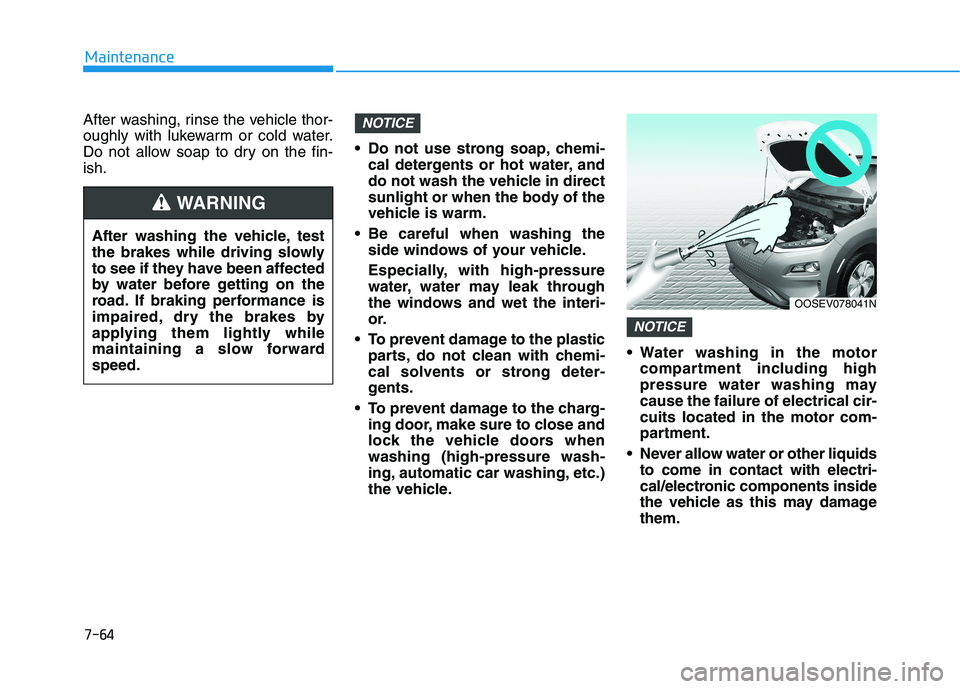
the vehicle. Water washing in the motor
compartment including high
pressure water washing may
cause the failure of electrical cir-
cuits located in the motor com-
partment.
Never allow water or other liquids
to come in contact with electri-
cal/electronic components inside
the vehicle as this may damage
them.
NOTICE
NOTICE
OOSEV078041N
After washing the vehicle, test
the brakes while driving slowly
to see if they have been affected
by water before getting on the
road. If braking performance is
impaired, dry the brakes by
applying them lightly while
maintaining a slow forward
speed.
WARNING
Page 448 of 478
7-66
Maintenance
Repairing your vehicle’s finish
Deep scratches or stone chips in the
painted surface must be repaired
promptly. Exposed metal will quickly
rust and may develop into a major
repair expense.
If your vehicle is damaged and
requires any metal repair or
replacement, be sure the body
shop applies anti-corrosion mate-
rials to the parts repaired or
replaced.
Matte paint finish vehicle
(if equipped)
In case of matte paint finish vehi-
cles, it is impossible to modify
only the damaged area and repair
of the whole part is necessary. If
the vehicle is damaged and paint-
ing is required, we recommend
that you have your vehicle main-
tained and repaired by an author-
ized HYUNDAI dealer. Take
extreme care, as it is difficult to
restore the quality after the repair.
Bright-metal maintenance
To remove road tar and insects,
use a tar remover, not a scraper or
other sharp object.
To protect the surfaces of bright-
metal parts from corrosion, apply a
coating of wax or chrome preser-
vative and rub to a high luster.
During winter weather or in coastal
areas, cover the bright metal parts
with a heavier coating of wax or
preservative. If necessary, coat the
parts with non-corrosive petroleum
jelly or other protective compound.
Underbody maintenance
Corrosive materials used for ice and
snow removal and dust control may
collect on the underbody. If these
materials are not removed, acceler-
ated rusting can occur on underbody
parts such as the fuel lines, frame,
floor pan and exhaust system, even
though they have been treated with
rust protection.Thoroughly flush the vehicle under-
body and wheel openings with luke-
warm or cold water once a month,
after off-road driving and at the end
of each winter. Pay special attention
to these areas because it is difficult
to see all the mud and dirt. It will do
more harm than good to wet down
the road grime without removing it.
The lower edges of doors, rocker
panels, and frame members have
drain holes that should not be
allowed to clog with dirt; trapped
water in these areas can cause rust-
ing.
NOTICE
NOTICE
After washing the vehicle, test
the brakes while driving slowly
to see if they have been affected
by water. If braking performance
is impaired, dry the brakes by
applying them lightly while
maintaining a slow forward
speed.
WARNING
Page 458 of 478
8-4
Specifications, Consumer information and Reporting safety defects
T TI
IR
RE
ES
S
A
AN
ND
D
W
WH
HE
EE
EL
LS
S
When replacing tires, use the same size originally supplied with the vehicle.
Using tires of a different size can damage the related parts or not work properly.
CAUTION
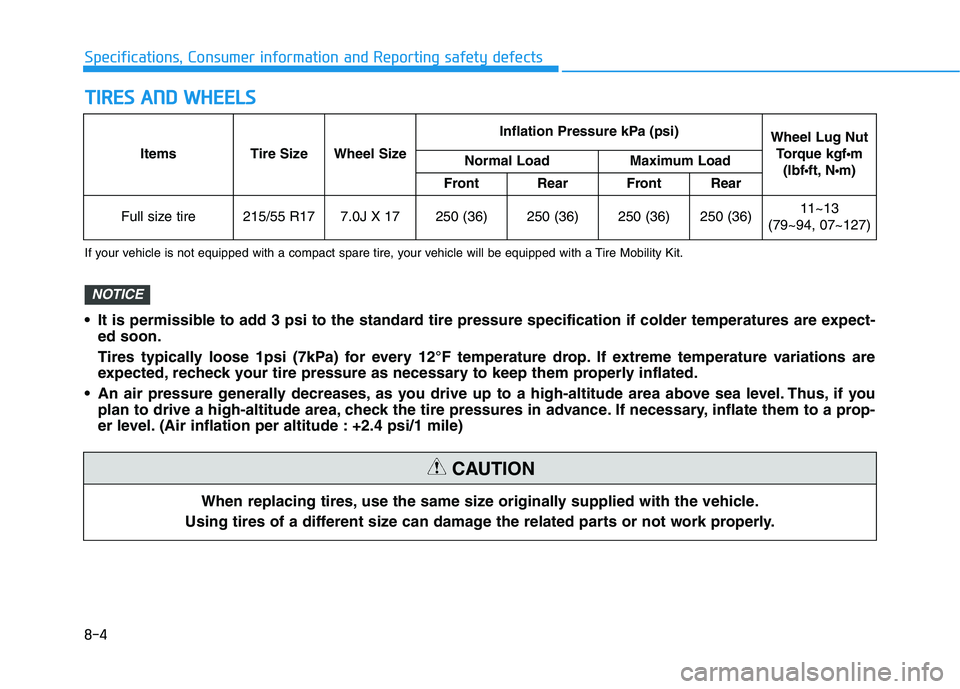
If your vehicle is not equipped with a compact spare tire, your vehicle will be equipped with a Tire Mobility Kit.
Items Tire SizeWheel Size
Inflation Pressure kPa (psi)Wheel Lug Nut
Torque kgf
•m
(lbf
ft, Nm)Normal LoadMaximum Load
FrontRearFrontRear
Full size tire215/55 R177.0J X 17250 (36)250 (36)250 (36)250 (36)11~13
(79~94, 07~127)
It is permissible to add 3 psi to the standard tire pressure specification if colder temperatures are expect-
ed soon.
Tires typically loose 1psi (7kPa) for every 12°F temperature drop. If extreme temperature variations are
expected, recheck your tire pressure as necessary to keep them properly inflated.
An air pressure generally decreases, as you drive up to a high-altitude area above sea level. Thus, if you
plan to drive a high-altitude area, check the tire pressures in advance. If necessary, inflate them to a prop-
er level. (Air inflation per altitude : +2.4 psi/1 mile)
NOTICE
Page 474 of 478
I-10
Range accumulated from Regenerative Braking ............3-51
Rear center seatbelt .........................................................2-29
Rear Cross-Traffic Collision Warning (RCCW) system .5-66
Rear seat adjustment .......................................................2-13
Armrest .......................................................................2-15
Folding the rear seat ...................................................2-13
Rear seat head restraints .................................................2-19
Adjusting the height up and down .............................2-20
Rear view monitor.........................................................3-114
Rear window wiper and washer....................................3-113
Auto rear wiper.........................................................3-113
Recommended cold tire inflation pressures ...................7-25
Recommended lubricants and capacities ..........................8-6
Reducing the risk of a rollover .....................................5-115
Refrigerant label ...............................................................8-8
Regenerative braking level indicator ..............................3-52
Regenerative braking system ..........................................5-19
One pedal driving .......................................................5-20
Removable towing hook .................................................6-21
Replacement light bulb ...................................................7-53
Reporting safety defects .................................................8-10
Reverse parking distance warning (PDW) ...................3-115
Rocking the vehicle.......................................................5-112
Rotation (Tire) ................................................................7-27Safety messages ................................................................F-6
Scheduled maintenance services.......................................7-7
Seat belt warning light
Driver's seat ................................................................2-24
Front passenger's seat ................................................2-25
Seat belts .........................................................................2-23
Additional seat belt safety precautions ......................2-32
Care of seat belts ........................................................2-35
Do not lie down ..........................................................2-32
Height adjustment ......................................................2-27
Keep belts clean and dry ............................................2-35
Lap/shoulder belt ........................................................2-26
One person per belt ....................................................2-32
Periodic inspection .....................................................2-35
Pre-tensioner seat belt ................................................2-29
Rear center seatbelt ....................................................2-29
Seat belt restraint system............................................2-26
Seat belt safety precautions ........................................2-23
Seat belt use and children...........................................2-32
Seat belt use during pregnancy ..................................2-32
Seat belt warning light ...............................................2-24
Transporting an injured person ..................................2-32
When to replace seat belts..........................................2-35
Seat heaters .....................................................................2-20
Index
RS
Page 476 of 478
I-12
Theft-alarm system .........................................................3-15
Tilt steering / Telescopic steering ...................................3-17
Tire chains .....................................................................5-117
Tire Mobility Kit (TMK) ................................................6-14
Tire Pressure Monitoring System (TPMS) .......................6-7
Tire rotation ....................................................................7-27
Tire specification and pressure label ................................8-8
Tires and wheels .............................................................7-24
Checking tire inflation pressure .................................7-26
Recommended cold tire inflation pressures ...............7-25
Tire care ......................................................................7-24
Tire maintenance ........................................................7-29
Tire replacement .........................................................7-28
Tire rotation ................................................................7-27
Tire sidewall labeling .................................................7-29
Tire terminology and definitions ................................7-33
Tire traction ................................................................7-29
Wheel alignment and tire balance ..............................7-28
Wheel replacement .....................................................7-29
Toque gauge ....................................................................3-49
Towing ............................................................................6-20
Emergency towing......................................................6-22
Flat towing ................................................................6-21
Removable towing hook ............................................6-21Trip computer..................................................................3-92
Accumulated Info display ..........................................3-94
Average energy consumption .....................................3-93
Consumption info display ..........................................3-93
Digital speedometer....................................................3-95
Drive Info display ......................................................3-94
Driving style ...............................................................3-95
Energy flow ................................................................3-95
Instant energy consumption .......................................3-93
Turn signals...................................................................3-104
USB charger ..................................................................3-142
User settings mode..........................................................3-82
Vanity mirror lamp........................................................3-109
Vehicle certification label .................................................8-7
Vehicle data collection and event data recorders .............F-8
Vehicle identification number (VIN) ................................8-7
Vehicle load limit ..........................................................5-120
Tire loading informations ........................................5-120
Vehicle modification .........................................................F-7
Vehicle Stability Management (VSM)............................5-45
Index
U
V
T