2021 HYUNDAI ELANTRA HYBRID emergency towing
[x] Cancel search: emergency towingPage 446 of 555

Emergency Situations
Hazard Warning Flasher ........................................................................\
........8-2
In Case of an Emergency While Driving
.......................................................8-2If the Engine Stalls While Driving ........................................................................\
....8-2
If the Engine Stalls at a Crossroad or Crossing ......................................................8-2
If you Have a Flat Tire While Driving .......................................................................8-3
If the Engine Will Not Start ........................................................................\
....8-3
If the 12 Volt Battery Is Discharged
...............................................................8-4Before Jump Starting ........................................................................\
.......................8-4
Jump Starting ........................................................................\
...................................8-5
If the Engine Overheats ........................................................................\
.........8 -7
Tire Pressure Monitoring System (TPMS)
....................................................8-9Check tire pressure ........................................................................\
..........................8-9
Tire pressure monitoring system ........................................................................\
...8-10
Low tire pressure telltale ........................................................................\
................8-11
Low tire pressure position and tire pressure telltale .............................................8-11
TPMS (Tire Pressure Monitoring System) malfunction indicator .........................8-13
Changing a tire with TPMS ........................................................................\
.............8-13
If you Have a Flat Tire (With spare tire) .......................................................8-15Jack and Tools ........................................................................\
.................................8-15
Changing Tires ........................................................................\
.................................8-16
Towing ........................................................................\
...................................8-21Towing Service ........................................................................\
................................8-21
Emergency Towing ........................................................................\
........................8-22
Removable towing hook ........................................................................\
................8-22
Emergency towing ........................................................................\
.........................8-23
8. Emergency Situations
8
Page 461 of 555
Emergency Situations
8-16
Changing Tires
WARNING
A vehicle can slip or roll off of a jack
causing serious injury or death to you or
those nearby. Take the following safety
precautions:
• Never place any portion of your body
under a vehicle that is supported by
a jack.
• NEVER attempt to change a tire in
the lane of traffic. ALWAYS move the
vehicle completely off the road on
level, firm ground away from traffic
before trying to change a tire. If you
cannot find a level, firm place off
the road, call a towing service for
assistance.
• Be sure to use the jack provided with
the vehicle.
• ALWAYS place the jack on the
designated jacking positions on the
vehicle and NEVER on the bumpers
or any other part of the vehicle for
jacking support.
• Do not start or run the engine while
the vehicle is on the jack.
• Do not allow anyone to remain in the
vehicle while it is on the jack.
• Keep children away from the road
and the vehicle. Follow these steps to change your
vehicle’s tire:
1. Park on a level, firm surface.
2. Shift the shift button into P (Park).
3. Press the hazard warning flasher
button.
4. Remove the wheel lug nut wrench,
jack, jack handle, and spare tire from
the vehicle.
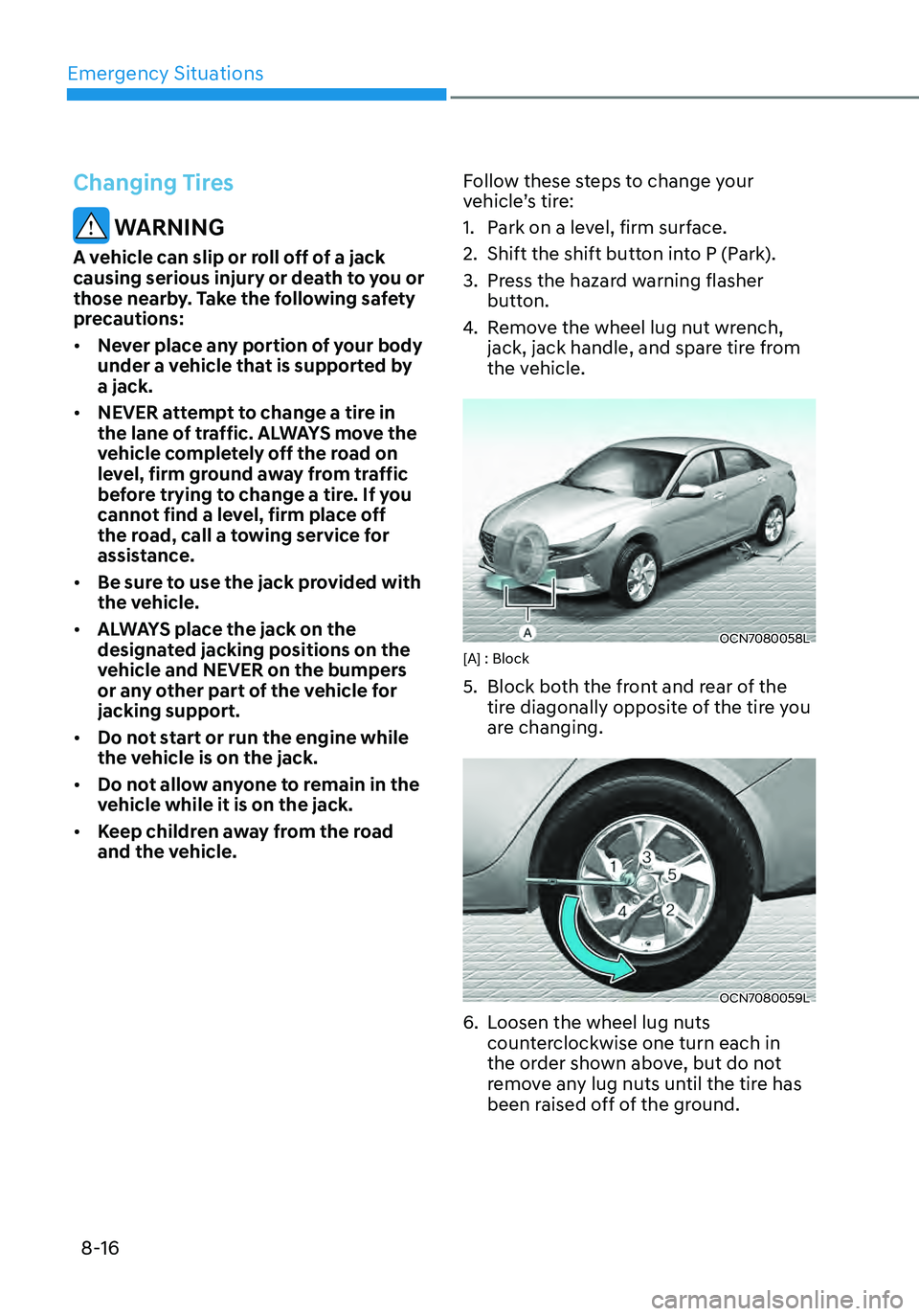
OCN7080058L[A] : Block
5. Block both the front and rear of the
tire diagonally opposite of the tire you
are changing.
OCN7080059L
6. Loosen the wheel lug nuts
counterclockwise one turn each in
the order shown above, but do not
remove any lug nuts until the tire has
been raised off of the ground.
Page 466 of 555
08
8-21
TOWING
Towing Service
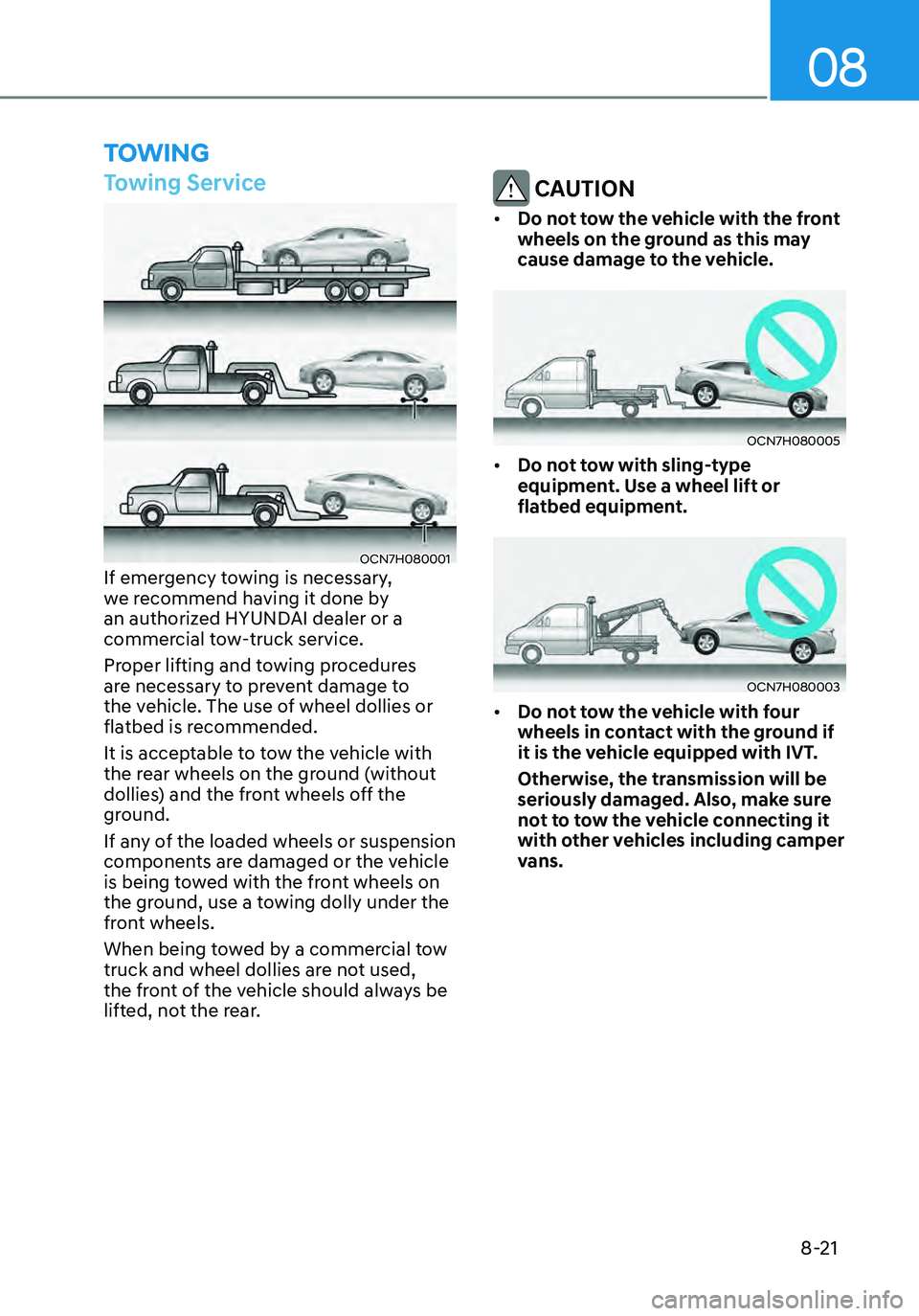
OCN7H080001If emergency towing is necessary,
we recommend having it done by
an authorized HYUNDAI dealer or a
commercial tow-truck service.
Proper lifting and towing procedures
are necessary to prevent damage to
the vehicle. The use of wheel dollies or
flatbed is recommended.
It is acceptable to tow the vehicle with
the rear wheels on the ground (without
dollies) and the front wheels off the
ground.
If any of the loaded wheels or suspension
components are damaged or the vehicle
is being towed with the front wheels on
the ground, use a towing dolly under the
front wheels.
When being towed by a commercial tow
truck and wheel dollies are not used,
the front of the vehicle should always be
lifted, not the rear.
CAUTION
• Do not tow the vehicle with the front
wheels on the ground as this may
cause damage to the vehicle.
OCN7H080005
• Do not tow with sling-type
equipment. Use a wheel lift or
flatbed equipment.
OCN7H080003
• Do not tow the vehicle with four
wheels in contact with the ground if
it is the vehicle equipped with IVT.
Otherwise, the transmission will be
seriously damaged. Also, make sure
not to tow the vehicle connecting it
with other vehicles including camper
vans.
Page 467 of 555

Emergency Situations
8-22
WARNING
If your vehicle is equipped with a
rollover sensor, place the ignition
switch in the LOCK/OFF or ACC position
when the vehicle is being towed.
The side impact and curtain air bag
may deploy if the sensor detects the
situation as a rollover.
OCN7H080004
When towing your vehicle in an
emergency without wheel dollies:
1. Place the ignition switch in the ACC
position.
2. Place the shift button in N (Neutral).
3. Release the parking brake.
CAUTION
Failure to place the shift button in N
(Neutral) when being towed with the
front wheels on the ground can cause
internal damage to the transmission.
Emergency Towing
If towing is necessary, we recommend
you have it done by an authorized
HYUNDAI dealer or a commercial tow
truck service.
Removable towing hook
OCN7H070011
1. Open the trunk, and remove the
towing hook from the tool case.
„„Front
OCN7070014
„„Rear
OCN7H070003
2. Remove the hole cover by pressing
the lower part of the cover on the
bumper.
3. Install the towing hook by turning it
clockwise into the hole until it is fully
secured.
4. Remove the towing hook and install
the cover after use.
Page 468 of 555
08
8-23
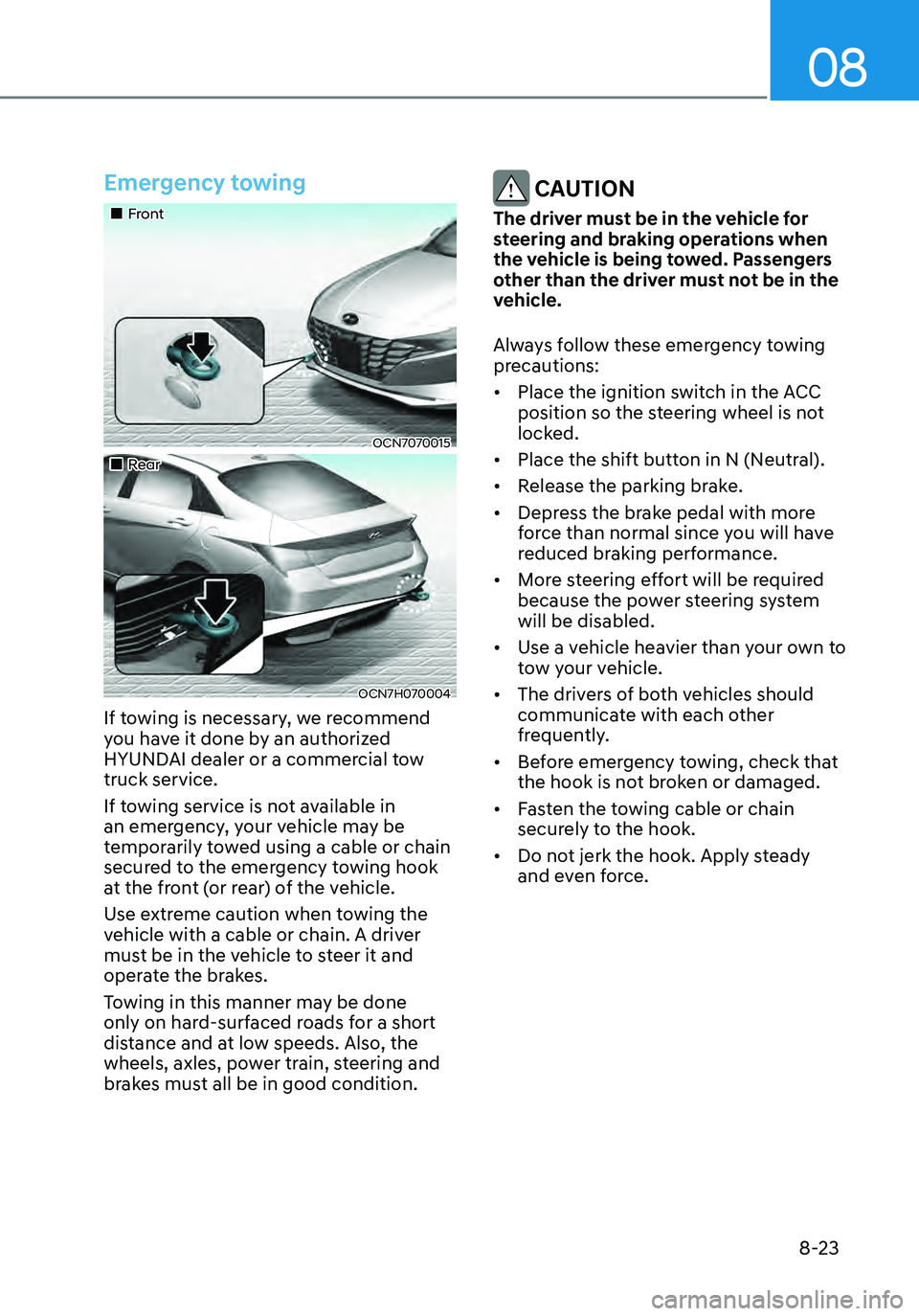
Emergency towing
„„Front
OCN7070015
„„Rear
OCN7H070004
If towing is necessary, we recommend
you have it done by an authorized
HYUNDAI dealer or a commercial tow
truck service.
If towing service is not available in
an emergency, your vehicle may be
temporarily towed using a cable or chain
secured to the emergency towing hook
at the front (or rear) of the vehicle.
Use extreme caution when towing the
vehicle with a cable or chain. A driver
must be in the vehicle to steer it and
operate the brakes.
Towing in this manner may be done
only on hard-surfaced roads for a short
distance and at low speeds. Also, the
wheels, axles, power train, steering and
brakes must all be in good condition.
CAUTION
The driver must be in the vehicle for
steering and braking operations when
the vehicle is being towed. Passengers
other than the driver must not be in the
vehicle.
Always follow these emergency towing
precautions:
• Place the ignition switch in the ACC
position so the steering wheel is not
locked.
• Place the shift button in N (Neutral).
• Release the parking brake.
• Depress the brake pedal with more
force than normal since you will have
reduced braking performance.
• More steering effort will be required
because the power steering system
will be disabled.
• Use a vehicle heavier than your own to
tow your vehicle.
• The drivers of both vehicles should
communicate with each other
frequently.
• Before emergency towing, check that
the hook is not broken or damaged.
• Fasten the towing cable or chain
securely to the hook.
• Do not jerk the hook. Apply steady
and even force.
Page 469 of 555
Emergency Situations
8-24
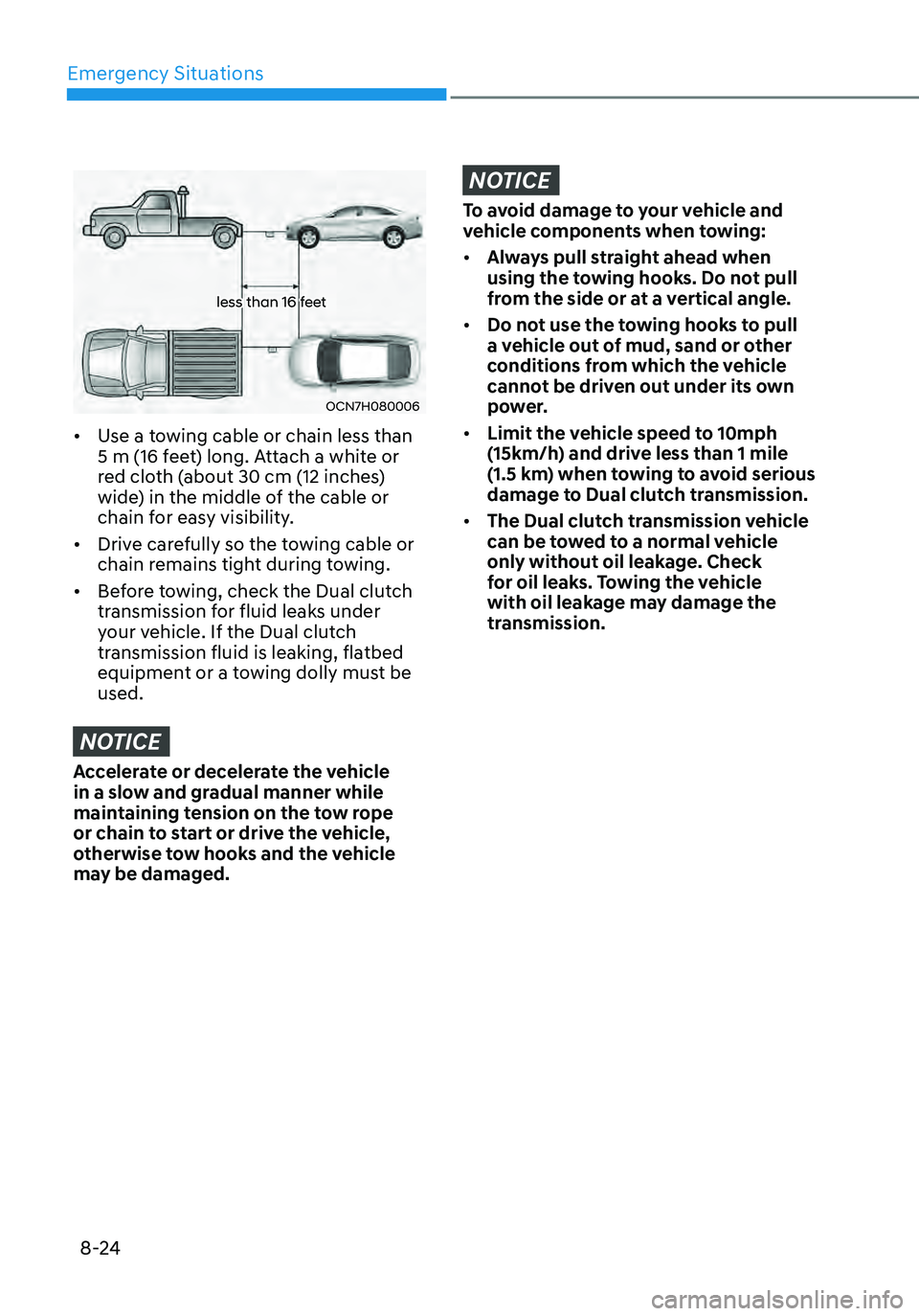
less than 16 feet
OCN7H080006
• Use a towing cable or chain less than
5 m (16 feet) long. Attach a white or
red cloth (about 30 cm (12 inches)
wide) in the middle of the cable or
chain for easy visibility.
• Drive carefully so the towing cable or
chain remains tight during towing.
• Before towing, check the Dual clutch
transmission for fluid leaks under
your vehicle. If the Dual clutch
transmission fluid is leaking, flatbed
equipment or a towing dolly must be
used.
NOTICE
Accelerate or decelerate the vehicle
in a slow and gradual manner while
maintaining tension on the tow rope
or chain to start or drive the vehicle,
otherwise tow hooks and the vehicle
may be damaged.
NOTICE
To avoid damage to your vehicle and
vehicle components when towing:
• Always pull straight ahead when
using the towing hooks. Do not pull
from the side or at a vertical angle.
• Do not use the towing hooks to pull
a vehicle out of mud, sand or other
conditions from which the vehicle
cannot be driven out under its own
power.
• Limit the vehicle speed to 10mph
(15km/h) and drive less than 1 mile
(1.5 km) when towing to avoid serious
damage to Dual clutch transmission.
• The Dual clutch transmission vehicle
can be towed to a normal vehicle
only without oil leakage. Check
for oil leaks. Towing the vehicle
with oil leakage may damage the
transmission.
Page 554 of 555

Index
I-12
Tire Sidewall Labeling ........................................................................\
.............9-34
Tire Terminology and Definitions ....................................................................9-37
Tire Traction ........................................................................\
.............................9-34
Wheel Alignment and Tire Balance .................................................................9-32
Wheel Replacement ........................................................................\
..................9-34
Towing
........................................................................\
.........................................8-21
Emergency towing ........................................................................\
....................8-23
Emergency Towing ........................................................................\
..................8-22
Removable towing hook ........................................................................\
...........8-22
Towing Service ........................................................................\
.........................8-21
Trailer Towing
........................................................................\
.............................6-53
Trunk
........................................................................\
............................................5-64
Emergency trunk safety release ........................................................................\
5-65
Smart Trunk release ........................................................................\
..................5-66
V
Vehicle Break-In Process
........................................................................\
...............1-7
Vehicle Certification Label
........................................................................\
..........2-13
Vehicle Data Collection and Event Data Recorders
..............................................1-8
Vehicle Identification Number ( VIN)
.................................................................2-13
Vehicle load limit
........................................................................\
.........................6-48
Tire Loading Information Label .......................................................................6-49
Vehicle Modifications
........................................................................\
....................1-7
Volume and Weight
........................................................................\
......................2-10