Page 324 of 589

TOWING YOUR VEHICLE
PRECAUTIONS
Use the following guidelines when towing
your vehicle. Failure to follow this
instruction could result in vehicle damage
not covered by the vehicle warranty.
Note:
Make sure you properly secure your
vehicle to the tow vehicle.
Note: If you are unsure of the vehicle ’s
configuration, contact an authorized dealer.
RECREATIONALLY TOWING
YOUR VEHICLE - GASOLINE,
AWD
You cannot recreational tow your vehicle
with all wheels on the ground because
vehicle or transmission damage could
occur. You must recreational tow your
vehicle with all four wheels off the ground,
such as when using a car-hauling trailer.
Otherwise, you cannot recreational tow
your vehicle.
RECREATIONALLY TOWING
YOUR VEHICLE - GASOLINE,
FWD
You cannot recreational tow your vehicle
with all wheels on the ground because
vehicle or transmission damage could
occur. Place the front wheels on a
two-wheel tow dolly. If you are using a tow
dolly, follow the instructions specified by
the equipment provider.
Note: Release the parking brake before
towing your vehicle. See Manually
Releasing the Electric Parking Brake
(page
224). RECREATIONALLY TOWING
YOUR VEHICLE - HYBRID
ELECTRIC VEHICLE (HEV)/
PLUG-IN HYBRID ELECTRIC
VEHICLE (PHEV)
Follow these guidelines if you have a need
for recreational towing. An example of
recreational towing is towing your vehicle
behind a motorhome. These guidelines
ensure that you do not damage the
transmission.
Note:
Put your climate control system in
recirculated air mode to prevent exhaust
fumes from entering your vehicle. See
Climate Control
(page 137).
You can tow your vehicle with all four
wheels on the ground under the following
conditions:
• You switch
Neutral Tow on.
• Your vehicle is facing forward for
towing in a forward direction.
• You release the parking brake.
• You do not exceed 70 mph (113 km/h).
Switching
Neutral Tow On
1. Switch your vehicle on in accessory mode.
2. Press the menu button on the steering
wheel to enter the information display
main menu.
3. Select
Settings.
4. Select
Neutral Tow.
5. Follow the instructions on the information display.
6. Fully press the brake pedal.
7. Shift into neutral (N).
8. Switch the ignition off.
Note: Switching neutral tow on requires
battery power.
321
Escape (CTC) Canada/United States of America, Vehicles Built From: 02-11-2020, enUSA, Edition date: 202011, First-Printing Towing Your Vehicle
Page 327 of 589
FUSE PRECAUTIONS
WARNING: Always disconnect the
battery before servicing high current
fuses. WARNING:
To reduce risk of
electrical shock, always replace the
cover to the power distribution box
before reconnecting the battery or
refilling fluid reservoirs. WARNING:
Always replace a fuse
with one that has the specified
amperage rating. Using a fuse with a
higher amperage rating can cause severe
wire damage and could start a fire.
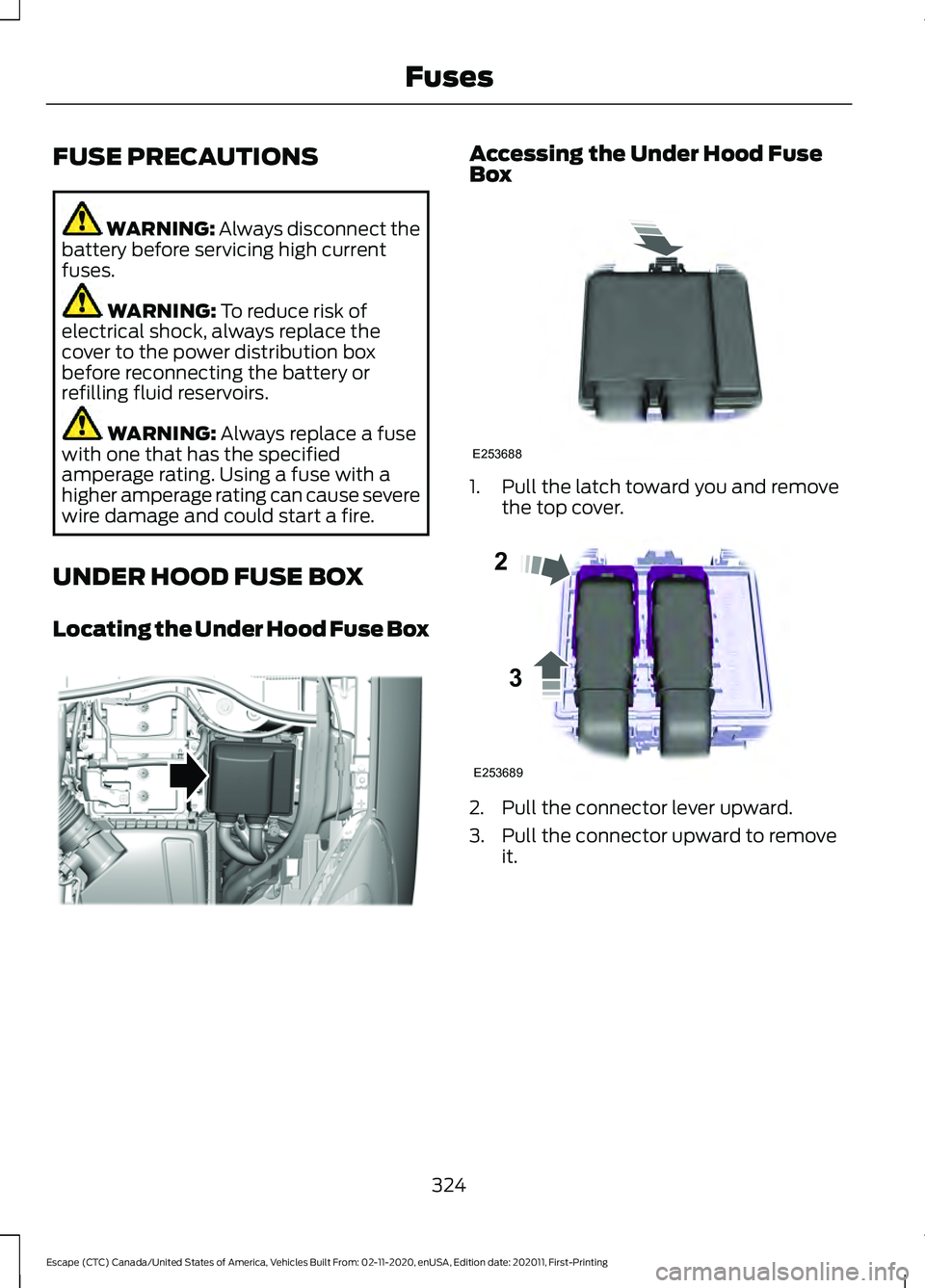
UNDER HOOD FUSE BOX
Locating the Under Hood Fuse Box Accessing the Under Hood Fuse
Box
1. Pull the latch toward you and remove
the top cover. 2. Pull the connector lever upward.
3. Pull the connector upward to remove
it.
324
Escape (CTC) Canada/United States of America, Vehicles Built From: 02-11-2020, enUSA, Edition date: 202011, First-Printing FusesE334436 E253688 E253689
2
3
Page 329 of 589
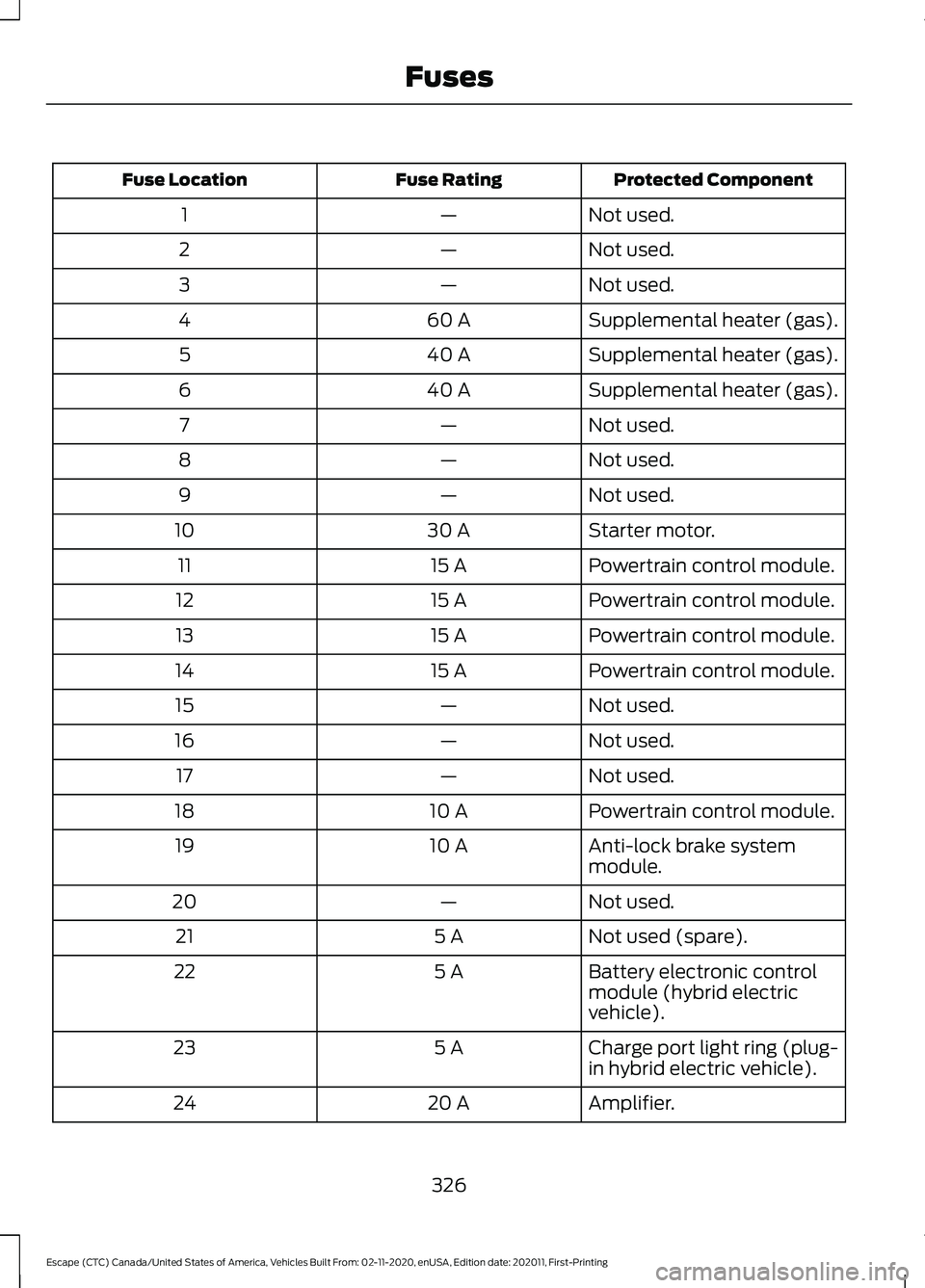
Protected Component
Fuse Rating
Fuse Location
Not used.
—
1
Not used.
—
2
Not used.
—
3
Supplemental heater (gas).
60 A
4
Supplemental heater (gas).
40 A
5
Supplemental heater (gas).
40 A
6
Not used.
—
7
Not used.
—
8
Not used.
—
9
Starter motor.
30 A
10
Powertrain control module.
15 A
11
Powertrain control module.
15 A
12
Powertrain control module.
15 A
13
Powertrain control module.
15 A
14
Not used.
—
15
Not used.
—
16
Not used.
—
17
Powertrain control module.
10 A
18
Anti-lock brake system
module.
10 A
19
Not used.
—
20
Not used (spare).
5 A
21
Battery electronic control
module (hybrid electric
vehicle).
5 A
22
Charge port light ring (plug-
in hybrid electric vehicle).
5 A
23
Amplifier.
20 A
24
326
Escape (CTC) Canada/United States of America, Vehicles Built From: 02-11-2020, enUSA, Edition date: 202011, First-Printing Fuses
Page 331 of 589
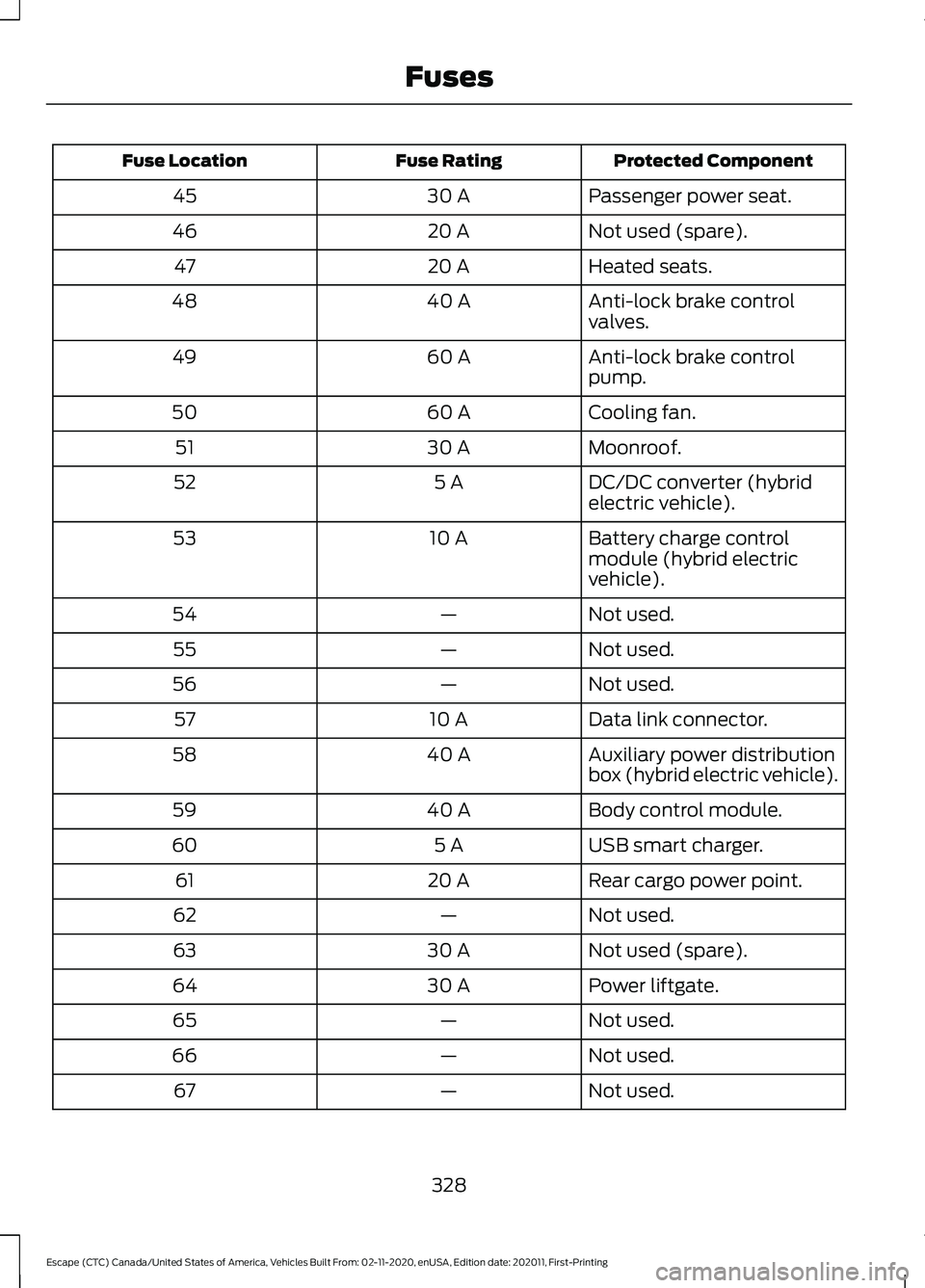
Protected Component
Fuse Rating
Fuse Location
Passenger power seat.
30 A
45
Not used (spare).
20 A
46
Heated seats.
20 A
47
Anti-lock brake control
valves.
40 A
48
Anti-lock brake control
pump.
60 A
49
Cooling fan.
60 A
50
Moonroof.
30 A
51
DC/DC converter (hybrid
electric vehicle).
5 A
52
Battery charge control
module (hybrid electric
vehicle).
10 A
53
Not used.
—
54
Not used.
—
55
Not used.
—
56
Data link connector.
10 A
57
Auxiliary power distribution
box (hybrid electric vehicle).
40 A
58
Body control module.
40 A
59
USB smart charger.
5 A
60
Rear cargo power point.
20 A
61
Not used.
—
62
Not used (spare).
30 A
63
Power liftgate.
30 A
64
Not used.
—
65
Not used.
—
66
Not used.
—
67
328
Escape (CTC) Canada/United States of America, Vehicles Built From: 02-11-2020, enUSA, Edition date: 202011, First-Printing Fuses
Page 336 of 589

MAINTENANCE PRECAUTIONS
Service your vehicle regularly to help
maintain its roadworthiness and resale
value. There is a large network of
authorized dealers that are there to help
you with their professional servicing
expertise. We believe that their specially
trained technicians are best qualified to
service your vehicle properly and expertly.
They are supported by a wide range of
highly specialized tools developed
specifically for servicing your vehicle.
If your vehicle requires professional service,
an authorized dealer can provide the
necessary parts and service. Check your
warranty information to find out which
parts and services are covered.
Use only recommended fuels, lubricants,
fluids and service parts conforming to
specifications.
•
Do not work on a hot engine.
• Make sure that nothing gets caught in
moving parts.
• Do not work on a vehicle with the
engine running in an enclosed space,
unless you are sure you have enough
ventilation.
• Keep all open flames and other burning
material, such as cigarettes, away from
the battery and all fuel related parts.
• Set the parking brake, shift the
transmission to park (P) and block the
wheels. OPENING AND CLOSING THE
HOOD
Opening the Hood
1. Open the left-hand front door.
2. Fully pull the hood release lever and
let it completely retract.
Note: This action releases the hood latch.
3. Fully pull the hood release lever for a second time.
Note: This action fully releases the hood.
4. Open the hood.
Note: There is no secondary hood release
under the hood.
333
Escape (CTC) Canada/United States of America, Vehicles Built From: 02-11-2020, enUSA, Edition date: 202011, First-Printing MaintenanceE263274
Page 338 of 589
UNDER HOOD OVERVIEW - 1.5L ECOBOOST™
Windshield washer fluid. See Adding Washer Fluid (page 96).
A
Engine coolant reservoir.
See Checking the Coolant (page 339).
B
Engine oil dipstick.
See Engine Oil Dipstick Overview (page 338).
C
Engine oil filler cap.
See Adding Engine Oil (page 338).
D
Brake fluid reservoir.
See Locating the Brake Fluid Reservoir (page 222).
E
Battery.
See Changing the 12V Battery (page 345).
F
Engine compartment fuse box.
See Fuses (page 324).
G
Air filter.
See Changing the Engine Air Filter (page 343).
H
335
Escape (CTC) Canada/United States of America, Vehicles Built From: 02-11-2020, enUSA, Edition date: 202011, First-Printing MaintenanceE308193
Page 339 of 589
UNDER HOOD OVERVIEW - 2.0L ECOBOOST™
Windshield washer fluid reservoir. See Adding Washer Fluid (page 96).
A
Engine coolant reservoir.
See Checking the Coolant (page 339).
B
Engine oil dipstick.
See Engine Oil Dipstick Overview (page 338).
C
Engine oil filler cap.
See Adding Engine Oil (page 338).
D
Brake fluid reservoir.
See Locating the Brake Fluid Reservoir (page 222).
E
Battery.
See Changing the 12V Battery (page 345).
F
Engine compartment fuse box.
See Fuses (page 324).
G
Air filter assembly. See
Changing the Engine Air Filter (page 343).
H
336
Escape (CTC) Canada/United States of America, Vehicles Built From: 02-11-2020, enUSA, Edition date: 202011, First-Printing MaintenanceE307705
Page 348 of 589
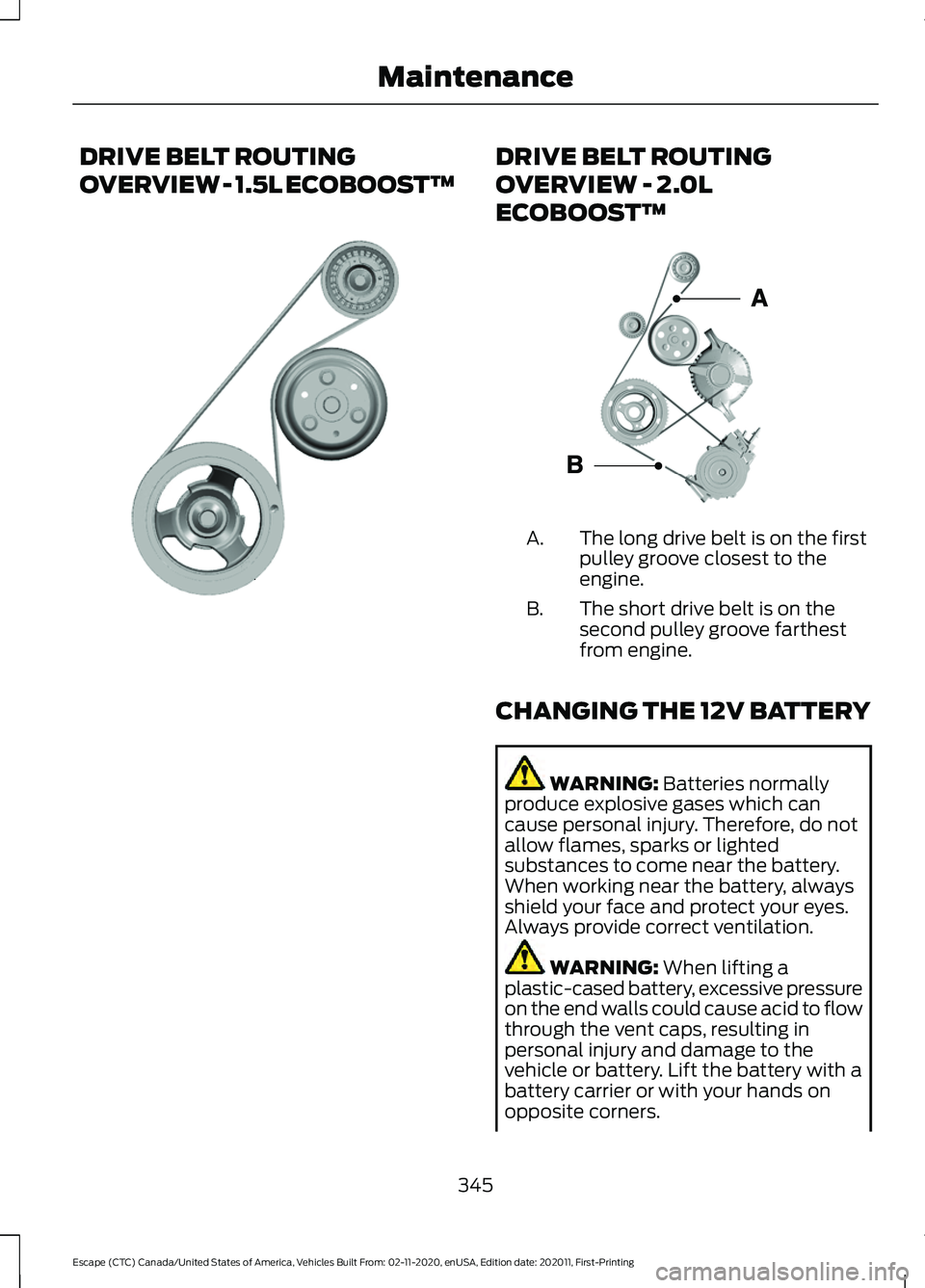
DRIVE BELT ROUTING
OVERVIEW - 1.5L ECOBOOST™ DRIVE BELT ROUTING
OVERVIEW - 2.0L
ECOBOOST™
The long drive belt is on the first
pulley groove closest to the
engine.
A.
The short drive belt is on the
second pulley groove farthest
from engine.
B.
CHANGING THE 12V BATTERY WARNING: Batteries normally
produce explosive gases which can
cause personal injury. Therefore, do not
allow flames, sparks or lighted
substances to come near the battery.
When working near the battery, always
shield your face and protect your eyes.
Always provide correct ventilation. WARNING:
When lifting a
plastic-cased battery, excessive pressure
on the end walls could cause acid to flow
through the vent caps, resulting in
personal injury and damage to the
vehicle or battery. Lift the battery with a
battery carrier or with your hands on
opposite corners.
345
Escape (CTC) Canada/United States of America, Vehicles Built From: 02-11-2020, enUSA, Edition date: 202011, First-Printing MaintenanceE338613 E161383