2021 CHEVROLET COLORADO oil filter
[x] Cancel search: oil filterPage 20 of 89
Chevrolet/GMC 2.8L Duramax Diesel Engine Supplement (GMNA-Localizing-
U.S./Canada-14465442) - 2021 - CRC - 2/3/20
Driving and Operating 19
temperatures below−29 °C (−20 °F), the
coolant heater should remain plugged in for
at least eight hours. Be sure to store the
cord before starting the engine. See Fuel for
Diesel Engines 025 for information on what
fuel to use in cold weather.
Caution
Do not use the engine heater
continuously. This could damage the
engine heater and may cause a fire.
Always unplug the engine heater
after use.
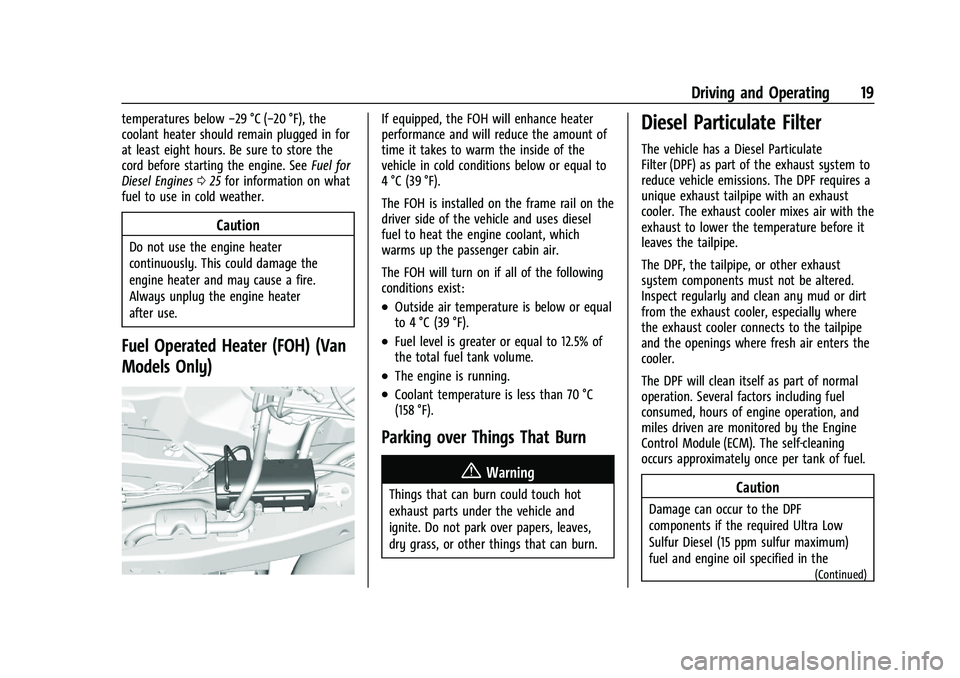
Fuel Operated Heater (FOH) (Van
Models Only)
If equipped, the FOH will enhance heater
performance and will reduce the amount of
time it takes to warm the inside of the
vehicle in cold conditions below or equal to
4 °C (39 °F).
The FOH is installed on the frame rail on the
driver side of the vehicle and uses diesel
fuel to heat the engine coolant, which
warms up the passenger cabin air.
The FOH will turn on if all of the following
conditions exist:
.Outside air temperature is below or equal
to 4 °C (39 °F).
.Fuel level is greater or equal to 12.5% of
the total fuel tank volume.
.The engine is running.
.Coolant temperature is less than 70 °C
(158 °F).
Parking over Things That Burn
{Warning
Things that can burn could touch hot
exhaust parts under the vehicle and
ignite. Do not park over papers, leaves,
dry grass, or other things that can burn.
Diesel Particulate Filter
The vehicle has a Diesel Particulate
Filter (DPF) as part of the exhaust system to
reduce vehicle emissions. The DPF requires a
unique exhaust tailpipe with an exhaust
cooler. The exhaust cooler mixes air with the
exhaust to lower the temperature before it
leaves the tailpipe.
The DPF, the tailpipe, or other exhaust
system components must not be altered.
Inspect regularly and clean any mud or dirt
from the exhaust cooler, especially where
the exhaust cooler connects to the tailpipe
and the openings where fresh air enters the
cooler.
The DPF will clean itself as part of normal
operation. Several factors including fuel
consumed, hours of engine operation, and
miles driven are monitored by the Engine
Control Module (ECM). The self-cleaning
occurs approximately once per tank of fuel.
Caution
Damage can occur to the DPF
components if the required Ultra Low
Sulfur Diesel (15 ppm sulfur maximum)
fuel and engine oil specified in the
(Continued)
Page 21 of 89
Chevrolet/GMC 2.8L Duramax Diesel Engine Supplement (GMNA-Localizing-
U.S./Canada-14465442) - 2021 - CRC - 2/3/20
20 Driving and Operating
Caution (Continued)
Recommended Fluids and Lubricants
section of this manual are not used. This
damage would not be covered by the
vehicle warranty.
Under certain driving conditions, such as
stop-and-go traffic, the filter cannot clean
itself. A message comes on when the DPF is
dirty and needs to perform a self cleaning.
For the filter to clean itself, the vehicle must
be driven above 50 km/h (30 mph) until the
message goes off. This will take about
30 minutes.
{Warning
During DPF self-cleaning or during
extended idling in P (Park), the exhaust
system and exhaust gases are very hot.
Things that burn could touch hot exhaust
parts under the vehicle and ignite. You or
others could be burned. Do not park,
or idle for an extended period of time,
near or over papers, leaves, dry grass,
or other things that can burn. Keep the (Continued)
Warning (Continued)
exhaust area clear of material that could
ignite or burn. SeeParking over Things
That Burn 019.
Caution
Extended idle should be avoided because
the DPF system is not capable of self
cleaning at idle. During extended idle
operation, monitor the instrument cluster
telltale lights and Driver Information
Center for messages and take appropriate
indicated action. Continued idling with
the warning light/message on could
cause irreversible damage to the DPF
requiring repair and possible replacement
that might not be covered by the vehicle
warranty.
You will also notice a change in the exhaust
sound and engine idle speed. Along with
this, a burning smell and reduction in fuel
economy may be noticed. This is normal.
If you continue to drive with the DPF
warning message on and the exhaust filter
is not cleaned as required, the malfunction
indicator lamp and the ENGINE POWER IS REDUCED message will come on and dealer
service is necessary. See
Malfunction
Indicator Lamp (Check Engine Light) 09.
Vehicles with the DPF have specific fuel and
engine oil requirements. See Fuel for Diesel
Engines 025 and
Engine Oil 055.
Extended idling in P (Park) can cause exhaust
parts and gases to become very hot. Keep
the exhaust area clear of material that could
ignite or burn. See Parking over Things That
Burn 019.
If equipped with Power Take-Off (PTO),
monitor the instrument cluster for lights
related to the DPF.
See Accessories and Modifications 052 for
important information if you are considering
adding accessories or modifying the vehicle.
Manual Regeneration of Diesel
Particulate Filter
This feature is only available on Fleet and
Commercial vehicles.
To verify that the vehicle has this feature,
refer to the Vehicle Service Parts
Identification label (SPID) for RPO code FPF
Page 27 of 89
Chevrolet/GMC 2.8L Duramax Diesel Engine Supplement (GMNA-Localizing-
U.S./Canada-14465442) - 2021 - CRC - 2/3/20
26 Driving and Operating
Caution
Use of fuel that does not comply with
the required technical standards can lead
to engine power loss, increased wear,
or engine damage and may void your
warranty.
Some improper fuels are:
.Diesel fuel with the addition of
gasoline.
.Diesel fuel mixed with engine oil or
automatic transmission fluid.
.Triglyceride fuels, such as raw
vegetable oil or animal fat, in any
form, including with blends of diesel
or biodiesel.
.Marine diesel fuel and fuel oils.
.Diesel-water emulsions, such as
Aquazole.
.Aftermarket diesel fuel additives,
which contain alcohols, organo-metallic
additives, or water emulsifiers.
Caution
If the vehicle is accidentally refueled with
gasoline, do not continue driving the
vehicle. Driving the vehicle will damage
the fuel system. Have the vehicle towed
to a qualified technician to have the
gasoline removed from the tank and fuel
system. Refuel with Ultra Low Sulfur
Diesel fuel. It is also recommended to
have the fuel system flushed with Ultra
Low Sulfur Diesel, to ensure all gasoline
is removed.
Some conditions, such as dirty fuel, may
decrease fuel filter life and a CHANGE FUEL
FILTER message may come on in the Driver
Information Center (DIC).
Climate Grade Diesel Fuels
At temperatures below 0 °C (32 °F), avoid
using biodiesel blends above 5% by volume.
Using such a fuel may cause fuel filter
plugging, system gelling, and freezing, which
may adversely impact vehicle starting.
Severe winter grade diesel fuel, such as 1-D
diesel fuel or Arctic grade diesel fuel, can be
used in extreme cold temperatures (below
−18 °C or 0 °F); however, doing so will reduce power and fuel economy. Avoid
using severe winter grade fuel in warm or
hot climates. It can result in stalling, poor
starting, and damage to the fuel injection
system.
Fuels improperly blended for cold
temperature operation may result in
restricted fuel filters. The vehicle is equipped
with a fuel heating system to prevent
gelling or waxing of conventional diesel fuel
and biodiesel blends, but may not prevent
all cases.
In case of severe winter conditions, the fuel
filter may become clogged by wax naturally
present in the fuel. To unclog it, move the
vehicle to a warm garage area and allow the
filter to warm up. The fuel filter may need
to be replaced. See
Fuel Filter Replacement
0 30.Biodiesel
Biodiesel is a renewable fuel produced from
vegetable oils or animal fats that have been
chemically modified to make it compatible
with diesel fuel.
Page 28 of 89
Chevrolet/GMC 2.8L Duramax Diesel Engine Supplement (GMNA-Localizing-
U.S./Canada-14465442) - 2021 - CRC - 2/3/20
Driving and Operating 27
Caution
Do not use home-made biodiesel or home
test kits because the quality cannot be
verified by approved scientific methods.
Do not use raw vegetable oil or other
unmodified bio-oils, fats, or blends of
vegetable oil with diesel. They could
damage the fuel system and engine, and
damages would not be covered by the
vehicle warranty.
Biodiesel Blends
Fuels with a biodiesel content up to 20% by
volume may be used (e.g., named B20).
Only use biodiesel blends up to 20% by
volume that comply with your country’s or
region’s fuel standards.
Caution
Do not use blends containing more than
20% biodiesel. Any engine, fuel system,
or exhaust after-treatment system
damage would not be covered by the
vehicle warranty.
As a renewable fuel, biodiesel provides some
environmental benefits. However, biodiesel
has unique properties and needs to be handled differently than diesel fuel. Its use
presents additional risks and may not be
appropriate in all situations. Certain vehicle
operating modes increase these risks and
should be avoided.
Biodiesel fuel quality degrades with time
and exposure to high temperature quicker
than Ultra Low Sulfur Diesel fuel. More
frequent refueling provides the best
opportunity to have a supply of fresh fuel.
Storage at hot ambient temperatures will
accelerate biodiesel degradation.
If the vehicle is not driven often and uses
little fuel, or if it is stored for extended
periods of time, avoid the use of biodiesel
blended fuels above 5% by volume. When
the vehicle is stored for longer than one
month, it should be run out of biodiesel to
below one-quarter tank, refueled with
biodiesel-free fuel, and driven several
kilometers (miles) before storage.
Cold Weather Operation
In cold weather, the fuel filter may become
clogged by wax naturally present in the
fuel. To unclog it, move the vehicle to a
warm garage area and allow the filter to
warm up. The fuel filter may need to be
replaced. See
Fuel Filter Replacement 030. At temperatures below 0 °C (32 °F), it is
recommended to avoid using biodiesel
blends above 5% blend. This blend may
cause fuel filter plugging, system gelling,
and freezing that may affect vehicle
starting. You may need to turn the ignition
on and off a few times before the vehicle
will start. Also, idle the vehicle for a couple
of minutes before accelerating.
It is recommended to use Ultra Low Sulfur
No. 1-D diesel fuel or a blend of No. 1-D and
No. 2-D diesel fuel to enhance vehicle
operation in cold weather at temperatures
below 0 °C (32 °F). Use of No. 1-D diesel fuel
may lower the fuel economy. For additional
information for better cold weather
operation, see
Engine Heater017.
Water in Fuel
Improper fuel tank inspection or cleaning,
or contaminated fuel from suppliers, can
cause water to be pumped into the fuel
tank along with the diesel fuel. If a WATER
IN FUEL SERVICE REQUIRED message displays,
the water must be drained immediately.
Page 45 of 89

Chevrolet/GMC 2.8L Duramax Diesel Engine Supplement (GMNA-Localizing-
U.S./Canada-14465442) - 2021 - CRC - 2/3/20
44 Driving and Operating
remain at curb idle. A press and release
of +RES on the cruise control will restore
engine rpm to the last PTO set speed. The
PTO system can also be programmed to
return engine rpm to the PTO Standby
Speed setting.
.Press*on the cruise control. The engine
returns to base idle, but the PTO load
relay remains engaged. The PTO indicator
light will blink slowly indicating that a
PTO set speed is still stored in memory.
Activating +RES on the cruise control will
restore engine rpm to the last PTO set
speed.
.Press and release the PTO in-cab switch.
The PTO load relay disengages and the
engine returns to base idle. The PTO
indicator light will turn off, indicating the
PTO load relay is disengaged and the
stored set speed has been cleared from
memory.
Stationary Modes (Preset or Variable) –
Remote Control
To disengage PTO:
.Open the Remote PTO Engine Start/
Shutdown switch. Load relay disengages
and the engine will stop.
.If equipped, press the PTO Emergency
Stop switch. Load relay disengages and
the engine will stop. Refer to the bulletins
in the GM Upfitter Integration website
www.gmupfitter.com for the Power
Take-Off (PTO) operating description and
application guide.
.With the key in the ignition and rotated
to the RUN position, press the brake
pedal. The PTO load relay disengages and
the engine returns to base idle speed. The
operator may drive the vehicle.
Stationary Modes will also disengage if:
.Vehicle movement is detected.
.The parking brake is released.
.The transmission is shifted out of
P (Park).
.The ignition is cycled from RUN to OFF.
.The PTO feedback signal is lost indicating
the load is disengaged if used. See
www.gmupfitter.com.
.Cruise control becomes enabled.
.Timed auto-engine shutdown: This feature
will shut down the engine automatically
after a predefined time. PTO must be
operational for this function to be active.
.Engine shutdown based on critical engine
or PTO system fault conditions: This
feature will shut down the engine when
PTO is operating if a critical engine
condition such as low oil, low oil pressure,
hot engine, hot transmission, low fuel,
or Diesel Particulate Filter regeneration is
detected by the vehicle system. If PTO
operation is continued when critical
engine conditions are present, a horn
chirp warning will occur after 30–
60 seconds. The engine will shut down
two minutes after the horn warning. The
engine can be restarted with the ignition
key or with the Remote PTO engine start
controls. The horn warning and engine
shutdown will again occur if the critical
engine condition is still present.
Resume memory speed is cleared for the
above actions.
When Remote PTO engine starting has been
initialized with the ignition key in the RUN
position, the shift lever will remain locked if
the brake pedal is pressed and a shift from
P (Park) is attempted while the engine is
running and PTO is active (standby mode).
A shift out of P (Park) will not be allowed
until one of the following actions is taken
by the vehicle operator:
Page 53 of 89

Chevrolet/GMC 2.8L Duramax Diesel Engine Supplement (GMNA-Localizing-
U.S./Canada-14465442) - 2021 - CRC - 2/3/20
52 Vehicle Care
Vehicle Care
General Information
Accessories and Modifications . . . . . . . . . . 52
Vehicle Checks
Engine Compartment Overview . . . . . . . . . 53
Engine Oil . . . . . . . . . . . . . . . . . . . . . . . . . . . . . . 55
Engine Oil Life System . . . . . . . . . . . . . . . . . 58
Automatic Transmission Fluid . . . . . . . . . . 58
Engine Air Cleaner/Filter . . . . . . . . . . . . . . . . 58
Cooling System . . . . . . . . . . . . . . . . . . . . . . . . 60
Engine Overheating . . . . . . . . . . . . . . . . . . . . 62
Battery (4-Cylinder Pickup Only) . . . . . . . . 63
Electrical System
Engine Compartment Fuse Block . . . . . . . 64
Appearance Care
Exterior Care . . . . . . . . . . . . . . . . . . . . . . . . . . . . 71
General Information
Accessories and Modifications
Adding non-dealer accessories or making
modifications to the vehicle can affect
vehicle performance and safety, including
such things as airbags, braking, stability,
ride and handling, emissions systems,
aerodynamics, durability, and electronic
systems like antilock brakes, traction control,
and stability control. These accessories or
modifications could even cause malfunction
or damage not covered by the vehicle
warranty.
Damage to vehicle components resulting
from modifications or the installation or use
of non-GM certified parts, including control
module or software modifications, is not
covered under the terms of the vehicle
warranty and may affect remaining
warranty coverage for affected parts.
GM Accessories are designed to complement
and function with other systems on the
vehicle. See your dealer to accessorize the
vehicle using genuine GM Accessories
installed by a dealer technician.
See the warranty manual.
Aftermarket Engine Performance
Enhancement Products and Modifications
Some aftermarket engine performance
products and modifications promise a way
to increase the horsepower and torque
levels of the vehicle's powertrain. You should
be aware that these products could have
harmful effects on the performance and life
of the engine, exhaust emission system,
transmission, and drivetrain. The engine,
transmission, and drivetrain have been
designed and built to offer industry leading
durability and performance in the most
demanding applications. Engine power
enhancement products may enable the
engine to operate at horsepower and torque
levels that could damage, create failure,
or reduce the life of the engine, engine
emission system, transmission, and
drivetrain. Damage, failure, or reduced life of
the engine, transmission, emission system,
drivetrain, or other vehicle components
caused by aftermarket engine performance
enhancement products or modifications
might not be covered under the vehicle
warranty.
Page 55 of 89
Chevrolet/GMC 2.8L Duramax Diesel Engine Supplement (GMNA-Localizing-
U.S./Canada-14465442) - 2021 - CRC - 2/3/20
54 Vehicle Care
1. Coolant Surge Tank and Pressure Cap
2. Engine Air Cleaner/Filter
3. Engine Oil Fill Cap
4. Engine Fan (Out of View)
5. Engine Oil Dipstick
6. Engine Compartment Fuse Block
7. Brake Fluid Reservoir
8. Windshield Washer Fluid Reservoir
9. Battery
Page 56 of 89
Chevrolet/GMC 2.8L Duramax Diesel Engine Supplement (GMNA-Localizing-
U.S./Canada-14465442) - 2021 - CRC - 2/3/20
Vehicle Care 55
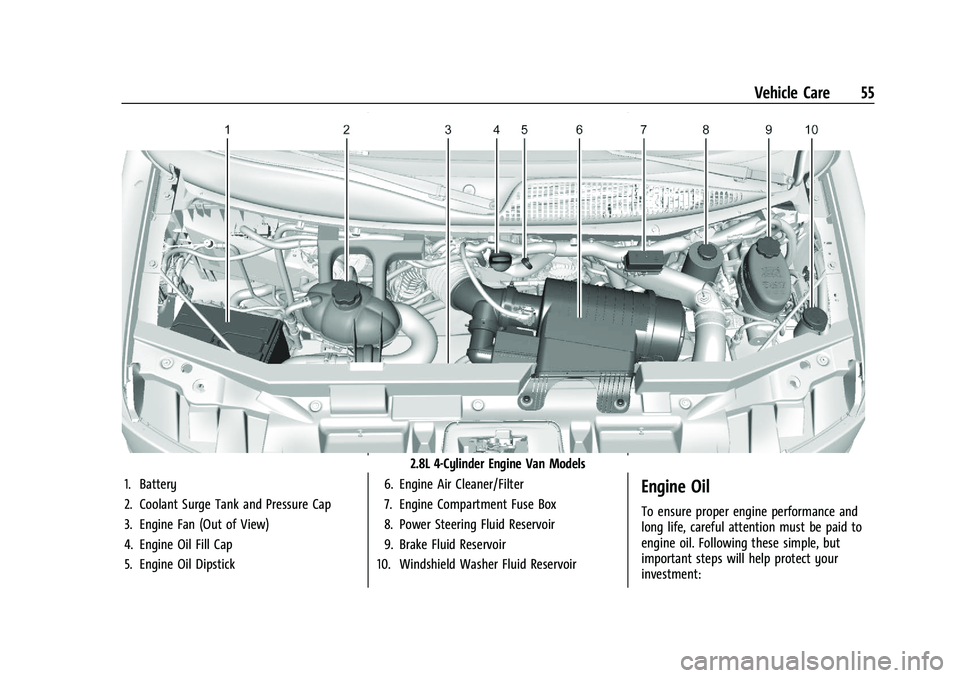
2.8L 4-Cylinder Engine Van Models
1. Battery
2. Coolant Surge Tank and Pressure Cap
3. Engine Fan (Out of View)
4. Engine Oil Fill Cap
5. Engine Oil Dipstick 6. Engine Air Cleaner/Filter
7. Engine Compartment Fuse Box
8. Power Steering Fluid Reservoir
9. Brake Fluid Reservoir
10. Windshield Washer Fluid Reservoir
Engine Oil
To ensure proper engine performance and
long life, careful attention must be paid to
engine oil. Following these simple, but
important steps will help protect your
investment: