2021 ALFA ROMEO GIULIA flat tire
[x] Cancel search: flat tirePage 252 of 284

SERVICING AND MAINTENANCE
250
DEPARTMENT OF
TRANSPORTATION UNIFORM
TIRE QUALITY GRADES
The following tire grading categories
were established by the National
Highway Traffic Safety Administration.
The specific grade rating assigned by
the tire's manufacturer in each cate-
gory is shown on the sidewall of the
tires on your vehicle.
All passenger vehicle tires must
conform to Federal safety require -
ments in addition to these grades.
Treadwear
The Treadwear grade is a comparative
rating, based on the wear rate of the
tire when tested under controlled
conditions on a specified government
test course. For example, a tire graded
150 would wear one and one-half times
as well on the government course as a
tire graded 100. The relative perfor -
mance of tires depends upon the
actual conditions of their use, however,
and may depart significantly from the
norm due to variations in driving habits,
service practices, and differences in
road characteristics and climate.
Traction Grades
The Traction grades, from highest to
lowest, are AA, A, B, and C. These
grades represent the tire's ability to
stop on wet pavement, as measured
under controlled conditions on speci -
fied government test surfaces of
asphalt and concrete. A tire marked C
may have poor traction performance.
Temperature Grades
The temperature grades are A (the
highest), B, and C, representing the
tire's resistance to the generation of
heat and its ability to dissipate heat,
when tested under controlled condi -
tions on a specified indoor laboratory
test wheel. Sustained high temperature
can cause the material of the tire to
degenerate and reduce tire life, and
excessive temperature can lead to
sudden tire failure. The grade C corre -
sponds to a level of performance, which all passenger vehicle tires must meet
under the Federal Motor Vehicle Safety
Standard No. 109. Grades B and A
represent higher levels of performance
on the laboratory test wheel, than the
minimum required by law.
STORING THE VEHICLE
If the vehicle is left inactive for longer than a
month, the following precautions should be
observed:
Park the vehicle in an area that is covered
and dry, and well-ventilated if possible.
Slightly open the windows.
Check that the Electric Park Brake is not
activated.
Carry out the procedure: “manual trunk
opening device” procedure described in this
paragraph.
Disconnect the negative battery terminal
and check the battery charge. Repeat this
check once every three months during
storage.
WARNING!
The traction grade assigned to this tire is
based on straight-ahead braking traction
tests, and does not include acceleration,
cornering, hydroplaning, or peak traction
characteristics.
WARNING!
The temperature grade for this tire is
established for a tire that is properly inflated
and not overloaded. Excessive speed,
under-inflation, or excessive loading, either
separately or in combination, can cause
heat buildup and possible tire failure.
21_GA_OM_EN_USC_t.book Page 250
Page 253 of 284
251
If the battery is not disconnected from the
electrical system, check its state of charge
every 30 days.
Clean and protect the painted parts using
protective wax.
Clean and protect the shiny metal parts
using special compounds available
commercially.
Sprinkle talcum powder on the windshield
wiper rubber blades, and lift them off the
glass.
Cover the vehicle with a fabric or perforated
plastic sheet, paying particular care not to
damage the painted surface by dragging
any dust that may have accumulated on it.
Do not use compact plastic sheets, as they
do not allow humidity to evaporate from the
surface of the vehicle.
Inflate tires to +7.25 psi (+0.5 bar) above
the standard prescribed pressure and
check it periodically.
Do not drain the engine cooling system.
Any time the vehicle is left inactive for two
weeks or more, operate the air conditioning
system with engine idling for at least five
minutes, setting external air and with fan
set to maximum speed. This operation will
ensure appropriate lubrication for the
system, thus minimizing the possibility of
damage to the compressor when the
system is operated again.
NOTE:
After placing the ignition in STOP and having
closed the driver side door, wait at least one
minute before disconnecting the electrical
supply from the battery. When reconnecting
the electrical supply to the battery, make sure
that the ignition is in the STOP position and the
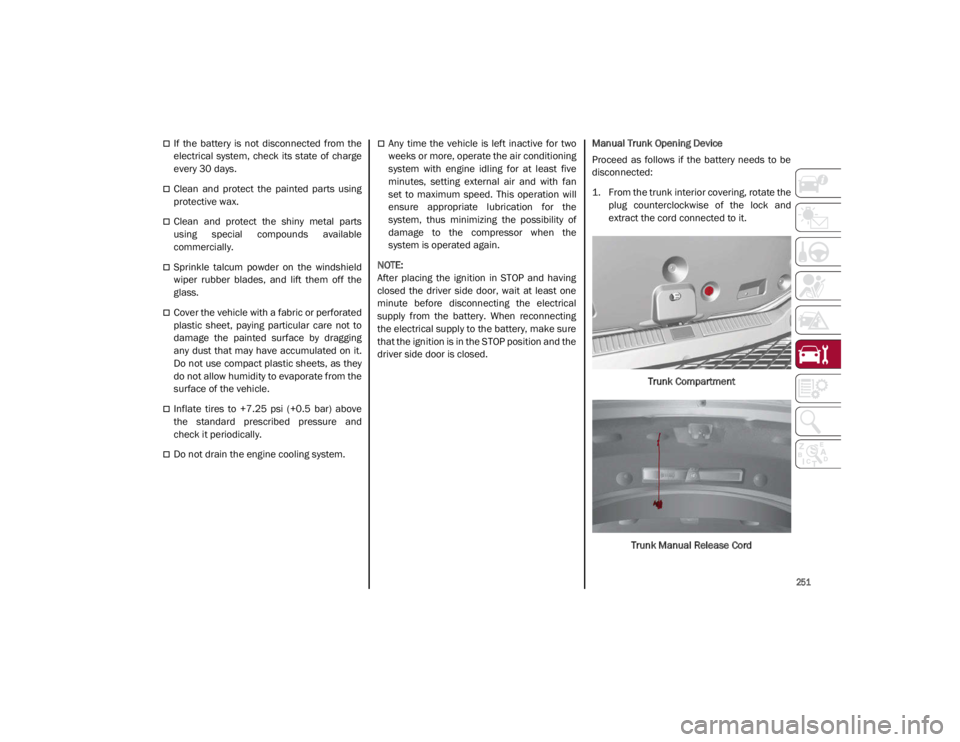
driver side door is closed. Manual Trunk Opening Device
Proceed as follows if the battery needs to be
disconnected:
1. From the trunk interior covering, rotate the
plug counterclockwise of the lock and
extract the cord connected to it.
Trunk Compartment
Trunk Manual Release Cord
21_GA_OM_EN_USC_t.book Page 251
Page 257 of 284

255
For the enthusiasts, the technician, or those
who just want to know every detail of their
vehicle, useful information on understanding
how your vehicle works is contained in this
chapter and illustrated with data, tables, and
graphics.VEHICLE IDENTIFICATION
NUMBER (VIN)
The VIN is stamped on a plate on the front left
corner of the dashboard cover, which can be
seen from outside the vehicle, through the
windshield.Windshield VIN Location
Vehicle Identification Number (VIN) Plate
The plates are located on the left side A-pillar
and contain the data about:
Vehicle Identification Number (VIN).
Vehicle type (USA and Canada only).
Color code.
Place of manufacturing of the vehicle (USA
and Mexico only).
Vehicle manufacturing date.
Maximum permitted weights.
Permitted tire inflation pressure (USA and
Canada only).
21_GA_OM_EN_USC_t.book Page 255
Page 280 of 284

278
INDEX
T
Tie Down Hooks, Cargo ................................ 64
Tire And Loading Information Placard ......237
Tire Markings..............................................234
Tire Safety Information .............................. 234
Tire Service Kit ...........................................194
Tires .................................188, 241, 246, 250Aging (Life Of Tires) ................................ 245Air Pressure ............................................ 241
Flat Changing .........................................194
General Information......................241, 246
High Speed ............................................. 242
Inflation Pressure...................................241Life Of Tires ............................................ 245
Load Capacity................................237, 238Pressure Monitoring System (TPMS) .............................. 75, 76
Quality Grading....................................... 250
Radial......................................................244
Replacement ..........................................245
Safety .............................................234, 241
Sizes .......................................................234
Snow Tires ..............................................247
Spare Tires ............................................. 246
Spinning..................................................244
Tread Wear Indicators ...........................244
Tow Hooks ..................................................202 Towing
Disabled Vehicle .................................... 201
Towing Trailers ........................................... 138
TPMS (Tire Pressure Monitoring
System) ....................................................... 156
Traction Control System (TCS) .................. 144
Transmission .............................................. 258
Transporting Animals................................. 139
Transporting Passengers .......................... 139
Transporting Pets....................................... 187
Tread Wear Indicators ............................... 244
Trunk Lid (Deck Lid) ..................................... 63
Turn Signals ...........................................44, 77
U
Uconnect Settings Customer Programmable Features ........ 24
Passive Entry Programming .................... 24
Uniform Tire Quality Grades ...................... 250
Universal Transmitter .................................. 38
Untwisting Procedure, Seat Belt ............... 162
Use Of The Owner’s Manual........................... 5
V
Vehicle Changes/Alterations ......................... 3
Vehicle Identification Number .................. 255
Vehicle Loading ................................. 136, 238 W
Warning Lights (Instrument Cluster
Descriptions)................................................. 75
Warranty Information ................................ 272
WARRANTY INFORMATION
.................. 272
Washer Fluid For Windshield/
Headlights .................................................. 214
Washers, Windshield.................................... 47
Weights ...................................................... 262
Wheel And Wheel Tire Care ...................... 246
Wheel And Wheel Tire Trim....................... 246
Wheels And Tires ....................................... 234
Wind Buffeting ..............................................59
Windows (Cleaning) ................................... 253
Windshield Defroster ................................ 187
Windshield Washers.....................................47
Windshield Wiper Replacing Blades .................................. 219
Windshield Wipers ........................................46
Wipers, Intermittent .....................................47
Wipers, Rain Sensitive .................................47
21_GA_OM_EN_USC_t.book Page 278