Page 348 of 405
Practical tips
Brake fluid Check and r efill the br
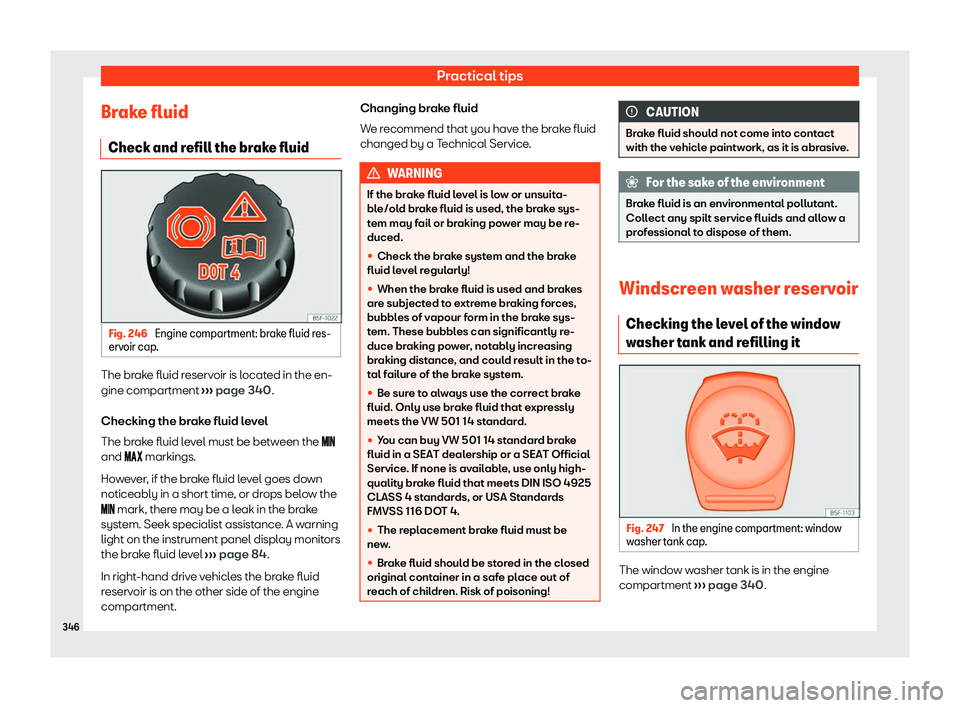
ake fluidFig. 246
Engine compartment: brake fluid res-
erv oir cap
. The brake fluid reservoir is located in the en-
gine compartment
››
› page 340
.
Checking the brake fluid level
The brake fluid level must be between the
and markings.
However, if the brake fluid level goes down
noticeably in a short time, or drops below the mark, there may be a leak in the brake system. Seek specialist assistance. A warning
light on the instrument panel display monitors
the brake fluid level ››› page 84
.
In right-hand drive vehicles the brake fluid
reservoir is on the other side of the engine
compartment. Changing brake fluid
We r
ecommend that you have the brake fluid
changed by a Technical Service. WARNING
If the brake fluid level is low or unsuita-
bl e/ol
d brake fluid is used, the brake sys-
tem may fail or braking power may be re-
duced.
�
Page 351 of 405
Checking and refilling levels
WARNING
The 12 volt battery is a subject to wear. A
r eduction in batt
ery power can mean that
some important safety systems, such as
power steering, braking intervention, lights
or airbag systems, operate with limitations
or stop working entirely. This may cause
serious accidents and injuries. To avoid
this, it is necessary to take the following
safety measure:
�
Page 353 of 405

Checking and refilling levels
Charging the battery
The v ehicl
e battery should be charged by a
specialised workshop only, as batteries using
special technology have been installed and
they must be charged in a controlled environ-
ment.
Replacing a vehicle battery
The 12-volt vehicle battery has been de-
signed to suit its location and has special
safety features. If you need to change the
battery, please go to a service centre before
buying a new one to get information about
the electromagnetic compatibility, size and
maintenance requirements, performance and
safety of your vehicle’s new battery. SEAT
recommends you have the battery replaced
by a technical service.
Start-Stop systems ( ››› page 223
) are equip-
ped with a special battery. Therefore, it must
only be replaced with a battery of the same
specifications.
Your vehicle is equipped with an intelligent
power management system to control the
distribution of electrical energy ››› page 351
.
The power management function ensures
that the battery is charged much more effi-
ciently than on vehicles without a power
management system. To maintain this func-
tion after replacing the battery, we recom-
mend that the replacement battery used is of
the same make and type as the original fitted battery. To make proper use of the power
management function after the batt
ery has
been changed, have the battery coded to the
power management mode at a specialised
workshop. WARNING
�
Page 357 of 405
Wheels
or COC document 1)
). The v ehicl
e documen-
tation varies depending on the country of res-
idence.
If the type of spare wheel is different form the
normal wheels — e.g. in the case of winter
tyres or particularly wide tyres — the spare
wheel should only be used temporarily in the
event of a puncture, and the vehicle should
be driven with care. Refit the normal road
wheel as soon as possible.
In vehicles with four-wheel drive, the 4 wheels
must be fitted with tyres of the same brand,
type and tread so that the traction system is
not damaged by a difference in the number
of turns of the wheels. Therefore, in the event
of a puncture, only a spare wheel with the
same perimeter as normal tyres should be
used.
Manufacturing date
The manufacturing date is also indicated on
the tyre sidewall (or on the inside face of the
wheel):
DOT ... 221� ...
it means, for example, that the tyre was man-
ufactured in the 22nd week of 2018. WARNING
�
Page 359 of 405
Wheels
WARNING
Unsuitable handling of the wheels and
t yr
es may lead to sudden tyre pressure los-
ses, to tread separation or even to a blow-
out.
�
Page 360 of 405
Practical tips
WARNING
The tyres must be replaced at the latest
when the tr ead is w
orn down to the tread
wear indicators. Failure to follow this in-
struction could result in an accident.
�
Page 361 of 405

Wheels
The performance of winter tyres is also se-
v er
ely impaired by ageing, even if the tread is
still much deeper than 4 mm.
A code letter indicating the speed limit is
stamped on all winter tyres ››› page 354
.
Vehicles capable of exceeding these speeds
must have an appropriate sticker attached
so that it is visible to the driver. Suitable stick-
ers are available from the SEAT Official Serv-
ice and specialised workshop. Please note
the regulations to this effect in your country.
“All-weather” tyres can also be used instead
of winter tyres.
Using winter tyres with V-rating
Please note that the generally applicable
240 km/h (149 mph) speed for winter tyres
with the letter V is subject to technical re-
strictions; the maximum permissible speed
for your vehicle may be significantly lower.
The maximum speed limit for these tyres de-
pends directly on the maximum axle weights
for your car and on the listed weight rating of
the tyres being used.
It is best to contact a SEAT Official Service to
check the maximum speed which is permissi-
ble for the V-rated tyres fitted on your car on
the basis of this information. WARNING
Exceeding the maximum speed permitted
f or the wint
er tyres fitted on your car can
cause tyre failure, resulting in a loss of con-
trol of the vehicle – risk of accident. For the sake of the environment
When winter is over, change back to sum-
mer t yr
es at an appropriate moment. In
temperatures above +7°C (+45°F), perform-
ance will be improved if summer tyres are
used. Fuel consumption, wear and noises
while driving will all be reduced. Snow chains
Snow chains must only be fitted t
o the fr
ont
wheels, even on vehicles with four-wheel
drive.
�
Page 365 of 405
Wheels
If you have a puncture on one of the front
wheel s when using sno
w chains, fit the tem-
porary spare wheel in place of one of the rear
wheels. Fit the snow chains on the rear wheel
that you have removed and replace the
punctured front wheel with this wheel. WARNING
Keep in mind that the standard wheel is
wider than the emer gency spar
e wheel, so
the 3rd row of seats cannot be completely
lowered when that standard wheel is
placed in the emergency spare wheel well.
�