2020 Ram ProMaster City flat tire
[x] Cancel search: flat tirePage 232 of 350

IN CASE OF EMERGENCY 229
Insert the power plug into the vehicle power outlet socket.
Start the vehicle engine.
Push the Tire Service Kit power button to the “I” position.
The electric compressor will be turned on, sealant and air
will inflate the tire.
Minimum 26 psi (1.8 bar) of pressure should be reached
within 20 minutes. If the pressure has not been reached, turn
off and remove the Tire Service Kit, drive the vehicle 30 feet
(10 meters) back and forth, to better distribute the sealant
inside the tire.
Attach the clear flexible filling tube of the compressor
directly to the tire valve and repeat the inflation process.
When the correct pressure has been reached, start driving the
vehicle to uniformly distribute the sealant inside the tire.
After 10 minutes, stop and check the tire pressure. If the
pressure is below 19 psi (1.3 bar), do not drive the vehicle, as
the tire is too damaged, contact the nearest authorized
dealer.
• A loose Tire Service Kit thrown forward in a collision
or hard stop could endanger the occupants of the
vehicle. Always stow the Tire Service Kit in the place
provided. Failure to follow these warnings can result in
injuries that are serious or fatal to you, your passengers,
and others around you.
• Take care not to allow the contents of Tire Service Kit to come in contact with hair, eyes, or clothing. Tire
Service Kit sealant is harmful if inhaled, swallowed, or
absorbed through the skin. It causes skin, eye, and
respiratory irritation. Flush immediately with plenty of
water if there is any contact with eyes or skin. Change
clothing as soon as possible, if there is any contact with
clothing.
• Tire Service Kit Sealant solution contains latex. In case of an allergic reaction or rash, consult a physician
immediately. Keep Tire Service Kit out of reach of chil -
dren. If swallowed, rinse mouth immediately with
plenty of water and drink plenty of water. Do not
induce vomiting! Consult a physician immediately.WARNING! (Continued)
6
2020_RAM_PROMASTER_CITY_OM_USA=GUID-7B6A7FCA-79B0-423F-95C5-ED2A949C3D13=1=en=.book Page 229
Page 233 of 350

230 IN CASE OF EMERGENCY
If the pressure is at 19 psi (1.3 bar) or above repeat the infla-
tion process to reach the correct tire pressure and continue
driving.
Peel off the warning label from the bottle and place it on the
dashboard as a reminder to the driver that a tire has been
treated with Tire Service Kit.
NOTE:
Replace the sealant canister prior to the expiration date at an
authorized dealer. Tire Service Kit Sealant Canister
WARNING!
Tire Service Kit is not a permanent flat tire repair. Have
the tire inspected and repaired or replaced after using
Tire Service Kit. Do not exceed 50 mph (80 km/h) until
the tire is repaired or replaced. Failure to follow this
warning can result in injuries that are serious or fatal to
you, your passengers, and others around you. Have the
tire checked as soon as possible at an authorized dealer.
WARNING!
The metal end fitting from Power Plug may get hot after
use, so it should be handled carefully.
WARNING!
Store the sealant canister in its special compartment,
away from sources of heat. Failure to follow this
WARNING may result in sealant canister rupture and
serious injury or death.
2020_RAM_PROMASTER_CITY_OM_USA=GUID-7B6A7FCA-79B0-423F-95C5-ED2A949C3D13=1=en=.book Page 230
Page 241 of 350

238 IN CASE OF EMERGENCY
NOTE:
Push the “ESC OFF” switch, to place the Electronic Stability
Control (ESC) system in “Partial Off” mode, before rocking
the vehicle. Refer to “Electronic Brake Control System” in
“Safety” for further information. Once the vehicle has been
freed, push the “ESC OFF” switch again to restore “ESC On”
mode.
TOWING A DISABLED VEHICLE
This section describes procedures for towing a disabled
vehicle using a commercial towing service.
WARNING!
Fast spinning tires can be dangerous. Forces generated
by excessive wheel speeds may cause damage, or even
failure, of the axle and tires. A tire could explode and
injure someone. Do not spin your vehicle's wheels faster
than 30 mph (48 km/h) or for longer than 30 seconds
continuously without stopping when you are stuck and
do not let anyone near a spinning wheel, no matter what
the speed.
CAUTION!
• When “rocking” a stuck vehicle by shifting between DRIVE and REVERSE, do not spin the wheels faster
than 15 mph (24 km/h), or drivetrain damage may
result.
• Revving the engine or spinning the wheels too fast may lead to transmission overheating and failure. It can also damage
the tires. Do not spin the wheels above 30 mph (48 km/h)
while in gear (no transmission shifting occurring).
Towing Condition Wheel OFF The Ground ALL MODELS
Flat Tow NONENOT ALLOWED
Wheel Lift Or Dolly Tow Front
OK
Rear NOT ALLOWED
Flatbed ALLBEST METHOD
2020_RAM_PROMASTER_CITY_OM_USA=GUID-7B6A7FCA-79B0-423F-95C5-ED2A949C3D13=1=en=.book Page 238
Page 272 of 350
SERVICING AND MAINTENANCE 269
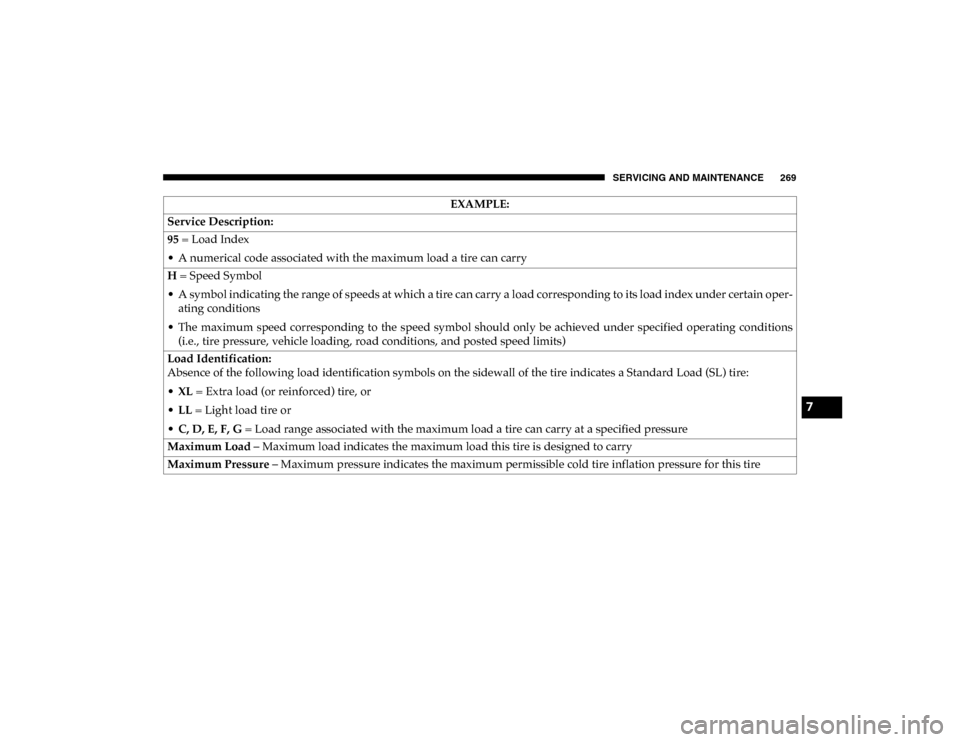
Service Description:
95 = Load Index
• A numerical code associated with the maximum load a tire can carry
H = Speed Symbol
• A symbol indicating the range of speeds at which a tire can carry a load corresponding to its load index under certain oper -
ating conditions
• The maximum speed corresponding to the speed symbol should only be achieved under specified operating conditions (i.e., tire pressure, vehicle loading, road conditions, and posted speed limits)
Load Identification:
Absence of the following load identification symbols on the sidewall of the tire indicates a Standard Load (SL) tire:
• XL = Extra load (or reinforced) tire, or
• LL = Light load tire or
• C, D, E, F, G = Load range associated with the maximum load a tire can carry at a specified pressure
Maximum Load – Maximum load indicates the maximum load this tire is designed to carry
Maximum Pressure – Maximum pressure indicates the maximum permissible cold tire inflation pressure for this tire EXAMPLE:
7
2020_RAM_PROMASTER_CITY_OM_USA=GUID-7B6A7FCA-79B0-423F-95C5-ED2A949C3D13=1=en=.book Page 269
Page 274 of 350

SERVICING AND MAINTENANCE 271
Tire Terminology And DefinitionsTerm Definition
B-Pillar The vehicle B-Pillar is the structural member of the body located behind
the front door.
Cold Tire Inflation Pressure Cold tire inflation pressure is defined as the tire pressure after the vehicle
has not been driven for at least three hours, or driven less than 1 mile
(1.6 km) after sitting for a minimum of three hours. Inflation pressure is
measured in units of PSI (pounds per square inch) or kPa (kilopascals).
Maximum Inflation Pressure The maximum inflation pressure is the maximum permissible cold tire
inflation pressure for this tire. The maximum inflation pressure is
molded into the sidewall.
Recommended Cold Tire Inflation Pressure Vehicle manufacturer's recommended cold tire inflation pressure as
shown on the tire placard.
Tire Placard A label permanently attached to the vehicle describing the vehicle’s
loading capacity, the original equipment tire sizes and the recommended
cold tire inflation pressures.
7
2020_RAM_PROMASTER_CITY_OM_USA=GUID-7B6A7FCA-79B0-423F-95C5-ED2A949C3D13=1=en=.book Page 271
Page 275 of 350

272 SERVICING AND MAINTENANCE
Tire Loading And Tire Pressure
NOTE:
The proper cold tire inflation pressure is listed on the
driver’s side B-Pillar or the rear edge of the driver's side
door.
Check the inflation pressure of each tire, including the spare
tire (if equipped), at least monthly and inflate to the recom-
mended pressure for your vehicle.
Example Tire Placard Location (Door) Example Tire Placard Location (B-Pillar)
2020_RAM_PROMASTER_CITY_OM_USA=GUID-7B6A7FCA-79B0-423F-95C5-ED2A949C3D13=1=en=.book Page 272
Page 276 of 350

SERVICING AND MAINTENANCE 273
Tire And Loading Information PlacardTire And Loading Information Placard
This placard tells you important information about the:
1. Number of people that can be carried in the vehicle.
2. Total weight your vehicle can carry.
3. Tire size designed for your vehicle.
4. Cold tire inflation pressures for the front, rear, and spare tires. Loading
The vehicle maximum load on the tire must not exceed the
load carrying capacity of the tire on your vehicle. You will
not exceed the tire's load carrying capacity if you adhere to
the loading conditions, tire size, and cold tire inflation pres
-
sures specified on the Tire and Loading Information placard
in “Vehicle Loading” in the “Starting And Operating”
section of this manual.
NOTE:
Under a maximum loaded vehicle condition, gross axle
weight ratings (GAWRs) for the front and rear axles must not
be exceeded.
For further information on GAWRs, vehicle loading, and
trailer towing, refer to “Vehicle Loading” in the “Starting
And Operating” chapter of this manual.
To determine the maximum loading conditions of your
vehicle, locate the statement “The combined weight of occu-
pants and cargo should never exceed XXX kg or XXX lbs” on
the Tire and Loading Information placard. The combined
weight of occupants, cargo/luggage and trailer tongue
weight (if applicable) should never exceed the weight refer -
enced here.
7
2020_RAM_PROMASTER_CITY_OM_USA=GUID-7B6A7FCA-79B0-423F-95C5-ED2A949C3D13=1=en=.book Page 273
Page 279 of 350
276 SERVICING AND MAINTENANCE
(Continued)
Tires — General Information
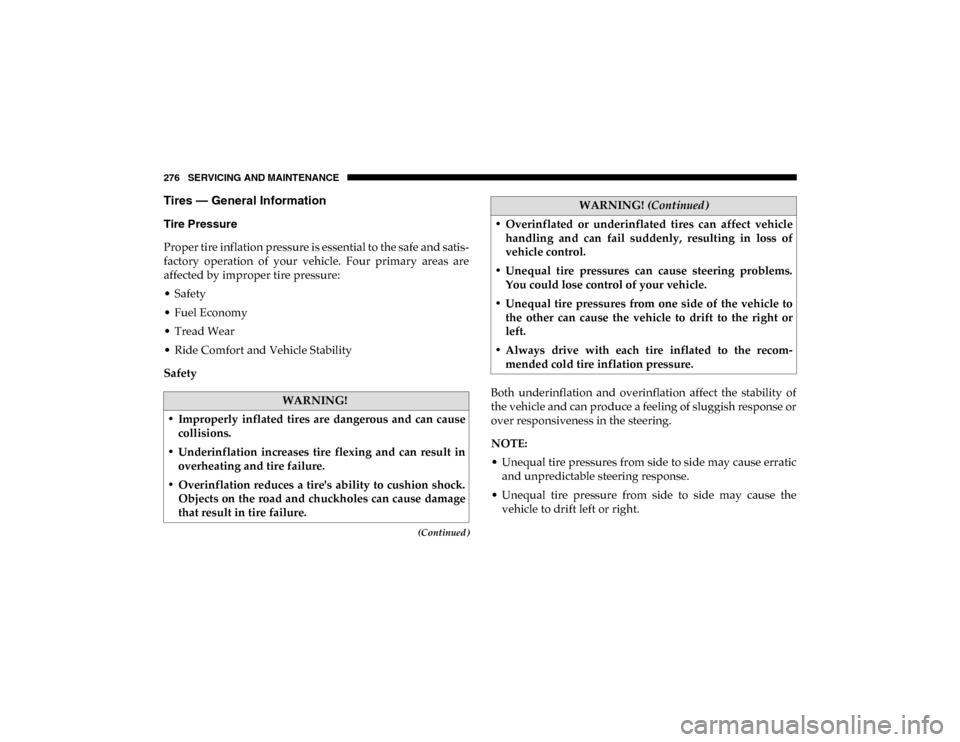
Tire Pressure
Proper tire inflation pressure is essential to the safe and satis-
factory operation of your vehicle. Four primary areas are
affected by improper tire pressure:
• Safety
• Fuel Economy
• Tread Wear
• Ride Comfort and Vehicle Stability
Safety
Both underinflation and overinflation affect the stability of
the vehicle and can produce a feeling of sluggish response or
over responsiveness in the steering.
NOTE:
• Unequal tire pressures from side to side may cause erraticand unpredictable steering response.
• Unequal tire pressure from side to side may cause the vehicle to drift left or right.
WARNING!
• Improperly inflated tires are dangerous and can cause collisions.
• Underinflation increases tire flexing and can result in overheating and tire failure.
• Overinflation reduces a tire's ability to cushion shock. Objects on the road and chuckholes can cause damage
that result in tire failure.
• Overinflated or underinflated tires can affect vehiclehandling and can fail suddenly, resulting in loss of
vehicle control.
• Unequal tire pressures can cause steering problems. You could lose control of your vehicle.
• Unequal tire pressures from one side of the vehicle to the other can cause the vehicle to drift to the right or
left.
• Always drive with each tire inflated to the recom -
mended cold tire inflation pressure.
WARNING! (Continued)
2020_RAM_PROMASTER_CITY_OM_USA=GUID-7B6A7FCA-79B0-423F-95C5-ED2A949C3D13=1=en=.book Page 276