2020 MERCEDES-BENZ GLS SUV airbag off
[x] Cancel search: airbag offPage 63 of 549
¯
Also secure TopTe ther if present
(/ page 68)
Third rowof seats, prefer red securing sy stem:
® ISOFIX child seat anchor (/ page 62)
¯ Also secure TopTe ther if present
(/ page 68).
Left/right rear seat (second and third seat row)
– alternative securing sy stem:
7 Ve
hicle seat belt (/ page 69)
Fr ont passenger seat
Securing sy stem:
7 Ve
hicle seat belt (/ page 69)
Be sure toobser ve:
R Ifth e front passenger seat is occupied,
ensure, bo thbefore and during the journe y,
th at thest atus of the front passenger airbag
is cor rect forth e cur rent situation
(/ page 50).
R Obse rveth e no tes on automatic front
passenger airbag shutoff (/ page 48)Centre
rear seat
Centre rear seat (second seat row) – securing
sy stem:
7 Ve
hicle seat belt (/ page 69) Appr
oval catego ries forch ild restra int sys‐
te ms On
lyuse appr ovedch ild restra int sy stems
Only child restra int sy stems that meet thefo l‐
lowing UNECE standards are permit tedfo r use in
th eve hicle:
R UN-R44
R UN-R129 (i-Size child restra int sy stems)
Identification on thech ild restra int sy stem
In fo rm ation about the appr oval categor y,we ight
category and appr oval number, forex ample, is
on the appr oval label on thech ild restra int sys‐
te m.
There may be fur ther information such as the
ISOFIX size categories, depending on the
appr oval category of thech ild restra int sy stem. Appr
oval catego ries in accordance with UN-
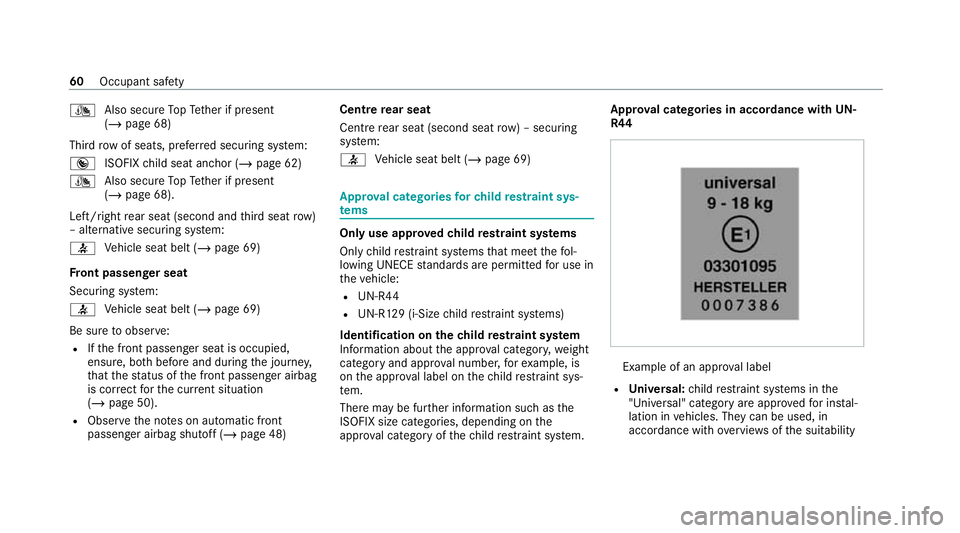
R44 Example of an appr
oval label
R Universal: child restra int sy stems in the
"Universal" category are appr oved for ins tal‐
lation in vehicles. They can be used, in
accordance with overviews ofthe suitability 60
Occupant saf ety
Page 74 of 549
Fr
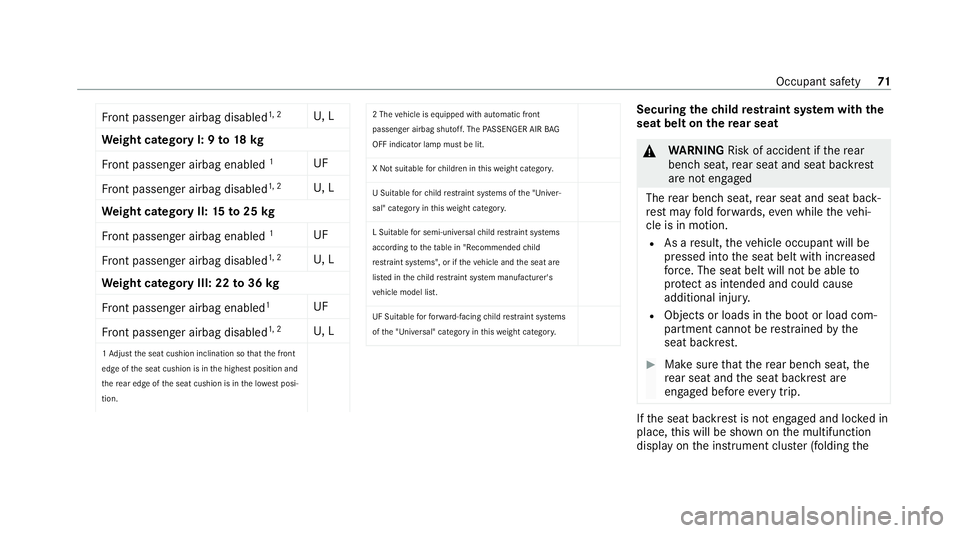
ont passenger airbag disabled 1, 2
U, L
We ight category I: 9 to18 kg
Fr ont passenger airbag enabled 1
UF
Fr ont passenger airbag disabled 1, 2
U, L
We ight category II: 15to25 kg
Fr ont passenger airbag enabled 1
UF
Fr ont passenger airbag disabled 1, 2
U, L
We ight category III: 22 to36 kg
Fr ont passenger airbag enabled 1
UF
Fr ont passenger airbag disabled 1, 2
U, L
1 Ad just the seat cushion inclination so that the front
edge of the seat cushion is in the highest position and
th ere ar edge of the seat cushion is in the lo west posi‐
tion. 2 The
vehicle is equipped with automatic front
passenger airbag shutoff. The PASSENGER AIR BAG
OFF indicator lamp must be lit.
X Not suitable forch ildren in this we ight categor y.
U Suitable forch ild restra int sy stems of the "Univer‐
sal" category in this we ight categor y.
L Suitable for semi-universal child restra int sy stems
according totheta ble in "Recommended child
re stra int sy stems", or if theve hicle and the seat are
lis ted in thech ild restrai nt sy stem manufacturer's
ve hicle model list.
UF Suitable forfo rw ard-facing child restra int sy stems
of the "Universal" category in this we ight categor y. Securing
thech ild restra int sy stem with the
seat belt on there ar seat &
WARNING Risk of accident if there ar
ben chseat, rear seat and seat backrest
are not engaged
The rear ben chseat, rear seat and seat back‐
re st may fold forw ards, even while theve hi‐
cle is in motion.
R As a result, theve hicle occupant will be
pressed into the seat belt with increased
fo rc e. The seat belt will not be able to
pr otect as intended and could cause
additional injur y.
R Objects or loads in the boot or load com‐
partment cann otbe restra ined bythe
seat backrest. #
Make sure that there ar ben chseat, the
re ar seat and the seat backrest are
engaged before everytrip. If
th e seat backrest is not engaged and loc ked in
place, this will be shown on the multifunction
display on the instrument clus ter (folding the Occupant saf
ety71
Page 76 of 549
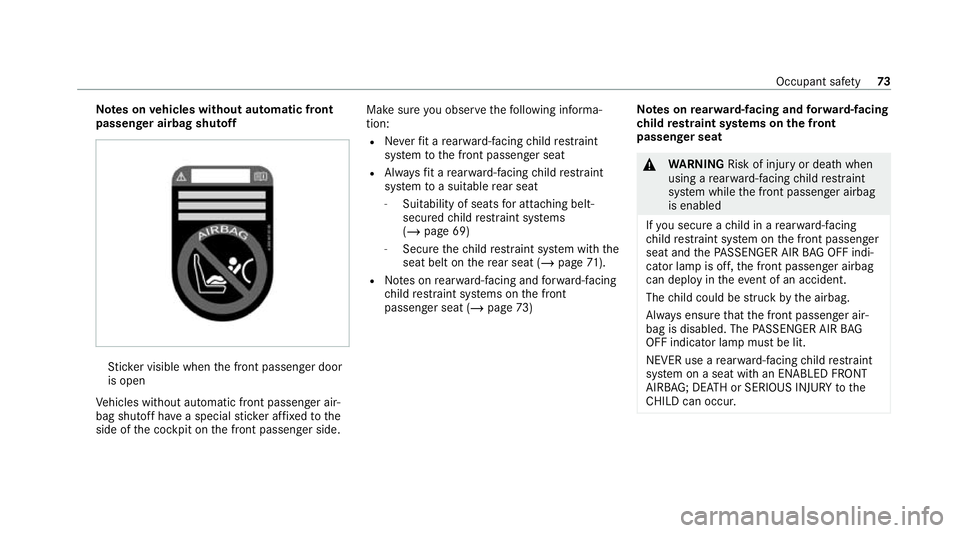
Note
s onvehicles without automatic front
passen ger airbag shu toff St
icke r visible when the front passenger door
is open
Ve hicles without automatic front passenger air‐
bag shutoff ha vea special sticke r af fixe dto the
side of the cockpit on the front passenger side. Make sure
you obse rveth efo llowing informa‐
tion:
R Neverfit a rear wa rd-facing child restra int
sy stem tothe front passenger seat
R Alw aysfit a rear wa rd-facing child restra int
sy stem toa suitable rear seat
- Suitability of seats for attaching belt-
secured child restra int sy stems
(/ page 69)
- Secure thech ild restra int sy stem with the
seat belt on there ar seat (/ page71).
R Notes on rear wa rd-facing and forw ard-facing
ch ild restra int sy stems on the front
passenger seat (/ page73) Note
s onrear wa rd-facing and forw ard-facing
ch ild restra int sy stems on the front
passenger seat &
WARNING Risk of inju ryor death when
using a rear wa rd-facing child restra int
sy stem while the front passenger airbag
is enabled
If yo u secure a child in a rear wa rd-facing
ch ild restra int sy stem on the front passenger
seat and thePA SSENGER AIR BAG OFF indi‐
cator lamp is off, the front passenger airbag
can deploy in theev ent of an accident.
The child could be stru ck bythe airbag.
Alw ays ensure that the front passenger air‐
bag is disabled. The PASSENGER AIR BAG
OFF indicator lamp must be lit.
NEVER use a rear wa rd-facing child restra int
sy stem on a seat with an ENABLED FRONT
AIRB AG; DEAT H or SERIOUS INJU RYtothe
CH ILD can occur. Occupant saf
ety73
Page 77 of 549
Obser
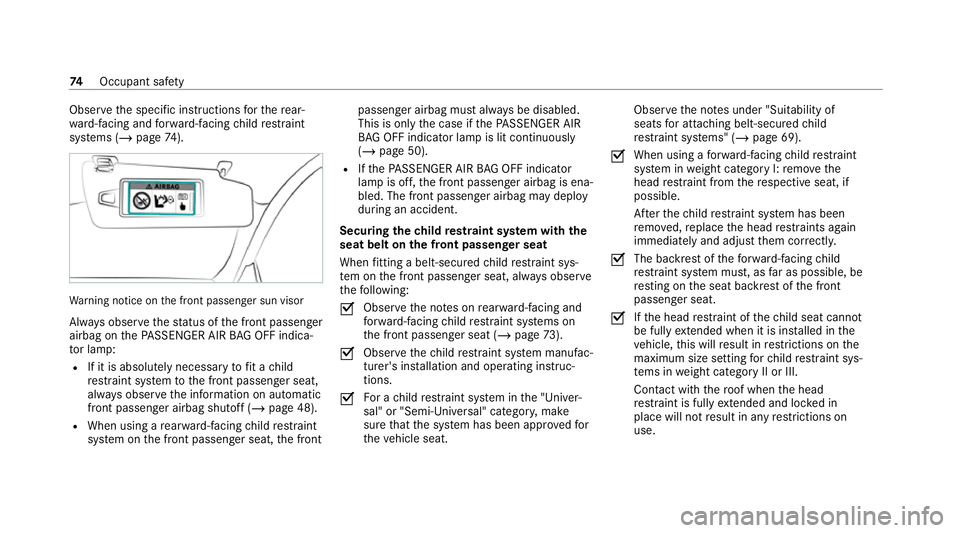
vethe specific instructions forth ere ar‐
wa rd-facing and forw ard-facing child restra int
sy stems (/ page74). Wa
rning notice on the front passenger sun visor
Alw ays obser vethest atus of the front passenger
airbag on thePA SSENGER AIR BAG OFF indica‐
to r lamp:
R If it is absolutely necessary tofit a child
re stra int sy stem tothe front passenger seat,
alw ays obser vethe information on automatic
front passenger airbag shutoff (/ page 48).
R When using a rear wa rd-facing child restra int
sy stem on the front passenger seat, the front passenger airbag must alw
ays be disabled.
This is only the case if thePA SSENGER AIR
BA G OFF indicator lamp is lit continuously
(/ page 50).
R Ifth ePA SSENGER AIR BAG OFF indicator
lamp is off, the front passenger airbag is ena‐
bled. The front passenger airbag may deploy
during an accident.
Securing thech ild restra int sy stem with the
seat belt on the front passenger seat
When fitting a belt-secu redch ild restra int sys‐
te m on the front passenger seat, alw ays obser ve
th efo llowing:
O Obser
vethe no tes on rear wa rd-facing and
fo rw ard-facing child restra int sy stems on
th e front passenger seat (/ page73).
O Obser
vethech ild restra int sy stem manufac‐
turer's ins tallation and operating instruc‐
tions.
O Fo
r a child restra int sy stem in the "Univer‐
sal" or "Semi-Universal" categor y,make
sure that the sy stem has been appr ovedfor
th eve hicle seat. Obser
vethe no tes under "Suitability of
seats for attaching belt-secu redch ild
re stra int sy stems" (/ page 69).
O When using a
forw ard-facing child restra int
sy stem in weight category I: remo vethe
head restra int from there spective seat, if
possible.
Af terth ech ild restra int sy stem has been
re mo ved, replace the head restra ints again
immediately and adjust them cor rectl y.
O The backrest of
thefo rw ard-facing child
re stra int sy stem must, as far as possible, be
re sting on the seat backrest of the front
passenger seat.
O If
th e head restra int of thech ild seat cannot
be fully extended when it is ins talled in the
ve hicle, this will result in restrictions on the
maximum size setting forch ild restra int sys‐
te ms in weight category II or III.
Contact with thero of when the head
re stra int is fully extended and lo cked in
place will not result in any restrictions on
use. 74
Occupant saf ety
Page 109 of 549
#
When leaving theve hicle, alw aysta ke
th eke y with you and lock theve hicle. #
Never lea vechildren unat tended in the
ve hicle. Yo
u can adjust the seats when the ignition is
switched off. &
WARNING Risk of becoming trapped
du ring seat adjustment
When you adjust a seat, you or other vehicle
occupants could become trapped, e.g. on the
seat guide rail. #
Make sure when adjusting a seat that
no one has any body parts in the sweep
of the seat. Obser
vethe saf ety no tes on "Airbags" and "Chil‐
dren in theve hicle". &
WARNING Risk of accident due to
adjusting vehicle settings while theve hi‐
cle is in motion
Yo u could lose cont rol of theve hicle in the
fo llowing situations in particular:
R Ifyo u adjust the driver's seat, the head
re stra ints, thesteering wheel or the mir‐
ro r while theve hicle is in motion.
R Ifyo ufast enyour seat belt while theve hi‐
cle is in motion. #
Before starting the engine: adjust the
driver's seat, the head restra ints, the
st eering wheel and the mir ror and fas‐
te nyo ur seat belt. &
WARNING Risk of becoming trapped if
th e seat height is adjus ted carelessly
If yo u adjust the seat height carelessly, you
or other vehicle occupants could be trapped
and thereby injured. Children in particular could acciden
tally
press the electrical seat adjustment buttons
and become trapped. #
While moving the seats, make sure that
hands or other body parts do not get
under the le ver assembly of the seat
adjustment sy stem. &
WARNING Risk of inju rydue tohead
re stra ints not being fitted or being adjus‐
te d incor rectly
If head restra ints ha venot been ins talled or
ha ve not been adjus ted cor rectly, there is an
increased risk of injury in the head and neck
area, e.g. in theev ent of an accident or when
braking. #
Alw ays drive with the head restra ints
fi tted. #
Before driving off, ma kesure forev ery
ve hicle occupant that the cent reofthe
head restra int supports the back of the
head at about eye le vel. 106
Seats and stowing
Page 162 of 549

The hazard
warning lights will switch on auto‐
matically if:
R the airbag has been deplo yed.
R theve hicle is heavily braked from a speed of
more than 70 km/h toast andstill.
When you pull away again, the hazard warning
light sy stem will switch off automatically at
appr oximately 10km/h. You can also swit choff
th e hazard warning light sy stem using but‐
to n1.
When the turn signal indicator is activated, the
hazard warning lights will be inter rupte d. Intelligent Light Sy
stem Intelligent Light Sy
stem function
The MULTIBEAM LED headlamps adapt tothe
driving and weather situation and pr ovide exten‐
ded functions for impr oved illumination of the
ro ad.
The sy stem comprises thefo llowing functions:
R Active headla mps (/ page159)
R Cor nering light (/ page 159) R
Motorw ay mode (/ page160)
R Enhanced fog light function (/ page160)
R Off- road light (/ page161)
The sy stem is active only when it is dar k.
Ac tive headlamps function Fu
nctions of the active headlamps:
R The headlamps follow thesteering mo ve‐
ments.
R Releva nt areas are better illumina ted during
a journe y.
The functions are active when the low beam is
switched on. Depending on
theve hicle's equipment, the
cou rse of the lane in which you are driving will
also be evaluated and the active headlamps
function will adjust the light in advance.
Cornering light function The cornering light impr
ovesth e illumination of
th e car riag ewa yove r a wide angle in the turning
direction, enabling better visibility on tight
bends, forex ample. It can be activated on ly
when the low beam is switched on. Light and sight
15 9
Page 373 of 549
acidic alloy wheel cleaners
toremo vebrake
dust. The aluminium trim inserts could other‐
wise be damaged.
Re versing camera and 360° Camera
R open the camera co ver with the multimedia
sy stem (/ page 283).
R use clean water and a soft clo thtoclean the
came ralens.
R do not use a high-pressure cleaner.
Ta ilpipes
R clean with a cleaning agent recommended
fo r Mercedes-Benz, especial lyin the winter
and af terwa shing theve hicle.
R do not use acidic cleaning agents.
Tr ailer hitch
R obse rveth e no tes on care in the trailer hitch
manufacturer's operating instructions.
R do not clean the ball neck with a high-pres‐
sure cleaner or solvent.
R remo vetraces of rust on the ball, e.g. with a
wire brush.
R remo vedirt with a lint-free clo th.R
afte r cleaning, lightly oil or grease the ball
head.
% Before using trailers with anti- torsional cou‐
pling, obser vethe manufacturer's operating
instructions. Note
s on care of the interior &
WARNING Risk of inju ryfrom pla stic
parts breaking off af terth e use of sol‐
ve nt-based care products
Ca reand cleaning products con taining sol‐
ve nts can cause su rfaces in the cockpit to
become porous. When the airbags are
deplo yed, plastic parts may break away. #
Do not use any care or cleaning prod‐
ucts containing sol vents toclean the
cockpit. &
WARNING Risk of inju ryor death from
bleached seat belts
Bleaching or dyeing seat belts can se verely
we aken them. This can,
forex ample, cause seat belts to
te ar or fail in an accident. #
Never blea chor dye seat belts. To
avo id damage totheve hicle, obser vethefo l‐
lowing no tes on cleaning and care:
Seat belts R clean with luk ewarmand soapy water.
R do not use chemical cleaning agents.
R do not dry byheating them toove r 80°C or
ex posing them todirect sunlight.
Display
R switch off the display and let it cool down.
R clean the sur face carefully wi tha mic rofibre
clo thand a suitable display care product
(TF T-LC D).
R do not use any other agents.
Plastic trim R clean with a damp microfibre clo th.
R for heavy soiling: use a cleaner recommen‐
ded for Mercedes-Benz. 37 0
Maintenance and care
Page 512 of 549
Au
tomatic car wash mode
Ac tivating.............................................. 366
Au tomatic distance control
see Active Dis tance Assi stDISTRONIC
Au tomatic driving lights ...........................157
Au tomatic engine start (ECO start/
sto p function)............................................ 197
Au tomatic engine stop (ECO start/
sto p function)............................................ 197
Au tomatic front passen ger front air‐
bag deacti vation sy stem
see Automatic front passenger front
airbag shutoff
Au tomatic front passen ger front air‐
bag shu toff
Fu nction of the automatic front
passenger front airbag deactivation
sy stem..................................................... 48
PA SSENGER AIR BAG indicator lamp....... 50
Au tomatic measures af ter an accident..... 54
Au tomatic mir rorfo lding function
Ac tivating/deactivating......................... 172Au
tomatic seat adjustment
Setting................................................... 12 0
Au tomatic transmission
DIRECT SELECT le ver............................ 204
Drive program displa y........................... 203
Drive programs...................................... 201
DY NA MIC SELECT switch...................... 201
Engaging drive position......................... 206
Engaging neutral................................... 205
Engaging park position.......................... 206
Engaging reve rsege ar........................... 205
Kickdown............................................. .208
Manual gear changing.......................... .207
St eering wheel gearshift paddles.......... 207
Tr ansmission position displa y................ 204
Tr ansmission position s.......................... 204
Axle load Perm issible............................................ 41 5
Tr ailer operation.................................... 432 B
Bag hook .................................................... 14 4
Ball ne ck
Extending/r etra cting............................ .296 Extending/r
etra cting (MBUX multi‐
media sy stem)....................................... 297
BA S (Brake Assist Sy stem)....................... 227
Battery Key.......................................................... 80
Re mo tecontrol (s tationary heater)........ 182
Battery see Battery (vehicle)
Battery (vehicle) Charging................................................ 384
Charging (Remo teOnline)..................... 189
No tes....................................................3 80
No tes (s tarting assis tance and
ch arging)............................................... 382
Re placing.............................................. 385
St arting assis tance................................ 384
Belt see Seat belt
Bic ycle rack
Load capacity........................................ 432
Tr ailer operation.................................... 300
Blind Spot Assist Activating/deactivating......................... 259 Index
509