2020 Hyundai Tucson air con
[x] Cancel search: air conPage 5 of 637

F5
The compliance plate shows that your vehicle has been tested and found to comply with all
relevant Australian Design Rules (ADR's) applicable at its date of manufacture.
Any part, that is subject to these ADR's, must not be removed or altered and is to be main-
tained in good order at all times for the vehicle to be roadworthy and re-registerable by all
registerable authorities.
We recommend that you consult an Authorised Hyundai dealer before conducting any
repairs that may affect these areas or if requiring further classification on design rules or
safety features. Failure to observe the above warning may render the vehicle compliance
invalid and result in personal injury which may have otherwise been avoided.
AUSTRALIAN DESIGN RULES
Page 8 of 637

Petrol containing ethanol
Ethanol [E-10], a mixture of petrol
and ethanol (also known as grain
alcohol), is marketed along with or
instead of leaded or unleaded petrol.
Do not use petrol containing more
than 10% ethanol, and do not use
petrol or ethanol containing any
methanol. Either of these fuels may
cause drivability problems and dam-
age to the fuel system, engine con-
trol system and emission control sys-
tem.
Discontinue using ethanol of any
kind if driveability problems occur.
Vehicle damage or driveability prob-
lems may not be covered by the
manufacturer’s warranty if they result
from the use of:
1. Petrol containing more than 10%
ethanol.
2. Petrol or ethanol containing
methanol.
3. Leaded fuel or leaded ethanol.
Other fuels
Using fuels such as;
- Silicone (Si) contained fuel,
- MMT (Manganese, Mn) contained
fuel,
- Ferrocene (Fe) contained fuel, and
- Other metallic additives contained
fuels,
may cause vehicle and engine dam-
age or cause plugging, misfiring,
poor acceleration, engine stalling,
catalyst melting, abnormal corrosion,
life cycle reduction, etc.
Also, the Malfunction Indicator Lamp
(MIL) may illuminate.
Damage to the fuel system or per-
formance problem caused by the
use of these fuels may not be cov-
ered by your New Vehicle Limited
Warranty.
NOTICE
F8
Introduction
Never use fuel which contains
methanol. Discontinue use of
any petrol containing ethanol
which impairs drivability.
CAUTION
Page 11 of 637
F11
Introduction
Biodiesel (for New Zealand)
Commercially supplied Diesel blends
of no more than 7% biodiesel, com-
monly known as "B7 Diesel" may be
used in your vehicle if the Biodiesel
meets EN 14214 or equivalent spec-
ifications. (EN stands for "European
Norm"). The use of biofuels exceed-
ing 7%, made from rapeseed methyl
ester (RME), vegetable oil methyl
ester (VME) etc. or mixing diesel
exceeding 7% with biodiesel will
cause increased wear or damage to
the engine and fuel system.
Repair or replacement of worn or
damaged components due to the
use of non approved fuels will not be
covered by the manufactures war-
ranty.No special run-in period is needed.
By following a few simple precau-
tions for the first 1,000 km you may
add to the performance, economy
and life of your vehicle.
Do not race the engine.
Whilst driving, keep your engine
speed (rpm, or revolutions per
minute) between 2,000 rpm and
4,000 rpm.
Do not maintain a single speed for
long periods of time, either fast or
slow. Varying engine speed is
needed to properly run-in the
engine.
Avoid hard stops, except in emer-
gencies, to allow the brakes to seat
properly.
Don't tow a trailer during the first
2,000 km of operation. Never use any fuel, whether
diesel, B7 biodiesel or other-
wise, that fails to meet the lat-
est petroleum industry speci-
fication.
Never use any fuel additives
or treatments that are not rec-
ommended or approved by
the vehicle manufacturer.CAUTION
V VE
EH
HI
IC
CL
LE
E
R
RU
UN
N-
-I
IN
N
P
PR
RO
OC
CE
ES
SS
S
Page 18 of 637
1-5
Your vehicle at a glance
1
I IN
NS
ST
TR
RU
UM
ME
EN
NT
T
P
PA
AN
NE
EL
L
O
OV
VE
ER
RV
VI
IE
EW
W
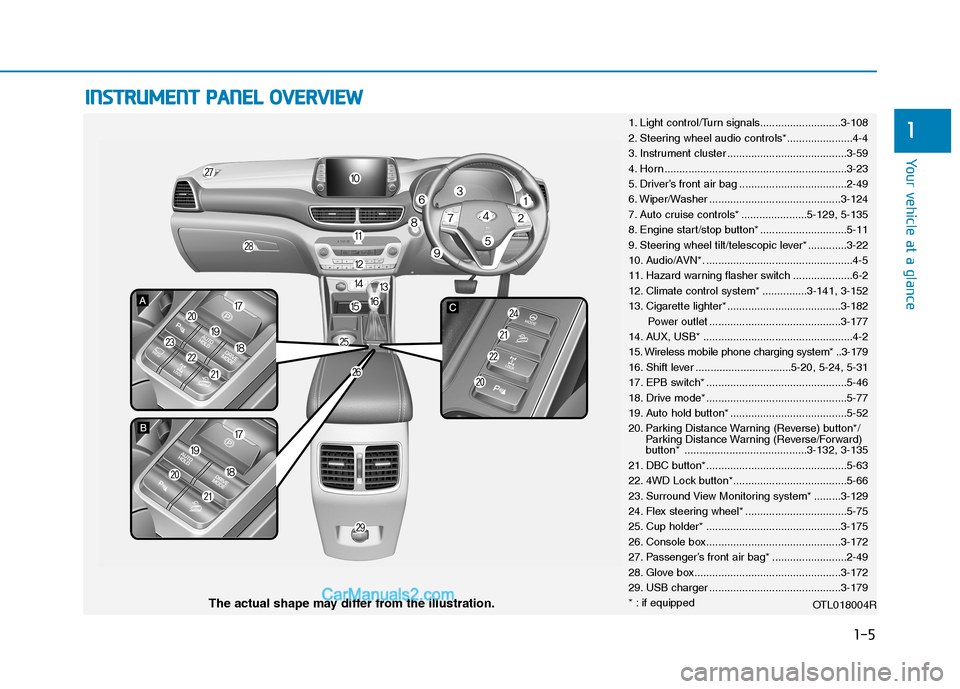
1. Light control/Turn signals...........................3-108
2. Steering wheel audio controls*......................4-4
3. Instrument cluster ........................................3-59
4. Horn .............................................................3-23
5. Driver’s front air bag ....................................2-49
6. Wiper/Washer ............................................3-124
7. Auto cruise controls* ......................5-129, 5-135
8. Engine start/stop button* .............................5-11
9. Steering wheel tilt/telescopic lever* .............3-22
10. Audio/AVN*. .................................................4-5
11. Hazard warning flasher switch ....................6-2
12. Climate control system* ...............3-141, 3-152
13. Cigarette lighter* ......................................3-182
Power outlet ............................................3-177
14. AUX, USB* ..................................................4-2
15. Wireless mobile phone charging system* ..3-179
16. Shift lever ................................5-20, 5-24, 5-31
17. EPB switch* ...............................................5-46
18. Drive mode* ...............................................5-77
19. Auto hold button* .......................................5-52
20. Parking Distance Warning (Reverse) button*/
Parking Distance Warning (Reverse/Forward)
button* .........................................3-132, 3-135
21. DBC button*...............................................5-63
22. 4WD Lock button*......................................5-66
23. Surround View Monitoring system* .........3-129
24. Flex steering wheel* ..................................5-75
25. Cup holder* .............................................3-175
26. Console box.............................................3-172
27. Passenger’s front air bag* .........................2-49
28. Glove box.................................................3-172
29. USB charger ............................................3-179
* : if equipped
OTL018004R
The actual shape may differ from the illustration.
Page 22 of 637

Safety system of your vehicle
2
Important safety precautions...............................2-2
Always wear your seat belt............................................2-2
Restrain all children ..........................................................2-2
Air bag hazards..................................................................2-2
Driver distraction ...............................................................2-2
Control your speed ...........................................................2-3
Keep your vehicle in a safe condition .........................2-3
Seats ........................................................................2-4
Safety precautions............................................................2-5
Front seats ..........................................................................2-6
Rear seats .........................................................................2-12
Headrest ............................................................................2-15
Seat warmers and air ventilation seats.....................2-19
Seat belts ..............................................................2-23
Seat belt safety precautions ........................................2-23
Seat belt warning light ..................................................2-25
Seat belt restraint system ............................................2-27
Additional seat belt safety precautions ....................2-34
Care of seat belts ...........................................................2-36
Child restraint system (CRS) ..............................2-37
Children always in the rear seats ...............................2-37
Selecting a Child Restraint System (CRS) .................2-38
Installing a Child Restraint System (CRS)..................2-40
Air bag - supplemental restraint system .........2-47
Where are the air bags? ...............................................2-49
How does the air bag system operate? ....................2-52
What to expect after an air bag inflates..................2-56
Why didn't my air bag go off in a collision? ...........2-58
SRS care ............................................................................2-63
Additional safety precautions ......................................2-64
Air bag warning labels ...................................................2-65
This chapter provides you with important information about how to protect yourself and your passengers.
It explains how to properly use your seats and seat belts, and how your air bags work.
Additionally, this chapter explains how to properly restrain infants and children in your vehicle.
Page 23 of 637
2-2
You will find many safety precautions
and recommendations throughout
this section, and throughout this
manual. The safety precautions in
this section are among the most
important.
Always wear your seat belt
A seat belt is your best protection in
all types of accidents. Air bags are
designed to supplement seat belts,
not replace them. So even though
your vehicle is equipped with air
bags, ALWAYS make sure you and
your passengers wear the seat belts,
and wear them properly.
Restrain all children
All children under age 13 should ride
in your vehicle properly restrained in
a rear seat, not the front seat. Infants
and small children should be
restrained in an appropriate Child
Restraint System. Larger children
should use a booster seat with the
lap/shoulder belt until they can use
the seat belt properly without a
booster seat.
Air bag hazards
Whilst air bags can save lives, they
can also cause serious or fatal
injuries to occupants who sit too
close to them, or who are not proper-
ly restrained. Infants, young children,
and short adults are at the greatest
risk of being injured by an inflating air
bag. Follow all instructions and warn-
ings in this manual.
Driver distraction
Driver distraction presents a serious
and potentially deadly danger, espe-
cially for inexperienced drivers.
Safety should be the first concern
when behind the wheel and drivers
need to be aware of the wide array of
potential distractions, such as
drowsiness, reaching for objects,
eating, personal grooming, other
passengers, and using mobile
phones.
Drivers can become distracted when
they take their eyes and attention off
the road or their hands off the wheel
to focus on activities other than driv-
ing. To reduce your risk of distraction
and an accident:
• ALWAYS set up your mobile
devices (i.e., MP3 players, phones,
navigation units, etc.) when your
vehicle is parked or safely stopped.
ONLY use your mobile device
when laws and conditions permit
safe use. NEVER text or email
whilst driving. Most countries have
laws prohibiting drivers from tex-
ting. Some countries and cities
also prohibit drivers from using
handheld phones.
I IM
MP
PO
OR
RT
TA
AN
NT
T
S
SA
AF
FE
ET
TY
Y
P
PR
RE
EC
CA
AU
UT
TI
IO
ON
NS
S
Safety system of your vehicle
Page 26 of 637
2-5
Safety system of your vehicle
2
Safety precautions
Adjusting the seats so that you are
sitting in a safe, comfortable position
plays an important role in driver and
passenger safety, together with seat
belts and air bags, if an accident
occurs.
Air bags
You can take steps to reduce the risk
of being injured by an inflating air
bag. Sitting too close to an air bag
greatly increases the risk of injury in
the event the air bag inflates. Move
your seat as far back as possible
from front air bags, whilst still main-
taining control of the vehicle.
Seat belts
Always fasten your seat belt before
starting any trip.
At all times, passengers should sit
upright and be properly restrained.
Infants and small children must be
restrained in appropriate Child
Restraint Systems. Children who
have outgrown a booster seat and
adults must be restrained using the
seat belts.
Do not use a cushion that
reduces friction between the
seat and the passenger. The
passenger's hips may slide
under the lap portion of the seat
belt during an accident or a
sudden stop. Serious or fatal
internal injuries could result
because the seat belt cannot
operate properly.
WARNING
To reduce the risk of serious
injury or death from an inflating
air bag, take the following pre-
cautions:
•Adjust the driver’s seat as far
to the rear as possible whilst
maintaining the ability to
maintain full control of the
vehicle.
Adjust the front passenger
seat as far to the rear as pos-
sible.
Hold the steering wheel by the
rim with hands at the 9 o’clock
and 3 o’clock positions to
minimise the risk of injuries to
your hands and arms.
NEVER place anything or any-
one between the air bag.
Do not allow the front passen-
ger to place feet or legs on the
instrument panel to minimise
the risk of leg injuries.
WARNING
Page 31 of 637

2-10
Safety system of your vehicle
Seatback angle
To recline the seatback:
1. Push the control switch forward or
rearward.
2. Release the switch once the seat-
back reaches the desired position.Reclining seatback
Sitting in a reclined position when
the vehicle is in motion can be dan-
gerous. Even when buckled up, the
protections of your restraint system
(seat belts and air bags) are greatly
reduced by reclining your seatback.Seat belts must be snug against your
hips and chest to work properly.
When the seatback is reclined, the
shoulder belt cannot do its job
because it will not be snug against
your chest. Instead, it will be in front
of you. During an accident, you could
be thrown into the seat belt, causing
neck or other injuries.
The more the seatback is reclined,
the greater chance the passenger’s
hips will slide under the lap belt or
the passenger’s neck will strike the
shoulder belt.
OTL035006/HNEVER ride with a reclined
seatback when the vehicle is
moving.
Riding with a reclined seatback
increases your chance of seri-
ous or fatal injuries in the event
of a collision or sudden stop.
The driver and passengers
should ALWAYS sit well back in
their seats, properly restrained,
and with the seatbacks upright.
WARNING