2020 Hyundai Tucson brake light
[x] Cancel search: brake lightPage 349 of 637
5-32
The indicator in the instrument clus-
ter displays the shift lever position
when the ignition switch is in the ON
position.
The dual clutch transmission gives
the driving feel of a manual trans-
mission, yet provides the ease of a
fully automatic transmission. Unlike
a traditional automatic transmis-
sion, the gear shifting can be felt
(and heard) on the dual clutch
transmission
- Think of it as an automatically
shifting manual transmission.
- Shift into Drive range and get fully
automatic shifting, similar to a
conventional automatic transmis-
sion.
Dual clutch transmission adopts a
dry-type dual clutch, which is dif-
ferent from torque converter of
automatic transmission, and
shows better acceleration perform-
ance during driving. But, initial
launch might be little bit slower
than Automatic Transmission. Gear shifts are sometimes more
noticeable than a conventional
automatic transmission and a light
vibration during launching can be
felt as the transmission speed is
matched with the engine speed.
This is a normal condition of the
dual clutch transmission.
The dry-type clutch transfers
torque and provides a direct driv-
ing feeling which may feel different
from a conventional automatic
transmission with a torque convert-
er. This may be more noticeable
when starting from a stop or low
vehicle speed.
When rapidly accelerating at low
vehicle speed, the engine could
rev at high rpm depending on vehi-
cle drive condition.
For smooth launch uphill, press
down the accelerator pedal
smoothly depending on the current
conditions.
If you release your foot from the
accelerator pedal at low vehicle
speed, you may feel strong engine
brake, which is similar to manual
transmission.
Driving your vehicle
Do not use the engine brake
(shifting from a high gear to
lower gear) rapidly on slip-
pery roads. The vehicle may
slip causing an accident.
To avoid damage to your
transmission, do not try to
accelerate in R (Reverse) or
any forward gear position with
the brakes on.
When stopped on slope, do
not hold the vehicle with
accelerator pedal. Use the
service brake or the parking
brake.
Page 358 of 637
5-41
Driving your vehicle
If you need to use the shift-lock sys-
tem, we recommend that the system
be inspected by an authorised
HYUNDAI dealer immediately.
Ignition key interlock system
(if equipped)
The ignition key cannot be removed
unless the shift lever is in the P
(Park) position.
Parking
Always come to a complete stop and
continue to depress the brake pedal.
Move the shift lever into the P (Park)
position, apply the parking brake,
and place the ignition switch in the
LOCK/OFF position. Take the Key
with you when exiting the vehicle.
Good driving practices
Never move the shift lever from P
(Park) or N (Neutral) to any other
position with the accelerator pedal
depressed.
Never move the shift lever into P
(Park) when the vehicle is in
motion.
Be sure the vehicle is completely
stopped before you attempt to shift
into R (Reverse) or D (Drive).
Do not move the shift lever to N
(Neutral) when driving. Doing so
may result in an accident because
of a loss of engine braking and the
transmission could be damaged.
Do not drive with your foot resting
on the brake pedal. Even light, but
consistent pedal pressure can
result in the brakes overheating,
brake wear and possibly even
brake failure.
When driving in sports mode, slow
down before shifting to a lower
gear. Otherwise, the lower gear
may not be engaged if the engine
rpms are outside of the allowable
range.
5
When you stay in the vehicle
with the engine running, be
careful not to depress the accel-
erator pedal for a long period of
time. The engine or exhaust
system may overheat and start
a fire.
The exhaust gas and the
exhaust system are very hot.
Keep away from the exhaust
system components.
Do not stop or park over flam-
mable materials, such as dry
grass, paper or leaves. They
may ignite and cause a fire.
WARNING
Page 360 of 637
5-43
Driving your vehicle
5
Power brakes
Your vehicle has power-assisted
brakes that adjust automatically
through normal usage.
If the engine is not running or is
turned off whilst driving, the power
assist for the brakes will not work.
You can still stop your vehicle by
applying greater force to the brake
pedal than typical. The stopping dis-
tance, however, will be longer than
with power brakes.
When the engine is not running, the
reserve brake power is partially
depleted each time the brake pedal
is applied. Do not pump the brake
pedal when the power assist has
been interrupted.
Pump the brake pedal only when
necessary to maintain steering con-
trol on slippery surfaces.
B BR
RA
AK
KI
IN
NG
G
S
SY
YS
ST
TE
EM
M
Take the following precautions:
Do not drive with your foot
resting on the brake pedal.
This will create abnormally
high brake temperatures,
excessive brake lining and
pad wear, and increased stop-
ping distances.
When descending a long or
steep hill, shift to a lower gear
and avoid continuous applica-
tion of the brakes. Applying
the brakes continuously will
cause the brakes to overheat
and could result in a tempo-
rary loss of braking perform-
ance.
Wet brakes may impair the
vehicle’s ability to safely slow
down; the vehicle may also
pull to one side when the
brakes are applied. Applying
the brakes lightly will indicate
whether they have been
affected in this way. Always
test your brakes in this fash-
ion after driving through deep
water. To dry the brakes, light-
ly tap the brake pedal to heat
up the brakes whilst maintain-
ing a safe forward speed until
brake performance returns to
normal. Avoid driving at high
speeds until the brakes func-
tion correctly.WARNING
Page 361 of 637
5-44
Driving your vehicle
Disc brakes wear indicator
When your brake pads are worn and
new pads are required, you will hear
a high pitched warning sound from
your front or rear brakes. You may
hear this sound come and go or it
may occur whenever you depress
the brake pedal.
Please remember some driving con-
ditions or climates may cause a
brake squeal when you first apply (or
lightly apply) the brakes. This is nor-
mal and does not indicate a problem
with your brakes.
To avoid costly brake repairs, do
not continue to drive with worn
brake pads.
Information
Always replace brake pads as com-
plete front or rear axle sets.
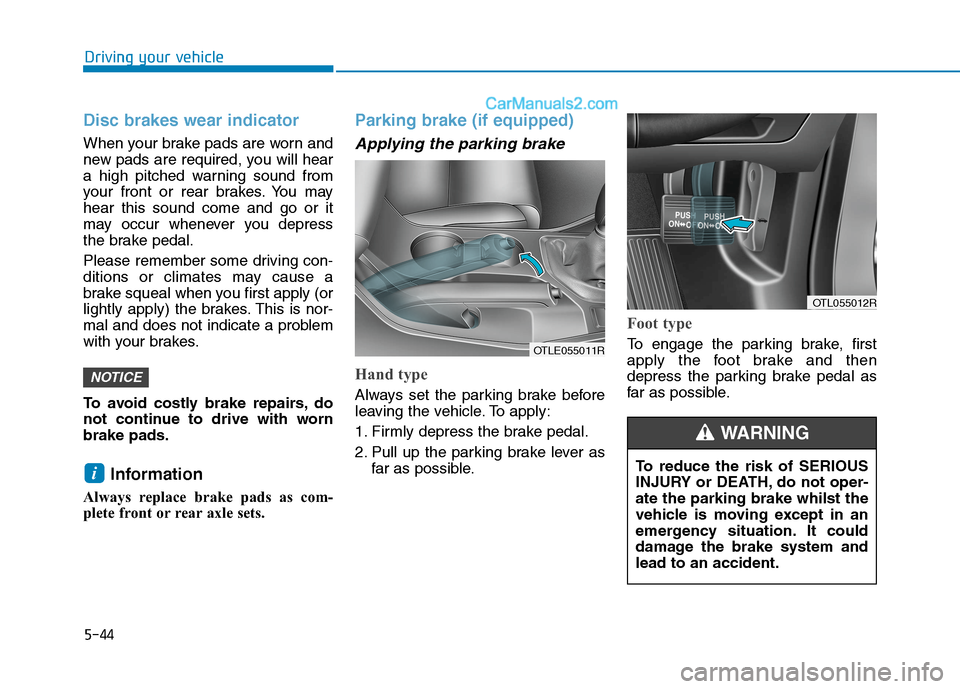
Parking brake (if equipped)
Applying the parking brake
Hand type
Always set the parking brake before
leaving the vehicle. To apply:
1. Firmly depress the brake pedal.
2. Pull up the parking brake lever as
far as possible.
Foot type
To engage the parking brake, first
apply the foot brake and then
depress the parking brake pedal as
far as possible.
i
NOTICE
OTL055012R
To reduce the risk of SERIOUS
INJURY or DEATH, do not oper-
ate the parking brake whilst the
vehicle is moving except in an
emergency situation. It could
damage the brake system and
lead to an accident.
WARNING
OTLE055011R
Page 362 of 637
5-45
Driving your vehicle
5
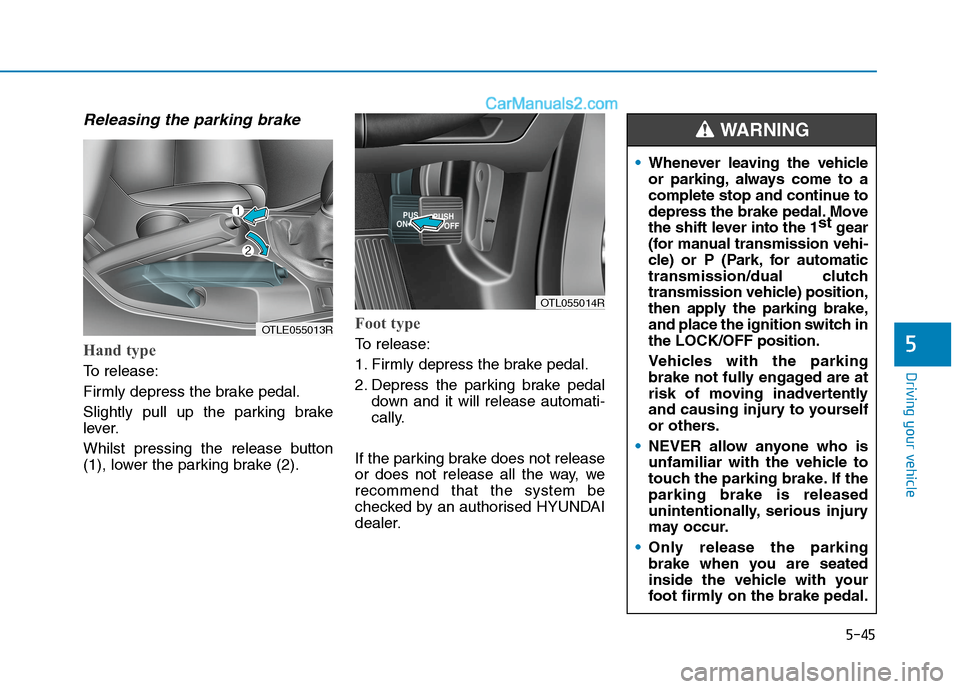
Releasing the parking brake
Hand type
To release:
Firmly depress the brake pedal.
Slightly pull up the parking brake
lever.
Whilst pressing the release button
(1), lower the parking brake (2).
Foot type
To release:
1. Firmly depress the brake pedal.
2. Depress the parking brake pedal
down and it will release automati-
cally.
If the parking brake does not release
or does not release all the way, we
recommend that the system be
checked by an authorised HYUNDAI
dealer.Whenever leaving the vehicle
or parking, always come to a
complete stop and continue to
depress the brake pedal. Move
the shift lever into the 1st
gear
(for manual transmission vehi-
cle) or P (Park, for automatic
transmission/dual clutch
transmission vehicle) position,
then apply the parking brake,
and place the ignition switch in
the LOCK/OFF position.
Vehicles with the parking
brake not fully engaged are at
risk of moving inadvertently
and causing injury to yourself
or others.
NEVER allow anyone who is
unfamiliar with the vehicle to
touch the parking brake. If the
parking brake is released
unintentionally, serious injury
may occur.
Only release the parking
brake when you are seated
inside the vehicle with your
foot firmly on the brake pedal.
WARNING
OTLE055013R
OTL055014R
Page 363 of 637
5-46
Driving your vehicle
Do not apply the accelerator
pedal whilst the parking brake is
engaged. If you depress the
accelerator pedal with the park-
ing brake engaged, a warning
will sound and damage to the
parking brake may occur.
Driving with the parking brake on
can overheat the braking system
and cause premature wear or
damage to brake parts. Make sure
the parking brake is released and
the Brake Warning Light is off
before driving.Check the Parking
Brake Warning Light
by placing the ignition
switch to the ON posi-
tion (do not start the
engine).
This light will be illuminated when the
parking brake is applied with the igni-
tion switch in the START or ON posi-
tion.
Before driving, be sure the parking
brake is released and the Brake
Warning Light is OFF.
If the Parking Brake Warning Light
remains on after the parking brake is
released whilst engine is running,
there may be a malfunction in the
brake system. Immediate attention is
necessary.
If at all possible, cease driving the
vehicle immediately. If that is not pos-
sible, use extreme caution whilst
operating the vehicle and only con-
tinue to drive the vehicle until you
can reach a safe location.
Electronic Parking Brake
(EPB) (if equipped)
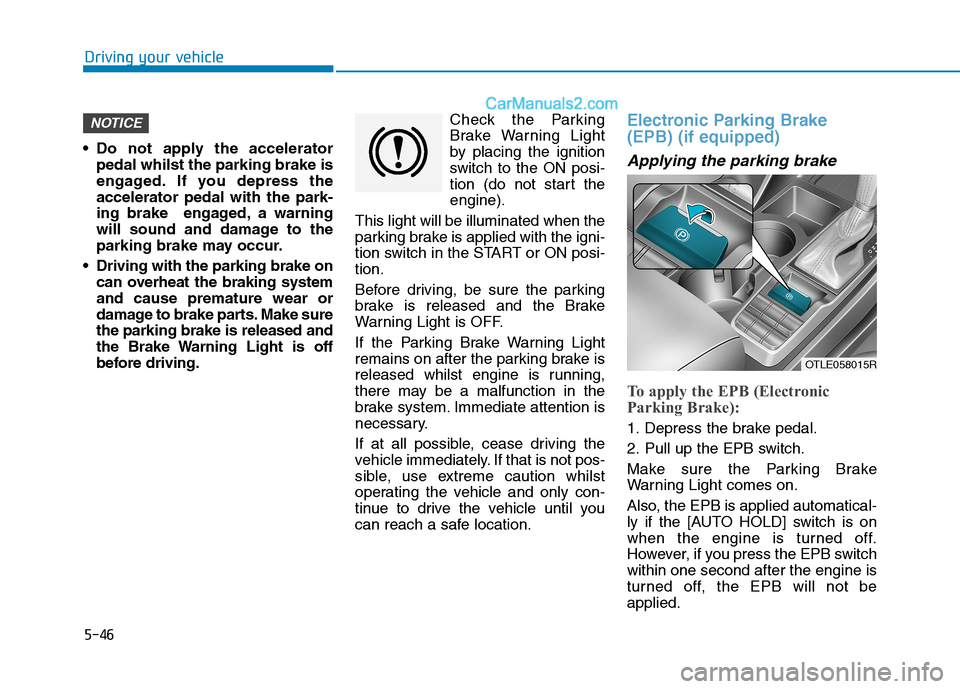
Applying the parking brake
To apply the EPB (Electronic
Parking Brake):
1. Depress the brake pedal.
2. Pull up the EPB switch.
Make sure the Parking Brake
Warning Light comes on.
Also, the EPB is applied automatical-
ly if the [AUTO HOLD] switch is on
when the engine is turned off.
However, if you press the EPB switch
within one second after the engine is
turned off, the EPB will not be
applied.
NOTICE
OTLE058015R
Page 364 of 637
5-47
Driving your vehicle
5
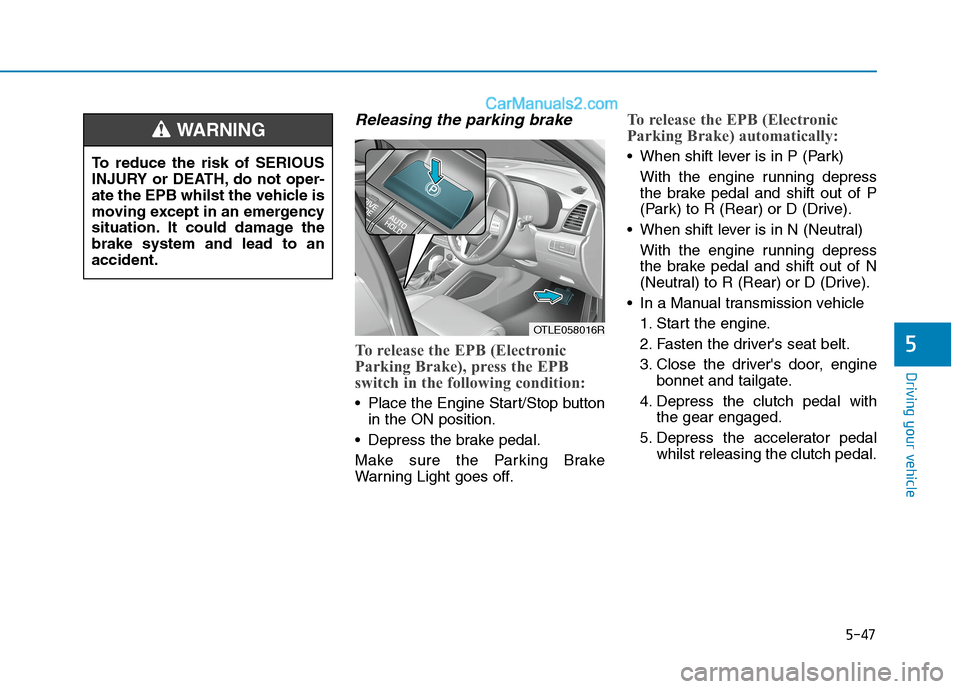
Releasing the parking brake
To release the EPB (Electronic
Parking Brake), press the EPB
switch in the following condition:
Place the Engine Start/Stop button
in the ON position.
Depress the brake pedal.
Make sure the Parking Brake
Warning Light goes off.
To release the EPB (Electronic
Parking Brake) automatically:
When shift lever is in P (Park)
With the engine running depress
the brake pedal and shift out of P
(Park) to R (Rear) or D (Drive).
When shift lever is in N (Neutral)
With the engine running depress
the brake pedal and shift out of N
(Neutral) to R (Rear) or D (Drive).
In a Manual transmission vehicle
1. Start the engine.
2. Fasten the driver's seat belt.
3. Close the driver's door, engine
bonnet and tailgate.
4. Depress the clutch pedal with
the gear engaged.
5. Depress the accelerator pedal
whilst releasing the clutch pedal. To reduce the risk of SERIOUS
INJURY or DEATH, do not oper-
ate the EPB whilst the vehicle is
moving except in an emergency
situation. It could damage the
brake system and lead to an
accident.
WARNING
OTLE058016R
Page 365 of 637
5-48
Driving your vehicle
In an Automatic transmission/dual
clutch transmission vehicle
1. Start the engine.
2. Fasten the driver's seat belt.
3. Close the driver's door, engine
bonnet and tailgate.
4. Depress the accelerator pedal
whilst the shift lever is in R
(Rear), D (Drive) or Sports mode.
Make sure the Parking Brake
Warning light goes off.
Information
• For your safety, you can engage the
EPB even though the Engine
Stop/Start button is in the OFF posi-
tion, but you cannot release it.
• For your safety, depress the brake
pedal and release the parking brake
manually with the EPB switch when
you drive downhill or when revers-
ing the vehicle.
Information - Manual trans-
mission
A vehicle towing a trailer on a hill or
on an incline may roll slightly rear-
wards when starting the vehicle.
To prevent the situation follow the
below instructions.
1. Depress the clutch pedal and select
a gear.
2. Keep pulling up the EPB switch.
3. Depress the accelerator pedal and
slowly release the clutch pedal.
4. If the vehicle starts off with enough
driving power release the EPB
switch.
Do not follow the above procedure
when driving on a flat level ground.
The vehicle may suddenly move for-
ward. If the parking brake warning
light is still on even though the
EPB has been released, we rec-
ommend that the system be
checked by an authorised
HYUNDAI dealer.
Do not drive your vehicle with
the EPB applied. It may cause
excessive brake pad and brake
rotor wear.
When the EPB (Electronic Parking
Brake) does not release:
We recommend that you contact an
authorised HYUNDAI dealer and
load the vehicle on a flatbed tow
truck to have the system checked.
NOTICEi
i