2020 Hyundai Sonata lubricants
[x] Cancel search: lubricantsPage 7 of 537

Foreword
1-2
INTRODUCTION
Congratulations, and thank you for choosing HYUNDAI. We are pleased to welcome
you to the growing number of discerning people who drive HYUNDAIs. We are very
proud of the advanced engineering and high-quality construction of each HYUNDAI
we build.
Your Owner’s Manual will introduce you to the features and operation of your new
HYUNDAI. To become familiar with your new HYUNDAI, so that you can fully enjoy it,
read this Owner’s Manual carefully before driving your new vehicle.
This manual contains important safety information and instructions intended to
familiarize you with your vehicle’s controls and safety features so you can safely
operate your vehicle.
This manual also contains information on maintenance designed to enhance safe
operation of the vehicle. It is recommended that all service and maintenance on your
car be performed by an authorized HYUNDAI dealer. HYUNDAI dealers are prepared
to provide high-quality service, maintenance and any other assistance that may be
required.
This Owner’s Manual should be considered a permanent part of your vehicle, and
should be kept in the vehicle so you can refer to it at any time. The manual should stay
with the vehicle if you sell it to provide the next owner with important operating, safety
and maintenance information.
HYUNDAI MOTOR AMERICA
CAUTION
Severe engine and transmission damage may result from the use of poor quality
fuels and lubricants that do not meet HYUNDAI specifications. You must always use
high quality fuels and lubricants that meet the specifications listed on Page 2-11 in
the Vehicle Specifications section of the Owner’s Manual.
Copyright 2019 HYUNDAI Motor America. All rights reserved. No part of this publication
may be reproduced, stored in any retrieval system or transmitted in any form or by any
means without the prior written permission of HYUNDAI Motor America.
Page 14 of 537

2
2. Vehicle Information
Vehicle Information
Exterior Overview ........................................................................\
..................2-2
Interior Overview
........................................................................\
...................2-4
Instrument Panel Overview
........................................................................\
...2-5
Engine Compartment
........................................................................\
............2-6
Dimensions
........................................................................\
..............................2-7
Engine Specification
........................................................................\
...............2-7
Bulb Wattage
........................................................................\
..........................2-8
Tires and Wheels
........................................................................\
....................2-9
Volume and Weight
........................................................................\
..............2-10
Air Conditioning System
........................................................................\
.......2-10
Recommended Lubricants and Capacities
..................................................2-11Recommended SAE Viscosity Number .................................................................2-12
Vehicle Identification Number (VIN) ...........................................................2-13
Vehicle Certification Label
........................................................................\
...2-13
Tire Specification and Pressure Label
.........................................................2-14
Engine Number
........................................................................\
.....................2-14
Refrigerant Label ........................................................................\
.................. 2-15
Page 24 of 537
02
2-11
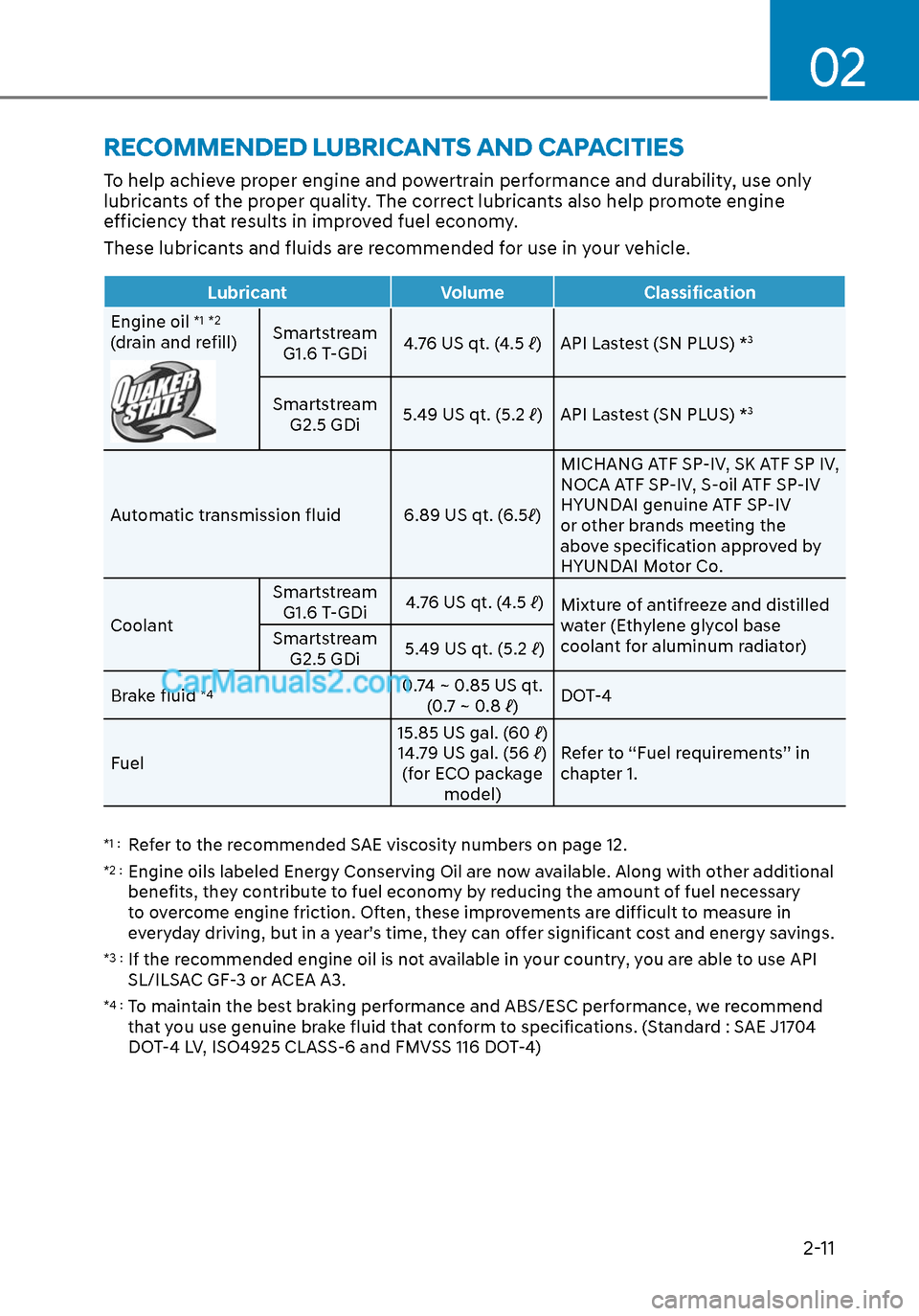
RECOMMENDED LUBRICANTS AND CAPACITIES
To help achieve proper engine and powertrain performance and durability, use only
lubricants of the proper quality. The correct lubricants also help promote engine
efficiency that results in improved fuel economy.
These lubricants and fluids are recommended for use in your vehicle.
LubricantVolumeClassification
Engine oil
*1 *2
(drain and refill) Smartstream
G1.6 T-GDi 4.76 US qt. (4.5 ℓ)
API Lastest (SN PLUS) *3
Smartstream G2.5 GDi5.49 US qt. (5.2 ℓ)
API Lastest (SN PLUS) *3
Automatic transmission fluid 6.89 US qt. (6.5ℓ)MICHANG ATF SP-IV, SK ATF SP IV,
NOCA ATF SP-IV, S-oil ATF SP-IV
HYUNDAI genuine ATF SP-IV
or other brands meeting the
above specification approved by
HYUNDAI Motor Co.
Coolant Smartstream
G1.6 T-GDi 4.76 US qt. (4.5 ℓ)
Mixture of antifreeze and distilled
water (Ethylene glycol base
coolant for aluminum radiator)
Smartstream
G2.5 GDi 5.49 US qt. (5.2 ℓ)
Brake fluid
*40.74 ~ 0.85 US qt. (0.7 ~ 0.8 ℓ) DOT-4
Fuel 15.85 US gal. (60 ℓ)
14.79 US gal. (56 ℓ) (for ECO package model) Refer to “Fuel requirements” in
chapter 1.
*1 : Refer to the recommended SAE viscosity numbers on page 12.
*2 : Engine oils labeled Energy Conserving Oil are now available. Along with other additional
benefits, they contribute to fuel economy by reducing the amount of fuel necessary
to overcome engine friction. Often, these improvements are difficult to measure in
everyday driving, but in a year’s time, they can offer significant cost and energy savings.
*3 : If the recommended engine oil is not available in your country, you are able to use API
SL/ILSAC GF-3 or ACEA A3.
*4 : To maintain the best braking performance and ABS/ESC performance, we recommend
that you use genuine brake fluid that conform to specifications. (Standard : SAE J1704
DOT-4 LV, ISO4925 CLASS-6 and FMVSS 116 DOT-4)
Page 452 of 537
08
8-5
WARNING
Performing maintenance work on a
vehicle can be dangerous. If you lack
sufficient knowledge and experience or
the proper tools and equipment to do
the work, have it done by an authorized
HYUNDAI dealer.
ALWAYS follow these precautions for
performing maintenance work:
• Park your vehicle on level ground,
move the shift button into the P
(Park) position, place the ignition
switch in the LOCK/OFF position.
• Block the tires (front and back) to
prevent the vehicle from moving.
Remove loose clothing or jewelry
that can become entangled in
moving parts.
• If you must run the engine during
maintenance, do so out doors or in
an area with plenty of ventilation.
• Keep flames, sparks, or smoking
materials away from the battery and
fuel-related parts. The following lists are vehicle checks and
inspections that should be performed
by the owner or an authorized HYUNDAI
dealer at the frequencies indicated to
help ensure safe, dependable operation
of your vehicle.
Any adverse conditions should be
brought to the attention of your dealer as
soon as possible.
These Owner Maintenance vehicle
checks are generally not covered by
warranties and you may be charged for
labor, parts and lubricants used.
Owner Maintenance Schedule
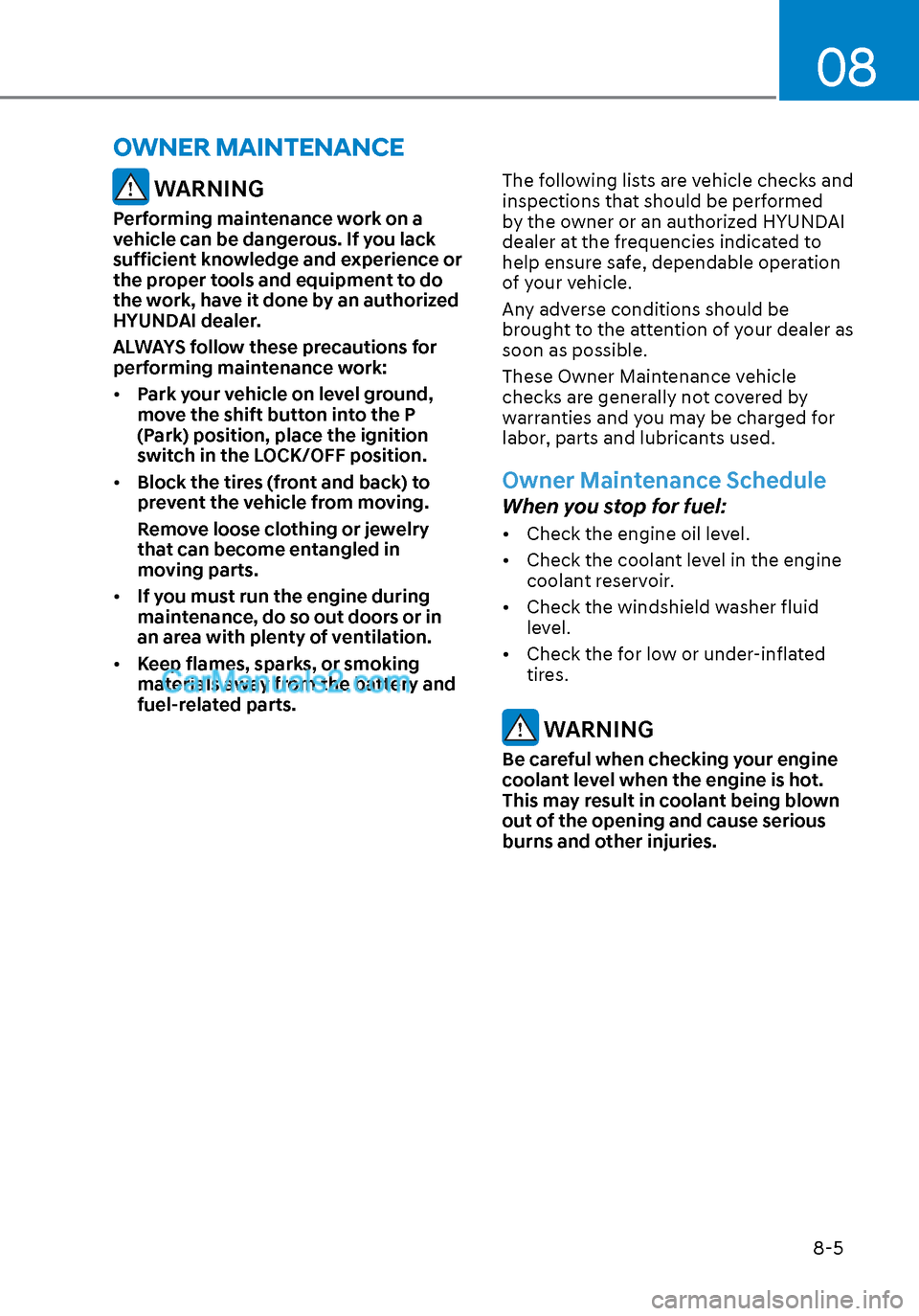
When you stop for fuel:
• Check the engine oil level.
• Check the coolant level in the engine
coolant reservoir.
• Check the windshield washer fluid level.
• Check the for low or under-inflated tires.
WARNING
Be careful when checking your engine
coolant level when the engine is hot.
This may result in coolant being blown
out of the opening and cause serious
burns and other injuries.
OWNER MAINTENANCE
Page 464 of 537
08
8-17
Engine Coolant
The coolant should be changed at the
intervals specified in the maintenance
schedule.
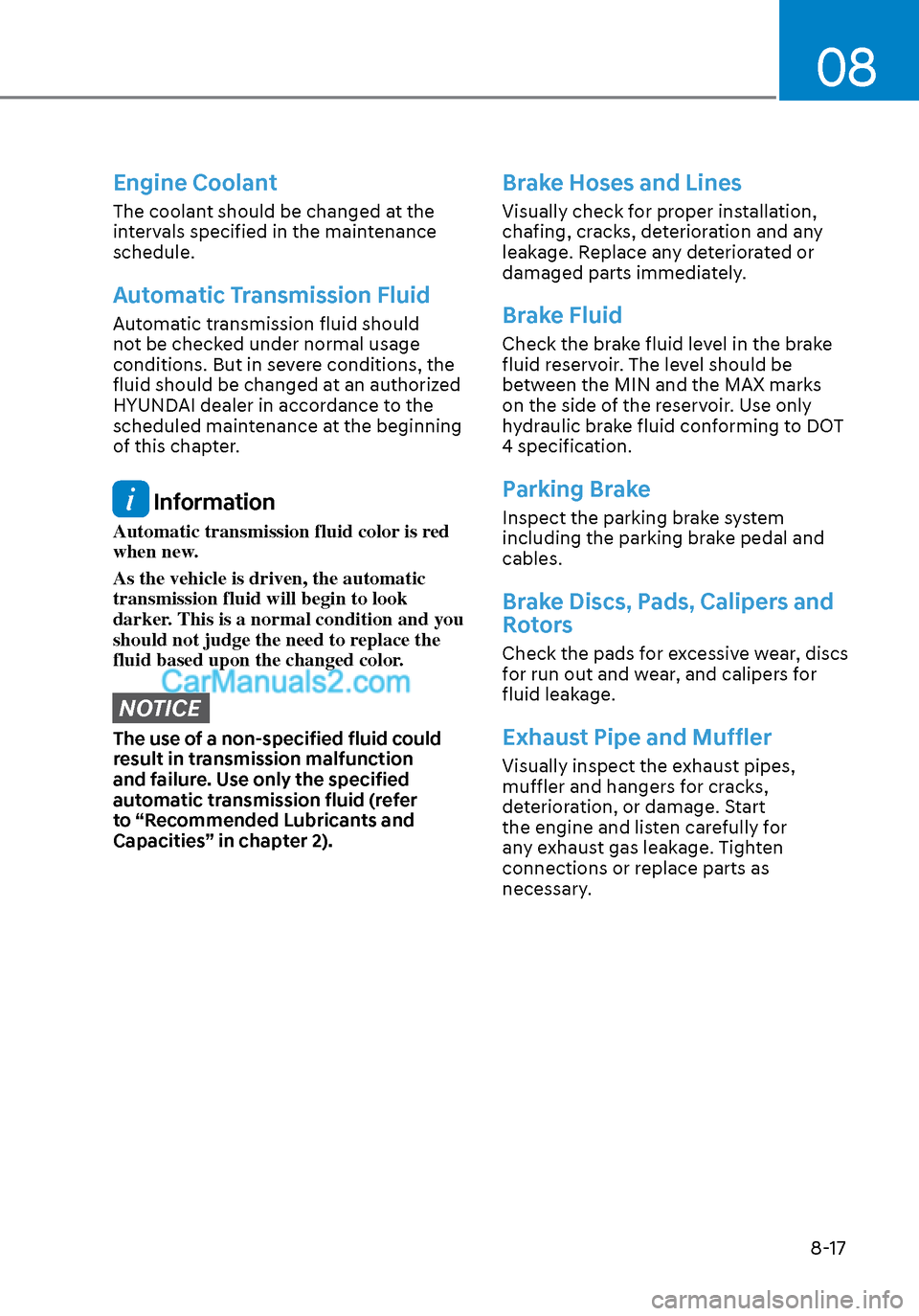
Automatic Transmission Fluid
Automatic transmission fluid should
not be checked under normal usage
conditions. But in severe conditions, the
fluid should be changed at an authorized
HYUNDAI dealer in accordance to the
scheduled maintenance at the beginning
of this chapter.
Information
Automatic transmission fluid color is red
when new.
As the vehicle is driven, the automatic
transmission fluid will begin to look
darker. This is a normal condition and you
should not judge the need to replace the
fluid based upon the changed color.
NOTICE
The use of a non-specified fluid could
result in transmission malfunction
and failure. Use only the specified
automatic transmission fluid (refer
to “Recommended Lubricants and
Capacities” in chapter 2).
Brake Hoses and Lines
Visually check for proper installation,
chafing, cracks, deterioration and any
leakage. Replace any deteriorated or
damaged parts immediately.
Brake Fluid
Check the brake fluid level in the brake
fluid reservoir. The level should be
between the MIN and the MAX marks
on the side of the reservoir. Use only
hydraulic brake fluid conforming to DOT
4 specification.
Parking Brake
Inspect the parking brake system
including the parking brake pedal and
cables.
Brake Discs, Pads, Calipers and
Rotors
Check the pads for excessive wear, discs
for run out and wear, and calipers for
fluid leakage.
Exhaust Pipe and Muffler
Visually inspect the exhaust pipes,
muffler and hangers for cracks,
deterioration, or damage. Start
the engine and listen carefully for
any exhaust gas leakage. Tighten
connections or replace parts as
necessary.
Page 466 of 537
08
8-19
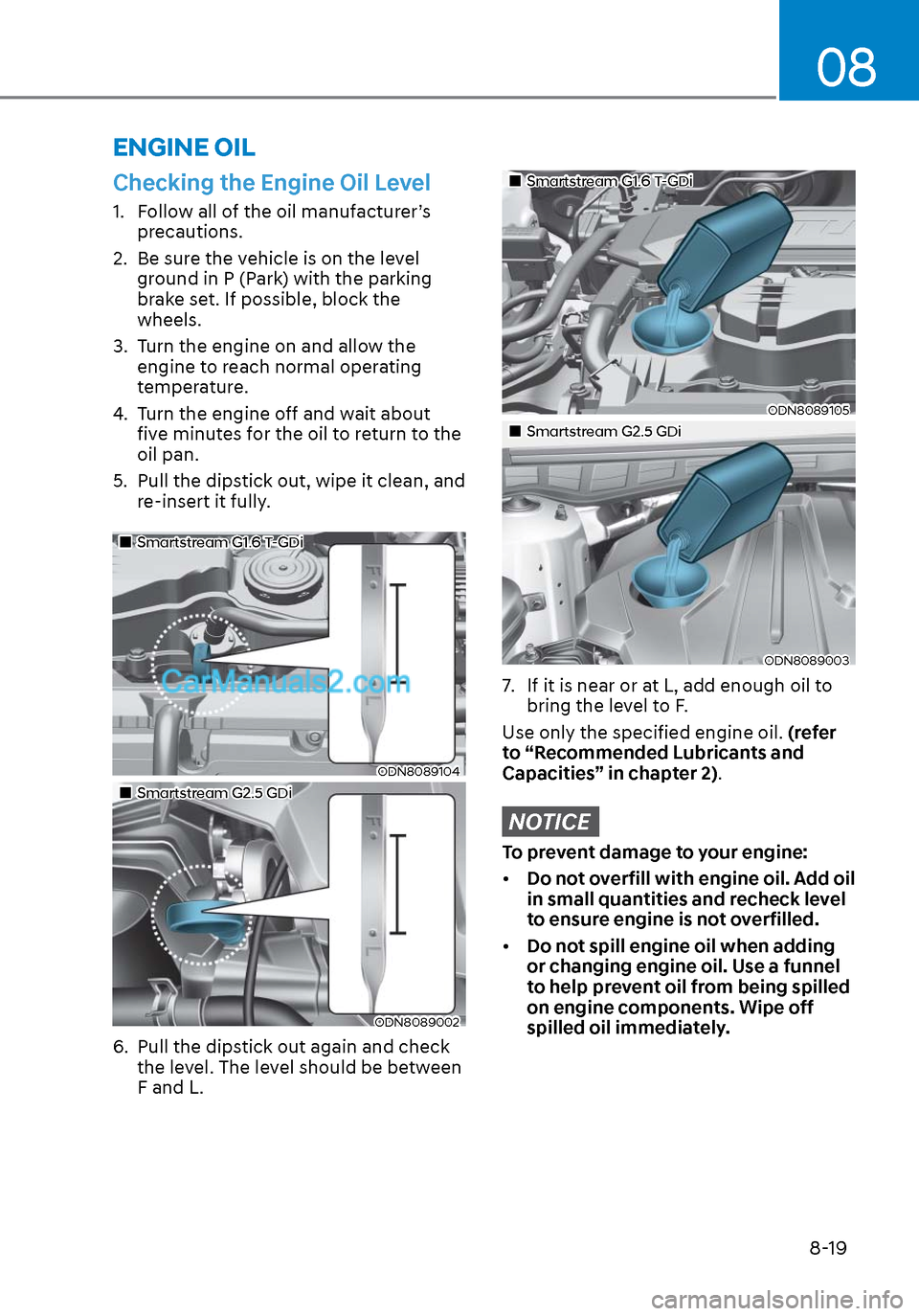
Checking the Engine Oil Level
1. Follow all of the oil manufacturer’s precautions.
2. Be sure the vehicle is on the level ground in P (Park) with the parking
brake set. If possible, block the
wheels.
3. Turn the engine on and allow the engine to reach normal operating
temperature.
4. Turn the engine off and wait about five minutes for the oil to return to the
oil pan.
5. Pull the dipstick out, wipe it clean, and re-insert it fully.
Smartstream G1.6 T-GDiSmartstream G1.6 T-GDi
ODN8089104ODN8089104
Smartstream G2.5 GDiSmartstream G2.5 GDi
ODN8089002ODN8089002
6. Pull the dipstick out again and check the level. The level should be between
F and L.
Smartstream G1.6 T-GDiSmartstream G1.6 T-GDi
ODN8089105ODN8089105
Smartstream G2.5 GDiSmartstream G2.5 GDi
ODN8089003ODN8089003
7. If it is near or at L, add enough oil to bring the level to F.
Use only the specified engine oil. (refer
to “Recommended Lubricants and
Capacities” in chapter 2).
NOTICE
To prevent damage to your engine:
• Do not overfill with engine oil. Add oil
in small quantities and recheck level
to ensure engine is not overfilled.
• Do not spill engine oil when adding
or changing engine oil. Use a funnel
to help prevent oil from being spilled
on engine components. Wipe off
spilled oil immediately.
ENGINE OIL
Page 471 of 537
Maintenance8-24
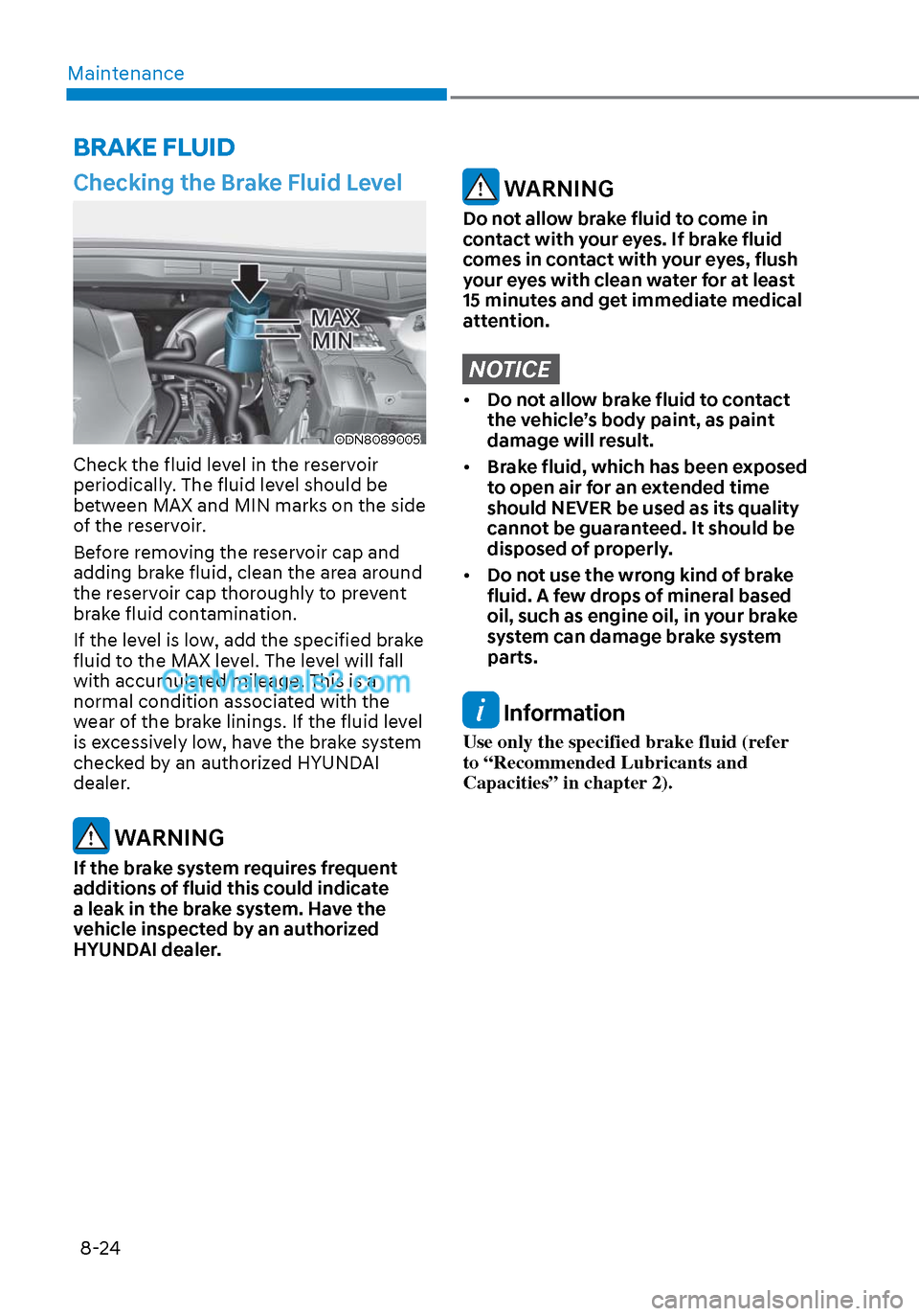
Checking the Brake Fluid Level
ODN8089005ODN8089005
Check the fluid level in the reservoir
periodically. The fluid level should be
between MAX and MIN marks on the side
of the reservoir.
Before removing the reservoir cap and
adding brake fluid, clean the area around
the reservoir cap thoroughly to prevent
brake fluid contamination.
If the level is low, add the specified brake
fluid to the MAX level. The level will fall
with accumulated mileage. This is a
normal condition associated with the
wear of the brake linings. If the fluid level
is excessively low, have the brake system
checked by an authorized HYUNDAI
dealer.
WARNING
If the brake system requires frequent
additions of fluid this could indicate
a leak in the brake system. Have the
vehicle inspected by an authorized
HYUNDAI dealer.
WARNING
Do not allow brake fluid to come in
contact with your eyes. If brake fluid
comes in contact with your eyes, flush
your eyes with clean water for at least
15 minutes and get immediate medical
attention.
NOTICE
• Do not allow brake fluid to contact
the vehicle’s body paint, as paint
damage will result.
• Brake fluid, which has been exposed
to open air for an extended time
should NEVER be used as its quality
cannot be guaranteed. It should be
disposed of properly.
• Do not use the wrong kind of brake
fluid. A few drops of mineral based
oil, such as engine oil, in your brake
system can damage brake system
parts.
Information
Use only the specified brake fluid (refer
to “Recommended Lubricants and
Capacities” in chapter 2).
BRAKE FLUID
Page 523 of 537

IndexI-4
Bulb replacement ........................................................................\
......................... 8-55 Headlamp ...............................................................\
......................................... 8-55
Parking lamp ........................................................................\
........................... 8-55
Daytime running light ........................................................................\
............. 8-55
Turn signal lamp ........................................................................\
...................... 8-55
Cornering lamp .........................................................\
...................................... 8-55
Side marker ........................................................................\
............................. 8-55
Auxiliary lamp ........................................................................\
........................ 8-55
Side repeater lamp ........................................................................\
................... 8-56
Rear combination light bulb ........................................................................\
.... 8-56
High mounted stop lamp ........................................................................\
......... 8-58
License plate light ........................................................................\
.................. 8-58
Interior light ........................................................................\
........................... 8-59
Bulb wattage ........................................................................\
.................................. 2-8
C
California perchlorate notice ........................................................................\
....... 8-70
Capacities (Lubricants) ........................................................................\
................ 2-11
Care Tire care ........................................................................\
................................... 8-34
Exterior care ........................................................................\
............................ 8-61
Interior care ........................................................................\
............................. 8-65
Center console storage ........................................................................\
............... 5-144
Central door lock/unlock switch ........................................................................\
.. 5-33
Certification label ........................................................................\
........................ 2-13
Check tire inflation pressure ........................................................................\
........ 8-35
Child restraint system (CRS) ........................................................................\
....... 3-29 Selecting a child restraint system (CRS) ......................................................... 3-30
Rearward-facing child restraint system ........................................................... 3-30
Forward-facing child restraint system ............................................................. 3-31
Booster seats........................................................................\
............................ 3-31
Installing a child restraint system (CRS) ........................................................ 3-31
Lower anchors and tether for Children (LATCH System) .............................. 3-32
Lower anchors ........................................................................\
........................ 3-33
Tether anchors ........................................................................\
......................... 3-34
Lap/shoulder belt ........................................................................\
..................... 3-35
Child-protector rear door lock ........................................................................\
..... 5-35
Climate control air filter ........................................................................\
.............. 8-28