Page 507 of 561
H2
An FCEV is an electric vehicle which is driven using the electricity generated from the fuel cell.
The power system of the FCEV is composed of the following:
- The fuel cell stack which generates the electricity
- The device which controls the heat generated after supplying the hydrogen and air for chemical reaction of the stack
- The inverter which converts the DC created from the stack to AC
- The traction motor which generates propelling power using the supplied AC
- Air processing system
- Fuel processing system
The hydrogen tanks that stores the hydrogen supplied to the fuel cell can be fueled at 70 MPa.
❈FCEV is Fuel Cell Electric Vehicle
I
IN
NT
TR
RO
OD
DU
UC
CT
TI
IO
ON
N
O
OF
F
F
FC
CE
EV
V
Page 509 of 561
H4
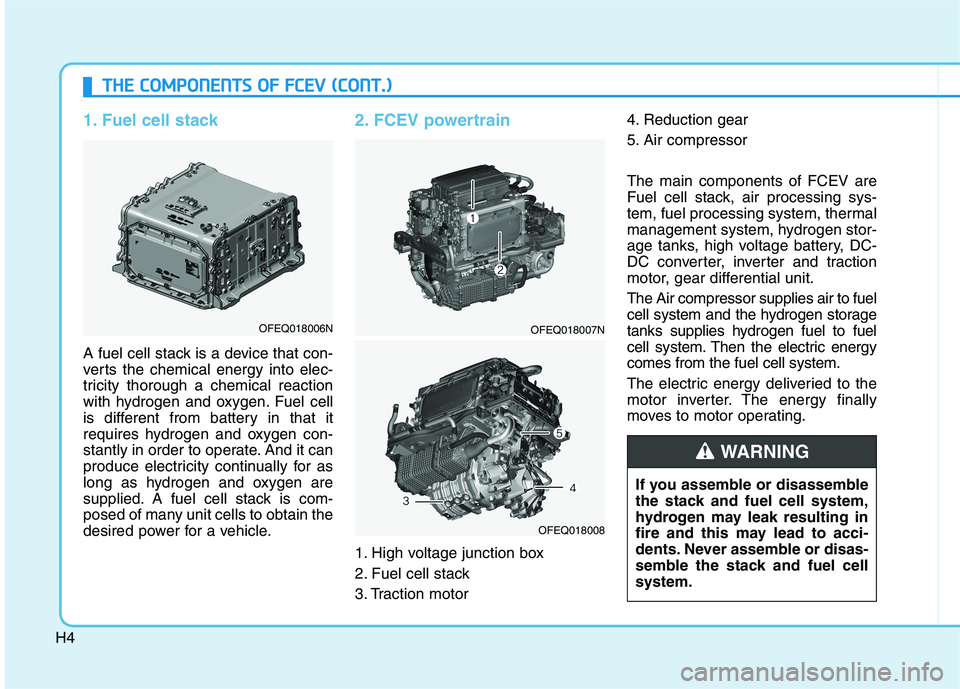
1. Fuel cell stack
A fuel cell stack is a device that con-
verts the chemical energy into elec-
tricity thorough a chemical reaction
with hydrogen and oxygen. Fuel cell
is different from battery in that it
requires hydrogen and oxygen con-
stantly in order to operate. And it can
produce electricity continually for as
long as hydrogen and oxygen are
supplied. A fuel cell stack is com-
posed of many unit cells to obtain the
desired power for a vehicle.
2. FCEV powertrain
1. High voltage junction box
2. Fuel cell stack
3. Traction motor4. Reduction gear
5. Air compressor
The main components of FCEV are
Fuel cell stack, air processing sys-
tem, fuel processing system, thermal
management system, hydrogen stor-
age tanks, high voltage battery, DC-
DC converter, inverter and traction
motor, gear differential unit.
The Air compressor supplies air to fuel
cell system and the hydrogen storage
tanks supplies hydrogen fuel to fuel
cell system. Then the electric energy
comes from the fuel cell system.
The electric energy deliveried to the
motor inverter. The energy finally
moves to motor operating.
T TH
HE
E
C
CO
OM
MP
PO
ON
NE
EN
NT
TS
S
O
OF
F
F
FC
CE
EV
V
(
(C
CO
ON
NT
T.
.)
)
OFEQ018006NOFEQ018007N
OFEQ018008
If you assemble or disassemble
the stack and fuel cell system,
hydrogen may leak resulting in
fire and this may lead to acci-
dents. Never assemble or disas-
semble the stack and fuel cell
system.
WARNING
Page 520 of 561
H15
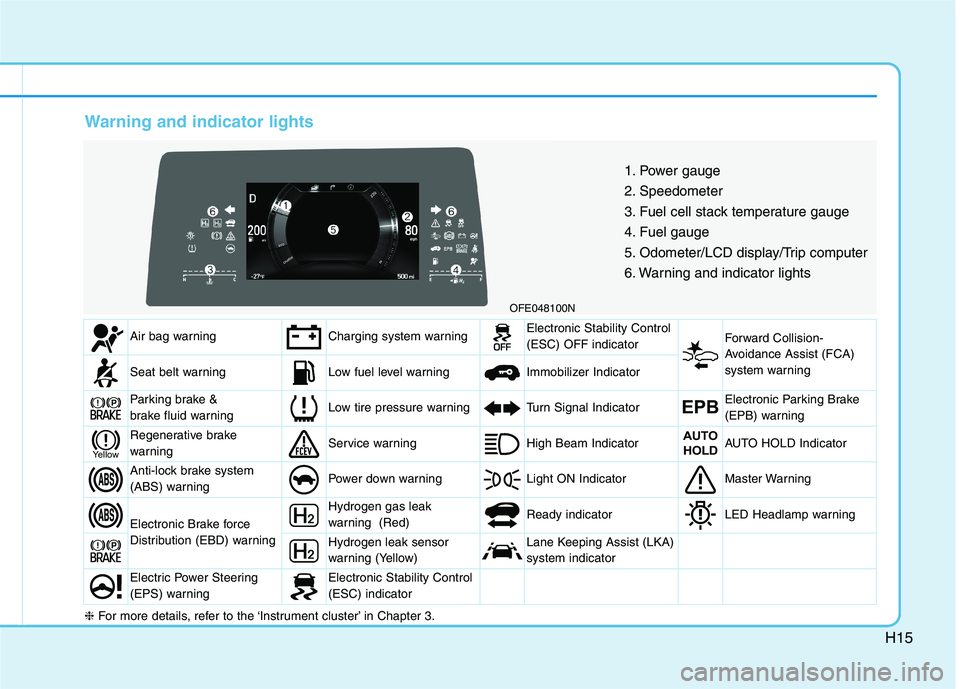
Warning and indicator lights
OFE048100N
1. Power gauge
2. Speedometer
3. Fuel cell stack temperature gauge
4. Fuel gauge
5. Odometer/LCD display/Trip computer
6. Warning and indicator lights
Air bag warningCharging system warningElectronic Stability Control
(ESC) OFF indicator Forward Collision-
Avoidance Assist (FCA)
system warning
Seat belt warningLow fuel level warning Immobilizer Indicator
Parking brake &
brake fluid warningLow tire pressure warningTurn Signal IndicatorEPBElectronic Parking Brake
(EPB) warning
Regenerative brake
warningService warning High Beam IndicatorAUTO
HOLDAUTO HOLD Indicator
Anti-lock brake system
(ABS) warningPower down warning Light ON IndicatorMaster Warning
Electronic Brake force
Distribution (EBD) warning
Hydrogen gas leak
warning (Red) Ready indicatorLED Headlamp warning
Hydrogen leak sensor
warning (Yellow)Lane Keeping Assist (LKA)
system indicator
Electric Power Steering
(EPS) warningElectronic Stability Control
(ESC) indicator
Yellow
❈For more details, refer to the ‘Instrument cluster’ in Chapter 3.
Page 521 of 561
H16
F FE
EA
AT
TU
UR
RE
ES
S
O
OF
F
F
FC
CE
EV
V
(
(C
CO
ON
NT
T.
.)
)
LCD Display Messages
Check FCEV System
This warning message is displayed
and the warning light illuminates
when the FCEV system is not work-
ing properly.
In this case,have the vehicle checked
by an authorized HYUNDAI dealer.
Power limited due to high
coolant temperature
This warning message is displayed
when the FCEV's stack is overheat-
ed and the power supply to the
FCEV system is limited.
If the warning light stays on when in
"Ready ( )" state or while driving
the vehicle, this indicates that the
fuel cell stack may have failure. In
this case, we recommend you to
drive safely and have your vehicle
inspected by an authorized
HYUNDAI dealer.Replace fuel cell coolant and
filter
This warning message is displayed
when the fuel cell coolant and filter
need to be checked.
In this case, have the vehicle
checked by an authorized HYUNDAI
dealer.Refill electric components
coolant
This warning message is displayed
when the electronic device's coolant
level in the tanks is low.
In this case, have the vehicle
checked by an authorized HYUNDAI
dealer and refill the coolant.
Stop vehicle and check power
supply
This warning message is displayed
when any serious malfunction of the
vehicle is detected.
In this case, drive the vehicle imme-
diately to a safe area and turn off the
vehicle. Then turn the vehicle on
again.
If the message is displayed again,
have the vehicle checked by an
authorized HYUNDAI dealer.
▲ ▲ ▲
▲
▲ ▲▲ ▲ ▲
▲
Do not drive on uphill or accel-
erate suddenly when the power
down warning light is on. The
power is limited and may result
in dangerous situation or vehi-
cle damage.
CAUTION
Page 531 of 561

H26
F FE
EA
AT
TU
UR
RE
ES
S
O
OF
F
F
FC
CE
EV
V
(
(C
CO
ON
NT
T.
.)
)
If you do not start the vehicle imme-
diately after pressing the 12V Battery
Reset switch, the power of 12V bat-
tery is automatically disconnected
after few seconds to save the 12V
battery from additional discharge. If
the 12V battery is disconnected prior
to starting the vehicle, press the 12V
Battery Reset switch again and then
immediately start the vehicle as
explained.
Repeated use of the 12V Battery
Reset switch without a sufficient ON
cycle (30 Min+) may cause over dis-
charge of the 12V battery, which will
prevent the vehicle from starting. If
the 12V battery is over discharged to
a point that the reset does not work,
try to jump-start the vehicle.Information
After starting the vehicle ( indica-
tor on), the 12V battery is being
charged whether the accelerator pedal
is depressed or not.
❈ ❈
For more details regarding the
jump start, refer to the 'Jump star-
ing' in Owner's manual Chapter 6.
Emergency while driving
If an accident occurs
1. Stop the vehicle, put the gear into
the P (Park) position, set the park-
ing brake, and turn the vehicle off
to prevent the hydrogen and cur-
rent from leaking.
The flow of hydrogen into the fuel
cell stack will be shut off to prevent
the current from being generated.
2. Evacuate to the safety place.
3. Call emergency services for help
and let them know the vehicle is a
Fuel Cell Electric Vehicle.
i
Page 532 of 561
H27
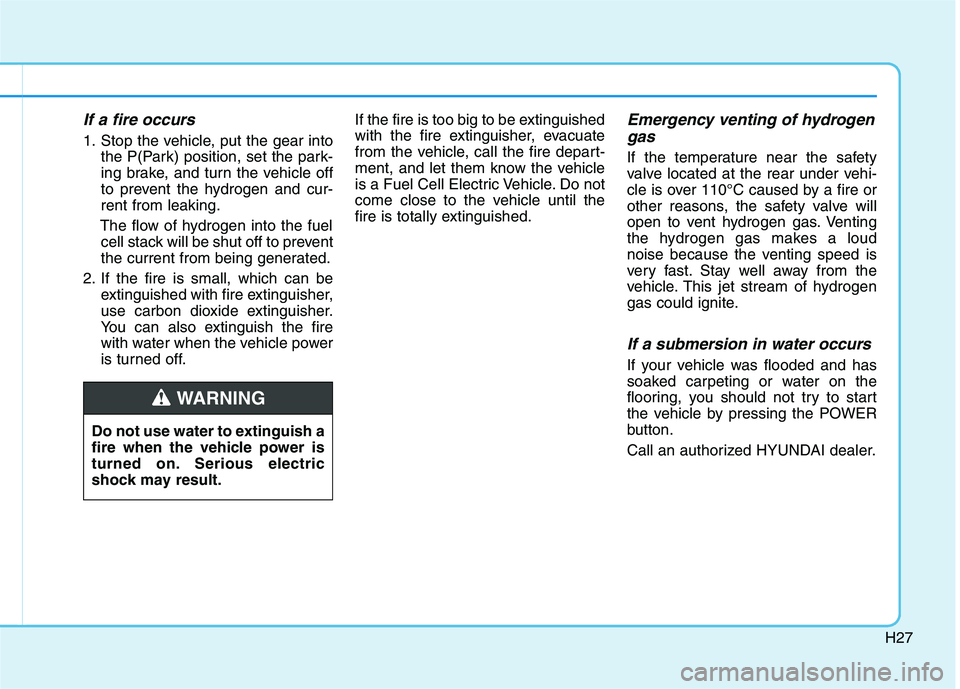
If a fire occurs
1. Stop the vehicle, put the gear into
the P(Park) position, set the park-
ing brake, and turn the vehicle off
to prevent the hydrogen and cur-
rent from leaking.
The flow of hydrogen into the fuel
cell stack will be shut off to prevent
the current from being generated.
2. If the fire is small, which can be
extinguished with fire extinguisher,
use carbon dioxide extinguisher.
You can also extinguish the fire
with water when the vehicle power
is turned off.If the fire is too big to be extinguished
with the fire extinguisher, evacuate
from the vehicle, call the fire depart-
ment, and let them know the vehicle
is a Fuel Cell Electric Vehicle. Do not
come close to the vehicle until the
fire is totally extinguished.
Emergency venting of hydrogen
gas
If the temperature near the safety
valve located at the rear under vehi-
cle is over 110°C caused by a fire or
other reasons, the safety valve will
open to vent hydrogen gas. Venting
the hydrogen gas makes a loud
noise because the venting speed is
very fast. Stay well away from the
vehicle. This jet stream of hydrogen
gas could ignite.
If a submersion in water occurs
If your vehicle was flooded and has
soaked carpeting or water on the
flooring, you should not try to start
the vehicle by pressing the POWER
button.
Call an authorized HYUNDAI dealer. Do not use water to extinguish a
fire when the vehicle power is
turned on. Serious electric
shock may result.
WARNING
Page 537 of 561
H32
CategoryQuestionsAnswers
Vehicle
overview
(10 items)
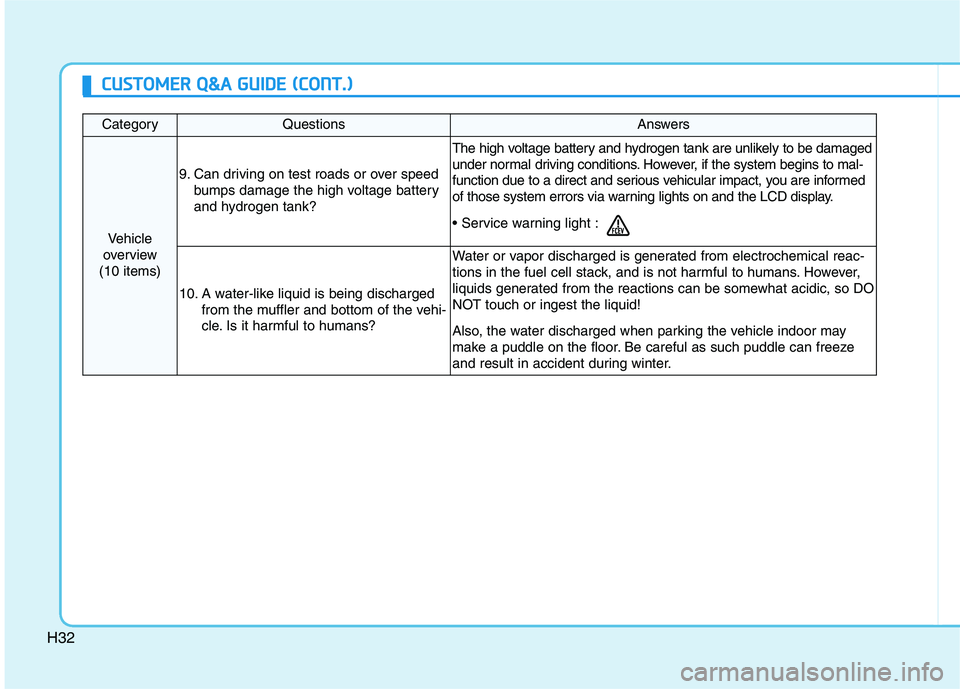
9. Can driving on test roads or over speed
bumps damage the high voltage battery
and hydrogen tank?
The high voltage battery and hydrogen tank are unlikely to be damaged
under normal driving conditions. However, if the system begins to mal-
function due to a direct and serious vehicular impact, you are informed
of those system errors via warning lights on and the LCD display.
10. A water-like liquid is being discharged
from the muffler and bottom of the vehi-
cle. Is it harmful to humans?
Water or vapor discharged is generated from electrochemical reac-
tions in the fuel cell stack, and is not harmful to humans. However,
liquids generated from the reactions can be somewhat acidic, so DO
NOT touch or ingest the liquid!
Also, the water discharged when parking the vehicle indoor may
make a puddle on the floor. Be careful as such puddle can freeze
and result in accident during winter.
C CU
US
ST
TO
OM
ME
ER
R
Q
Q&
&A
A
G
GU
UI
ID
DE
E
(
(C
CO
ON
NT
T.
.)
)
Page 539 of 561
H34
CategoryQuestionsAnswers
Vehicle
Management
(12 items)
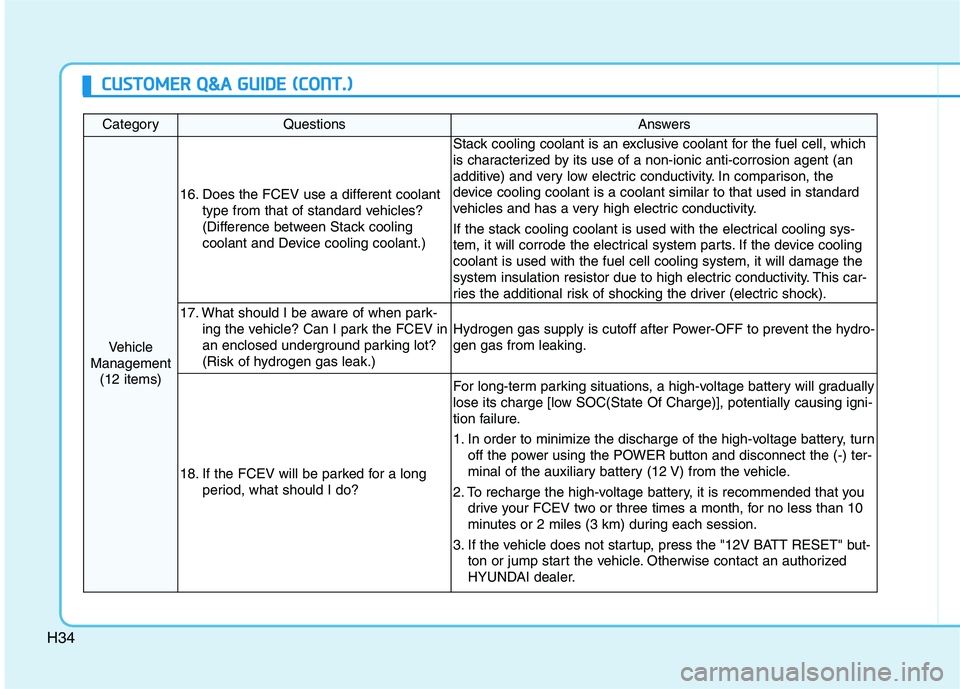
16. Does the FCEV use a different coolant
type from that of standard vehicles?
(Difference between Stack cooling
coolant and Device cooling coolant.)
Stack cooling coolant is an exclusive coolant for the fuel cell, which
is characterized by its use of a non-ionic anti-corrosion agent (an
additive) and very low electric conductivity. In comparison, the
device cooling coolant is a coolant similar to that used in standard
vehicles and has a very high electric conductivity.
If the stack cooling coolant is used with the electrical cooling sys-
tem, it will corrode the electrical system parts. If the device cooling
coolant is used with the fuel cell cooling system, it will damage the
system insulation resistor due to high electric conductivity. This car-
ries the additional risk of shocking the driver (electric shock).
17. What should I be aware of when park-
ing the vehicle? Can I park the FCEV in
an enclosed underground parking lot?
(Risk of hydrogen gas leak.)
Hydrogen gas supply is cutoff after Power-OFF to prevent the hydro-
gen gas from leaking.
18. If the FCEV will be parked for a long
period, what should I do?
For long-term parking situations, a high-voltage battery will gradually
lose its charge [low SOC(State Of Charge)], potentially causing igni-
tion failure.
1. In order to minimize the discharge of the high-voltage battery, turn
off the power using the POWER button and disconnect the (-) ter-
minal of the auxiliary battery (12 V) from the vehicle.
2. To recharge the high-voltage battery, it is recommended that you
drive your FCEV two or three times a month, for no less than 10
minutes or 2 miles (3 km) during each session.
3. If the vehicle does not startup, press the "12V BATT RESET" but-
ton or jump start the vehicle. Otherwise contact an authorized
HYUNDAI dealer.
C CU
US
ST
TO
OM
ME
ER
R
Q
Q&
&A
A
G
GU
UI
ID
DE
E
(
(C
CO
ON
NT
T.
.)
)