2020 HYUNDAI NEXO fuel cell stack
[x] Cancel search: fuel cell stackPage 426 of 561
7
Maintenance
7
Maintenance
Fuel cell power module compartment.................7-3
Maintenance services ...........................................7-4
Owner's Responsibility .....................................................7-4
Owner Maintenance Precautions..................................7-4
Owner maintenance ...............................................7-5
Owner maintenance schedule ........................................7-6
Scheduled maintenance services.........................7-7
Normal Maintenance Schedule ......................................7-8
Maintenance Under Severe Usage Conditions ........7-10
Explanation of scheduled maintenance items .7-12
Device cooling coolant ........................................7-13
Checking the Coolant Level ..........................................7-13
Changing Coolant ............................................................7-15
Stack cooling coolant ..........................................7-16
Checking the Coolant Level ..........................................7-16
Changing Coolant ............................................................7-18
Brake fluid ............................................................7-19
Checking the Brake Fluid Level ...................................7-19
Washer fluid .........................................................7-20
Checking the Washer Fluid Level................................7-20
Air cleaner ............................................................7-20
Filter Replacement ..........................................................7-20
Climate control air filter .....................................7-22
Filter Inspection ...............................................................7-22
Wiper blades .........................................................7-24
Blade Inspection ..............................................................7-24
Blade Replacement .........................................................7-24
12V battery ...........................................................7-27
Battery recharging .........................................................7-28
Reset Features.................................................................7-28
Tires and wheels ..................................................7-29
Tire Care ........................................................................\
....7-29
Recommended Cold Tire Inflation Pressures ...........7-30
Check Tire Inflation Pressure ......................................7-31
Tire Rotation...................................................................\
..7-32
Wheel Alignment and Tire Balance ............................7-33
Tire Replacement ............................................................7-33
Wheel Replacement ........................................................7-34
Tire Traction .....................................................................7-3\
4
Tire Maintenance ............................................................7-34
Tire Sidewall Labeling ....................................................7-34
Tire Terminology and Definitions................................7-38
All Season Tires ...............................................................7-42
Summer Tires ...................................................................7-42
Snow Tires ........................................................................\
7-42
Radial-Ply Tires ...............................................................7-42
Low Aspect Ratio Tires..................................................7-43
7
Page 428 of 561
7-3
7
Maintenance
F
FU
U E
EL
L
C
C E
E L
LL
L
P
P O
O W
W E
ER
R
M
M O
OD
DU
U L
LE
E
C
C O
O M
M P
PA
A R
RT
TM
M E
EN
N T
T
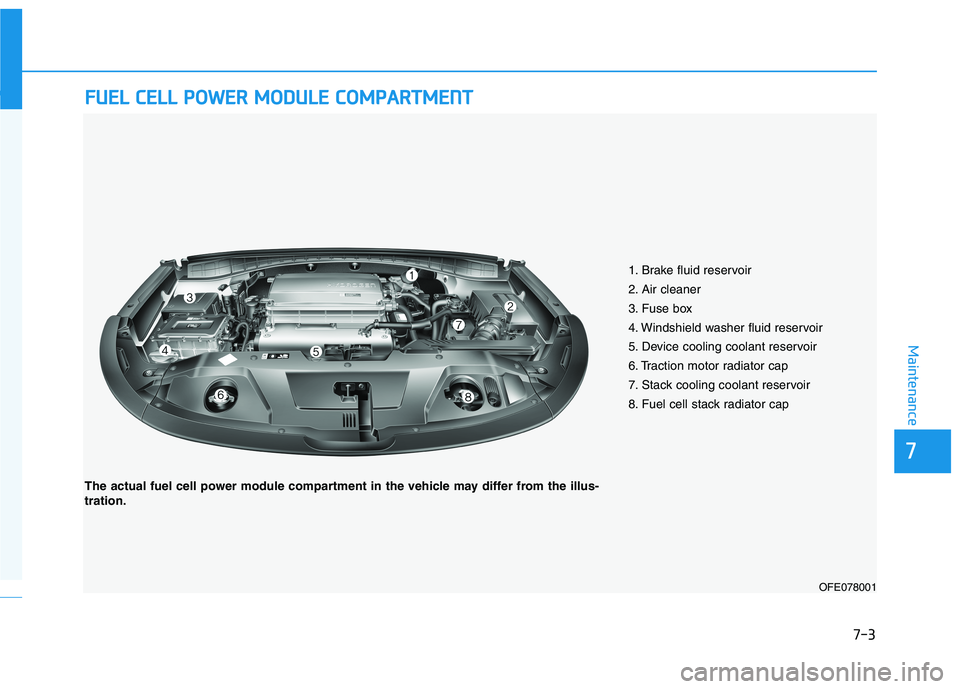
1. Brake fluid reservoir
2. Air cleaner
3. Fuse box
4. Windshield washer fluid reservoir
5. Device cooling coolant reservoir
6. Traction motor radiator cap
7. Stack cooling coolant reservoir
8. Fuel cell stack radiator cap
OFE078001
The actual fuel cell power module compartment in the vehicle may differ from the illus-
tration.
Page 431 of 561
7-6
Maintenance
Owner maintenance schedule
When you stop for fuel:
• Check for both fuel cell stack andDevice cooling coolant level in
coolant reservoir.
Check the windshield washer fluid level.
Look for low or under-inflated tires.
While operating your vehicle:
Check for vibrations in the steering wheel. Notice if there is any
increased steering effort or loose-
ness in the steering wheel, or
change in its straight-ahead posi-
tion.
Notice if your vehicle constantly turns slightly or "pulls" to one side
when traveling on smooth, level
road.
When stopping, listen and check for unusual sounds, pulling to one
side, increased brake pedal travel
or "hard-to-push" brake pedal.
If any slipping or changes in the operation of your reduction gear
occurs, check the reduction gear
fluid level.
Check the reduction gear P (Park) function.
Check the parking brake.
Check for fluid leaks under your vehicle (water dripping from the air
conditioning system during or after
use is normal).
At least monthly:
Check coolant level in the coolantreservoir.
Check the operation of all exterior lights, including the brake lights,
turn signals and hazard warning
flashers.
Check the inflation pressures of all tires that are worn, show uneven
wear, or are damaged.
Check for loose wheel lug nuts.
At least twice a year: (i.e., every Spring and Fall)
Check radiator, heater and air con-
ditioning hoses for leaks or dam-
age.
Check windshield washer spray and wiper operation. Clean wiper
blades with clean cloth dampened
with washer fluid.
Check headlamp alignment.
Check the seat belts for wear and function.
Be careful when checking the
coolant level when the fuel cell
power module is hot. Scalding
hot coolant and steam may
blow out under pressure. This
could cause burns or other seri-
ous injury.
WARNING
Page 441 of 561
7-16
Maintenance
S
ST
T A
A C
CK
K
C
C O
O O
OL
LI
IN
N G
G
C
C O
O O
OL
LA
A N
N T
T
The high-pressure cooling system
has a reservoir filled with year-round
antifreeze coolant. The reservoir is
filled at the factory.
Check the antifreeze protection and
coolant level at least once a year, at
the beginning of the winter season
and before traveling to a colder cli-
mate.Checking the Coolant Level
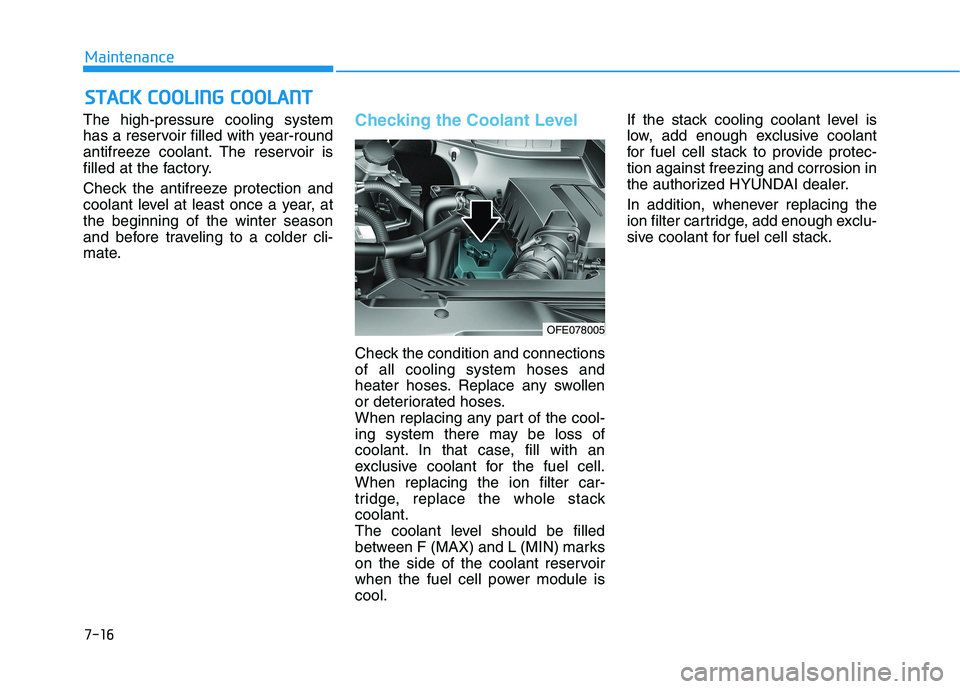
Check the condition and connections
of all cooling system hoses and
heater hoses. Replace any swollen
or deteriorated hoses.
When replacing any part of the cool-
ing system there may be loss of
coolant. In that case, fill with an
exclusive coolant for the fuel cell.
When replacing the ion filter car-
tridge, replace the whole stack
coolant.
The coolant level should be filled
between F (MAX) and L (MIN) marks
on the side of the coolant reservoir
when the fuel cell power module is
cool. If the stack cooling coolant level is
low, add enough exclusive coolant
for fuel cell stack to provide protec-
tion against freezing and corrosion in
the authorized HYUNDAI dealer.
In addition, whenever replacing the
ion filter cartridge, add enough exclu-
sive coolant for fuel cell stack.
OFE078005
Page 442 of 561
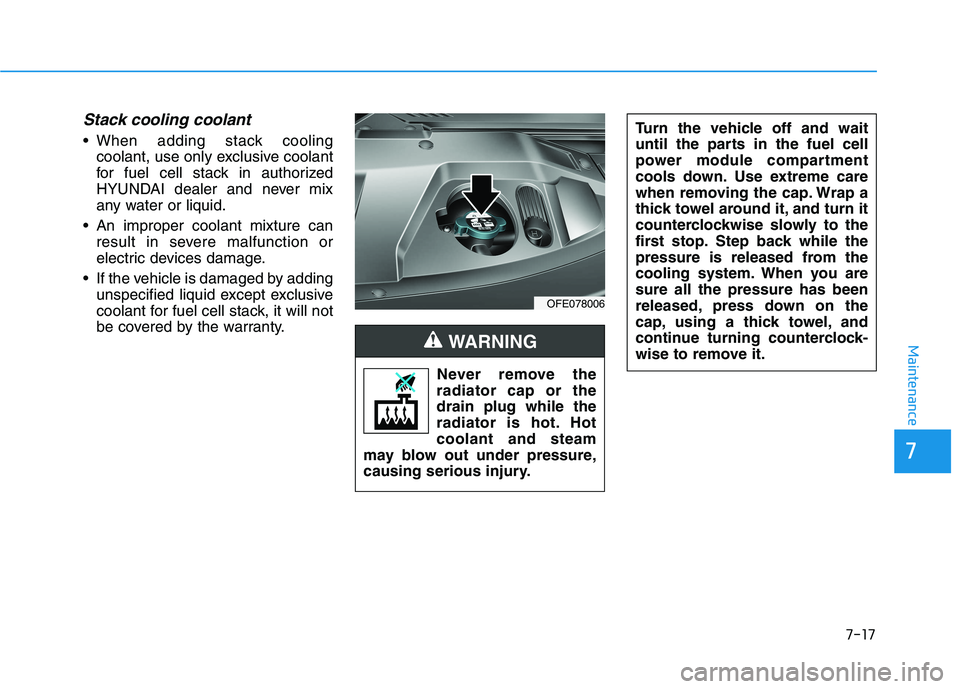
Stack cooling coolant
When adding stack coolingcoolant, use only exclusive coolant
for fuel cell stack in authorized
HYUNDAI dealer and never mix
any water or liquid.
An improper coolant mixture can result in severe malfunction or
electric devices damage.
If the vehicle is damaged by adding unspecified liquid except exclusive
coolant for fuel cell stack, it will not
be covered by the warranty.
7-17
7
Maintenance
Never remove the
radiator cap or the
drain plug while the
radiator is hot. Hot
coolant and steam
may blow out under pressure,
causing serious injury.
WARNING
OFE078006
Turn the vehicle off and wait
until the parts in the fuel cell
power module compartment
cools down. Use extreme care
when removing the cap. Wrap a
thick towel around it, and turn it
counterclockwise slowly to the
first stop. Step back while the
pressure is released from the
cooling system. When you are
sure all the pressure has been
released, press down on the
cap, using a thick towel, and
continue turning counterclock-
wise to remove it.
Page 443 of 561
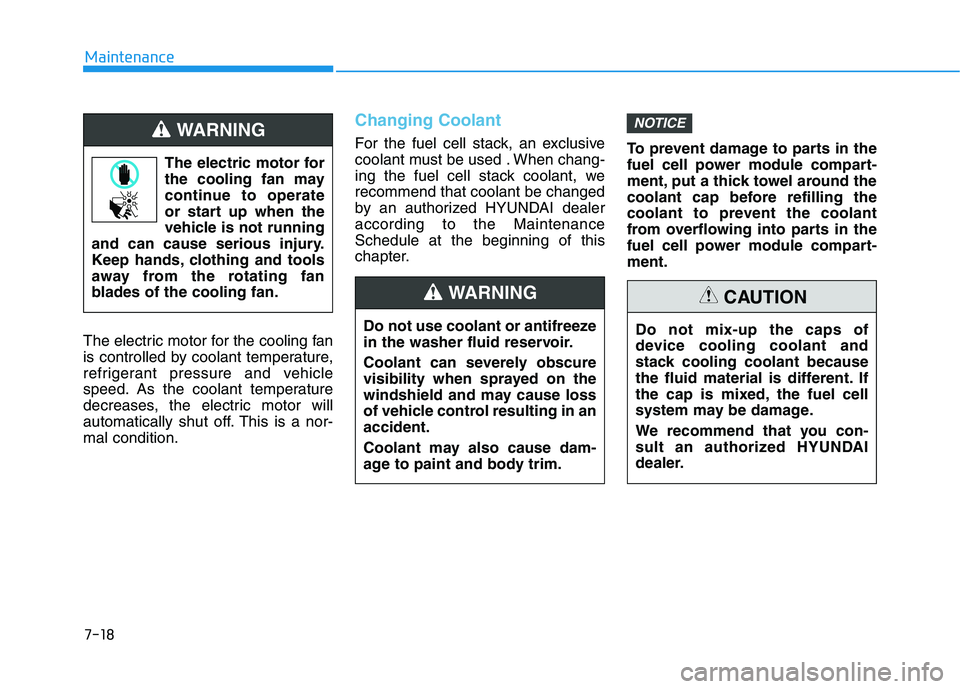
The electric motor for the cooling fan
is controlled by coolant temperature,
refrigerant pressure and vehicle
speed. As the coolant temperature
decreases, the electric motor will
automatically shut off. This is a nor-
mal condition.
Changing Coolant
For the fuel cell stack, an exclusive
coolant must be used . When chang-
ing the fuel cell stack coolant, we
recommend that coolant be changed
by an authorized HYUNDAI dealer
according to the Maintenance
Schedule at the beginning of this
chapter.To prevent damage to parts in the
fuel cell power module compart-
ment, put a thick towel around the
coolant cap before refilling the
coolant to prevent the coolant
from overflowing into parts in the
fuel cell power module compart-
ment.
NOTICE
7-18
Maintenance
The electric motor for
the cooling fan may
continue to operate
or start up when the
vehicle is not running
and can cause serious injury.
Keep hands, clothing and tools
away from the rotating fan
blades of the cooling fan.
WARNING
Do not use coolant or antifreeze
in the washer fluid reservoir.
Coolant can severely obscure
visibility when sprayed on the
windshield and may cause loss
of vehicle control resulting in an
accident.
Coolant may also cause dam-
age to paint and body trim.
WARNING
Do not mix-up the caps of
device cooling coolant and
stack cooling coolant because
the fluid material is different. If
the cap is mixed, the fuel cell
system may be damage.
We recommend that you con-
sult an authorized HYUNDAI
dealer.
CAUTION
Page 501 of 561
8-6
Specifications, Consumer information and Reporting safety defects
R RE
EC
CO
OM
MM
ME
EN
ND
DE
ED
D
L
LU
UB
BR
RI
IC
CA
AN
NT
TS
S
A
AN
ND
D
C
CA
AP
PA
AC
CI
IT
TI
IE
ES
S
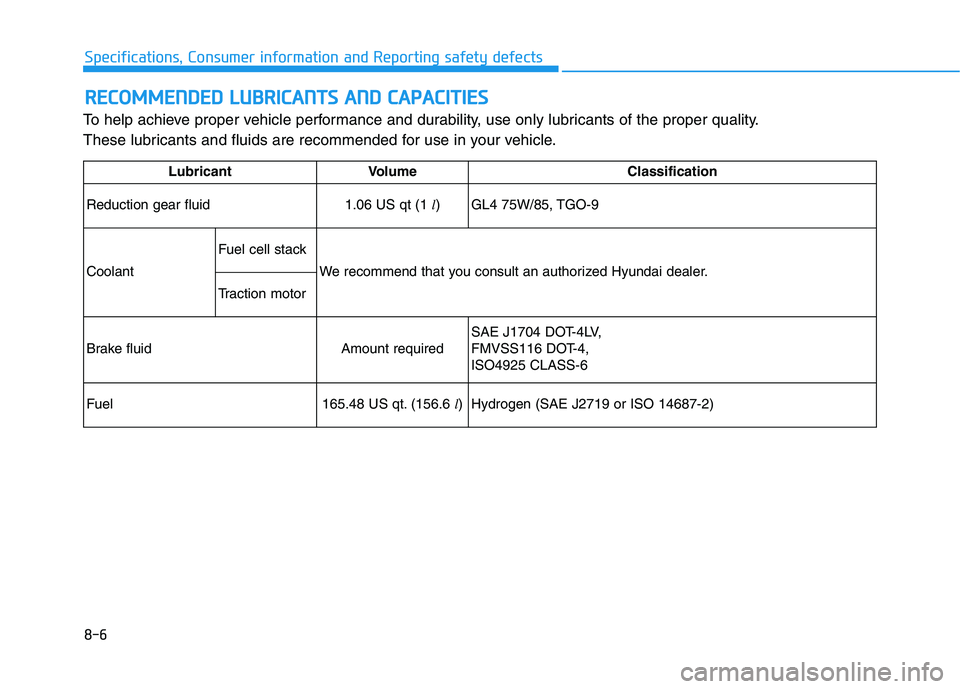
To help achieve proper vehicle performance and durability, use only lubricants of the proper quality.
These lubricants and fluids are recommended for use in your vehicle.
Lubricant Volume Classification
Reduction gear fluid1.06 US qt (1 l)
GL4 75W/85, TGO-9
CoolantFuel cell stack
We recommend that you consult an authorized Hyundai dealer.
Traction motor
Brake fluid Amount requiredSAE J1704 DOT-4LV,
FMVSS116 DOT-4,
ISO4925 CLASS-6
Fuel165.48 US qt. (156.6 l)
Hydrogen (SAE J2719 or ISO 14687-2)
Page 506 of 561
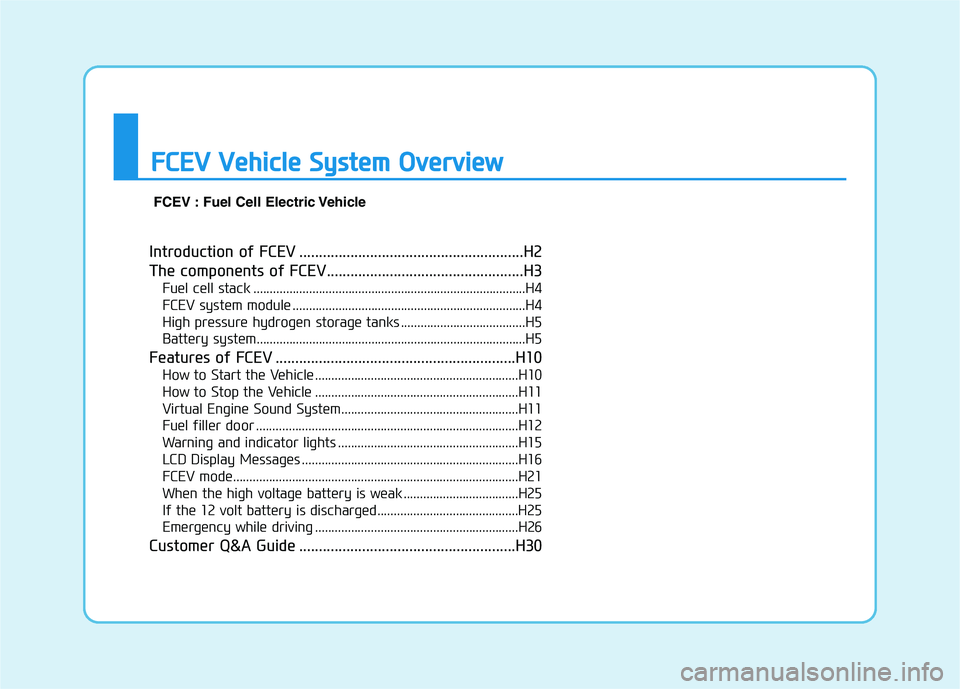
Introduction of FCEV .........................................................H2
The components of FCEV..................................................H3
Fuel cell stack ...................................................................................H4
FCEV system module .......................................................................H4
High pressure hydrogen storage tanks ......................................H5
Battery system..................................................................................H5
Features of FCEV .............................................................H10
How to Start the Vehicle ..............................................................H10
How to Stop the Vehicle ..............................................................H11
Virtual Engine Sound System......................................................H11
Fuel filler door ................................................................................H12
Warning and indicator lights .......................................................H15
LCD Display Messages ..................................................................H16
FCEV mode.......................................................................................H21
When the high voltage battery is weak ...................................H25
If the 12 volt battery is discharged...........................................H25
Emergency while driving ..............................................................H26
Customer Q&A Guide .......................................................H30
F FC
CE
EV
V
V
Ve
eh
hi
ic
cl
le
e
S
Sy
ys
st
te
em
m
O
Ov
ve
er
rv
vi
ie
ew
w
FCEV : Fuel Cell Electric Vehicle