Page 532 of 561
H44
C CH
HA
AR
RG
GI
IN
NG
G
E
EL
LE
EC
CT
TR
RI
IC
C
V
VE
EH
HI
IC
CL
LE
E
(
(T
TR
RI
IC
CK
KL
LE
E
C
CH
HA
AR
RG
GE
E)
)
(
(C
CO
ON
NT
T.
.)
)
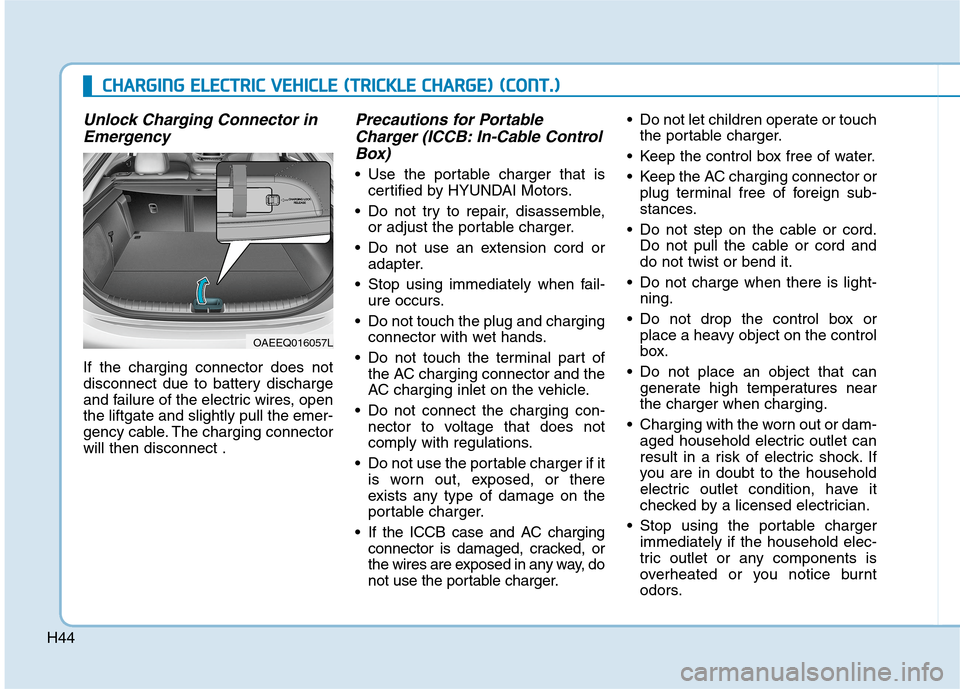
Unlock Charging Connector in
Emergency
If the charging connector does not
disconnect due to battery discharge
and failure of the electric wires, open
the liftgate and slightly pull the emer-
gency cable. The charging connector
will then disconnect .
Precautions for Portable
Charger (ICCB: In-Cable Control
Box)
Use the portable charger that is
certified by HYUNDAI Motors.
Do not try to repair, disassemble,
or adjust the portable charger.
Do not use an extension cord or
adapter.
Stop using immediately when fail-
ure occurs.
Do not touch the plug and charging
connector with wet hands.
Do not touch the terminal part of
the AC charging connector and the
AC charging inlet on the vehicle.
Do not connect the charging con-
nector to voltage that does not
comply with regulations.
Do not use the portable charger if it
is worn out, exposed, or there
exists any type of damage on the
portable charger.
If the ICCB case and AC charging
connector is damaged, cracked, or
the wires are exposed in any way, do
not use the portable charger. Do not let children operate or touch
the portable charger.
Keep the control box free of water.
Keep the AC charging connector or
plug terminal free of foreign sub-
stances.
Do not step on the cable or cord.
Do not pull the cable or cord and
do not twist or bend it.
Do not charge when there is light-
ning.
Do not drop the control box or
place a heavy object on the control
box.
Do not place an object that can
generate high temperatures near
the charger when charging.
Charging with the worn out or dam-
aged household electric outlet can
result in a risk of electric shock. If
you are in doubt to the household
electric outlet condition, have it
checked by a licensed electrician.
Stop using the portable charger
immediately if the household elec-
tric outlet or any components is
overheated or you notice burnt
odors.
OAEEQ016057L
Page 542 of 561
H54
D DR
RI
IV
VI
IN
NG
G
E
EL
LE
EC
CT
TR
RI
IC
C
V
VE
EH
HI
IC
CL
LE
E
(
(C
CO
ON
NT
T.
.)
)
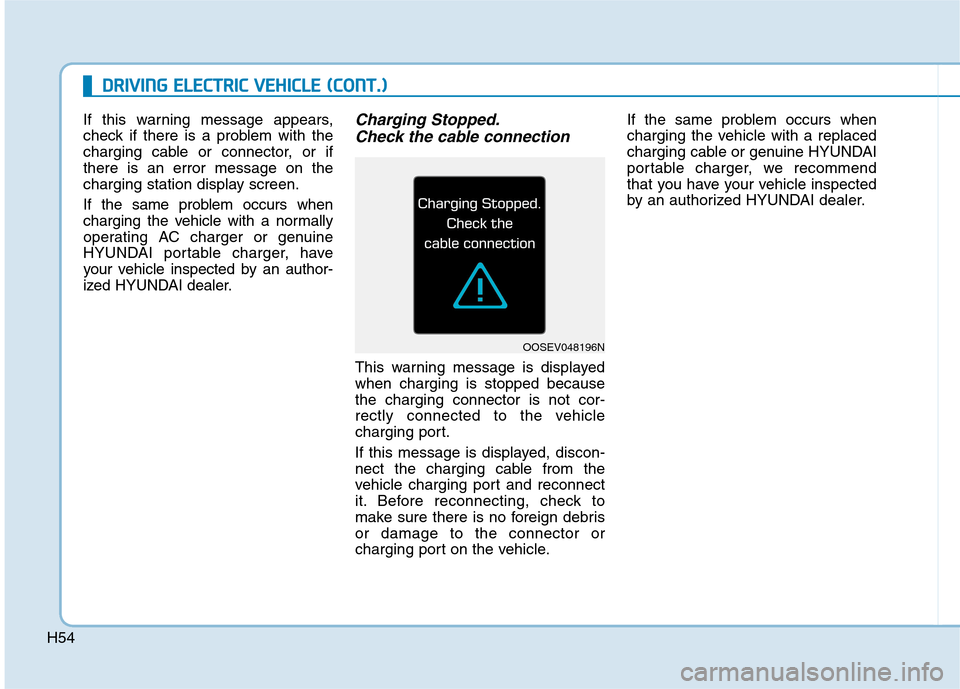
If this warning message appears,
check if there is a problem with the
charging cable or connector, or if
there is an error message on the
charging station display screen.
If the same problem occurs when
charging the vehicle with a normally
operating AC charger or genuine
HYUNDAI portable charger, have
your vehicle inspected by an author-
ized HYUNDAI dealer.Charging Stopped.
Check the cable connection
This warning message is displayed
when charging is stopped because
the charging connector is not cor-
rectly connected to the vehicle
charging port.
If this message is displayed, discon-
nect the charging cable from the
vehicle charging port and reconnect
it. Before reconnecting, check to
make sure there is no foreign debris
or damage to the connector or
charging port on the vehicle.If the same problem occurs when
charging the vehicle with a replaced
charging cable or genuine HYUNDAI
portable charger, we recommend
that you have your vehicle inspected
by an authorized HYUNDAI dealer.
OOSEV048196N
Page 549 of 561
H61
System Setting
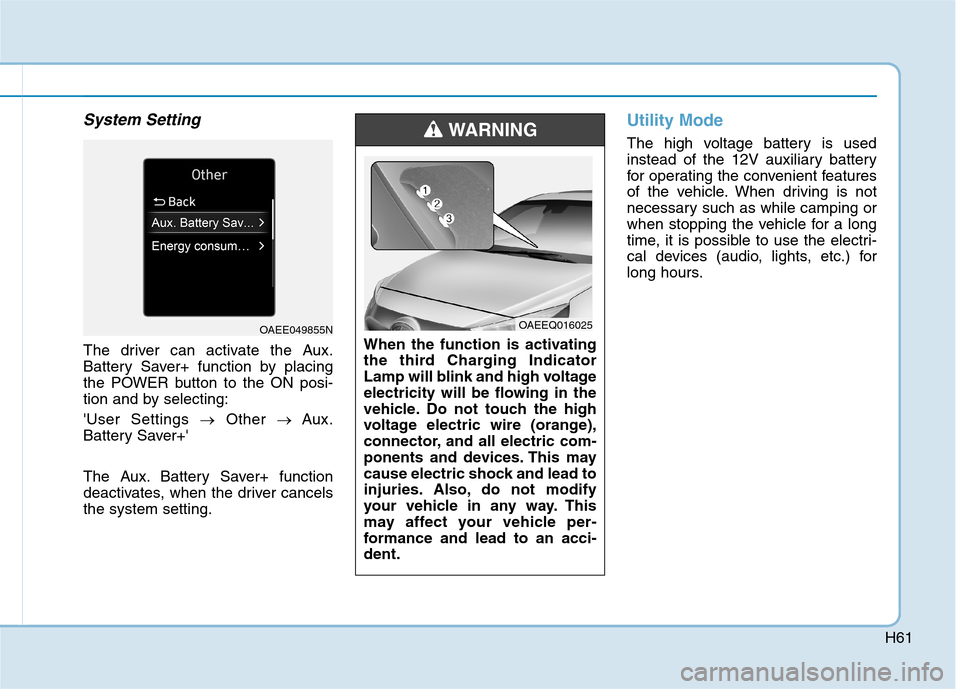
The driver can activate the Aux.
Battery Saver+ function by placing
the POWER button to the ON posi-
tion and by selecting:
'User Settings →Other → Aux.
Battery Saver+'
The Aux. Battery Saver+ function
deactivates, when the driver cancels
the system setting.
Utility Mode
The high voltage battery is used
instead of the 12V auxiliary battery
for operating the convenient features
of the vehicle. When driving is not
necessary such as while camping or
when stopping the vehicle for a long
time, it is possible to use the electri-
cal devices (audio, lights, etc.) for
long hours.
OAEE049855N
When the function is activating
the third Charging Indicator
Lamp will blink and high voltage
electricity will be flowing in the
vehicle. Do not touch the high
voltage electric wire (orange),
connector, and all electric com-
ponents and devices. This may
cause electric shock and lead to
injuries. Also, do not modify
your vehicle in any way. This
may affect your vehicle per-
formance and lead to an acci-
dent.
WARNING
OAEEQ016025
Page 551 of 561
H63
If an Accident Occurs
S SA
AF
FE
ET
TY
Y
P
PR
RE
EC
CA
AU
UT
TI
IO
ON
NS
S
F
FO
OR
R
E
EL
LE
EC
CT
TR
RI
IC
C
V
VE
EH
HI
IC
CL
LE
E
When a vehicle accident
occurs, move the vehicle to a
safe place, turn OFF the vehi-
cle and remove the auxiliary
battery (12 V) terminal to pre-
vent high voltage electricity
from flowing.
If electric wires are exposed
from inside or outside the
vehicle, do not touch the
wires.
Also, do not touch the high
voltage electric wire (orange),
connector, and all electric
components and devices. This
may cause electric shock and
lead to injuries.
WARNING When a vehicle accident
occurs and the high voltage
battery is damaged, harmful
gas and electrolytes may leak.
Be careful not to touch the
leaked liquid.
When you suspect leakage of
inflammable gas and other
harmful gases, open the win-
dows and evacuate to a safe
place. If any leaked fluid
comes in contact with your
eyes or skin, immediately
clean the affected area thor-
oughly with tap water or
saline solution and have doc-
tors inspect it as soon as pos-
sible.
WARNING
If a small scale fire occurs,
use a fire extinguisher (ABC,
BC) that is meant for electrical
fires. If it is impossible to
extinguish the fire in the early
stage, remain a safe distance
from the vehicle and immedi-
ately call 911. Also, advise
them that an electric vehicle is
involved.
If the fire spreads to the high
voltage battery, large amount
of water is needed to put out
the fire. Using small amount
of water or fire extinguishers
not meant for electrical fires
could cause serious injury or
death from electrical shocks.
WARNING