2020 FORD GT height
[x] Cancel search: heightPage 140 of 316

Grounding Stud Location
Jump Starting
1.
Start the engine of the booster vehicle
and rev the engine moderately, or press
the accelerator gently to keep your
engine speed between 2000 and 3000
RPM, as shown in your tachometer.
2. Start the engine of the disabled vehicle.
3. Once the disabled vehicle has been started, run both vehicle engines for an
additional three minutes before
disconnecting the jumper cables.
Removing the Jumper Cables
Remove the jumper cables in the reverse
order that they were connected.
1. Remove the jumper cable from the negative (-) terminal of the booster
vehicle battery.
2. Remove the jumper cable from the negative (A) post of the disabled
vehicle.
3. Remove the jumper cable from the positive (+) terminal of the booster
vehicle battery.
4. Remove the jumper cable from the positive (B) post of the disabled
vehicle.
5. Allow the engine to idle for at least one
minute. POST-CRASH ALERT SYSTEM
The system flashes the direction indicators
and sounds the horn (intermittently) in the
event of a serious impact that deploys an
airbag (front and side) or the safety belt
pretensioners.
The horn and indicators will turn off when:
•
You press the hazard control button.
• You press the panic button on the
remote entry transmitter (if equipped).
• Your vehicle runs out of power.
TRANSPORTING THE VEHICLE
If you need to transport your vehicle,
please contact the Ford GT Concierge at
800-210-5795.
You can only transport your vehicle in an
enclosed trailer or on a roll back flatbed
truck. The ramp angle or angle of approach
on Ford GT is 9 degrees. Below are some
ramp lengths required to achieve this angle
depending on trailer or bed entrance
height. Ramp Length
Height
11 ft (330 cm)
20 in (50 cm)
10 ft (292 cm)
18 in (45 cm)
9 ft (266 cm)
16 in (40 cm)
7 ft (228 cm)
14 in (35 cm)
7 ft (203 cm)
12 in (30 cm)
137
Ford GT (CGX) Canada/United States of America, enUSA, Edition date: 201908, First-Printing Roadside EmergenciesE229889
Page 141 of 316

Your vehicle has a front end lift feature
that uses the electronically controlled
suspension hydraulics to lift the front of
the car. You can use this feature for
driveway approaches and speed bumps.
If there is power to this system, use it to lift
the front when loading the car onto a trailer
or a roll back. To operate the front lift, use
the switch in the console.
Note:
The ground clearance on the car at
standard ride height is only 5 in (12 cm). Use
care when moving or loading the car to
make sure it does not bottom out.
Note: The vehicle doors swing both upward
and outward. At the full open position, the
top edge of the door is 67 in (170 cm) from
the ground and swings outward 26 in
(66 cm). Make sure you have the clearance
you need prior to opening the door.
The full undertrays of the vehicle are
carbon fiber, there are no tie down slots.
Use only over the tire straps to tie the car
down for transport.
Getting the Transmission in
Neutral
If the battery loses charge, the
transmission moves to park (P). You can
use the transmission tool to place the car
into Neutral (N). See
Automatic
Transmission (page 105).
Note: If your battery loses charge with the
electric park brake on, you cannot transport
your vehicle until you restore power to your
vehicle to turn off the electric park brake.
TOWING POINTS
Recovery Hook Location
Your vehicle comes with a screw-in
recovery hook, it is in the storage
compartment under the rear hatch. Installing the Recovery Hook
Note:
The screw-in recovery hook has a
left-hand thread. Turn it counterclockwise
to install it. Make sure that the recovery
hook is fully tightened.
The installation point for the recovery hook
is the receptacle in the right corner of the
front grille. 138
Ford GT (CGX) Canada/United States of America, enUSA, Edition date: 201908, First-Printing Roadside EmergenciesE233260
Page 173 of 316

Run the tip of your fingers over the edge of
the blade to check for roughness.
Clean the wiper blades with washer fluid
or water applied with a soft sponge or
cloth.
CHANGING THE WIPER
BLADES
Replacement blades are available at your
Ford dealer.
Note:
To avoid damaging the windshield,
lift the wiper blade a few inches off the
glass and place a cloth on the windshield
under the blade.
Note: Manually move the wiper blades to
the midway position.
Note: The windshield wiper blades are
different in length. The longer blade is on
the driver's side.
1. Disconnect the washer pipe from the wiper arm.
2. Press the release button on the top of the wiper arm where the blade
assembly attaches to the arm.
3. Pull the blade assembly away from the
arm, while rocking it from side to side
to help release it.
4. Keep the cloth in place to avoid the arm from hitting the windshield glass. 5. Install the new blade assembly and
reconnect the washer pipe.
6. When complete, switch on the wipers and they will cycle back to the park
position when you switch them off.
Replace wiper blades at least once per
year for optimum performance.
ADJUSTING THE HEADLAMPS
Headlamp Aim Target 8 ft (2.4 m).
A
Center height of lamp to ground.
B
25 ft (7.6 m).
C
Horizontal reference line.
D
Vertical Aim Adjustment
1. Park your vehicle on a level surface approximately 25 ft (7.6 m) away from
a vertical wall or screen.
2. Apply the parking brake.
3. Measure the height from the center of the headlamp to the ground.
Note: There may be an identifying mark on
the lens to help you locate the center of the
headlamp bulb.
170
Ford GT (CGX) Canada/United States of America, enUSA, Edition date: 201908, First-Printing MaintenanceE233208 E142592
Page 176 of 316
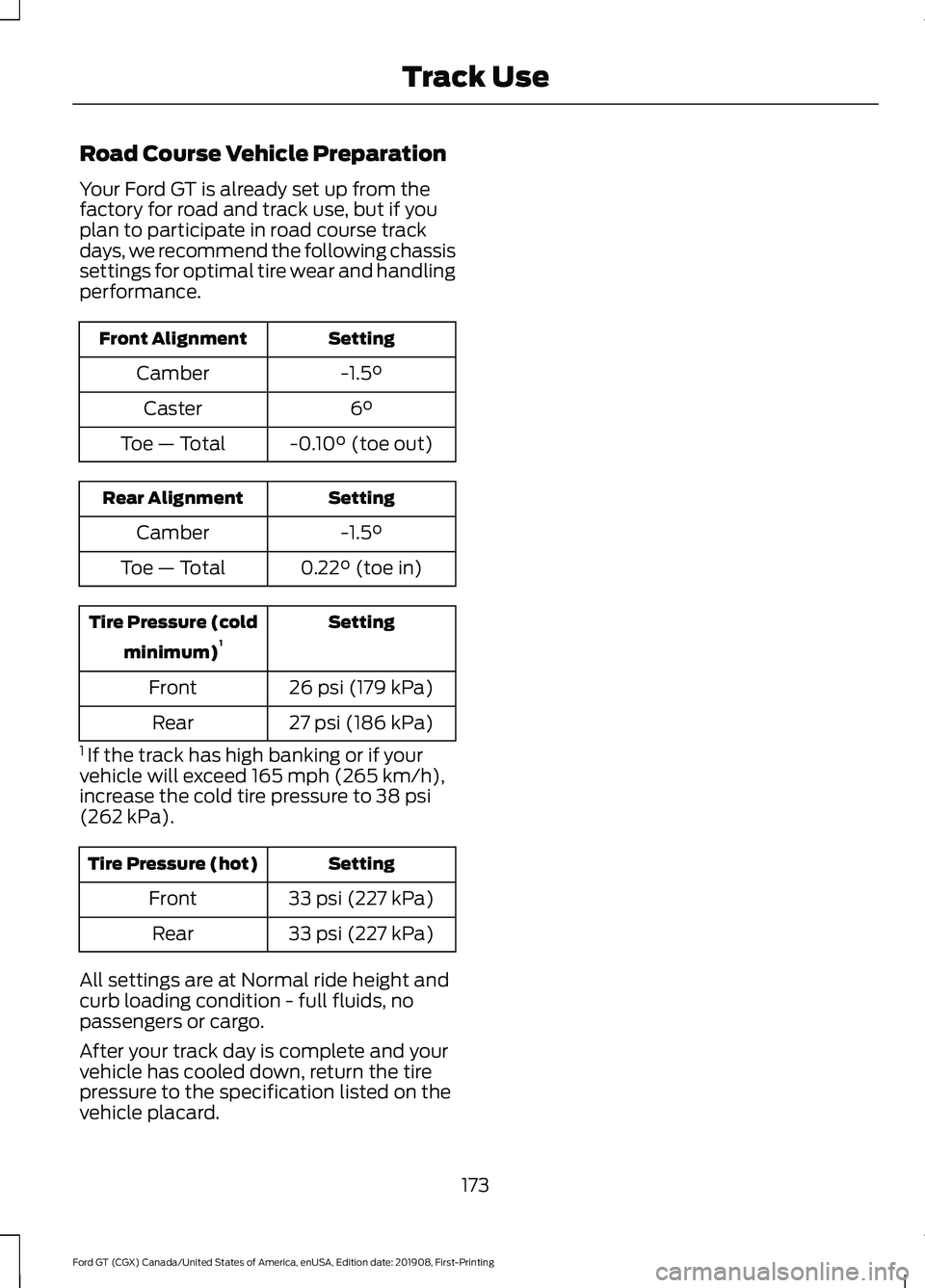
Road Course Vehicle Preparation
Your Ford GT is already set up from the
factory for road and track use, but if you
plan to participate in road course track
days, we recommend the following chassis
settings for optimal tire wear and handling
performance.
Setting
Front Alignment
-1.5°
Camber
6°
Caster
-0.10° (toe out)
Toe — Total Setting
Rear Alignment
-1.5°
Camber
0.22° (toe in)
Toe — Total Setting
Tire Pressure (cold
minimum) 1
26 psi (179 kPa)
Front
27 psi (186 kPa)
Rear
1 If the track has high banking or if your
vehicle will exceed 165 mph (265 km/h),
increase the cold tire pressure to 38 psi
(262 kPa). Setting
Tire Pressure (hot)
33 psi (227 kPa)
Front
33 psi (227 kPa)
Rear
All settings are at Normal ride height and
curb loading condition - full fluids, no
passengers or cargo.
After your track day is complete and your
vehicle has cooled down, return the tire
pressure to the specification listed on the
vehicle placard.
173
Ford GT (CGX) Canada/United States of America, enUSA, Edition date: 201908, First-Printing Track Use
Page 195 of 316

Information Contained on the
Tire Sidewall
Both United States and Canada
Federal regulations require tire
manufacturers to place
standardized information on the
sidewall of all tires. This
information identifies and
describes the fundamental
characteristics of the tire and also
provides a U.S. DOT Tire
Identification Number for safety
standard certification and in case
of a recall.
Information on P Type Tires
P215/65R15 95H is an example of
a tire size, load index and speed
rating. The definitions of these
items are listed below. (Note that
the tire size, load index and speed
rating for your vehicle may be
different from this example.) A.
P: Indicates a tire, designated
by the Tire and Rim Association,
that may be used for service on
cars, sport utility vehicles,
minivans and light trucks. Note:
If
your tire size does not begin with
a letter this may mean it is
designated by either the European
Tire and Rim Technical
Organization or the Japan Tire
Manufacturing Association.
B. 215:
Indicates the nominal
width of the tire in millimeters
from sidewall edge to sidewall
edge. In general, the larger the
number, the wider the tire.
C. 65:
Indicates the aspect ratio
which gives the tire's ratio of
height to width.
D. R:
Indicates a radial type tire.
E. 15:
Indicates the wheel or rim
diameter in inches. If you change
your wheel size, you will have to
purchase new tires to match the
new wheel diameter.
F. 95:
Indicates the tire's load
index. It is an index that relates to
how much weight a tire can carry.
You may find this information in
your owner ’s manual. If not,
contact a local tire dealer.
Note: You may not find this
information on all tires because it
is not required by federal law.
192
Ford GT (CGX) Canada/United States of America, enUSA, Edition date: 201908, First-Printing Wheels and TiresH
I
J
KL
M
A
B
CDEFG
E142543
Page 200 of 316

6.
Visually inspect the tires to
make sure there are no nails or
other objects embedded that
could poke a hole in the tire
and cause an air leak.
7. Check the sidewalls to make sure there are no gouges, cuts
or bulges.
Inspecting Your Tires and
Wheel Valve Stems
Periodically inspect the tire treads
for uneven or excessive wear and
remove objects such as stones,
nails or glass that may be wedged
in the tread grooves. Check the tire
and valve stems for holes, cracks,
or cuts that may permit air
leakage and repair or replace the
tire and replace the valve stem.
Inspect the tire sidewalls for
cracking, cuts, bruises and other
signs of damage or excessive
wear. If internal damage to the tire
is suspected, have the tire
demounted and inspected in case
it needs to be repaired or replaced.
For your safety, tires that are
damaged or show signs of
excessive wear should not be used
because they are more likely to
blow out or fail.
Improper or inadequate vehicle
maintenance can cause tires to
wear abnormally. Inspect all your
tires, including the spare,
frequently, and replace them if
one or more of the following
conditions exist: Tire Wear
When the tread is worn down to
one sixteenth of an inch (2 mm),
tires must be replaced to help
prevent your vehicle from skidding
and hydroplaning. Built-in
treadwear indicators, or wear bars,
which look like narrow strips of
smooth rubber across the tread
will appear on the tire when the
tread is worn down to one
sixteenth of an inch (2 mm).
When the tire tread wears down
to the same height as these wear
bars, the tire is worn out and must
be replaced.
Damage
Periodically inspect the tire treads
and sidewalls for damage (such
as bulges in the tread or sidewalls,
cracks in the tread groove and
separation in the tread or
sidewall). If damage is observed
or suspected have the tire
inspected by a tire professional.
197
Ford GT (CGX) Canada/United States of America, enUSA, Edition date: 201908, First-Printing Wheels and TiresE142546
Page 212 of 316

VEHICLE DIMENSIONS
Specification
Dimension
Item
187.5 in (4,763 mm)
Overall length.
A
106.7 in (2,710 mm)
Wheelbase.
B
78.9 in (2,004 mm)
Overall width excluding the exterior mirrors.
C
83.2 in (2,113 mm)
Overall width with mirrors folded.
C
88.1 in (2,238 mm)
Overall width with mirrors extended.
C
43.7 in (1,109 mm)
Overall height without options (Normal drive mode).
D
209
Ford GT (CGX) Canada/United States of America, enUSA, Edition date: 201908, First-Printing Capacities and SpecificationsE291810
Page 315 of 316

Track Use..........................................................172
Operating at High Speeds and on Track
Days..................................................................... 172
Road Course Vehicle Preparation.................173
Transmission Code Designation..............211
Transmission..................................................105
Transporting the Vehicle............................137 Getting the Transmission in Neutral...........138
U
Under Hood Overview................................159
Under Seat Storage......................................90
Unique Features...............................................17
USB Port
..........................................................218
Using Cruise Control....................................120 Switching Cruise Control Off......................... 120
Switching Cruise Control On.......................... 120
Using Launch Control
..................................174
Using Snow Chains......................................201
Using Stability Control................................116
AdvanceTrac ™ Electronic Stability Control
........................................................................\
....... 116
Stability Control.................................................... 117
Using Summer Tires
....................................201
Using Voice Recognition.............................221 Audio Voice Commands.................................. 222
Climate Voice Commands.............................. 223
Mobile App Voice Commands...................... 226
Navigation Voice Commands........................ 225
Phone Voice Commands................................ 223
SiriusXM Traffic and Travel Link Voice Commands..................................................... 226
Voice Settings Commands............................. 227
Utilizing the Mediation/Arbitration Program (Canada Only)..........................141
V
Vehicle Care....................................................175 General Information........................................... 175
Vehicle Certification Label.........................211
Vehicle Dimensions
....................................209
Vehicle Identification Number.................210
Vehicle Storage
..............................................181
Battery.................................................................... 182
Body........................................................................\
.. 181
Brakes..................................................................... 182Cooling system....................................................
182
Engine...................................................................... 181
Fuel system............................................................ 181
General.................................................................... 181
Miscellaneous...................................................... 182
Removing Vehicle From Storage.................. 182
Tires........................................................................\
. 182
Ventilation See: Climate Control.......................................... 84
VIN See: Vehicle Identification Number.............210
Voice Control....................................................57
W
Warning Lamps and Indicators................69 Anti-Lock Braking System................................ 69
Battery...................................................................... 70
Brake System......................................................... 70
Carbon Ceramic Brakes..................................... 70
Cruise Control........................................................ 70
Damper Comfort Mode...................................... 70
Direction Indicator................................................ 70
Door Ajar.................................................................. 70
Electric Park Brake............................................... 70
Engine Coolant Temperature........................... 70
Engine Oil................................................................ 70
Fasten Seatbelt...................................................... 71
Front Airbag............................................................. 71
Front Lift Mode Active......................................... 71
Frost Warning Lamp............................................. 71
Hatch Ajar................................................................. 71
High Beam................................................................ 71
Hood Ajar.................................................................. 71
Hydraulic System Fault....................................... 71
Launch Control....................................................... 71
Low Beam Malfunction Warning Lamp........71
Low Fuel Level........................................................ 71
Low Tire Pressure Warning................................ 71
Parking Lamps....................................................... 72
Powertrain Fault.................................................... 72
Rear Fog Lamp....................................................... 72
Ride Height System Fault.................................. 72
Service Engine Soon............................................ 72
Stability Control.................................................... 72
Stability Control Off............................................. 72
Transmission Fault............................................... 72
Washer Fluid Check.....................................167
312
Ford GT (CGX) Canada/United States of America, enUSA, Edition date: 201908, First-Printing Index