2020 FORD ECOSPORT seats
[x] Cancel search: seatsPage 29 of 448

Perform the following steps to install achild safety seat with tether anchors:
Note:If you install a child seat with rigidLATCH attachments, do not tighten thetether strap enough to lift the child seat offyour vehicle seat cushion when the child isseated in it. Keep the tether strap just snugwithout lifting the front of the child seat.Keeping the child seat just touching yourvehicle seat gives the best protection in asevere crash.
1.Route the child safety seat tether strapover the back of the seat. For outboardseating positions, route the tether strapunder the head restraint and betweenthe head restraint posts. For the centerseating positions, route the tether strapover the top of the head restraint. Ifneeded, the head restraints can alsobe removed.
2.Locate the correct anchor for theselected seating position.
3.Clip the tether strap to the anchor asshown.
4.Tighten the child safety seat tetherstrap according to the manufacturer'sinstructions.
If your child restraint system is equippedwith a tether strap, and the child restraintmanufacturer recommends its use, Fordalso recommends its use.
BOOSTER SEATS
WARNING: Do not put theshoulder section of the seatbelt or allowthe child to put the shoulder section ofthe seatbelt under their arm or behindtheir back. Failure to follow thisinstruction could reduce theeffectiveness of the seatbelt andincrease the risk of injury or death in acrash.
Use a belt-positioning booster seat forchildren who have outgrown or no longerproperly fit in a child safety restraint(generally children who are less than 57 in(1.45 m) tall, are greater than age 4 andless than age 12, and between 40 lb (18 kg)and 80 lb (36 kg) and upward to 100 lb
25
EcoSport (CBW) Canada/United States of America, Vehicles Built From: 17-06-2019, LN1J-19A321-ZFA enUSA, Edition date: 201904, First-PrintingChild Safety
Page 30 of 448

(45 kg) if recommended by your childrestraint manufacturer). Many state andprovincial laws require that children useapproved booster seats until they reachage eight, a height of 57 in (1.45 m) tall, or80 lb (36 kg).
Booster seats should be used until you cananswer YES to ALL of these questionswhen seated without a booster seat:
•Can the child sit all the way backagainst their vehicle seat backrest withknees bent comfortably at the edge ofthe seat cushion?
•Can the child sit without slouching?
•Does the lap belt rest low across thehips?
•Is the shoulder belt centered on theshoulder and chest?
•Can the child stay seated like this forthe whole trip?
Always use booster seats in conjunctionwith your vehicle lap and shoulder belt.
Types of Booster Seats
•Backless booster seats
If your backless booster seat has aremovable shield, remove the shield. If avehicle seating position has a low seatbackrest or no head restraint, a backlessbooster seat may place your child's head(as measured at the tops of the ears)above the top of the seat. In this case,move the backless booster to anotherseating position with a higher seat backrestor head restraint and lap and shoulderbelts, or consider using a high back boosterseat.
•High back booster seats
If, with a backless booster seat, you cannotfind a seating position that adequatelysupports your child's head, a high backbooster seat would be a better choice.
26
EcoSport (CBW) Canada/United States of America, Vehicles Built From: 17-06-2019, LN1J-19A321-ZFA enUSA, Edition date: 201904, First-PrintingChild Safety
Page 31 of 448
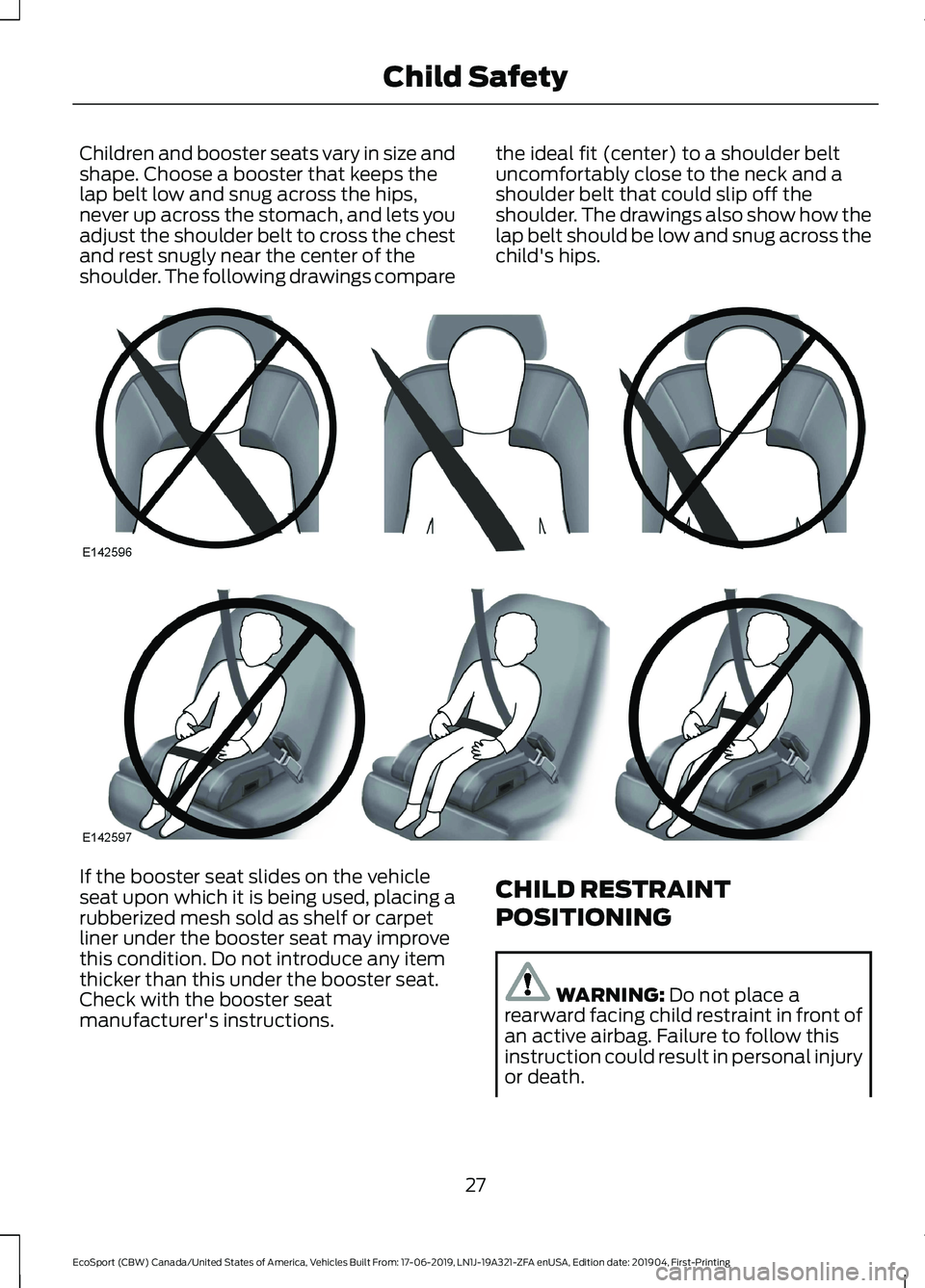
Children and booster seats vary in size andshape. Choose a booster that keeps thelap belt low and snug across the hips,never up across the stomach, and lets youadjust the shoulder belt to cross the chestand rest snugly near the center of theshoulder. The following drawings compare
the ideal fit (center) to a shoulder beltuncomfortably close to the neck and ashoulder belt that could slip off theshoulder. The drawings also show how thelap belt should be low and snug across thechild's hips.
If the booster seat slides on the vehicleseat upon which it is being used, placing arubberized mesh sold as shelf or carpetliner under the booster seat may improvethis condition. Do not introduce any itemthicker than this under the booster seat.Check with the booster seatmanufacturer's instructions.
CHILD RESTRAINT
POSITIONING
WARNING: Do not place arearward facing child restraint in front ofan active airbag. Failure to follow thisinstruction could result in personal injuryor death.
27
EcoSport (CBW) Canada/United States of America, Vehicles Built From: 17-06-2019, LN1J-19A321-ZFA enUSA, Edition date: 201904, First-PrintingChild Safety
Page 32 of 448

WARNING: Properly securechildren 12 years old and under in a rearseating position whenever possible. Ifyou are unable to properly secure allchildren in a rear seating position,properly secure the largest child on thefront seat. If you must use a forwardfacing child restraint on the front seat,move the seat as far back as possible.Failure to follow these instructions couldresult in personal injury or death.
WARNING: Always carefullyfollow the instructions and warningsprovided by the manufacturer of anychild restraint to determine if therestraint device is appropriate for yourchild's size, height, weight, or age. Followthe child restraint manufacturer'sinstructions and warnings provided forinstallation and use in conjunction withthe instructions and warnings providedby your vehicle manufacturer. A safetyseat that is improperly installed orutilized, is inappropriate for your child'sheight, age, or weight or does notproperly fit the child may increase therisk of serious injury or death.
WARNING: Do not allow apassenger to hold a child on their lapwhen your vehicle is moving. Failure tofollow this instruction could result inpersonal injury or death in the event of asudden stop or crash.
WARNING: Do not use pillows,books or towels to boost your child'sheight. Failure to follow this instructioncould result in personal injury or death.
WARNING: Properly secure childrestraints or booster seats when they arenot in use. They could become projectilesin a sudden stop or crash. Failure tofollow this instruction could result inpersonal injury or death.
WARNING: Do not put theshoulder section of the seatbelt or allowthe child to put the shoulder section ofthe seatbelt under their arm or behindtheir back. Failure to follow thisinstruction could reduce theeffectiveness of the seatbelt andincrease the risk of injury or death in acrash.
WARNING: Do not leave childrenor pets unattended in your vehicle.Failure to follow this instruction couldresult in personal injury or death.
28
EcoSport (CBW) Canada/United States of America, Vehicles Built From: 17-06-2019, LN1J-19A321-ZFA enUSA, Edition date: 201904, First-PrintingChild Safety
Page 33 of 448

Recommendations for Attaching Child Safety Restraints for Children
Use Any Attachment Method as Indicated Below by X
CombinedWeight ofChild andChildRestraint
RestraintType
SeatbeltOnlySeatbeltand LATCH(LowerAnchorsand TopTetherAnchor)
Seatbeltand TopTetherAnchor
LATCH(LowerAnchorsOnly)
LATCH(LowerAnchorsand TopTetherAnchor)
XXUp to 65 lb(29.5 kg)
Rear facingchildrestraint
XOver 65 lb(29.5 kg)
Rear facingchildrestraint
XXXUp to 65 lb(29.5 kg)
Forwardfacingchildrestraint
XXOver 65 lb(29.5 kg)
Forwardfacingchildrestraint
Note:The child restraint must rest tightlyagainst the vehicle seat upon which it isinstalled. It may be necessary to lift orremove the head restraint. See Seats (page115).
CHILD SAFETY LOCKS
WARNING: You cannot open therear doors from inside if you have put thechild safety locks on.
Rear Left-Hand Door
Turn anti-clockwise to lock and clockwiseto unlock.
29
EcoSport (CBW) Canada/United States of America, Vehicles Built From: 17-06-2019, LN1J-19A321-ZFA enUSA, Edition date: 201904, First-PrintingChild Safety
Page 35 of 448

PRINCIPLE OF OPERATION
WARNING: Always drive and ridewith your seatback upright and the lapbelt snug and low across the hips.
WARNING: To reduce the risk ofinjury, make sure children sit where theycan be properly restrained.
WARNING: Never let a passengerhold a child on his or her lap while yourvehicle is moving. The passenger cannotprotect the child from injury in a crash.
WARNING: All occupants of yourvehicle, including the driver, shouldalways properly wear their seatbelts,even when an airbag supplementalrestraint system is provided. Failure toproperly wear your seatbelts couldseriously increase the risk of injury ordeath.
WARNING: It is extremelydangerous to ride in a cargo area, insideor outside of a vehicle. In a crash, peopleriding in these areas are more likely to beseriously injured or killed. Do not allowpeople to ride in any area of your vehiclethat is not equipped with seats andseatbelts. Be sure everyone in yourvehicle is in a seat and using a seatbeltproperly.
WARNING: In a rollover crash, anunbelted person is significantly morelikely to die than a person wearing aseatbelt.
WARNING: Each seating positionin your vehicle has a specific seatbeltassembly which is made up of onebuckle and one tongue that are designedto be used as a pair. 1) Use the shoulderbelt on the outside shoulder only. Neverwear the shoulder belt under the arm. 2)Never swing the seatbelt around yourneck over the inside shoulder. 3) Neveruse a single belt for more than oneperson.
WARNING: When possible, allchildren 12 years old and under shouldbe properly restrained in a rear seatingposition. Failure to follow this couldseriously increase the risk of injury ordeath.
WARNING: Seatbelts and seatscan become hot in a vehicle that hasbeen closed up in sunny weather; theycould burn a small child. Check seatcovers and buckles before you place achild anywhere near them.
WARNING: Front and rear seatoccupants, including pregnant women,should wear seatbelts for optimumprotection in an accident.
All seating positions in your vehicle havelap and shoulder seatbelts. All occupantsof the vehicle should always properly weartheir seatbelts, even when an airbagsupplemental restraint system is provided.
The seatbelt system consists of:
•Lap and shoulder seatbelts.
•Shoulder seatbelt with automaticlocking mode, (except driver seatbelt).
•Height adjuster at the front outboardseating positions.
31
EcoSport (CBW) Canada/United States of America, Vehicles Built From: 17-06-2019, LN1J-19A321-ZFA enUSA, Edition date: 201904, First-PrintingSeatbelts
Page 45 of 448

After all occupants have adjusted theirseats and put on seatbelts, it is veryimportant that they continue to sitproperly. A properly seated occupant sitsupright, leaning against the seatback, andcentered on the seat cushion, with theirfeet comfortably extended on the floor.Sitting improperly can increase the chanceof injury in a crash event. For example, ifan occupant slouches, lies down, turnssideways, sits forward, leans forward orsideways, or puts one or both feet up, thechance of injury during a crash is greatlyincreased.
Children and Airbags
WARNING: Airbags can kill orinjure a child in a child restraint. Neverplace a rear-facing child restraint in frontof an active airbag. If you must use aforward-facing child restraint in the frontseat, move the seat upon which the childrestraint is installed all the way back.
Children must always be properlyrestrained. Accident statistics suggest thatchildren are safer when properly restrainedin the rear seating positions than in thefront seating position. Failure to followthese instructions may increase the risk ofinjury in a crash.
FRONT PASSENGER SENSING
SYSTEM
WARNING: Even with advancedrestraints systems, properly restrainchildren 12 and under in a rear seatingposition. Failure to follow this couldseriously increase the risk of injury ordeath.
WARNING: Sitting improperly, outof position or with the seatback reclinedtoo far can take weight off the seatcushion and affect the decision of thepassenger sensing system, resulting inserious injury or death in the event of acrash. Always sit upright against yourseat back, with your feet on the floor.
WARNING: Any alteration ormodification to the front passenger seatmay affect the performance of the frontpassenger sensing system. This couldseriously increase the risk of injury ordeath.
This system works with sensors that arepart of the front passenger’s seat andseatbelt to detect the presence of aproperly-seated occupant and determineif the front passenger’s frontal airbagshould be enabled (may inflate) or not.
41
EcoSport (CBW) Canada/United States of America, Vehicles Built From: 17-06-2019, LN1J-19A321-ZFA enUSA, Edition date: 201904, First-PrintingSupplementary Restraints System
Page 47 of 448

Passenger airbagPassenger airbag statusindicatorOccupant
ON: Unlit
EnabledOFF: UnlitAdult
ON: Lit
After all occupants have adjusted theirseats and put on seatbelts, it is veryimportant that they continue to sitproperly. A properly seated occupant sitsupright, leaning against the seatback, andcentered on the seat cushion, with theirfeet comfortably extended on the floor.Sitting improperly can increase the chanceof injury in a crash event. For example, ifan occupant slouches, lies down, turnssideways, sits forward, leans forward orsideways, or puts one or both feet up, thechance of injury during a crash is greatlyincreased.
If you think that the status of the passengerairbag off indicator lamp is incorrect, checkfor the following:
•Objects lodged underneath the seat
•Objects between the seat cushion andthe center console
•Objects hanging off the seat back
•Objects stowed in the seat back mappocket
•Objects placed on the occupant's lap
•Cargo interference with the seat
•Other passengers pushing or pulling onthe seat
•Rear passenger feet and knees restingor pushing on the seat
The conditions listed above may cause theweight of a properly seated occupant tobe incorrectly interpreted by the frontpassenger sensing system. The person inthe front passenger seat may appearheavier or lighter due to the conditionsdescribed in the list above.
Make sure the front passengersensing system is operatingproperly. See Front PassengerSensing System (page 41).
Do not attempt to repair or service thesystem. Take your vehicle immediately toan authorized dealer.
If it is necessary to modify an advancedfront airbag system to accommodate aperson with disabilities, contact the FordCustomer Relationship Center. See FrontPassenger Sensing System (page 41).
SIDE AIRBAGS
WARNING: Do not place objectsor mount equipment on or near theairbag cover, on the side of the front orrear seatbacks, or in areas that maycome into contact with a deployingairbag. Failure to follow theseinstructions may increase the risk ofpersonal injury in the event of a crash.
43
EcoSport (CBW) Canada/United States of America, Vehicles Built From: 17-06-2019, LN1J-19A321-ZFA enUSA, Edition date: 201904, First-PrintingSupplementary Restraints System