2019 VOLVO XC90 TWIN ENGINE lock
[x] Cancel search: lockPage 576 of 697

||WHEELS AND TIRES
* Option/accessory.
574
Related information
Recommended tire pressure (p. 569)
Adjusting tire pressure (p. 568)
Calibrating the tire pressure monitoring sys-
tem* (p. 571)
Viewing tire pressure status in the center
display* (p. 572)
Tire pressure monitoring system* (p. 569)
Inflate tires with the compressor included in
the tire sealing system (p. 587) When changing wheels
The wheels can be changed, e.g. to switch to
snow tires or spare tires. Follow the applicable
instructions for removing and installing the
wheel.
Changing to tires of another dimensionMake sure that the tire dimension is approved for
use on the vehicle.
If you change to tires of another dimension, con-
tact an authorized Volvo workshop to update the
vehicle's software. A software update may be
necessary when changing to tires of larger/
smaller dimensions or when changing to or from
snow tires.
Related information
Removing a wheel (p. 576)
Installing a wheel (p. 578)
Tool kit (p. 574)
Snow tires (p. 581)
Spare wheel (p. 579)
Wheel bolts (p. 575) Tool kit
Tools for e.g. towing or changing wheels are
provided in the vehicle's cargo compartment.
The foam block under the cargo compartment
floor contains the towing eyelet, the tire sealing
system, the tool for removing plastic wheel bolt
covers and the tool for removing the locking
wheel bolts.
If the vehicle is equipped with a spare wheel*
14
, a
jack, lug wrench, and a package with
disposable gloves and a bag for the damaged
wheel are also provided.
Related information
When changing wheels (p. 574)
Jack* (p. 575) 14
Not available on all models.
Page 577 of 697
WHEELS AND TIRES
}}
* Option/accessory. 575
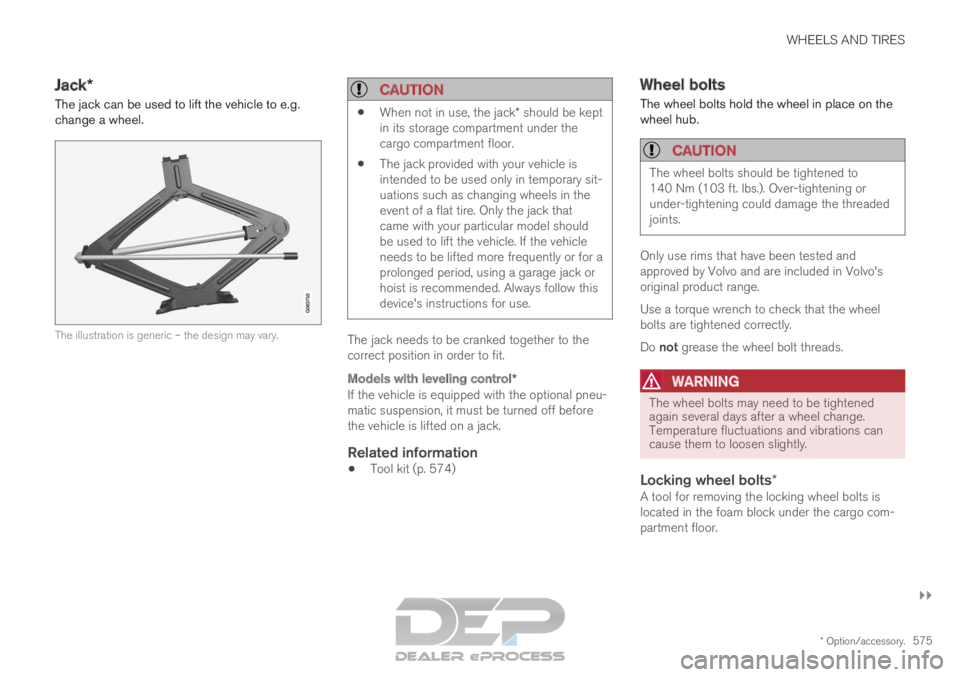
Jack*
The jack can be used to lift the vehicle to e.g.
change a wheel. The illustration is generic – the design may vary.
CAUTION
When not in use, the jack* should be kept
in its storage compartment under the
cargo compartment floor.
The jack provided with your vehicle is
intended to be used only in temporary sit-
uations such as changing wheels in the
event of a flat tire. Only the jack that
came with your particular model should
be used to lift the vehicle. If the vehicle
needs to be lifted more frequently or for a
prolonged period, using a garage jack or
hoist is recommended. Always follow this
device's instructions for use. The jack needs to be cranked together to the
correct position in order to fit.
Models with leveling control*
If the vehicle is equipped with the optional pneu-
matic suspension, it must be turned off before
the vehicle is lifted on a jack.
Related information
Tool kit (p. 574) Wheel bolts
The wheel bolts hold the wheel in place on the
wheel hub.
CAUTION The wheel bolts should be tightened to
140 Nm (103 ft. lbs.). Over-tightening or
under-tightening could damage the threaded
joints.
Only use rims that have been tested and
approved by Volvo and are included in Volvo's
original product range.
Use a torque wrench to check that the wheel
bolts are tightened correctly.
Do not grease the wheel bolt threads.
WARNING
The wheel bolts may need to be tightened
again several days after a wheel change.
Temperature fluctuations and vibrations can
cause them to loosen slightly.
Locking wheel bolts*A tool for removing the locking wheel bolts is
located in the foam block under the cargo com-
partment floor.
Page 578 of 697

||WHEELS AND TIRES
* Option/accessory.
576
Related information
Removing a wheel (p. 576)
Installing a wheel (p. 578) Removing a wheel
Instructions for removing a wheel when chang-
ing wheels. Wheel changes must always be car-
ried out correctly.
CAUTION
When not in use, the jack* should be kept
in its storage compartment under the
cargo compartment floor.
The jack provided with your vehicle is
intended to be used only in temporary sit-
uations such as changing wheels in the
event of a flat tire. Only the jack that
came with your particular model should
be used to lift the vehicle. If the vehicle
needs to be lifted more frequently or for a
prolonged period, using a garage jack or
hoist is recommended. Always follow this
device's instructions for use.
WARNING
Apply the parking brake and put the gear
selector in the Park (P) position.
Block the wheels standing on the ground,
use rigid wooden blocks or large stones.
Check that the jack is not damaged, the
threads are properly lubricated and it is
free from dirt.
Be sure the jack is on a firm, level, non-
slippery surface and that it is upright and
not leaning.
The jack must correctly engage in the
jack attachment.
No objects should be placed between the
base of the jack and the ground, or
between the jack and the attachment bar
on the vehicle.
Never let anyone remain in the vehicle
when it is raised on a jack.
If a tire must be changed near passing
traffic, make sure all passengers move to
a safe location.
Use a jack intended for the vehicle when
changing a tire. For any other job, use
stands to support the vehicle.
Never crawl under or allow any part of
your body to be extended under a vehicle
supported by a jack.
Page 579 of 697

WHEELS AND TIRES
}}
* Option/accessory. 577
1.
Turn on the vehicle's hazard warning flashers
if a wheel change must be performed in an
area with traffic.
2. Apply the parking brake and put the gear selector in P.
For vehicles with Leveling Control*: If the
vehicle is equipped with pneumatic suspen-
sion, this must be switched off before the
vehicle is lifted with the jack*.
3. Take out the jack*, lug wrench* and tool for
removing the plastic covers, which are
stowed in the foam block. Tool for removing the plastic covers on the wheel bolts.
4. Place chocks in front of and behind the
wheels that are still on the ground. For exam-
ple, use heavy wooden blocks or large
stones. 5.
Using the lug wrench*, screw the towing eye
into place as far as possible according to the
instructions.
CAUTION The towing eyelet must be screwed into the
lug wrench* as far as possible.
6. Remove the plastic covers from the wheel
bolts using the designated tool.
7.
With the vehicle still on the ground, use the
lug wrench/towing eye to loosen the wheel
bolts ½-1 turn by pressing downward (coun-
terclockwise). 8. When hoisting the vehicle, it is important that
the jack* or garage lift arms are positioned
on the designated points under the vehicle.
The triangle markings on the plastic cover
indicate where the jack attachment points/
lifting points are located. There are two jack
attachment points on each side of the vehi-
cle. There is a groove for the jack at each
attachment point. 9. Position the jack under the attachment point
being used, ensuring that the surface is firm,
flat and not slippery.
Page 580 of 697

||WHEELS AND TIRES
* Option/accessory.
578 10. Crank it up until it is properly aligned and it is
in contact with the vehicle's jack attachment
point. Make sure the top of the jack (or the
garage lift arms) is correctly positioned in the
attachment point, with the bump on the top
of the jack in the recess in the attachment
point and the base positioned vertically under
the attachment point.
11. Turn the jack so that the crank is as far as possible from the side of the vehicle, which
will position the jack's arms perpendicular to
the vehicle's direction of movement.
12. Raise the vehicle until the wheel to be changed can move freely. Unscrew the wheel
bolts and lift off the wheel.
Related information
Leveling control settings* (p. 464)
When changing wheels (p. 574)
Hoisting the vehicle (p. 618)
Jack* (p. 575)
Tool kit (p. 574)
Installing a wheel (p. 578) Installing a wheel
Instructions for installing a wheel during a wheel
change.
NOTE The jack provided with your vehicle is
intended to be used only in temporary situa-
tions such as changing wheels in the event of
a flat tire. Only the jack that came with your
particular model should be used to lift the
vehicle. If the vehicle needs to be lifted more
frequently or for a prolonged period, using a
garage jack or hoist is recommended. Always
follow this device's instructions for use.
WARNING
Apply the parking brake and put the gear
selector in the Park (P) position.
Block the wheels standing on the ground,
use rigid wooden blocks or large stones.
Check that the jack is not damaged, the
threads are properly lubricated and it is
free from dirt.
Be sure the jack is on a firm, level, non-
slippery surface and that it is upright and
not leaning.
The jack must correctly engage in the
jack attachment.
No objects should be placed between the
base of the jack and the ground, or
between the jack and the attachment bar
on the vehicle.
Never let anyone remain in the vehicle
when it is raised on a jack.
If a tire must be changed near passing
traffic, make sure all passengers move to
a safe location.
Use a jack intended for the vehicle when
changing a tire. For any other job, use
stands to support the vehicle.
Never crawl under or allow any part of
your body to be extended under a vehicle
supported by a jack.
Page 584 of 697

||WHEELS AND TIRES
582
CAUTION
Snow chains can be used on the vehicle, with
the following restrictions:
Volvo recommends not using snow
chains on wheel dimensions larger than
19 inches.
Always follow the manufacturer's installa-
tion instructions carefully. Install chains
as tightly as possible and retighten peri-
odically.
Only put snow chains on the front wheels
(also applies to all-wheel drive vehicles).
If accessory, aftermarket or "custom"
tires and wheels with different dimen-
sions than the original tires and wheels
are used, snow chains in some cases
may NOT be used. Sufficient distance
between the chains and brakes, suspen-
sion and body components must be
maintained.
Check local regulations regarding the use
of snow chains before installing.
Never exceed the snow chain manufac-
turer's specified maximum speed limit.
Under no circumstances should you
exceed 50 km/h (30 mph).
Avoid bumps, holes or sharp turns when
driving with snow chains.
Avoid driving on surfaces without snow as
this wears out both the snow chains and
the tires.
The handling of the vehicle can be
adversely affected when driving with
chains. Avoid fast or sharp turns as well
as locked wheel braking.
Some types of strap-on chains affect
brake components and therefore must
NOT be used. Consult a Volvo retailer for more information
about snow chains.
Related information
Winter driving (p. 472) Tire sealing system
17
The temporary tire sealing system can be used
to seal a puncture in a tire or to check and
adjust the pressure in the tire.
Models equipped with a spare wheel 18
do not
have the tire sealing system.
WARNING California Proposition 65
Operating, servicing and maintaining a pas-
senger vehicle can expose you to chemicals
including engine exhaust, carbon monoxide,
phthalates, and lead, which are known to the
State of California to cause cancer and birth
defects or other reproductive harm. To mini-
mize exposure, avoid breathing exhaust, do
not idle the engine except as necessary, serv-
ice your vehicle in a well ventilated area and
wear gloves or wash your hands frequently
when servicing your vehicle. For more infor-
mation go to www.P65Warnings.ca.gov/
passenger-vehicle.
The tire sealing system consists of a compressor
and a bottle containing sealing compound. The
sealing functions as a temporary repair.
Page 585 of 697

WHEELS AND TIRES
}}
583
NOTE The sealing compound effectively seals tires
with punctures in the tread but may not be
able to fully seal tires with punctures in the
sidewall. Do not use the tire sealing system
on tires with large tears, cracks or similar
damage.
NOTE
The compressor is intended for temporary tire
sealing and is approved by Volvo.
LocationThe tire sealing system is located in a foam block
under the floor of the cargo compartment.
Sealing compound expiration dateThe sealing compound bottle must be replaced if
its expiration date has passed (see the decal on
the bottle). Handle the old bottle as hazardous
waste.
Related information
Using the tire sealing system (p. 583)
Inflate tires with the compressor included in
the tire sealing system (p. 587)
Tires (p. 560) Using the tire sealing system
Sealing a tire using the tire sealing system, the
Temporary Mobility Kit (TMK).
Overview Electrical cable
Hose
Air release valve
Protective hose cover
Speed limit sticker
Bottle holder (orange cover)
Air pressure gauge
17
Certain models only.
18 Not available on all models.
Page 598 of 697

LOADING, STORAGE AND PASSENGER COMPARTMENT
* Option/accessory.
596 Using the electrical outlets
The 12 V outlet can be used for devices
intended for this such as MP3 players, coolers
and cellular phones.
The high-voltage outlet* can be used for devices
intended for this, such as chargers, laptops, etc.
The ignition must be in at least mode I for the
outlets to supply current. The outlets will then be
active as long as there is sufficient charge in the
start battery.
If the engine is turned off and the vehicle is
locked, the outlets will be deactivated. If the
engine is turned off and the vehicle remains
unlocked, the sockets will remain active for up to
7 minutes.
NOTE Bear in mind that using the electrical outlets
when the engine is off could cause the starter
battery to have too low of a charge level,
which could limit other functionality.
Accessories connected to the electrical out-
lets can be activated even when the vehicle
electrical system is off or if preconditioning is
used. For this reason, disconnect plugs when
they are not in use to prevent the starter bat-
tery from becoming discharged.
WARNING
Do not use accessories with large or
heavy plugs – they could damage the out-
let or come loose while you are driving.
Do not use accessories that could cause
disruptions to e.g. the vehicle's radio
receiver or electrical system.
Position the accessory so that there is no
risk of it injuring the driver or passengers
in the event of heavy braking or a colli-
sion.
Pay attention to connected accessories
as they can generate heat that could burn
passengers or the interior.
Using 12 V outlets1. Remove the stopper (tunnel console) or fold
down the cover (trunk/cargo compartment)
over the socket and plug in the device.
2. Unplug the device and put the stopper back in (tunnel console) or fold up the cover
(trunk/cargo compartment) when the socket
is not in use or left unattended.
CAUTION The maximum power is 120 W (10 A) per
outlet.
Using high-voltage outletsThe ignition must be in at least mode I for outlets
to supply current. The outlets will then be active
as long as there is sufficient charge in the start
battery.
1. Slide down the cover over the outlet and plug
in the device.
>
The LED 2
light on the outlet will indicate
its status.
2. The outlet is supplying electrical current when the light is glowing steadily green.
3. Disconnect the device by pulling out the plug (do not pull on the cord).
Pull up the cover when the outlet is not in
use or is left unattended.
CAUTION The maximum power is 150 W.
WARNING
Do not attempt to alter or repair the high-volt-
age outlet on your own. Volvo recommends
contacting an authorized Volvo workshop.
2
LED (Light Emitting Diode)