2019 VOLVO XC90 TWIN ENGINE battery
[x] Cancel search: batteryPage 614 of 697

||MAINTENANCE AND SERVICE
612
Monthly:
Check cold tire pressure in all tires. Inspect
the tires for wear.
Check that engine coolant and other fluid
levels are between the indicated "min" and
"max" markings.
Clean interior glass surfaces with a glass
cleaner and soft paper towels.
Wipe driver information displays with a soft
cloth.
Visually inspect battery terminals for corro-
sion. Corrosion may indicate a loose terminal
connector, or a battery near the end of its
useful service life. Consult your Volvo retailer
for additional information.
As needed:
Wash the car, including the undercarriage, to
reduce wear that can be caused by a buildup of
dirt, and corrosion that can be caused by salt res-
idues.
Clean leaves and twigs from air intake vents at
the base of the windshield, and from other places
where they may collect.
NOTE Complete service information for qualified
technicians is available online for purchase or
subscription at www.volvotechinfo.com.
Related information
Vehicle status (p. 614)
Scheduling service and repairs (p. 615)
Connecting equipment to the vehicle's data
link connector (p. 37)
Technician certification (p. 38)
Climate control system service (p. 621)
Maintenance of the brake system (p. 442)
Engine compartment overview (p. 622) Data transfer between vehicle and
workshop over Wi-Fi
Volvo workshops have a designated Wi-Fi net-
work for secure data transfer between your vehi-
cle and the workshop. Your visit to the workshop
will be easier and more effective when diagnos-
tics information and software can be transferred
over the workshop's network.
When you arrive at the workshop, your service
technician can connect your vehicle to the work-
shop's Wi-Fi network to perform troubleshooting
and download software. For this type of commu-
nication, the vehicle only connects to a work-
shop's network. It is not possible to connect the
vehicle to another Wi-Fi network (e.g. your home
network) in the same way as to a workshop's net-
work.
Connecting with remote keyConnection is usually managed by the service
technician, who will use the remote key buttons. It
is therefore important to bring a key with buttons
with you when you visit the workshop. Pressing
the lock button on the remote key three times will
connect the vehicle to the workshop's Wi-Fi net-
work.
When the car is connected to a Wi-Fi network,
the symbol appears in the center display.
Page 629 of 697
MAINTENANCE AND SERVICE
}}
627
Start battery
The vehicle has a single-pole electrical system
that uses the chassis and engine mount as con-
ductors.
The start battery is used to start the electrical
system and power electrical equipment in the
vehicle. The hybrid battery is used to start the
combustion engine.
The start battery should only be replaced by a
workshop 15
.
The start battery is a 12 V AGM (Absorbed Glass
Mat) battery, dimensioned for regenerative charg-
ing and to support the function of the vehicle's
various systems.
The service life and performance of the start bat-
tery are affected by factors such as driving style,
driving conditions, climate, battery discharges,
number of starts, etc.
Never disconnect the start battery while the
engine is running.
Make sure the cables to the start battery are
correctly connected and the clamps are
securely tightened.
WARNING
Batteries generate hydrogen gas, which
is flammable and explosive.
Do not connect the jumper cable to any
part of the fuel system or to any moving
parts. Avoid touching hot manifolds.
Battery fluid contains sulfuric acid. Do not
allow battery fluid to contact eyes, skin,
fabrics or painted surfaces.
If contact occurs, flush the affected area
immediately with water. Obtain medical
help immediately if eyes are affected.
Never expose the battery to open flame
or electric spark. Do not smoke near the
battery. Failure to follow the instructions
for jump starting can lead to injury.
Connection points
WARNING PROPOSITION 65 WARNING
Battery posts, terminals, and related accesso-
ries contain lead and lead compounds, chemi-
cals known to the state of California to cause
cancer and reproductive harm. Wash hands
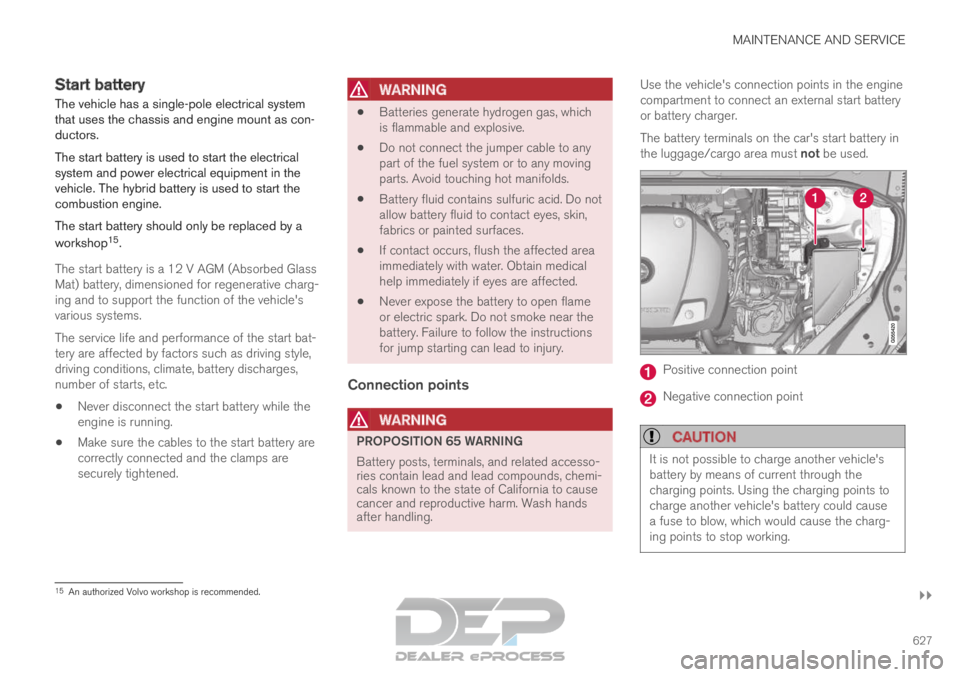
after handling.Use the vehicle's connection points in the engine
compartment to connect an external start battery
or battery charger.
The battery terminals on the car's start battery in
the luggage/cargo area must not be used.
Positive connection point
Negative connection point
CAUTION
It is not possible to charge another vehicle's
battery by means of current through the
charging points. Using the charging points to
charge another vehicle's battery could cause
a fuse to blow, which would cause the charg-
ing points to stop working.
15
An authorized Volvo workshop is recommended.
Page 630 of 697

||MAINTENANCE AND SERVICE
628
CAUTION
Only a modern battery charger with controlled
charge voltage should be used to charge the
starter battery. The rapid charging function
should not be used as this could damage the
battery.
NOTE
If both the starter battery and the hybrid bat-
tery are discharged, both batteries must be
charged. In such cases, it is not possible to
charge only the hybrid battery first.
The starter battery must have a certain level
of charge for it to be possible to charge the
hybrid battery.
CAUTION Failure to observe the following could cause
the infotainment energy save mode to tempo-
rarily stop working and/or a message in the
driver's display regarding the state of charge
of the starter battery may be temporarily
incorrect after an external starter battery or
battery charger has been connected:
The negative battery terminal of the vehi-
cle's starter battery must never be used
to connect an external starter battery or
battery charger – only the vehicle's neg-
ative charging point should be used as
a grounding point.NOTE If the starter battery becomes discharged too
many times, it will shorten its service life.
The service life of the starter battery is affec-
ted by several factors, such as driving condi-
tions and climate. The starting capacity of the
battery reduces gradually over time. The bat-
tery must therefore be recharged if the vehi-
cle is not used or a long period of time or if it
is only driven short distances. Severe cold fur-
ther limits the starting capacity.
To keep the starter battery in a good condi-
tion, the vehicle should be driven at least
15 minutes per week or the battery should be
connected to a battery charger with automatic
trickle charging.
A starter battery that is always kept fully
charged has the maximum service life.
Page 631 of 697

MAINTENANCE AND SERVICE
}}
629
Location The start battery is located in the cargo compartment.WARNING If the starter battery is disconnected, the func-
tion for automatic opening and closing must
be reset to function correctly. A reset is
required in order for the pinch protection to
work.
CAUTION
On certain models, the battery is secured with
a tensioning strap. Make sure that the ten-
sioning strap is always securely tightened.
Specifications for start battery
Battery type
H8 AGM
Voltage (V) 12
Cold start capacity A
- CCA B
(A) 850
Dimensions, L×W×H 353×175×190 mm (13.9×6.9×7.5 inches)
Capacity (Ah) 95A
According to EN standard.
B Cold Cranking Amperes.
Volvo recommends that batteries are replaced by
an authorized Volvo workshop.
Page 632 of 697

||MAINTENANCE AND SERVICE
630
CAUTION
If replacing the battery, make sure you
replace it with a battery of the same size, cold
start capacity and type as the original battery
(see the decal on the battery).
Related information
Battery symbols (p. 632)
Hybrid battery (p. 631)
Jump starting using another battery (p. 481)
Page 633 of 697

MAINTENANCE AND SERVICE
631
Hybrid battery
The vehicle's electric motor is powered by a
rechargeable, maintenance-free, lithium-ion
hybrid battery.
NOTE The vehicle cannot be started if the hybrid
battery is discharged.
NOTE
If both the starter battery and the hybrid bat-
tery are discharged, both batteries must be
charged. In such cases, it is not possible to
charge only the hybrid battery first.
The starter battery must have a certain level
of charge for it to be possible to charge the
hybrid battery.
WARNING
Hybrid battery replacement may only be per-
formed by a workshop – an authorized Volvo
workshop is recommended.
CoolantThe hybrid battery's cooling system has its own
expansion tank.
CAUTION Filling the hybrid battery coolant should only
be performed by a workshop – an authorized
Volvo workshop is recommended.
Specifications for hybrid batteryType: Lithium-ion
Power reserve: 10.4 kWh.
NOTE
The capacity of the hybrid battery decreases
with age and use, which could result in
increased use of the combustion engine,
leading to higher fuel consumption and
reduced electric motor range.
Related information
Battery symbols (p. 632)
Start battery (p. 627)
Charging the hybrid battery (p. 417)
Page 634 of 697

MAINTENANCE AND SERVICE
632Battery symbols
There are warning symbols and information on
the batteries. Wear protective goggles.
See the Owner's Manual for
additional information. Keep batteries away from
children. Batteries contain corrosive
acid. Avoid smoking, open
flames, and/or sparks. Risk of explosion.
Recycle properly.
NOTE
A used start battery contains lead and must
be recycled in an environmentally responsible
manner.
Related information
Start battery (p. 627)
Hybrid battery (p. 631) Fuses and fuseboxes
All electrical functions and components are pro-
tected by a number of fuses in order to protect
the vehicle's electrical system from damage by
short circuiting or overloading.
WARNING Never use a foreign object or a fuse with a
higher amperage than that specified to
replace a fuse. This could cause significant
damage to the electrical system and possibly
lead to a fire.
WARNING
Orange wiring may only be handled by quali-
fied personnel.
WARNING
Several components in the vehicle work with
high voltage that can be hazardous in case of
an incorrect procedure.
Do not touch anything that is not clearly
described in this Owner's Manual.
If any electrical component or function is not
responding, the component may have blown a
fuse due to temporary overload. If the same fuse
blows repeatedly, there may be a problem with
the component. Volvo recommends contacting an
authorized Volvo workshop to have the compo-
nent checked.
Page 637 of 697

MAINTENANCE AND SERVICE
}}
635
Fuse pliers are provided on the inside of the fuse
box cover to assist in removing and inserting
fuses.
There are also spaces for several extra fuses in
the fusebox.
PositionsThere is a decal with a diagram of the locations
of the fuses on the inside of the cover.
Fuses 1–13, 18–30, 35–37 and 46–70 are
"Micro" fuses.
Fuses 14–17, 31–34, 38–45 and 71–78 are
"MCase" fuses and should only be replaced
by a workshop 16
. Function
Ampere–
––
––
–Control module for actuator
for engaging/changing gears,
automatic transmission
5High-voltage coolant heater
control module
5 Function
Ampere Control module for A/C; heat
exchanger cut-off valve; cut-
off valve for coolant through
the climate system
5 Hybrid battery control module;
high-voltage converter for
combined high-voltage gener-
ator/starter motor with 500
V–12 V voltage converter
5 –
– Converter for controlling feed
to rear axle electric motor
10 Hybrid battery control module;
high-voltage converter for
combined high-voltage gener-
ator/starter motor with 500
V–12 V voltage converter
10 Charge module
5 Cut-off valve for hybrid battery
coolant; coolant pump 1 for
hybrid battery
10 Coolant pump for electric drive
system
10 Function
Ampere Hybrid component cooling fan 25
–
– –
– –
– –
– –
– –
– –
– –
– –
– 12 V outlet in tunnel console,
front
15 12 V outlet in tunnel console
between second-row seats
A
12 V outlet in tunnel console,
between rear seats B
; USB
ports in tunnel console
between rear seats B15
16
An authorized Volvo workshop is recommended.