Page 22 of 700
22Pictorial index
YARIS_F_OM_Europe_OM52K19E
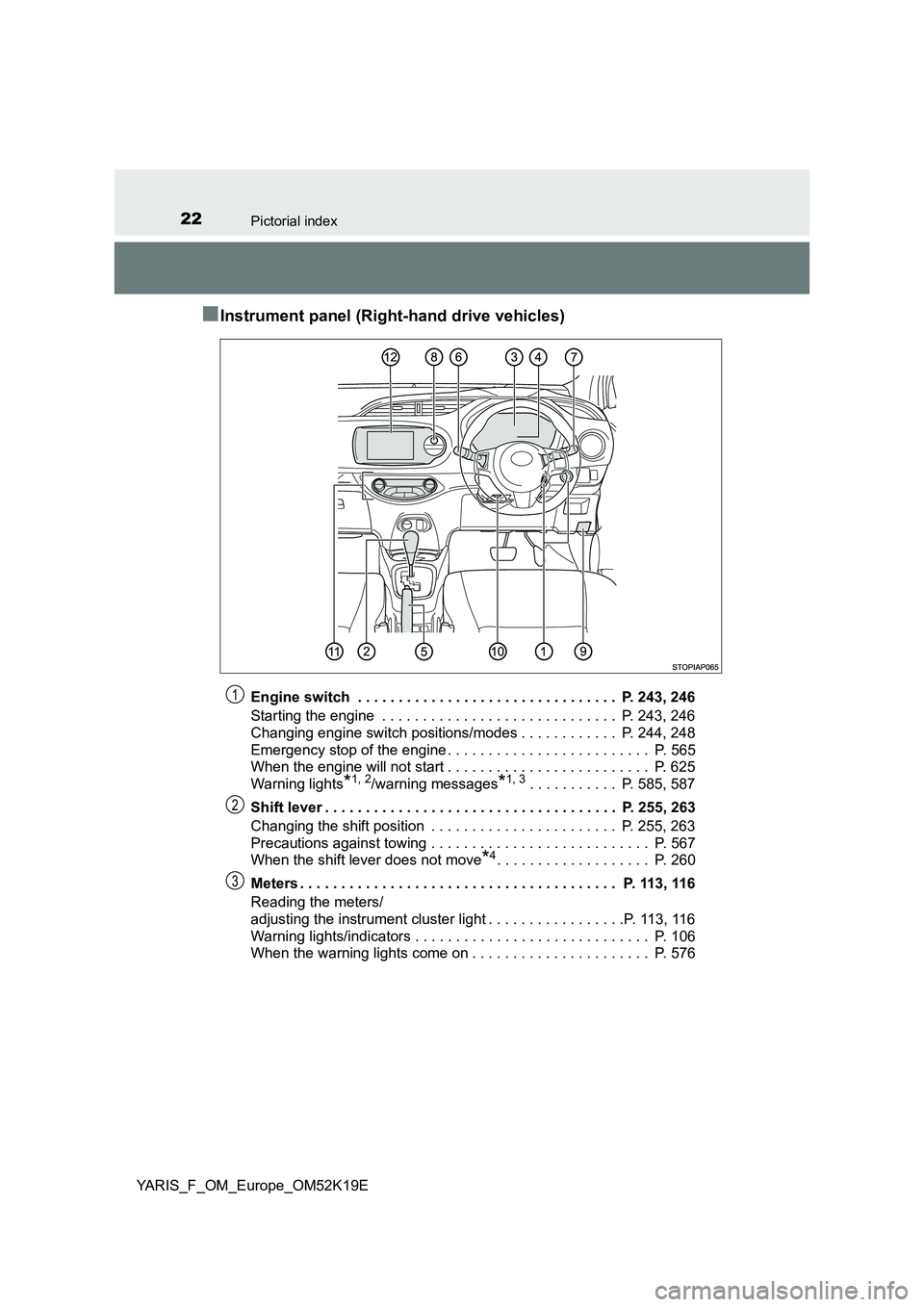
■Instrument panel (Right-hand drive vehicles)
Engine switch . . . . . . . . . . . . . . . . . . . . . . . . . . . . . . . . P. 243, 246
Starting the engine . . . . . . . . . . . . . . . . . . . . . . . . . . . . . P. 243, 246
Changing engine switch positions/modes . . . . . . . . . . . . P. 244, 248
Emergency stop of the engine . . . . . . . . . . . . . . . . . . . . . . . . . P. 565
When the engine will not start . . . . . . . . . . . . . . . . . . . . . . . . . P. 625
Warning lights*1, 2/warning messages*1, 3. . . . . . . . . . . P. 585, 587
Shift lever . . . . . . . . . . . . . . . . . . . . . . . . . . . . . . . . . . . . P. 255, 263
Changing the shift position . . . . . . . . . . . . . . . . . . . . . . . P. 255, 263
Precautions against towing . . . . . . . . . . . . . . . . . . . . . . . . . . . P. 567
When the shift lever does not move*4. . . . . . . . . . . . . . . . . . . P. 260
Meters . . . . . . . . . . . . . . . . . . . . . . . . . . . . . . . . . . . . . . . P. 113, 116
Reading the meters/
adjusting the instrument cluster light . . . . . . . . . . . . . . . . .P. 113, 116
Warning lights/indicators . . . . . . . . . . . . . . . . . . . . . . . . . . . . . P. 106
When the warning lights come on . . . . . . . . . . . . . . . . . . . . . . P. 576
1
2
3
Page 23 of 700

23Pictorial index
YARIS_F_OM_Europe_OM52K19E
Multi-information display . . . . . . . . . . . . . . . . . . . . . . . P. 120, 125
If a warning message or indicator is displayed*3 . . . . . . P. 576, 587
Parking brake . . . . . . . . . . . . . . . . . . . . . . . . . . . . . . . . . . . . . P. 268
Applying/releasing . . . . . . . . . . . . . . . . . . . . . . . . . . . . . . . . . . P. 268
Precautions against winter season . . . . . . . . . . . . . . . . . . . . . P. 356
Warning buzzer . . . . . . . . . . . . . . . . . . . . . . . . . . . . . . . . . . . . P. 576
Turn signal lever . . . . . . . . . . . . . . . . . . . . . . . . . . . . . . . . . . P. 267
Headlight switch . . . . . . . . . . . . . . . . . . . . . . . . . . . . . . . . . . P. 269
Headlights/front position lights/tail lights/
daytime running lights . . . . . . . . . . . . . . . . . . . . . . . . . . . . . . . P. 269
Front fog lights*5/rear fog light . . . . . . . . . . . . . . . . . . . . . . . . P. 274
Wiper and washer switch . . . . . . . . . . . . . . . . . . . . . . . P. 276, 280
Usage (front) . . . . . . . . . . . . . . . . . . . . . . . . . . . . . . . . . . . . . . P. 276
Usage (rear) . . . . . . . . . . . . . . . . . . . . . . . . . . . . . . . . . . . . . . P. 280
Adding washer fluid . . . . . . . . . . . . . . . . . . . . . . . . . . . . . . . . . P. 501
Emergency flasher switch . . . . . . . . . . . . . . . . . . . . . . . . . . P. 564
Hood lock release lever . . . . . . . . . . . . . . . . . . . . . . . . . . . . P. 483
Tilt and telescopic steering lock release lever . . . . . . . . . . P. 207
Air conditioning system . . . . . . . . . . . . . . . . . . . . . . . . P. 432, 440
Usage (manual air conditioning system) . . . . . . . . . . . . . . . . . P. 432
Usage (automatic air conditioning system) . . . . . . . . . . . . . . . P. 440
Rear window defogger. . . . . . . . . . . . . . . . . . . . . . . . . . . P. 434, 445
Audio system*5. . . . . . . . . . . . . . . . . . . . . . . . . . . . . . . . . . . P. 360
Navigation/Multimedia system*5, 6
*1: Vehicles with a smart entry & start system
*2: Vehicles with monochrome display
*3: Vehicles with color display
*4: Vehicles with a Multidrive
*5: If equipped
*6: Refer to “Navigation and multimedia system Owner’s manual”.
4
5
6
7
8
9
10
11
12
Page 41 of 700
411-1. For safe use
1
For safety and security
YARIS_F_OM_Europe_OM52K19E
WARNING
■People suffering illness
Obtain medical advice and wear the seat belt in the proper way. ( P. 36)
■ When children are in the vehicle
P. 7 8
■ Seat belt pretensioners
If the pretensioner has activated, the SRS warning light will come on. In that
case, the seat belt cannot be used again and must be replaced at any
authorized Toyota retailer or Toyota authorized repairer, or any reliable
repairer.
■ Seat belt damage and wear
● Do not damage the seat belts by allowing the belt, plate, or buckle to be
jammed in the door.
● Inspect the seat belt system periodically. Check for cuts, fraying, and loose
parts. Do not use a damaged seat belt until it is replaced. Damaged seat
belts cannot protect an occupant from death or serious injury.
● Ensure that the belt and plate are locked and the belt is not twisted.
If the seat belt does not function correctly, immediately contact any autho-
rized Toyota retailer or Toyota authorized repairer, or any reliable repairer.
● Replace the seat assembly, including the belts, if your vehicle has been
involved in a serious accident, even if there is no obvious damage.
● Do not attempt to install, remove, modify, disassemble or dispose of the
seat belts. Have any necessary repairs carried out by any authorized
Toyota retailer or Toyota authorized repairer, or any reliable repairer. Inap-
propriate handling may lead to incorrect operation.
Page 44 of 700
441-1. For safe use
YARIS_F_OM_Europe_OM52K19E
*: If equipped
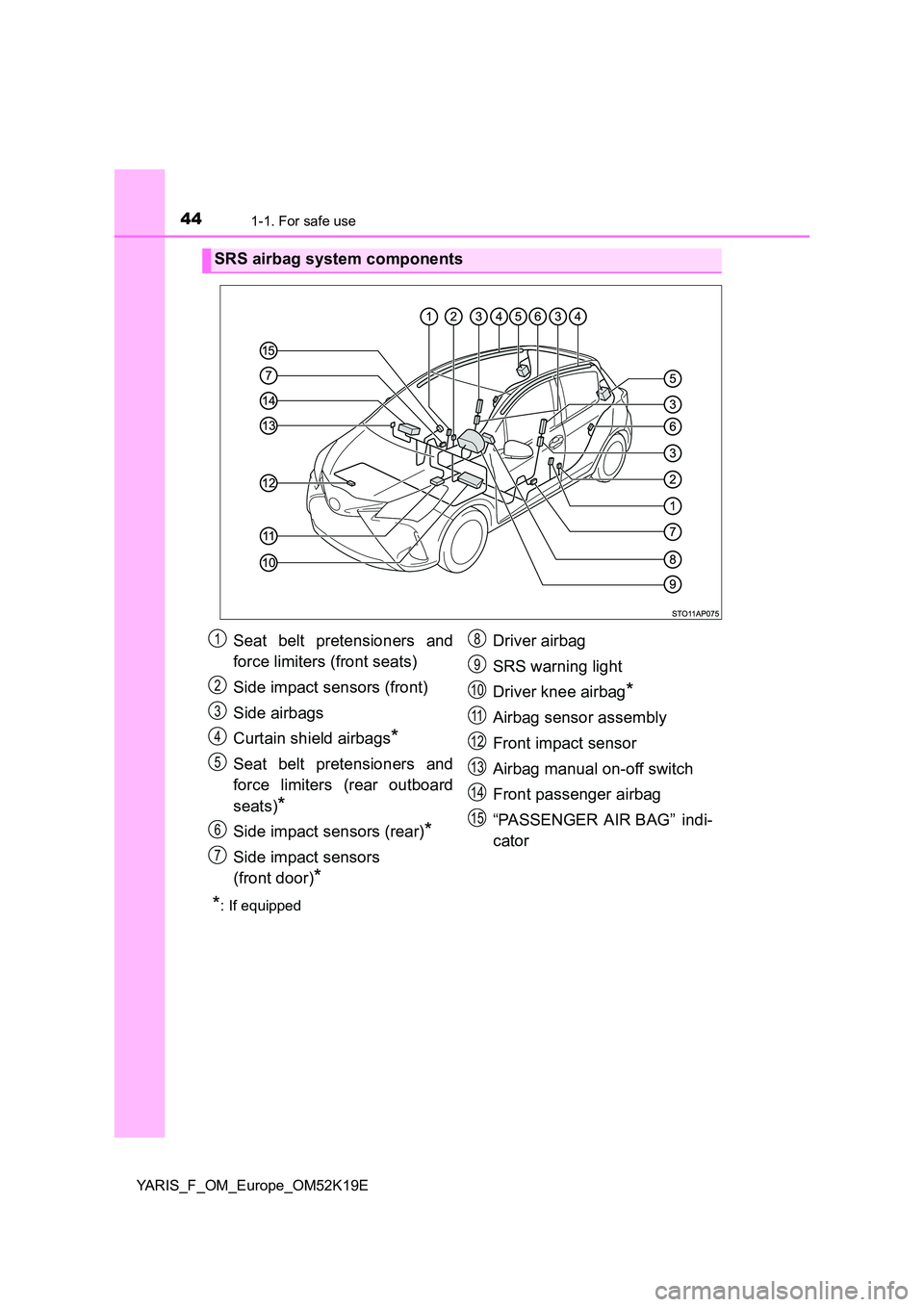
SRS airbag system components
Seat belt pretensioners and
force limiters (front seats)
Side impact sensors (front)
Side airbags
Curtain shield airbags*
Seat belt pretensioners and
force limiters (rear outboard
seats)*
Side impact sensors (rear)*
Side impact sensors
(front door)*
Driver airbag
SRS warning light
Driver knee airbag*
Airbag sensor assembly
Front impact sensor
Airbag manual on-off switch
Front passenger airbag
“PASSENGER AIR BAG” indi-
cator
1
2
3
4
5
6
7
8
9
10
11
12
13
14
15
Page 45 of 700
451-1. For safe use
1
For safety and security
YARIS_F_OM_Europe_OM52K19E
The main SRS airbag system components are shown above. The
SRS airbag system is controlled by the airbag sensor assembly. As
the airbags deploy, a chemical reaction in the inflators quickly fills the
airbags with non-toxic gas to help restrain the motion of the occu-
pants.
WARNING
■ SRS airbag precautions
Observe the following precautions regarding the SRS airbags.
Failure to do so may cause death or serious injury.
● The driver and all passengers in the vehicle must wear their seat belts
properly.
The SRS airbags are supplemental devic es to be used with the seat belts.
● The SRS driver airbag deploys with considerable force, and can cause
death or serious injury especially if the driver is very close to the airbag.
Since the risk zone for the driver’s airbag is the first 50 - 75 mm (2 - 3 in.)
of inflation, placing yourself 250 mm ( 10 in.) from your driver airbag pro-
vides you with a clear margin of safety. This distance is measured from
the center of the steering wheel to your breastbone. If you sit less than
250 mm (10 in.) away now, you can change your driving position in sev-
eral ways:
• Move your seat to the rear as far as you can while still reaching the ped-
als comfortably.
• Slightly recline the back of the seat. Although vehicle designs vary,
many drivers can achieve the 250 mm (10 in.) distance, even with the
driver seat all the way forward, simply by reclining the back of the seat
somewhat. If reclining the back of your seat makes it hard to see the
road, raise yourself by using a firm, non-slippery cushion, or raise the
seat if your vehicle has that feature.
• If your steering wheel is adjustable, tilt it downward. This points the
airbag toward your chest instead of your head and neck.
The seat should be adjusted as recommended above, while still maintain-
ing control of the foot pedals, steering wheel, and your view of the instru-
ment panel controls.
Page 55 of 700

551-1. For safe use
1
For safety and security
YARIS_F_OM_Europe_OM52K19E
Exhaust gas precautions
Harmful substance to the human body is included in exhaust
gases if inhale.
WARNING
Exhaust gases include harmful carbon monoxide (CO), which is colorless and
odorless. Observe the following precautions.
Failure to do so may cause exhaust gases enter the vehicle and may lead to
an accident caused by light-headedness, or may lead to death or a serious
health hazard.
■ Important points while driving
● Keep the back door closed.
● If you smell exhaust gases in the vehicle even when the back door is
closed, open the windows and have the vehicle inspected at any autho-
rized Toyota retailer or Toyota authorized repairer, or any reliable repairer
as soon as possible.
■ When parking
● If the vehicle is in a poorly ventilated area or a closed area, such as a
garage, stop the engine.
● Do not leave the vehicle with the engine running for a long time.
If such a situation cannot be avoided, park the vehicle in an open space
and ensure that exhaust fumes do not enter the vehicle interior.
● Do not leave the engine running in an area with snow build-up, or where it
is snowing. If snowbanks build up around the vehicle while the engine is
running, exhaust gases may collect and enter the vehicle.
■ Exhaust pipe
The exhaust system needs to be checked periodically. If there is a hole or
crack caused by corrosion, damage to a joint or abnormal exhaust noise, be
sure to have the vehicle inspected and repaired by any authorized Toyota
retailer or Toyota authorized repairer, or any reliable repairer.
Page 105 of 700
105
2Instrument cluster
YARIS_F_OM_Europe_OM52K19E
2. Instrument cluster
Warning lights and
indicators ......................... 106
Gauges and meters
(vehicles with
monochrome display) ...... 113
Gauges and meters
(vehicles with
color display) ................... 116
Multi-information display
(vehicles with
monochrome display) ...... 120
Multi-information display
(vehicles with
color display) ................... 125
Fuel consumption
information ....................... 135
Page 106 of 700
1062. Instrument cluster
YARIS_F_OM_Europe_OM52K19E
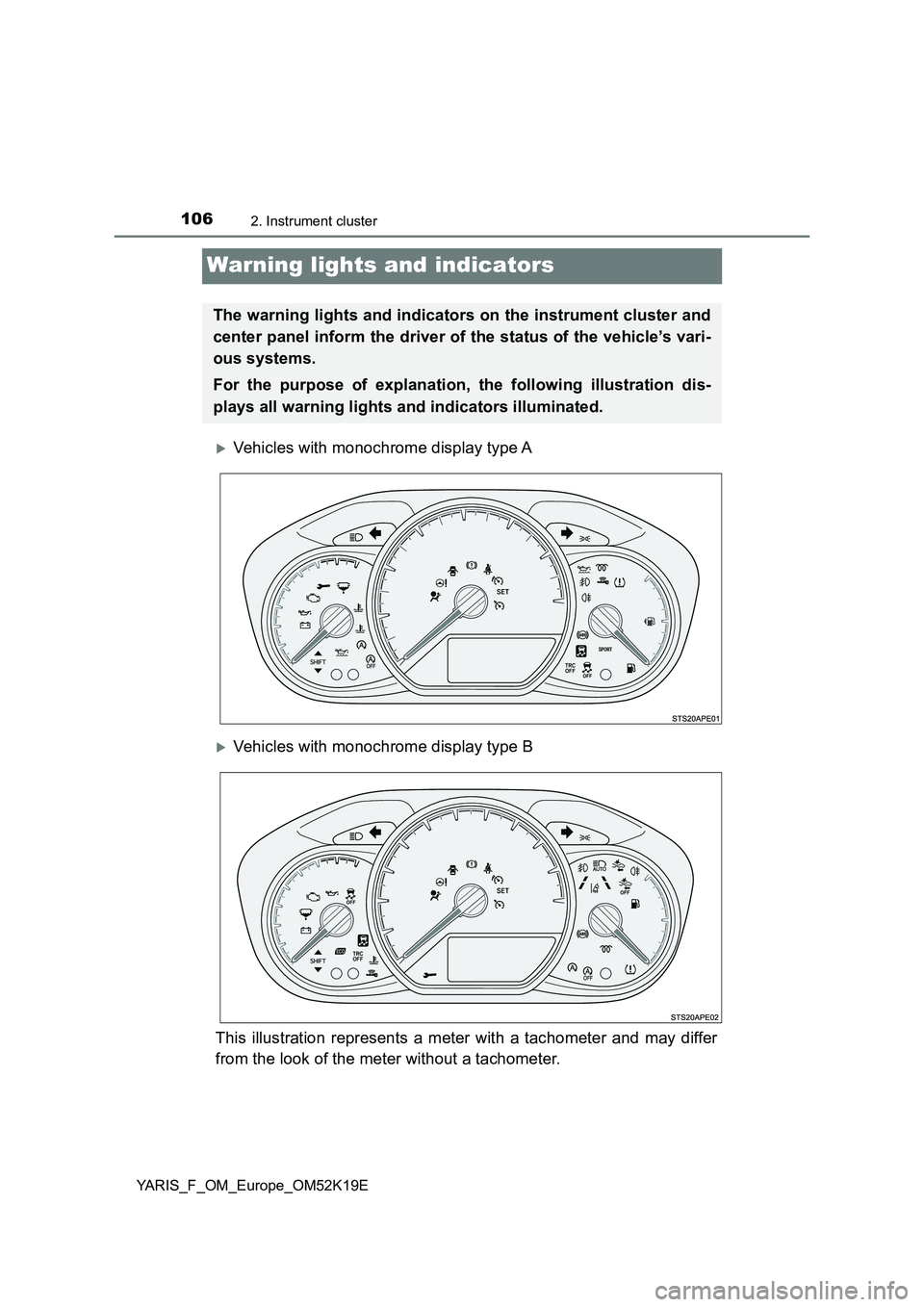
Warning lights and indicators
Vehicles with monochrome display type A
Vehicles with monochrome display type B
This illustration represents a meter with a tachometer and may differ
from the look of the meter without a tachometer.
The warning lights and indicators on the instrument cluster and
center panel inform the driver of the status of the vehicle’s vari-
ous systems.
For the purpose of explanation, the following illustration dis-
plays all warning lights and indicators illuminated.