2019 TOYOTA PRIUS PLUS radio
[x] Cancel search: radioPage 157 of 568

1573-2. Opening, closing and locking the doors
3
Operation of each component
PRIUS +_OM_OM47D30E_(EE)■Note for the entry function
●Even when the electronic key is within the effective range (detection areas),
the system may not operate properly in the following cases:
• The electronic key is too close to the window or outside door handle, near
the ground, or in a high place when the doors are locked or unlocked.
• The electronic key is on the instrument panel, luggage room, floor, or in
the door pockets or glove box when the hybrid system is started or power
switch modes are changed.
●Do not leave the electronic key on top of the instrument panel or near the
door pockets when exiting the vehicle. Depending on the radio wave recep-
tion conditions, it may be detected by the antenna outside the cabin and the
door will become lockable from the outside, possibly trapping the electronic
key inside the vehicle.
●As long as the electronic key is within the effective range, the doors may be
unlocked or locked by anyone. However, only the doors detecting the elec-
tronic key can be used to unlock the vehicle.
●Even if the electronic key is not inside the vehicle, it may be possible to start
the hybrid system if the electronic key is near the window.
●The doors may unlock if a large amount of water splashes on the door han-
dle, such as in the rain or in a car wash when the electronic key is within the
effective range. (The doors will automatically be locked after approximately
30 seconds if the doors are not opened and closed.)
●If the wireless remote control is used to lock the doors when the electronic
key is near the vehicle, there is a possibility that the door may not be
unlocked by the entry function. (Use the wireless remote control to unlock
the doors.)
●Touching the door lock or unlock sensor while wearing gloves may delay or
prevent lock or unlock operation.
●If the door handle becomes wet while the electronic key is within the effec-
tive range, the door may lock and unlock repeatedly. In that case, follow the
following correction procedures to wash the vehicle:
• Place the electronic key in a location 2 m (6 ft.) or more away from the
vehicle. (Take care to ensure that the key is not stolen.)
• Set the electronic key to battery-saving mode to disable the smart entry &
start system. (P. 155)
●If the electronic key is inside the vehicle and a door handle becomes wet
during a car wash, a message may be shown on the multi-information dis-
play (if equipped) and a buzzer will sound outside the vehicle. To turn off the
alarm, lock all the doors.
●The lock sensor may not work properly if it comes into contact with ice,
snow, mud, etc. Clean the lock sensor and attempt to operate it again, or
use the lock sensor on the lower part of the door handle.
Page 186 of 568
1863-2. Opening, closing and locking the doors
PRIUS +_OM_OM47D30E_(EE)
WARNING
■Caution regarding interference with electronic devices
● People with implantable cardiac pacemakers, cardiac resynchronization
therapy-pacemakers or implantable card ioverter defibrillators should main-
tain a reasonable distance between themselves and the smart entry &
start system antennas. ( P. 153)
The radio waves may affect the operation of such devices. If necessary,
the entry function can be disabled. Ask any authorized Toyota retailer or
Toyota authorized repairer, or any reliable repairer for details, such as the
frequency of radio waves and timing of the emitted radio waves. Then,
consult your doctor to see if you should disable the entry function.
● Users of any electrical medical device other than implantable cardiac
pacemakers, cardiac resynchronizati on therapy-pacemakers or implanta-
ble cardioverter defibrillators should consult the manufacturer of the
device for information about its operation under the influence of radio
waves.
Radio waves could have unexpected effects on the operation of such
medical devices.
Ask any authorized Toyota retailer or To yota authorized repairer, or any reli-
able repairer for details on disabling the entry function.
On vehicles with the navigation syst em, the entry function can be disabled
personally. ( P. 539)
Page 279 of 568
2794-5. Using the driving support systems
4
Driving
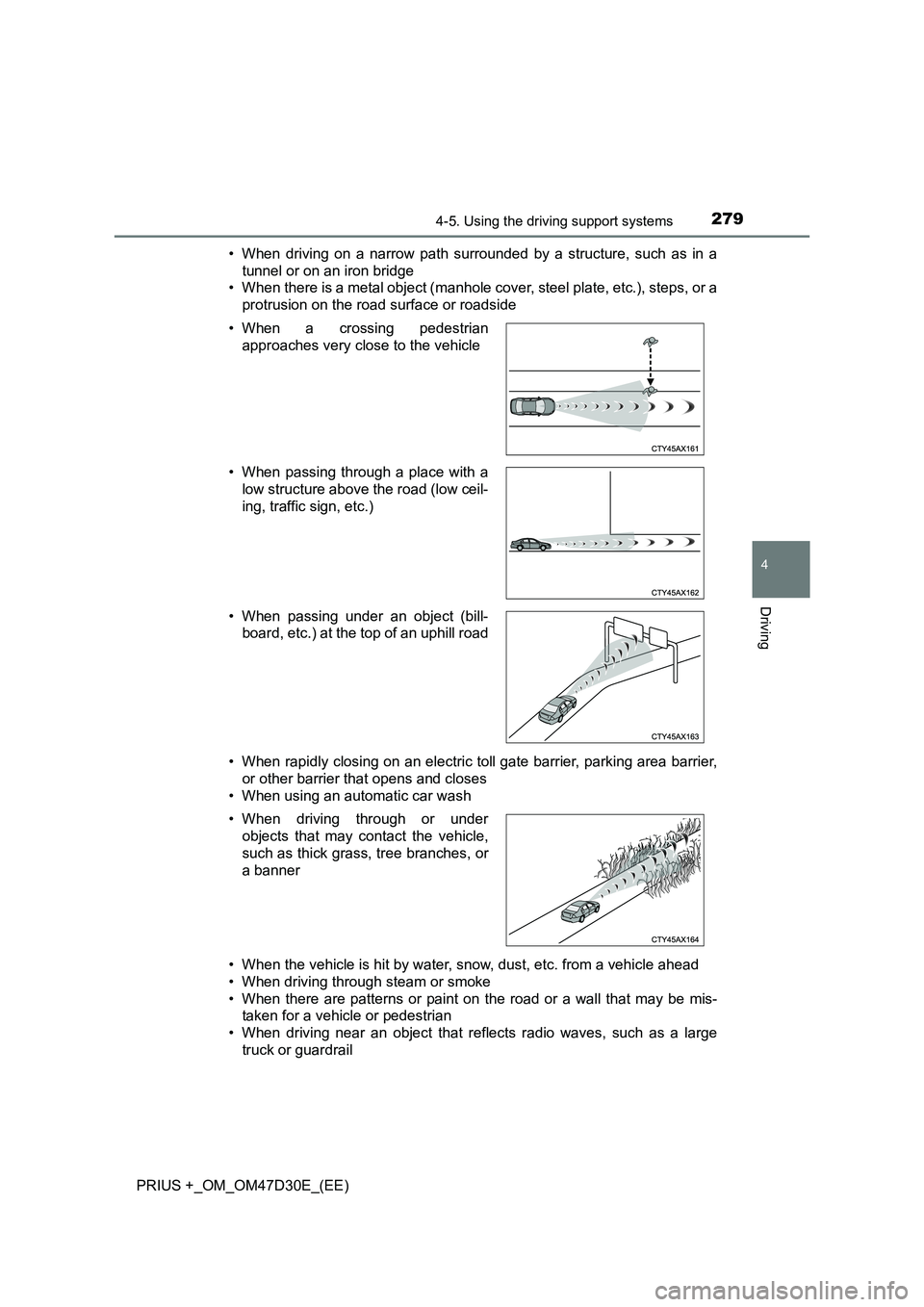
PRIUS +_OM_OM47D30E_(EE)• When driving on a narrow path surrounded by a structure, such as in a
tunnel or on an iron bridge
• When there is a metal object (manhole cover, steel plate, etc.), steps, or a
protrusion on the road surface or roadside
• When rapidly closing on an electric toll gate barrier, parking area barrier,
or other barrier that opens and closes
• When using an automatic car wash
• When the vehicle is hit by water, snow, dust, etc. from a vehicle ahead
• When driving through steam or smoke
• When there are patterns or paint on the road or a wall that may be mis-
taken for a vehicle or pedestrian
• When driving near an object that reflects radio waves, such as a large
truck or guardrail • When a crossing pedestrian
approaches very close to the vehicle
• When passing through a place with a
low structure above the road (low ceil-
ing, traffic sign, etc.)
• When passing under an object (bill-
board, etc.) at the top of an uphill road
• When driving through or under
objects that may contact the vehicle,
such as thick grass, tree branches, or
a banner
Page 280 of 568

2804-5. Using the driving support systems
PRIUS +_OM_OM47D30E_(EE)• When driving near a TV tower, broadcasting station, electric power plant,
or other location where strong radio waves or electrical noise may be
present
■Situations in which the system may not operate properly
●In some situations such as the following, a vehicle may not be detected by
the radar sensor and camera sensor, preventing the system from operating
properly:
• If an oncoming vehicle is approaching your vehicle
• If a vehicle ahead is a motorcycle or bicycle
• When approaching the side or front of a vehicle
• If a preceding vehicle has a small rear end, such as an unloaded truck
• If a vehicle ahead is carrying a load which protrudes past its rear bumper
• If a vehicle ahead is irregularly shaped, such as a tractor or side car
• If the sun or other light is shining directly on a vehicle ahead
• If a vehicle cuts in front of your vehicle or emerges from beside a vehicle
• If a vehicle ahead makes an abrupt maneuver (such as sudden swerving,
acceleration or deceleration)
• When suddenly cutting behind a preceding vehicle • If a preceding vehicle has a low rear
end, such as a low bed trailer
• If a vehicle ahead has extremely high
ground clearance
• When a vehicle ahead is not directly
in front of your vehicle
Page 397 of 568
3976-3. Do-it-yourself maintenance
PRIUS +_OM_OM47D30E_(EE)
6
Maintenance and care
■Situations in which the tire pressure warning system may not operate
properly
●In the following cases, the tire pressure warning system may not operate
properly.
• If non-genuine Toyota wheels are used.
• When a replacement tire is used, the system may not operate correctly
due to the structure of the replacement tire.
• A tire has been replaced with a tire that is not of the specified size.
• Tire chains etc. are equipped.
• An auxiliary-supported run-flat tire is equipped.
• If a window tint that affects the radio wave signals is installed.
• If there is a lot of snow or ice on the vehicle, particularly around the
wheels or wheel housings.
• If the tire inflation pressure is extremely higher than the specified level.
• If wheel without the tire pressure warning valve and transmitter is used.
• If the ID code on the tire pressure warning valves and transmitters is not
registered in the tire pressure warning computer.
●Performance may be affected in the following situations.
• Near a TV tower, electric power plant, gas station, radio station, large dis-
play, airport or other facility that generates strong radio waves or electri-
cal noise
• When carrying a portable radio, cellular phone, cordless phone or other
wireless communication device
●When the vehicle is parked, the time taken for the warning to start or go off
could be extended.
●When tire inflation pressure declines rapidly for example when a tire has
burst, the warning may not function.
Page 548 of 568
548What to do if... (Troubleshooting)
PRIUS +_OM_OM47D30E_(EE)
What to do if... (Troubleshooting)
●If you lose your mechanical keys, new genuine mechanical keys can be
made by any authorized Toyota retailer or Toyota authorized repairer, or
any reliable repairer. (P. 141)
●If you lose your electronic keys, the risk of vehicle theft increases signifi-
cantly. Contact any authorized Toyota retailer or Toyota authorized
repairer, or any reliable repairer immediately. (P. 143)
●Is the electronic key battery weak or depleted? (P. 417)
●Is the power switch in ON mode?
When locking the doors, turn the power switch off. (P. 227)
●Is the electronic key left inside the vehicle?
When locking the doors, make sure that you have the electronic key on
your person.
●The function may not operate properly due to the condition of the radio
wave. (P. 156)
●Is the child-protector lock set?
The rear door cannot be opened from inside the vehicle when the lock is
set. Open the rear door from outside and then unlock the child-protector
lock. (P. 147)
If you have a problem, check the following before contacting any
authorized Toyota retailer or Toyota authorized repairer, or any
reliable repairer.
The doors cannot be locked, unlocked, opened or closed
You lose your keys
The doors cannot be locked or unlocked
The rear door cannot be opened
Page 562 of 568
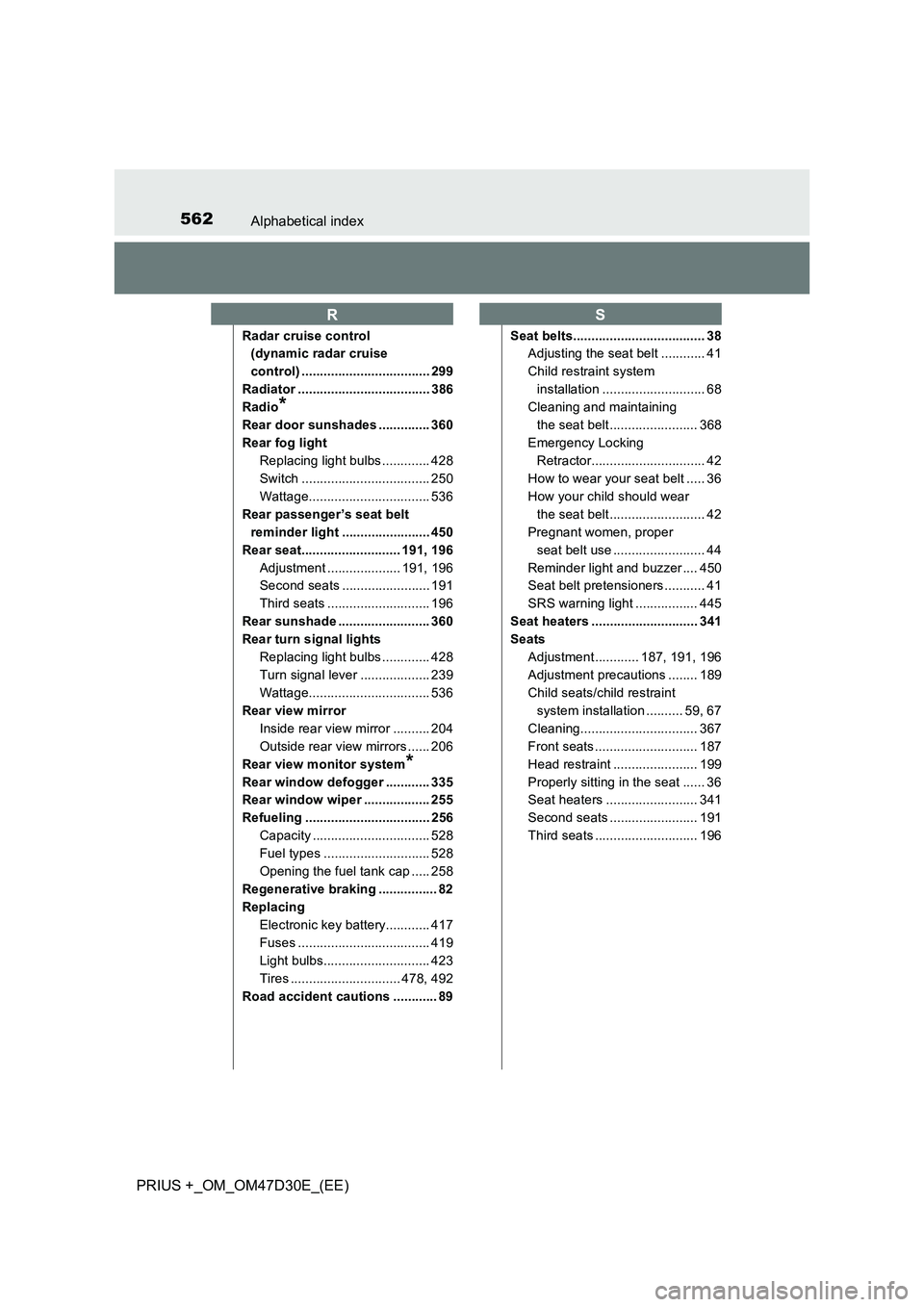
562Alphabetical index
PRIUS +_OM_OM47D30E_(EE)
Radar cruise control
(dynamic radar cruise
control) ................................... 299
Radiator .................................... 386
Radio
*
Rear door sunshades .............. 360
Rear fog light
Replacing light bulbs ............. 428
Switch ................................... 250
Wattage................................. 536
Rear passenger’s seat belt
reminder light ........................ 450
Rear seat........................... 191, 196
Adjustment .................... 191, 196
Second seats ........................ 191
Third seats ............................ 196
Rear sunshade ......................... 360
Rear turn signal lights
Replacing light bulbs ............. 428
Turn signal lever ................... 239
Wattage................................. 536
Rear view mirror
Inside rear view mirror .......... 204
Outside rear view mirrors ...... 206
Rear view monitor system
*
Rear window defogger ............ 335
Rear window wiper .................. 255
Refueling .................................. 256
Capacity ................................ 528
Fuel types ............................. 528
Opening the fuel tank cap ..... 258
Regenerative braking ................ 82
Replacing
Electronic key battery............ 417
Fuses .................................... 419
Light bulbs............................. 423
Tires .............................. 478, 492
Road accident cautions ............ 89Seat belts.................................... 38
Adjusting the seat belt ............ 41
Child restraint system
installation ............................ 68
Cleaning and maintaining
the seat belt........................ 368
Emergency Locking
Retractor............................... 42
How to wear your seat belt ..... 36
How your child should wear
the seat belt.......................... 42
Pregnant women, proper
seat belt use ......................... 44
Reminder light and buzzer .... 450
Seat belt pretensioners ........... 41
SRS warning light ................. 445
Seat heaters ............................. 341
Seats
Adjustment ............ 187, 191, 196
Adjustment precautions ........ 189
Child seats/child restraint
system installation .......... 59, 67
Cleaning................................ 367
Front seats ............................ 187
Head restraint ....................... 199
Properly sitting in the seat ...... 36
Seat heaters ......................... 341
Second seats ........................ 191
Third seats ............................ 196
RS