2019 TOYOTA 86 seats
[x] Cancel search: seatsPage 94 of 532
941-7. Safety information
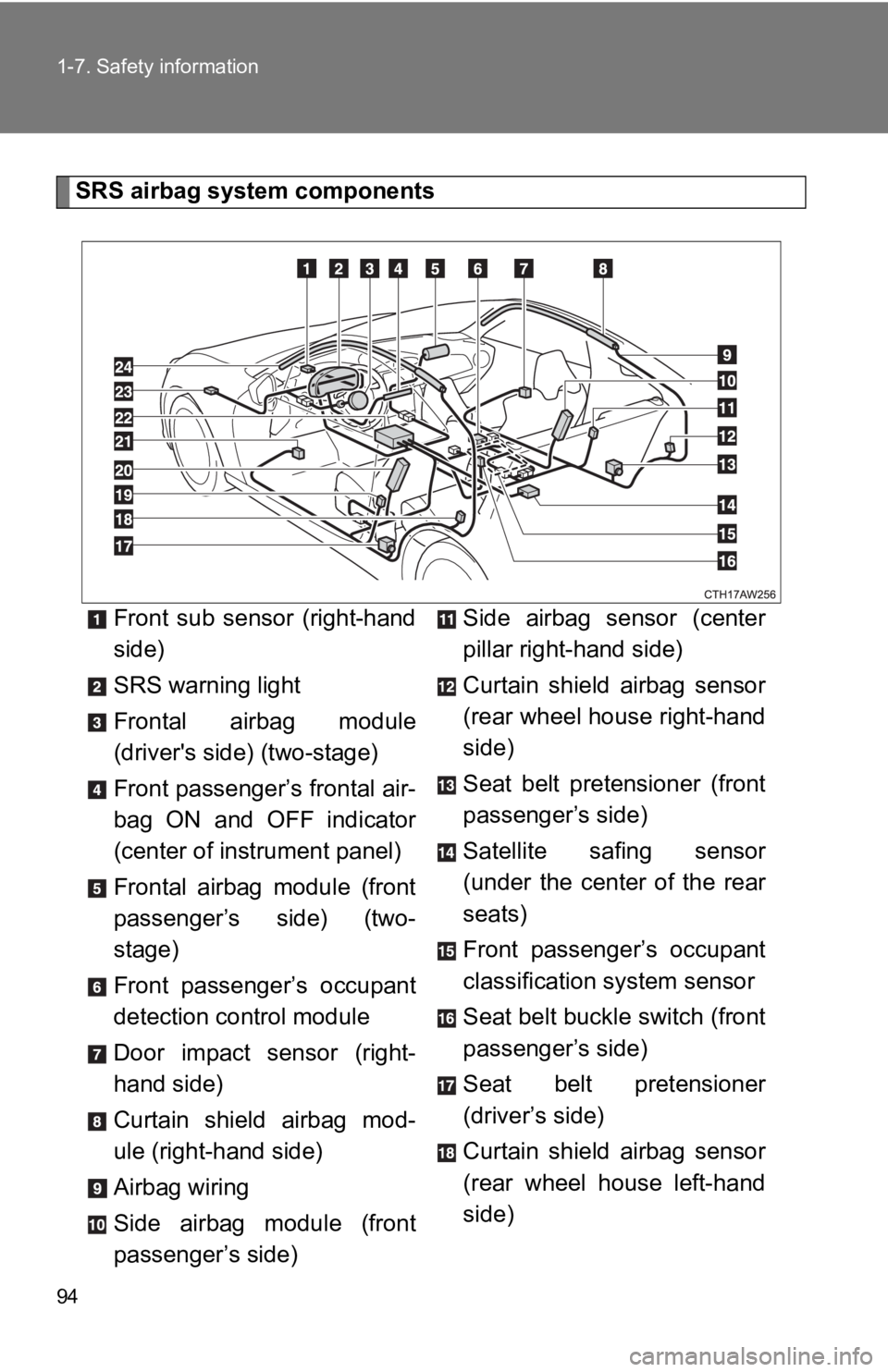
SRS airbag system components
Front sub sensor (right-hand
side)
SRS warning light
Frontal airbag module
(driver's side) (two-stage)
Front passenger’s frontal air-
bag ON and OFF indicator
(center of instrument panel)
Frontal airbag module (front
passenger’s side) (two-
stage)
Front passenger’s occupant
detection control module
Door impact sensor (right-
hand side)
Curtain shield airbag mod-
ule (right-hand side)
Airbag wiring
Side airbag module (front
passenger’s side) Side airbag sensor (center
pillar right-hand side)
Curtain shield airbag sensor
(rear wheel house right-hand
side)
Seat belt pretensioner (front
passenger’s side)
Satellite safing sensor
(under the center of the rear
seats)
Front passenger’s occupant
classification system sensor
Seat belt buckle switch (front
passenger’s side)
Seat belt pretensioner
(driver’s side)
Curtain shield airbag sensor
(rear wheel house left-hand
side)
Page 95 of 532

951-7. Safety information
1
Before driving
Your vehicle is equipped with ADVANCED AIRBAGS designed based
on US motor vehicle safety standards (FMVSS208). The airbag sys -
tem controls airbag deployment power for the driver and front p as-
senger. The front passenger's air bag system consists of the fro nt
passenger occupant detec tion control module etc.
The main SRS airbag system components are shown above. The
SRS airbag system is controlled by the airbag control module. T he
airbag control module cons ists of an airbag sensor.
In certain types of severe front or side impacts, the SRS airba g sys-
tem triggers the airbag inflators. A chemical reaction in the inflators
quickly fills the airbags with non- toxic gas to help restrain t he motion
of the occupants. Side airbag sensor (center
pillar left-hand side)
Side airbag module (driver’s
side)
Door impact sensor (left-
hand side) Airbag control module
(including impact sensors
and rollover sensors)
Front sub sensor (left-hand
side)
Curtain shield airbag mod-
ule (left-hand side)
■ If the SRS airbags deploy (inflate)
● Slight abrasions, burns, bruisi ng etc., may be sustained from S RS air-
bags, due to the extremely high speed deployment (inflation) by hot
gases.
● A loud noise and white powder will be emitted.
● Parts of the airbag module (steering wheel hub, airbag cover an d inflator)
as well as the front seats, parts of the front and rear pillars , and roof side
rails, may be hot for several minutes. The airbag itself may al so be hot.
● The windshield may crack.
Page 109 of 532

1091-7. Safety information
1
Before driving WARNING■ If the SRS airbags deploy
Do not touch the SRS airbag system components around the steeri ng wheel
and dashboard with bare hands right after deployment. Doing so can cause
burns because the components can be very hot as a result of dep loyment.
■ Child restraint precautions
NEVER INSTALL A REARWARD FACING CHILD SEAT IN THE FRONT
PASSENGER’S SEAT EVEN IF THE FRONT PASSENGER’S SRS FRON-
TAL AIRBAG IS DEACTIVATED. Be sure to install it in the REAR se at in a
correct manner. Also, it is strongly recommended that any forwa rd facing
child seat or booster seat be installed in the REAR seat, and t hat even chil-
dren who have outgrown a child restraint system be also seated in the
REAR seat. This is because children sitting in the front passen ger’s seat
may be killed or severely injured should the front passenger’s SRS frontal
airbag deploy. REAR seats are the safest place for children.
Page 111 of 532

1111-7. Safety information
1
Before driving ■ Operation
The SRS side airbag and SRS curtain shield airbag can function only when
the engine switch is in the “ON” position (vehicles without a s mart key sys-
tem) or when the “ENGINE START ST OP” switch is in IGNITION ON m ode
(vehicles with a smart key system).
The driver’s and front passenger’s SRS side airbags and SRS cur tain shield
airbags deploy independently of each other since each has its o wn impact
sensor. Therefore, they may not both deploy in the same acciden t. Also, the
SRS side airbag and SRS curtain shield airbag deploys independe ntly of the
driver’s and front passenger’s SRS front airbags in the steerin g wheel and
instrument panel.
A rollover sensor is also located inside the airbag control mod ule.
An impact sensor, which senses impact force, is located in each of the left
and right center pillars, doors and rear wheel houses. Another impact sen-
sor, which also senses impact force, is located under the cente r of the rear
seats.
If the impact sensor that is located under the center of the re ar seats and
one of the center pillar impact sensors or door impact sensors together
sense an impact force above a predetermined level in a side col lision, the
control module causes both the SRS side airbag and curtain shield airbag on
the impacted side to inflate regardless of whether the rear whe el house
impact sensor on the same side senses an impact.
If the impact sensor that is located under the center of the re ar seats and
one of the rear wheel house impact sensors together sense an im pact force
above a predetermined level, the control module causes only the SRS cur-
tain shield airbag on the impacted side to inflate.
If the rollover sensor detects rollover of the vehicle, the control module
inflates the SRS curtain shield airbags. At this time, the driver's and front
passenger’s seat belt pretensioners also operate at the same ti me.
Page 119 of 532
1191-7. Safety information
1
Before driving ■ When to contact your Toyota dealer
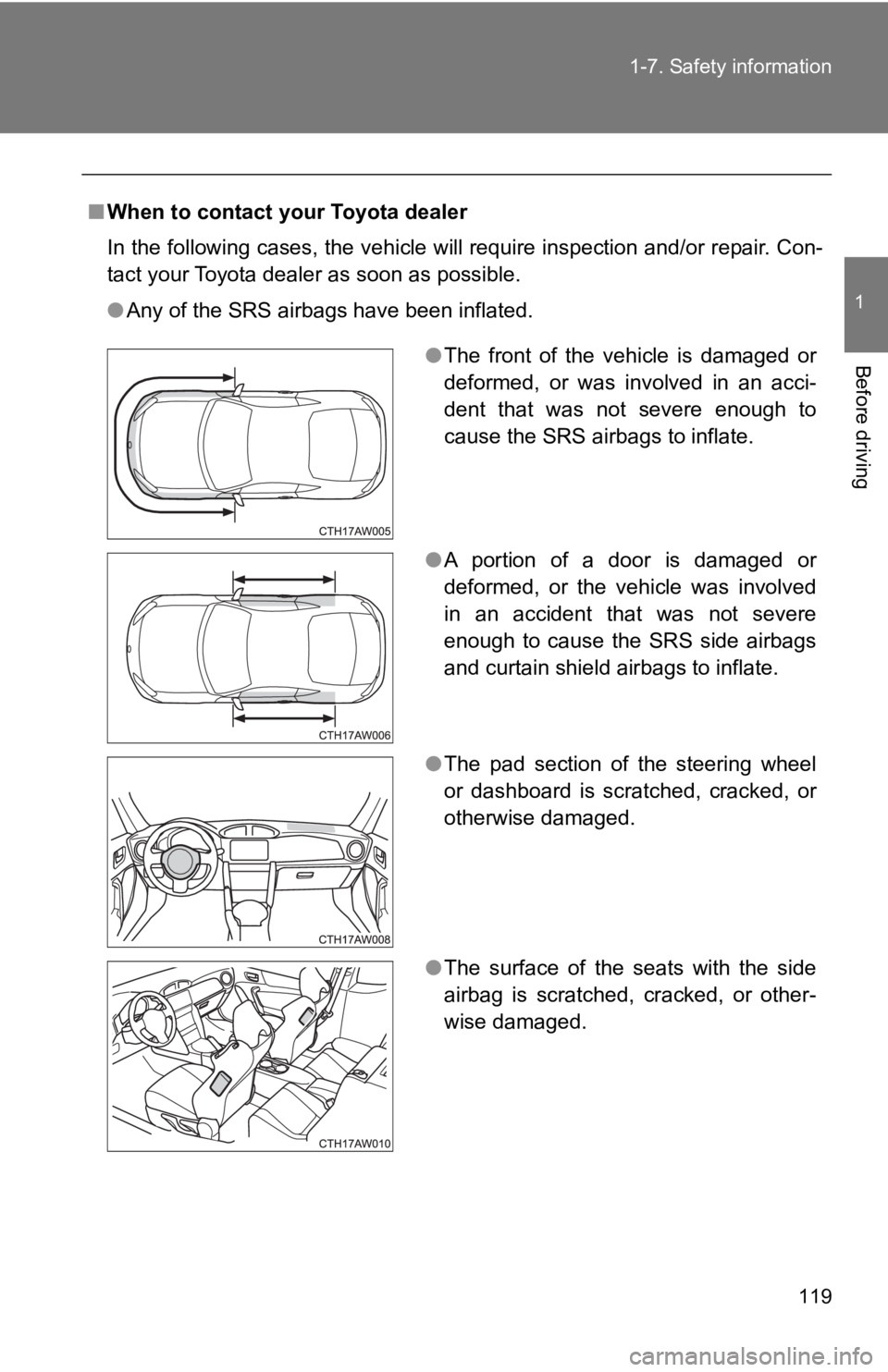
In the following cases, the vehicle will require inspection and /or repair. Con-
tact your Toyota dealer as soon as possible.
● Any of the SRS airbags have been inflated.
● The front of the vehicle is damaged or
deformed, or was involved in an acci-
dent that was not severe enough to
cause the SRS airbags to inflate.
● A portion of a door is damaged or
deformed, or the vehicle was involved
in an accident that was not severe
enough to cause the SRS side airbags
and curtain shield airbags to inflate.
● The pad section of the steering wheel
or dashboard is scratched, cracked, or
otherwise damaged.
● The surface of the seats with the side
airbag is scratched, cracked, or other-
wise damaged.
Page 121 of 532

1211-7. Safety information
1
Before driving WARNING■ SRS airbag precautions
● The SRS driver airbag deploys with considerable force, and can cause
death or serious injury especially if the driver is very close to the airbag.
The National Highway Traffic Safety Administration (“NHTSA”) ad vises:
Since the risk zone for the driver’s airbag is the first 2 - 3 in. (50 - 75 mm)
of inflation, placing yourself 10 in. (250 mm) from your driver airbag pro-
vides you with a clear margin of safety. This distance is measu red from the
center of the steering wheel to your breastbone. If you sit les s than 10 in.
(250 mm) away now, you can change your driving position in seve ral
ways:
• Move your seat to the rear as far as you can while still reaching the
pedals comfortably.
• Slightly recline the back of the seat. Although vehicle design s vary,
many drivers can achieve the 10 in. (250 mm) distance, even wit h the
driver seat all the way forward, simply by reclining the back o f the seat
somewhat. If reclining the back of your seat makes it hard to s ee the
road, raise yourself by using a firm, non-slippery cushion, or raise the
seat if your vehicle has that feature.
• If your steering wheel is adjustable, tilt it downward. This p oints the air-
bag toward your chest instead of your head and neck.
The seat should be adjusted as recommended by NHTSA above, whil e
still maintaining control of the foot pedals, steering wheel, a nd your view of
the instrument panel controls.
● The SRS front passenger airbag al so deploys with considerable f orce, and
can cause death or serious injury especially if the front passe nger is very
close to the airbag. The front passenger seat should be as far from the air-
bag as possible with the seatback adjusted, so the front passen ger sits
upright.
● Improperly seated and/or restrained infants and children can be killed or
seriously injured by a deploying airbag. An infant or child who is too small
to use a seat belt should be properly secured using a child res traint sys-
tem. Toyota strongly recommends that all infants and children be placed in
the rear seats of the vehicle and properly restrained. The rear seats are
safer for infants and children than the front passenger seat. ( P. 137)
Page 124 of 532
1241-7. Safety information
WARNING■ SRS airbag precautions
● Do not touch any of the component parts immediately after the S RS air-
bags have deployed (inflated) as they may be hot.
● If breathing becomes difficult after the SRS airbag has deploye d, open a
door or window to allow fresh air in, or leave the vehicle if i t is safe to do
so. Wash off any residue as soon as possible to prevent skin ir ritation.
● If the areas where the SRS airbags are stored, such as the stee ring wheel
pad and front and rear pillar garnishes, are damaged or cracked, have
them replaced by your Toyota dealer.
■ Modification and disposal of SRS airbag system components
Do not dispose of your vehicle or perform any of the following modifications
without consulting your Toyota dealer.
The SRS airbags may malfunction or deploy (inflate) accidentall y, causing
death or serious injury.
● Installation, removal, disassem bly and repair of the SRS airbag s.
● Repairs, modifications, removal or replacement of the steering wheel,
instrument panel, dashboard, seats or seat upholstery, front, side and rear
pillars or roof side rails.
● Repairs or modifications of the front fender, front bumper, or side of the
occupant compartment.
● Installation of a grille guard (bull bars, kangaroo bar, etc.), snow plows,
winches.
● Modifications to the vehicle's suspension system.
● Installation of electronic devices such as mobile two-way radio s and CD
players.
● Modifications to your vehicle for a person with a physical disa bility.
Page 126 of 532

1261-7. Safety information
● Side airbag module (fro nt passenger’s side)
● Curtain shield airbag sensor (re ar wheel house right-hand side)
● Curtain shield airbag sensor (re ar wheel house left-hand side)
● Curtain shield airbag module (right-hand side)
● Curtain shield airbag module (left-hand side)
● Satellite safing sensor (under the center of the rear seats)
● Seat belt pretensi oner (driver’s side)
● Seat belt pretensioner (front passenger’s side)
● Seat belt buckle switch (front passenger’s side)
● Front passenger’s occupant cla ssification system sensor
● Front passenger’s occupan t detection c ontrol module
● Front passenger’s frontal air bag ON and OFF indicator
● All related wiring