Page 136 of 532

1361-7. Safety information
WARNING■ Front passenger occupant classification system precautions
● Never install a rearward facing child seat in the front passeng er’s seat
even if the front passenger’s SRS frontal airbag is deactivated . Be sure to
install it in the rear seat in a correct manner. Also, it is st rongly recom-
mended that any forward facing child seat or booster seat be in stalled in
the rear seat, and that even children who have outgrown a child restraint
system be also seated in the rear seat. This is because childre n sitting in
the front passenger’s seat may be killed or severely injured should the
front passenger’s SRS frontal airbag deploy. Toyota believes th at the rear
seats are the safest place for children
● If luggage or electronic devices are placed on the front passen ger seat,
the OFF indicator may turn off and the ON indicator may illumin ate. If this
occurs, the front passenger’s airbag may deploy during a collision. If this is
not desirable, remove the luggage or electronic devices from th e front pas-
senger seat.
● Modifications for persons with disabilities that may affect the front passen-
ger occupant classification system. (U.S. only) Removing, repla cing or
modifying any parts of the front seats, seat belts, front bumpe r, front side
frame, instrument panel, combination meter, steering wheel, ste ering col-
umn, tires, suspension or floor panel can affect the operation of the Toyota
front passenger occupant classification system.
Page 141 of 532
141 11-7. Safety information
Before driving
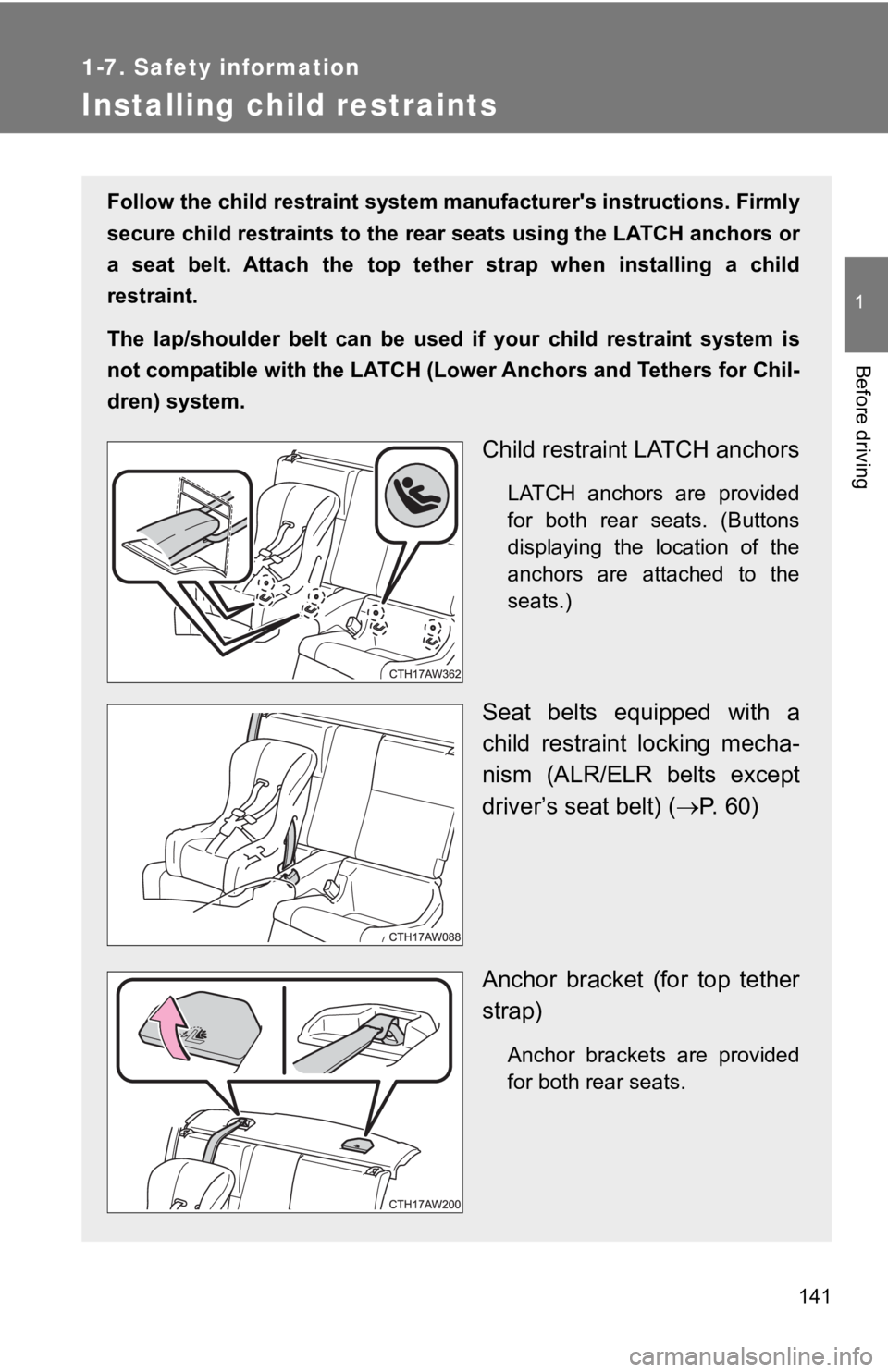
Installing child restraints Follow the child restraint system m anufacturer's instructions. Firmly
secure child restraints to the r ear seats using the LATCH ancho rs or
a seat belt. Attach the top tether strap when installing a chil d
restraint.
The lap/shoulder belt can be used if your child restraint syste m is
not compatible with the LATCH (Lower Anchors and Tethers for Ch il-
dren) system.
Child restraint LATCH anchors LATCH anchors are provided
for both rear seats. (Buttons
displaying the location of the
anchors are attached to the
seats.)
Seat belts equipped with a
child restraint locking mecha-
nism (ALR/ELR belts except
driver’s seat belt) ( P. 6 0 )
Anchor bracket (for top tether
strap)
Anchor brackets are provided
for both rear seats.
Page 259 of 532

2592-5. Driving information
2
When driving WARNING■
Storage precautions
Observe the following precautions.
Failure to do so may result i n death or serious injury.●
Stow cargo and luggage in the trunk whenever possible.●
To prevent cargo and luggage from sliding forward during brakin g, do
not stack anything in the enlarged trunk. Keep cargo and luggag e low,
as close to the floor as possible.●
When you fold down the rear seats, long items should not be pla ced
directly behind the front seats.●
Never allow anyone to ride in the enlarged trunk. It is not des igned for
passengers. They should ride in their seats with their seat bel ts prop-
erly fastened. Otherwise, they are much more likely to suffer d eath or
serious bodily injury, in the event of sudden braking, sudden s werving
or an accident.
●
Do not place cargo or luggage in or on the following locations as the
item may get under the clutch, brake or accelerator pedal and p revent
the pedals from being depressed properly, block the driver’s vi sion, or
hit the driver or passengers, causing an accident:
• At the feet of the driver
• On the front passenger or rear seats (when stacking items)
• On the package tray
• On the instrument panel
• On the dashboard
●
Secure all items in the occupant compartment, as they may shift and
injure someone during sudden braking, sudden swerving or an acc i-
dent.
■
Capacity and distribution
●
Do not exceed the maximum axle weight rating or the total vehic le
weight rating.
●
Even if the total load of occupant's weight and the cargo load is less
than the total load capacity, do not apply the load unevenly. I mproper
loading may cause deterioration of steering or braking control which
may cause death or serious injury.
Page 276 of 532
2763-1. Using the air condit ioning system and defogger
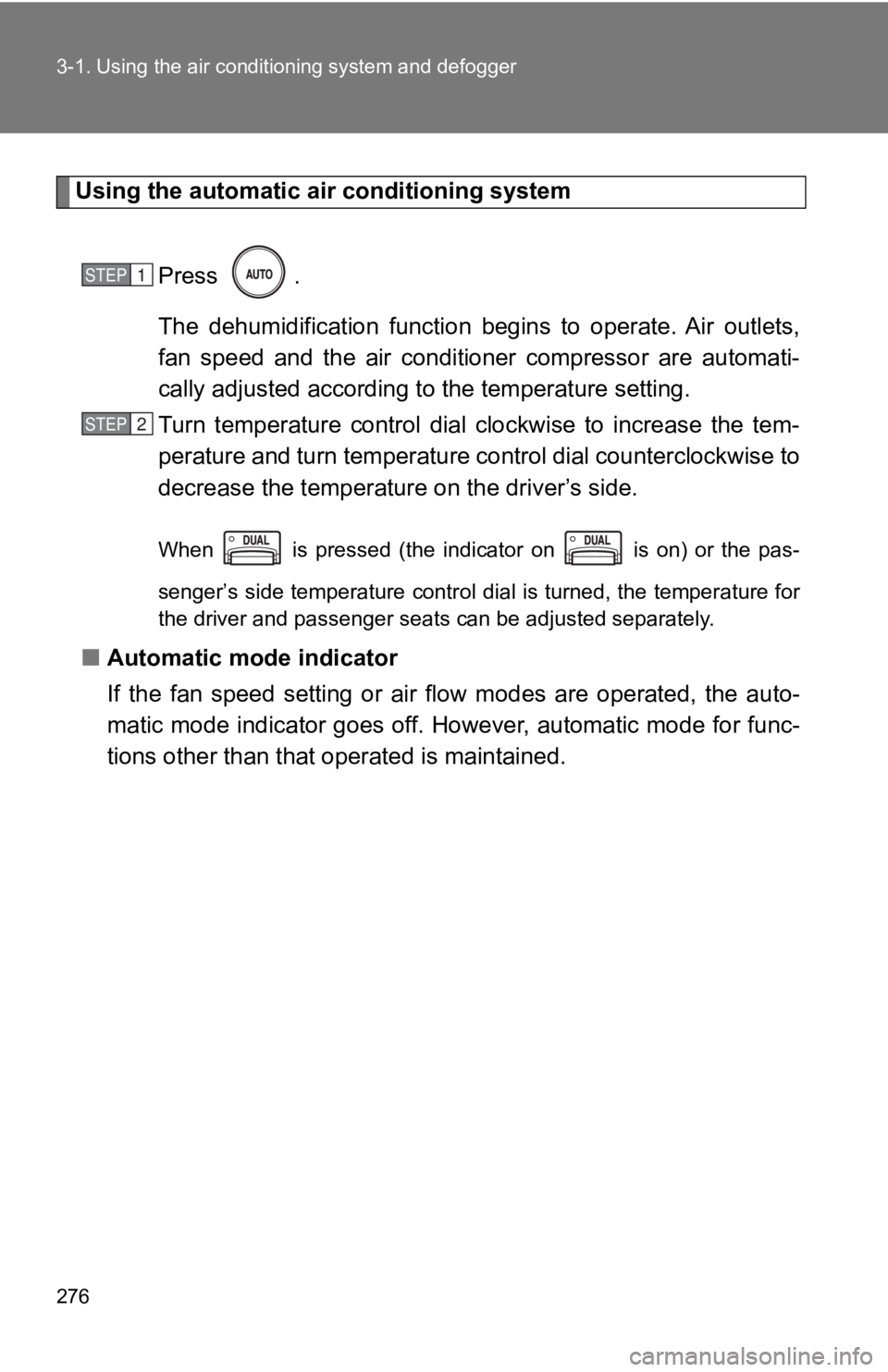
Using the automatic air conditioning system
Press .
The dehumidification function begins to operate. Air outlets,
fan speed and the air conditioner compressor are automati-
cally adjusted according t o the temperature setting.
Turn temperature control dial clockwise to increase the tem-
perature and turn temperature cont rol dial counterclockwise to
decrease the temperatur e on the driv er’s side.When is pressed (the indicator on is on) or the pas-
senger’s side temperature control dial is turned, the temperatu re for
the driver and passenger seats can be adjusted separately.
■ Automatic mode indicator
If the fan speed setting or air flow modes are operated, the au to-
matic mode indicator goes off. However, automatic mode for func -
tions other than that operated is maintained. STEP 1
STEP 2
Page 301 of 532
3013-5. Other interior features
3
Interior features
Seat heaters
■ The seat heaters can be used when
The “ENGINE START STOP” switch is in IGNITION ON mode.
■ When not in use
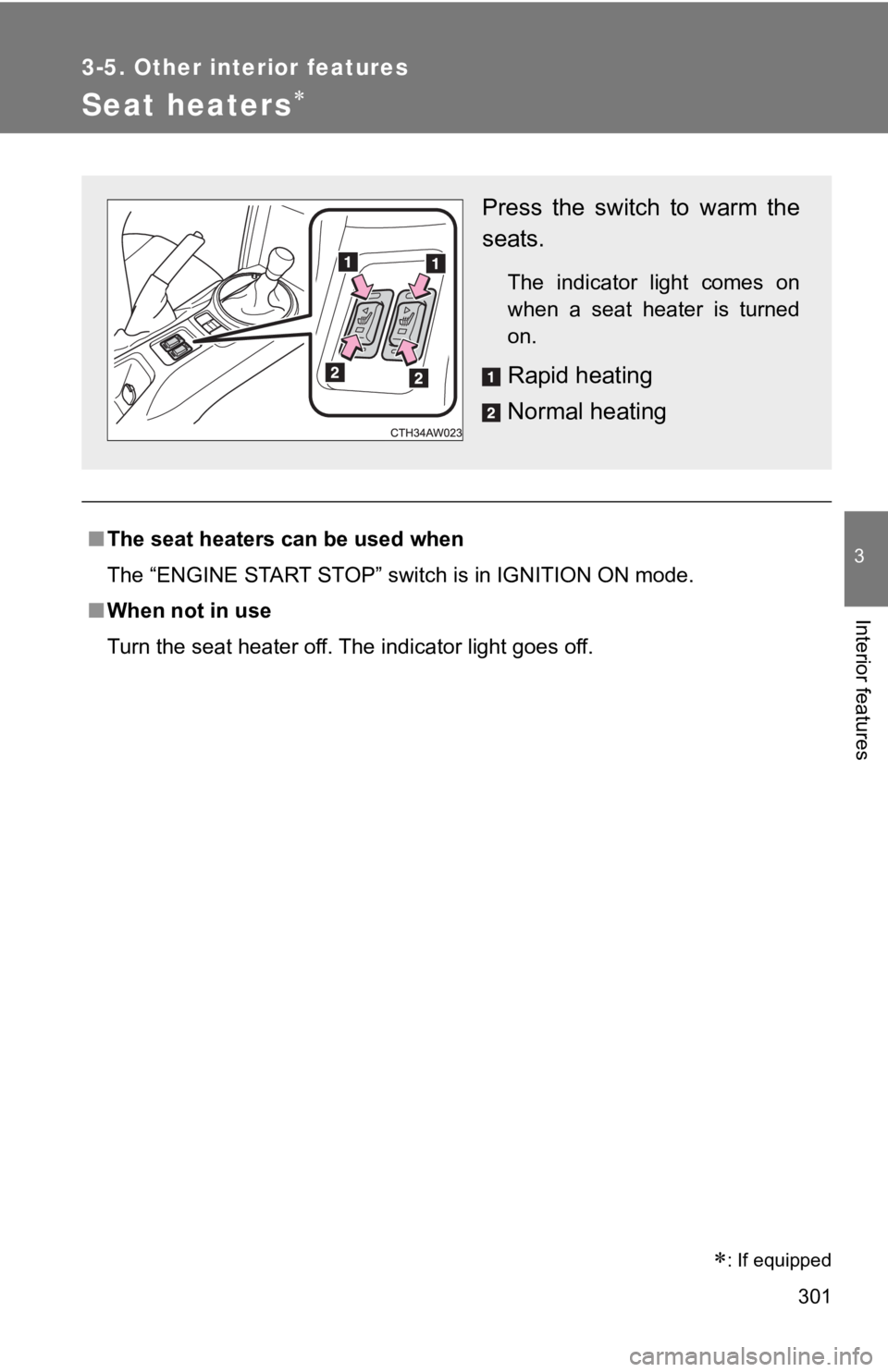
Turn the seat heater off. The indicator light goes off. Press the switch to warm the
seats. The indicator light comes on
when a seat heater is turned
on.
Rapid heating
Normal heating
: If equipped
Page 321 of 532
3214-2. Maintenance
4
Maintenance and care Vehicle interior Items Check points
Accelerator pedal • Moves smoothly (without uneven
pedal effort or catching)?
Automatic transmission “Park”
mechanism • Can the vehicle be held securely
on an incline with the shift lever in
P?
Brake pedal • Moves smoothly?
• Does it have appropriate clear-
ance and correct amount of free
play?
Brakes • Not pull to one side when
applied?
• Loss of brake effectiveness?
• Spongy feeling brake pedal?
• Pedal almost touches floor?
Clutch pedal • Moves smoothly?
Head restraints • Move smoothly and lock
securely?
Indicators/buzzers • Function properly?
Lights • Do all the lights come on?
Parking brake • Moves smoothly?
• Can hold the vehicle securely on
an incline?
Seat belts • Does the seat belt system oper-
ate smoothly?
• Are the belts undamaged?
Seats • Do the seat controls operate
properly?
Steering wheel • Moves smoothly?
• Has correct free play?
• No strange noises?
Page 428 of 532
4285-2. Steps to take in an emergency
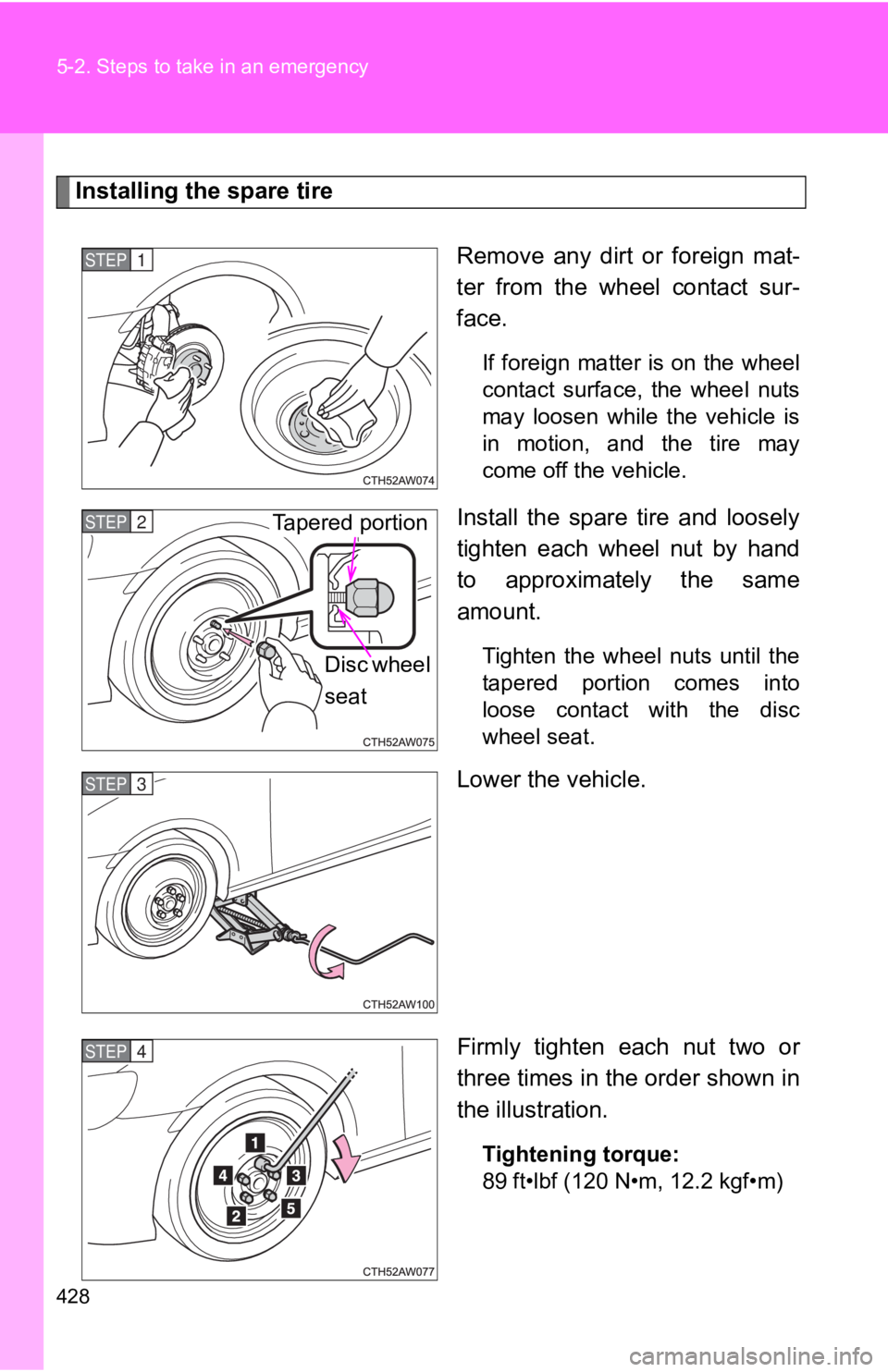
Installing the spare tire
Remove any dirt or foreign mat-
ter from the wheel contact sur-
face. If foreign matter is on the wheel
contact surface, the wheel nuts
may loosen while the vehicle is
in motion, and the tire may
come off the vehicle.
Install the spare tire and loosely
tighten each wheel nut by hand
to approximately the same
amount.
Tighten the wheel nuts until the
tapered portion comes into
loose contact with the disc
wheel seat.
Lower the vehicle.
Firmly tighten each nut two or
three times in the order shown in
the illustration.
Tightening torque:
89 ft•lbf (120 N•m, 12.2 kgf•m)STEP 1
Tapered portion
Disc wheel
seatSTEP 2
STEP 3
STEP 4
Page 480 of 532

4806-1. Specifications
Warning: The temperature grades of a tire assume that it is pro perly
inflated and not overloaded.
Excessive speed, underinflation, or excessive loading, either s epa-
rately or in combination, can cause heat buildup and possible t ire fail-
ure.
Glossary of tire terminology
Tire related term Meaning
Cold tire inflation
pressure Tire pressure when the vehicle has been
parked for three hours or more, or has not
been driven more than 1 mile or 1.5 km under
that condition
Maximum inflation
pressure The maximum cold inflated pressure to which a
tire may be inflated, shown on the sidewall of
the tire
Recommended
inflation pressure Cold tire inflation pressure recommended by a
manufacturer.
Accessory weight The combined weight (i n excess of those stan-
dard items which may be replaced) of auto-
matic transmission, po wer steering, power
brakes, power windows, power seats, radio
and heater, to the exten t that these items are
available as factory-installed equipment
(whether installed or not)
Curb weight The weight of a motor vehicle with standard
equipment, including th e maximum capacity of
fuel, oil and coolant, and if so equipped, air
conditioning and additional weight optional
engine
Maximum loaded
vehicle weight The sum of:
(a) Curb weight
(b) Accessory weight
(c) Vehicle capacity weight
(d) Production options weight