2019 SUZUKI CELERIO air
[x] Cancel search: airPage 71 of 201

3-1
OPERATING YOUR VEHICLE
76MH1-74E
76MH1-74E
Exhaust Gas Warning
52D334
Daily Inspection Checklist
Before Driving
60A187S
1) Make sure that windows, mirrors, lights, and reflectors are clean and unob-structed. 2) Visually check the tires for the following points:– the depth of the tread groove – abnormal wear, cracks and damage – loose wheel nuts– existence of foreign material such as nails, stones, etc. Refer to “Tires” in “INSPECTION ANDMAINTENANCE” section for details. 3) Look for fluid and oil leaks.
WA R N I N G
Avoid breathing exhaust gases. Exhaust gases contain carbon mon- oxide, a potentially lethal gas that is colorless and odorless. Since carbonmonoxide is difficult to detect by itself, be sure to take the following precautions to help prevent carbonmonoxide from entering your vehicle. • Do not leave the engine running in garages or other confined areas.(Continued)
WA R N I N G
(Continued)• Do not park with the engine run- ning for a long period of time, even in an open area. If it is necessary to sit for a short time in a parked vehi- cle with the engine running, make sure the air intake selector is set to “FRESH AIR” and the fan is at highspeed. • Avoid operating the vehicle with the tailgate or trunk open. If it isnecessary to operate the vehicle with the tailgate or trunk open, make sure the sunroof (if equipped)and all windows are closed, and the blower is at high speed with the air intake selector set to “FRESH AIR”.• To allow proper operation of your vehicle’s ventilation system, keep the air inlet grille in front of thewindshield clear of snow, leaves, or other obstructions at all times. • Keep the exhaust tailpipe area clearof snow and other material to help reduce the buildup of exhaust gases under the vehicle. This isparticularly important when parked in blizzard conditions. • Have the exhaust system inspectedperiodically for damage and leaks. Any damage or leaks should be repaired immediately.
60
Page 72 of 201

3-2
OPERATING YOUR VEHICLE
76MH1-74E
76MH1-74E
NOTE: It is normal for water to drip from the air conditioning system after use.
4) Make sure the hood is fully closed and latched.5) Check the headlights, turn signal lights, brake lights and horn for proper opera- tion.6) Adjust the seat and head restraint (if equipped). 7) Check the brake pedal and the parkingbrake lever. 8) Adjust the mirrors. 9) Make sure that you and all passengershave properly fastened your seat belts. 10)Make sure that all warning lights come on as the key is turned to the “ON” posi-tion. 11)Check all gauges. 12)Make sure that the BRAKE SYSTEMWARNING light turns off when the parking brake is released.
Once a week, or each time you fill your fuel tank, perform the following under-hood checks:
1) Engine oil level 2) Coolant level3) Brake fluid level 4) Windshield washer fluid level 5) Battery solution level6) Hood latch operation Pull the hood release handle inside the vehicle. Make sure that you cannotopen the hood all the way without
releasing the secondary latch. Be sure to close the hood securely after check- ing for proper latch operation. See “Alllatches, hinges & locks” of “CHASSIS AND BODY” in the “Periodic Mainte- nance Schedule” in the “INSPECTIONAND MAINTENANCE” section for lubri- cation schedule.
Once a month, or each time you fill your fuel tank, check the tire pressure using a tire pressure gauge. Also check the tirepressure of the spare tire.
Engine Oil Consumption
It is normal for the engine to consume some engine oil during normal vehicle operation.
The amount of engine oil consumed depends on the viscosity of the oil, thequality of the oil and the conditions the vehicle is driven under. More oil is consumed during high-speeddriving and when there is frequent acceler- ation and deceleration. Under high loads, your engine also will consume more oil.A new engine also consumes more oil, since its pistons, piston rings and cylinder
walls have not yet become conditioned. New engines reach the normal level of oil consumption only after approximately 5000km (3000 miles) driving.
Oil consumption: Max. 1.0 L per 1000 km (1 Qt. per 600 miles)
When judging the amount of oil consump- tion, note that the oil may become diluted and make it difficult to accurately judge thetrue oil level. As an example, if a vehicle is used for repeated short trips, and consumes a nor-mal amount of oil, the dipstick may not show any drop in the oil level at all, even after 1000 km (600 miles) or more of driv-ing. This is because the oil is gradually becoming diluted with fuel or moisture, making it appear that the oil level has notchanged. You should also be aware that the diluting ingredients evaporate out when the vehicleis subsequently driven at high speeds, such as on an expressway, making it appear that oil is excessively consumedafter high-speed driving.
WA R N I N G
Make sure the hood is fully closed and latched before driv ing. If it is not, it can fly up unexpectedly duringdriving, obstructing your view and resulting in an accident.
61
Page 89 of 201

4-1
DRIVING TIPS
76MH1-74E
76MH1-74E
52D078S
Running-in Catalytic Converter
80G106
The purpose of the catalytic converter is to minimize the amount of harmful pollutantsin your vehicle’s exhaust. Use of leaded fuel in vehicles equipped with catalytic converters is prohibited, because leaddeactivates the pollutant-reducing compo- nents of the catalyst system.
The converter is designed to last the life of the vehicle under normal usage and when unleaded fuel is used. No special mainte-nance is required on the converter. How- ever, it is very important to keep the engine properly tuned. Engine misfiring, whichcan result from an improperly tuned engine, may cause overheating of the cat- alyst. This may result in permanent heatdamage to the catalyst and other vehicle components.
WA R N I N G
• Wear Your Seat Belts at All Times. Even though air bags are equippedat the front seating positions, the driver and all passengers should be properly restrained at all times,using the seat belts provided. Refer to the “Seat Belts and Child Restraint Systems” section forinstructions on proper use of the seat belts. • Never drive while under the influ-ence of alcohol or other drugs. Alcohol and drugs can seriously impair your ability to drive safely,greatly increasing the risk of injury to yourself and others. You should also avoid driving when you aretired, sick, irritated, or under stress.
NOTICE
The future performance and reliabil- ity of the engine depends on the care and restraint exercised during its early life. It is especially important toobserve the following precautions during the initial 960 km (600 miles) of vehicle operation.• After starting, do not race the engine. Warm it up gradually. • Avoid prolonged vehicle operationat a constant speed. Moving parts will break in better if you vary your speed.• Start off from a stop slowly. Avoid full throttle starts. • Avoid hard braking, especiallyduring the first 320 km (200 miles) of driving. • Do not drive slowly with thetransaxle in a high gear. • Drive the vehicle at moderate engine speeds.• Do not tow a trailer during the first 960 km (600 miles) of vehicle oper- ation.
78
Page 90 of 201

4-2
DRIVING TIPS
76MH1-74E
76MH1-74E
54G584S
Improving Fuel Economy
The following instructions will help you improve fuel economy.
Avoid excessive idling If you are to wait for more than a minutewhile you are parked, stop the engine and start it again later. When warming up a cold engine, do not allow the engine to idleor apply full throttle until the engine has reached operating temperature. Allow the engine to warm up by driving.
Avoid “fast” starts Fast starts away from lights or stop signs will consume fuel unnecessarily andshorten engine life. Start off slowly.
Avoid unnecessary stops Avoid unnecessary deceleration and stop- ping. Try to maintain a slow, steady speed whenever possible. Slowing down and thenaccelerating again uses more fuel.
Keep a steady cruising speed Keep as constant a speed as road and traf- fic conditions will permit.
Keep the air cleaner clean
60A183S
If the air cleaner is clogged with dust, there will be greater intake resistance, resulting in decreased power output and increased fuel consumption.
NOTICE
To avoid damaging catalyst or othervehicle damage:• Maintain the engine in the properoperating condition.• In the event of an engine malfunc-tion, particularly one involving engine misfiring or other apparent loss of performance, have the vehi-cle serviced promptly.• Do not turn off the engine or inter-rupt the ignition when the transaxleis in gear and the vehicle is in motion.• Do not try to start the engine bypushing or towing the vehicle, orcoasting down a hill.• Do not idle the engine with anyspark plug wires disconnected orremoved, such as during diagnos- tic testing.• Do not idle the vehicle for pro-longed periods if idling seemsrough or there are other malfunc-tions.• Do not allow the fuel tank to getnear the empty level.• Avoid driving your vehicle atexcessively high engine speed inor around the red zone of thetachometer (if equipped).
WA R N I N G
Be careful in areas where you parkand drive; the catalytic converter and other exhaust components can get very hot. As with any vehicle, do not park or operate this vehicle in areas where combustible materials such asdry grass or leaves can come in con- tact with a hot exhaust system.
EXAMPLE
79
Page 96 of 201

OTHER CONTROLS AND EQUIPMENT
76MH1-74E
76MH1-74E
OTHER CONTROLS AND EQUIPMENTFuel Filler Cap ..................................................................... 5-1
Engine Hood ........................................................................ 5-2
Sun Visor ............................................................................. 5-3
Interior Light ........................................................................ 5-4
Accessory Socket ........ ....................................................... 5-5
AUX/USB Socket (if equipped) ........................................... 5-5
Assist Grips (if equipped) .................................................. 5-5
Glove Box ............................................................................ 5-6
Cup Holder and Storage Area ............................................ 5-6
Floor Mats (if equipped) ..................................................... 5-7
Luggage Compartment Hooks ........................................... 5-8
Luggage Compartment Cover (if equipped) ..................... 5-8
Frame Hooks ....................................................................... 5-9
Manual Heating and Air Conditioning System ................. 5-10
Radio Antenna ..................................................................... 5-13
Audio System (if equipped) ................................................ 5-14
85
Page 100 of 201
5-4
OTHER CONTROLS AND EQUIPMENT
76MH1-74E
76MH1-74E
Vanity mirror (if equipped)
74LHT0532
(2) Vanity mirror
There is a vanity mirror (2) on the back of the sun visor.
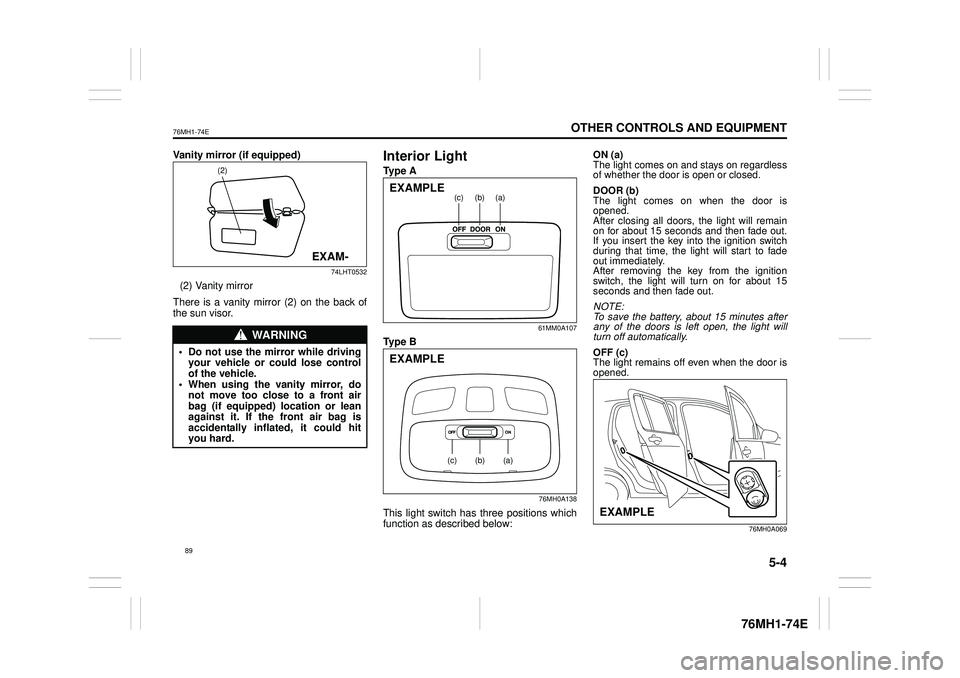
Interior Light
Ty p e A
61MM0A107
Ty p e B
76MH0A138
This light switch has three positions which function as described below:
ON (a) The light comes on and stays on regardless of whether the door is open or closed.
DOOR (b) The light comes on when the door isopened. After closing all doors, the light will remain on for about 15 seconds and then fade out.If you insert the key into the ignition switch during that time, the light will start to fade out immediately. After removing the key from the ignition switch, the light will turn on for about 15 seconds and then fade out.
NOTE: To save the battery, about 15 minutes after any of the doors is left open, the light will turn off automatically.
OFF (c) The light remains off even when the door is opened.
76MH0A069
WA R N I N G
• Do not use the mirror while driving your vehicle or could lose controlof the vehicle. • When using the vanity mirror, do not move too close to a front airbag (if equipped) location or lean against it. If the front air bag is accidentally inflated, it could hityou hard.
(2)
EXAM-
(a)(b)(c)EXAMPLE
(a)(b)(c)
EXAMPLE
EXAMPLE
89
Page 106 of 201

5-10
OTHER CONTROLS AND EQUIPMENT
76MH1-74E
76MH1-74E
Manual Heating and Air
Conditioning System (if
equipped)
Air outlet
76MH0A080
1. Windshield defroster outlet 2. Side defroster outlet 3. Side outlet 4. Center outlet5. Front floor outlet
Side outlet
76MH0A118
When “Open”, air comes out regardless of the air flow selector position.
Center outlet
76MH0A081
Move the knob (1) vertically or horizontally to adjust the direction of airflow as desired.
Description of Controls
76MH0A082
Temperature selector (1)
This is used to select the temperature by turning the selector.
Blower speed selector (2) This is used to turn on the blower and to select blower speed by turning the selec-tor.
Air flow selector (3)
61MM0A019
This is used to select one of the functions described below.
Ventilation (a)
76MH0A083
Temperature-controlled air comes out of the center and side air outlets.
1 1
22
334
55
EXAMPLE
(1) (1)
0 1 2 3 4
(3) (4) (1)
(2)(5)
(a)
(b)
(e)
(d)
(c)
95
Page 107 of 201

5-11
OTHER CONTROLS AND EQUIPMENT
76MH1-74E
76MH1-74E
Bi-level (b)
76MH0A084
Temperature-controlled air comes out of the floor outlets and cooler air comes out of the center and side outlets. When thetemperature selector (1) is in the fully COLD position or fully HOT position, how- ever, the air from the floor outlets and theair from the center and side outlets will be the same temperature.
Heat (c)
76MH0A085
Temperature-controlled air comes out of the floor outlets and the side outlets, also comes out of the windshield defroster out-lets and also comes slightly out of the side defroster outlets.
Heat & defrost (d)
76MH0A087
Temperature-controlled air comes out of the floor outlets, the windshield defroster outlets, the side defroster outlets and theside outlets.
Defrost (e)
76MH0A088
Temperature-controlled air comes out of the windshield defroster outlets, the side defroster outlets and the side outlets.
Air intake selector (4)
76MH0A089
This selector is used to select the following modes.
Fresh Air (f) When this mode is selected by moving the lever to right, outside air is used.
Recirculated Air (g) When this mode is selected by moving thelever to left, outside air is shut out and inside air is recirculat ed. This mode is suit- able when driving through dusty or pollutedair such as in a tunnel, or when attempting to quickly cool down the interior.
NOTE: If you select “RECIRCULATED AIR” for an extended period of time, the air in the vehi-cle can become contam inated. Therefore, you should occasionally select “FRESH AIR”.
(g) (f)
96