2019 SUZUKI CELERIO air
[x] Cancel search: airPage 45 of 201

2-23
BEFORE DRIVING
76MH1-74E
76MH1-74E
Supplemental Restraint
System (air bags)
(if equipped)
Your vehicle is equipped with a Supplemen- tal Restraint System consisting of the follow-
ing components in addition to a lap-shoulderbelt at each front seating position.
1. Driver’s front air bag module (ifequipped)2. Front passenger’s front air bag module(if equipped)3. Air bag controller (if equipped)4. Forward crash sensor (if equipped)
Page 46 of 201
2-24
BEFORE DRIVING
76MH1-74E
76MH1-74E
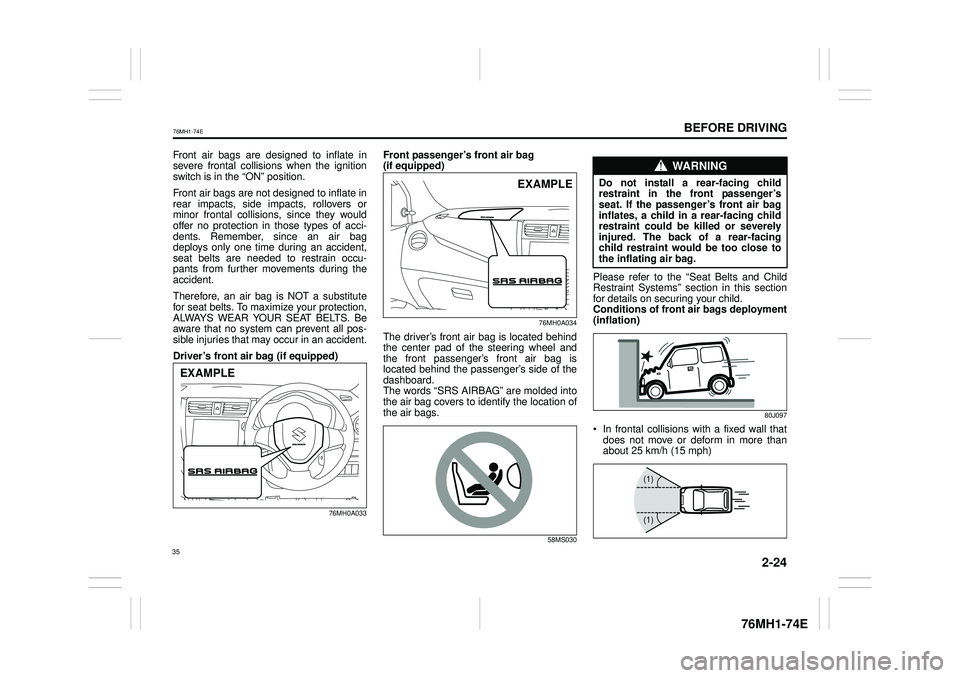
Front air bags are designed to inflate in severe frontal collisions when the ignition switch is in the “ON” position.
Front air bags are not designed to inflate in rear impacts, side impacts, rollovers orminor frontal collisions, since they would offer no protection in those types of acci- dents. Remember, since an air bagdeploys only one time during an accident, seat belts are needed to restrain occu- pants from further movements during theaccident.
Therefore, an air bag is NOT a substitute for seat belts. To maximize your protection, ALWAYS WEAR YOUR SEAT BELTS. Be aware that no system can prevent all pos-sible injuries that may occur in an accident.
Driver
Page 47 of 201

2-25
BEFORE DRIVING
76MH1-74E
76MH1-74E
In collisions such as above at an angle ofabout 30 degrees (1) or less from the front
Conditions of front air bags may inflateReceiving a strong impact to the lower bodyof your vehicle, the front air bags will inflatein many cases.
80J099
Hitting a curb or medial strip
80J100E
Falling into a deep hole or ditch
Landing hard or falling Front air bags may inflate in a strong impact
80J120
Collision from the rear
80J119
Collision from the side
80J110
Vehicle rollover
Front air bags may not inflate The front air bags may not inflate when the impact is absorbed since the collision object moved, vehicle body deformed, or
collision angle was greater than about 30 degrees from the front.
80J102
Page 48 of 201

2-26
BEFORE DRIVING
76MH1-74E
76MH1-74E
80J105E
Collision with a fixed wall or guardrail atan angle of greater than about 30 degrees (1) from the front
80J106
In frontal collisions with a fixed wall thatdoes not move or deform in less thanabout 25 km/h (15 mph)
80J107
Collision angle is offset from the vehicleangle (offset collision)
How the system worksIn a frontal collision, the crash sensors will detect rapid deceleration, and if the control-ler judges that the deceleration represents asevere frontal crash, the controller will trig- ger the inflators. The inflators inflate the airbags with nitrogen or argon gas. The inflated air bags provide a cushion for yourhead and upper body. The air bag inflatesand deflates so quickly that you may noteven realize that it has activated. The airbag will neither hinder your view nor make itharder to exit the vehicle.
Air bags must inflate quickly and forcefully in order to reduce the chance of serious or fatal injuries. However, an unavoidable con-sequence of the quick inflation is that the airbag may irritate bare skin, such as the facialarea. Also, upon inflation, a loud noise willoccur and some powder and smoke will be released. These conditions are not harmful and do not indicate a fire in the vehicle. Beaware, however, that some air bag compo-nents may be hot for a while after inflation.
A seat belt helps keep you in the proper position for maximum protection when an airbag inflates. Adjust your seat as far back aspossible while still maintaining control of the vehicle. Sit fully back in your seat; sit upstraight; do not lean over the steering wheel or dashboard. Please refer to the “FrontSeat” section and the “Seat Belts and ChildRestraint Systems” section in this sectionfor details on proper seat and seat belt adjustments.
65D610
(1)
WA R N I N G
• The driver should not lean over thesteering wheel. The front passen- ger should not rest his or her body against the dashboard, or other- wise get too close to the dash-board. In these situations, the out- of-position occupant would be too close to an inflating air bag, andmay suffer severe injury.• Do not attach any objects to, orplace any objects over, the steeringwheel or dashboard. Do not place any objects between the air bag and the driver or front passenger.These objects may interfere with air bag operation or may be propelled by the air bag in the event of acrash. Either of these conditions may cause severe injury.
37
Page 49 of 201

2-27
BEFORE DRIVING
76MH1-74E
76MH1-74E
Note that even though your vehicle may be moderately damaged in a frontal collision,the collision may not have been severe enough to trigger the air bags to inflate. If your vehicle sustains ANY front-end dam-age, have the air bag system inspected by an authorized MARUTI SUZUKI dealer to ensure it is in proper working order.
Your vehicle is equipped with a diagnostic module which records information aboutthe air bag system if the air bags deploy ina crash. The module records informationabout overall system status, which sensorsactivated the deployment, and for a certain vehicle only, whether the driver’s seat belt was in use.
Servicing the air bag system If the air bags inflate, have the air bags andrelated components replaced by an autho- rized MARUTI SUZUKI dealer as soon as possible.
If your vehicle ever gets in deep water and the driver’s floor is submerged, the air bagcontroller could be damaged. If it does, have the air bag system inspected by theMARUTI SUZUKI dealer as soon as possi- ble.
Special procedures are required for servic- ing or replacing an air bag. For that reason, only an authorized MARUTI SUZUKI dealer should be allowed to service orreplace your air bags. Please remind any-
one who services your vehicle that it has air bags.
Service on or around air bag components or wiring must be performed only by an authorized MARUTI SUZUKI dealer.Improper service could result in unin- tended air bag deployment or could render the air bag inoperative. Either of these twoconditions may result in severe injury.
To prevent damage or unintended inflation of the air bag system, be sure the batteryis disconnected and the ignition switch hasbeen in the “LOCK” position for at least 90seconds before performing any electrical service work on your vehicle. Do not touch air bag system components or wires. Thewires are wrapped with yellow tape or yel- low tubing, and the couplers are yellow for easy identification.
Scrapping a vehicle that has an uninflated air bag can be hazardous. Ask your dealer,body repair shop or scrap yard for help with disposal.
38
Page 59 of 201

2-37
BEFORE DRIVING
76MH1-74E
76MH1-74E
76MH0017
NOTE: • As shown in the above illustration,“ ” indicates on the display of cur- rently setting item.• To go back to the higher level displayduring operation, turn the indicatorselector knob (2) to display “bACK” or“-bAC” and then push the indicatorselector knob (2).• If the security system “S1” is in the dis-abled state, the shock sensor “S2”, pre-warning sensitivity “S3” and full blastwarning sensitivity “S4” cannot be setup.
5) To exit the setting mode, switch the dis-play to show “End” and then push theindicator selector knob (2).
Warning and Indicator Lights
Brake System Warning Light
65D477
Three different types of operations existdepending on the vehicle’s specification.
1) The light comes on briefly when theignition switch is turned to the “ON” position.2) The light comes on when the parkingbrake is engaged with the ignition switch in the “ON” position.3) The light comes on when under eitheror both of above two conditions.
The light also comes on when the fluid in the brake fluid reservoir falls below the specified level.The light should go out after starting the engine and fully releasing the parking brake, if the fluid level in the brake fluid res-ervoir is adequate. The light also comes on together with the ABS warning light when the rear brakeforce control function (proportioning valve function) of the ABS system fails. If the brake system warning light comes onwhile you are driving the vehicle, it may mean that there is something wrong with
the vehicle’s brake system. If this happens,you should:
1) Pull off the road and stop carefully.
2) Test the brakes by carefully starting andstopping at the side of the road.– If you determine that it is safe, drivecarefully at low speed to the nearest dealer for repairs, or– Have the vehicle towed to the nearestdealer for repairs.
EXAMPLE
WA R N I N G
Remember that stopping distancemay be longer, you may have to push harder on the pedal, and the pedal may go down farther than normal.
WA R N I N G
If any of the following conditions occur, you should immediately ask your MARUTI SUZUKI dealer toinspect the brake system. • If the brake system warning lightdoes not go out after the engine has been started and the parking brake has been fully released.• If the brake system warning lightdoes not come on when the igni-tion switch is turned to the “ON” position.• If the brake system warning lightcomes on at any time during vehi-cle operation.
48
Page 60 of 201

2-38
BEFORE DRIVING
76MH1-74E
76MH1-74E
NOTE: Because the disc brake system is self- adjusting, the fluid level will drop as thebrake pads become worn. Replenishing the brake fluid reservoir is considered nor- mal periodic maintenance.
NOTE: (Parking Brake Reminder Buzzer) (ifequipped) A buzzer sounds intermittently to remind you to release the parking brake if youstart the vehicle without releasing the park- ing brake. Make sure that the parking brake is fully released and the brake sys-tem warning light turns off.
Seat Belt Warning Light
(if equipped)
60G049
This light blinks as a reminder until the driver’s seat belt is buckled.
For details about the seat belt reminder, refer to “Seat Belts and Child Restraint Systems” in this section.
“AIR BAG” Light (if equipped)
63J030
This light blinks or comes on for severalseconds when the ignition switch is turned to the “ON” position so you can check if the light is working.
The light will come on and stay on if there is a problem in the air bag system (ifequipped).
Anti-Lock Brake System (ABS)
Warning Light (if equipped)
65D529
When the ignition switch is turned to the “ON” position, the light comes on briefly so you can check that the light is working. If the light stays on, or comes on whendriving, there may be something wrong with the ABS.
If this happens: 1) Pull off the road and stop carefully.2) Turn the ignition switch to “LOCK” andthen start the engine again.
If the warning light comes on briefly then turns off, the system is normal. If the warn- ing light still stays on, the system will besomething wrong.
If the light and the brake system warning light stay on, or come on simultaneously when driving, your ABS system is equipped with the rear brake force controlfunction (proportioning valve function) and there may be something wrong with both the rear brake force control function andanti-lock function of the ABS system.
WA R N I N G
If the “AIR BAG” light does not blinkor come on briefly when the ignition switch is turned to the “ON” position,stays on for more than 10 seconds, or comes on while driving, the air bag system (if equipped) may not workproperly. Have both systems inspected by an authorized MARUTI SUZUKI dealer.
49
Page 68 of 201

2-46
BEFORE DRIVING
76MH1-74E
76MH1-74E
Windshield Washer
76MH0A050
To spray windshield washer fluid, pull the lever toward you. The windshield wipers will automatically turn on at low speed ifthey are not already on and the “INT” posi- tion is equipped.
Rear Window Wiper/Washer Switch
(if equipped)
76MH0A051
To turn the rear wiper on, twist the rear wiper switch on the end of the lever for-ward to the “ON” position. To turn the rear wiper off, twist the switch rearward to the “OFF” position.
With the rear wiper in the “OFF” position, twist the switch rearward and hold it thereto spray window washer fluid.
With the rear wiper in the “ON” position, turn the switch forward and hold it there to spray window washer fluid.
WA R N I N G
• To prevent windshield icing in coldweather, turn on the defroster to heat the windshield before and during windshield washer use.• Do not use radiator antifreeze inthe windshield washer reservoir. Itcan severely impair visibility when sprayed on the windshield, and canalso damage your vehicle’s paint.
EXAMPLE
NOTICE
To help prevent damage to the wind-shield wiper and washer systemcomponents, you should take the fol- lowing precautions: • Do not continue to hold in the leverwhen there is no windshield washer fluid being sprayed or the washer motor can be damaged.• Do not attempt to remove dirt froma dry windshield with the wipers oryou can damage the windshieldand the wiper blades. Always wet the windshield with washer fluid before operating the wipers.• Clear ice or packed snow from thewiper blades before using the wip-ers.• Check the washer fluid level regu-larly. Check it often when theweather is bad.• Only fill the washer fluid reservoir3/4 full during cold weather to allowroom for expansion if the tempera-ture falls low enough to freeze thesolution.
NOTICE
Clear ice or snow from the rear win- dow and rear wiper blade before using the rear wiper. Accumulatedice or snow could prevent the wiper blade from moving, causing damage to the wiper motor.
Washer
Wiper
EXAMPLE
57