Page 425 of 698
Air Suspension System
To aid in attaching/detaching the trailer from the vehicle,
the air suspension system can be used. Refer to “Air
Suspension System” in “Starting And Operating” for fur-
ther information.
NOTE:The vehicle must remain in the engine running
position while attaching a trailer for proper leveling of the
air suspension system.
SNOWPLOW
NOTE: Do not use this model vehicle for snowplow
applications.
WARNING!
Snowplows and other aftermarket equipment should
not be added to the front end of your vehicle. The
airbag crash sensors may be affected by the change in
the front end structure. The airbags could deploy
unexpectedly or could fail to deploy during a collision
resulting in serious injury or death.
WARNING!
Attaching a snowplow to this vehicle could adversely
affect performance of the airbag system in a collision.
Do not expect that the airbag will perform as described
earlier in this manual.
CAUTION!
Using this vehicle for snowplow applications can
cause damage to the vehicle.6
STARTING AND OPERATING 423
Page 428 of 698

CAUTION!(Continued)
•Before recreational towing, the transfer case must be
in NEUTRAL. To be certain the transfer case is fully
in NEUTRAL, perform the procedure outlined under
“Shifting Into NEUTRAL”. Internal transmission
damage will result, if the transfer case is not in
NEUTRAL during towing.
• The transmission must be in PARK for recreational
towing.
• Ensure that the Electric Park Brake is released, and
remains released, while being towed.
• Towing this vehicle in violation of the above require-
ments can cause severe transmission and/or transfer
case damage. Damage from improper towing is not
covered under the New Vehicle Limited Warranty.
• Do not disconnect the rear driveshaft because fluid
will leak from the transfer case, causing damage to
internal parts.
• Do not use a bumper-mounted clamp-on tow bar on
your vehicle. The bumper face bar will be damaged.
Shifting Into NEUTRAL (N)
Use the following procedure to prepare your vehicle for
recreational towing.
WARNING!
You or others could be injured or killed if you leave the
vehicle unattended with the transfer case in the NEU-
TRAL (N) position without first fully engaging the
parking brake. The transfer case NEUTRAL (N) posi-
tion disengages both the front and rear driveshafts
from the powertrain and will allow the vehicle to roll,
even if the transmission is in PARK. The parking brake
should always be applied when the driver is not in the
vehicle.
CAUTION!
It is necessary to follow these steps to be certain that
the transfer case is fully in NEUTRAL (N) before
recreational towing to prevent damage to internal
parts.
1. Bring the vehicle to a complete stop on level ground, with the engine running. Apply the parking brake.
426 STARTING AND OPERATING
Page 431 of 698
12. Shift the transmission into DRIVE, release the brakepedal, and check that the vehicle operates normally.
NOTE:
• Steps 3 and 4 are requirements that must be met before
pushing the button to shift out of NEUTRAL (N), and
must continue to be met until the shift has been com-
pleted. If any of these requirements are not met before
pushing the button or are no longer met during the shift,
the NEUTRAL (N) indicator light will flash continu-
ously until all requirements are met or until the button is
released.
• The ignition must be in the ON/RUN mode for a shift to
take place and for the position indicator lights to be
operable. If the ignition is not in the ON/RUN mode, the
shift will not take place and no position indicator lights
will be on or flashing.
• A flashing NEUTRAL (N) position indicator light indi-
cates that shift requirements have not been met.DRIVING TIPS
Driving On Slippery Surfaces
Acceleration
Rapid acceleration on snow covered, wet, or other slippery
surfaces may cause the driving wheels to pull erratically to
the right or left. This phenomenon occurs when there is a
difference in the surface traction under the rear (driving)
wheels.
WARNING!
Rapid acceleration on slippery surfaces is dangerous.
Unequal traction can cause sudden pulling of the rear
wheels. You could lose control of the vehicle and
possibly have a collision. Accelerate slowly and care-
fully whenever there is likely to be poor traction (ice,
snow, wet, mud, loose sand, etc.).
6
STARTING AND OPERATING 429
Page 432 of 698

Driving Through Water
Driving through water more than a few inches/centimeters
deep will require extra caution to ensure safety and pre-
vent damage to your vehicle.
Flowing/Rising Water
WARNING!
Do not drive on or across a road or path where water is
flowing and/or rising (as in storm run-off). Flowing
water can wear away the road or path’s surface and
cause your vehicle to sink into deeper water. Further-
more, flowing and/or rising water can carry your ve-
hicle away swiftly. Failure to follow this warning may
result in injuries that are serious or fatal to you, your
passengers, and others around you.
Shallow Standing Water
Although your vehicle is capable of driving through shal-
low standing water, consider the following Cautions and
Warnings before doing so.
WARNING!
•Driving through standing water limits your vehicle’s
traction capabilities. Do not exceed 5 mph (8 km/h)
when driving through standing water.
• Driving through standing water limits your vehicle’s
braking capabilities, which increases stopping dis-
tances. Therefore, after driving through standing
water, drive slowly and lightly press on the brake
pedal several times to dry the brakes.
• Failure to follow these warnings may result in inju-
ries that are serious or fatal to you, your passengers,
and others around you.
CAUTION!
• Always check the depth of the standing water before
driving through it. Never drive through standing
water that is deeper than the bottom of the tire rims
mounted on the vehicle.
• Determine the condition of the road or the path that
is under water and if there are any obstacles in the
way before driving through the standing water.
(Continued)
430 STARTING AND OPERATING
Page 434 of 698
•Check for accumulations of plants or brush. These things
could be a fire hazard. They might hide damage to fuel
lines, brake hoses, axle pinion seals, and propeller shafts.
• After extended operation in mud, sand, water, or similar
dirty conditions, have the radiator, fan, brake rotors,
wheels, brake linings, and axle yokes inspected and
cleaned as soon as possible.
WARNING!
Abrasive material in any part of the brakes may cause
excessive wear or unpredictable braking. You might
not have full braking power when you need it to
prevent a collision. If you have been operating your
vehicle in dirty conditions, get your brakes checked
and cleaned as necessary.
• If you experience unusual vibration after driving in
mud, slush or similar conditions, check the wheels for
impacted material. Impacted material can cause a wheel
imbalance and freeing the wheels of it will correct the
situation.
432 STARTING AND OPERATING
Page 435 of 698

IN CASE OF EMERGENCY
CONTENTS
�HAZARD WARNING FLASHERS ............435
� ASSIST AND SOS SYSTEM — IF EQUIPPED . . . .436
� BULB REPLACEMENT ....................441
▫ Replacement Bulbs .....................441
▫ Replacing Exterior Bulbs ..................442
� FUSES ............................... .449
▫ Power Distribution Center ................450
▫ Internal Power Distribution Center ..........454
� JACKING AND TIRE CHANGING ...........459
▫ Jack Location ......................... .459
▫ Removal Of Jack And Tools ................460
▫ Removing The Spare Tire .................463
▫ Preparations For Jacking ..................466 ▫
Jacking Instructions .....................466
▫ To Stow The Flat Or Spare ................470
▫ Reinstalling The Jack And Tools .............473
� JUMP STARTING ....................... .474
▫ Preparations For Jump Start ...............475
▫ Jump Starting Procedure ..................476
� IF YOUR ENGINE OVERHEATS .............477
� MANUAL PARK RELEASE .................478
� FREEING A STUCK VEHICLE ..............480
� TOWING A DISABLED VEHICLE ............481
▫ Two-Wheel Drive Models .................483
▫ Four-Wheel Drive Models .................483
▫ Emergency Tow Hooks — If Equipped ........484
7
Page 437 of 698
HAZARD WARNING FLASHERS
The Hazard Warning switch is located on the upper switch
bank just below the radio.
NOTE:If your vehicle is equipped with a 12–inch
Uconnect display, the Hazard Warning switch is located
above the display. Push the switch to turn on the Hazard Warning flasher.
When the switch is activated, all directional turn signals
will flash on and off to warn oncoming traffic of an
emergency. Push the switch a second time to turn off the
Hazard Warning flashers.
Hazard Warning Switch Location
Hazard Warning Switch Location With 12–Inch Display
7
IN CASE OF EMERGENCY 435
Page 438 of 698
This is an emergency warning system and it should not be
used when the vehicle is in motion. Use it when your
vehicle is disabled and it is creating a safety hazard for
other motorists.
When you must leave the vehicle to seek assistance, the
Hazard Warning flashers will continue to operate even
though the ignition is placed in the OFF position.
NOTE:With extended use the Hazard Warning flashers
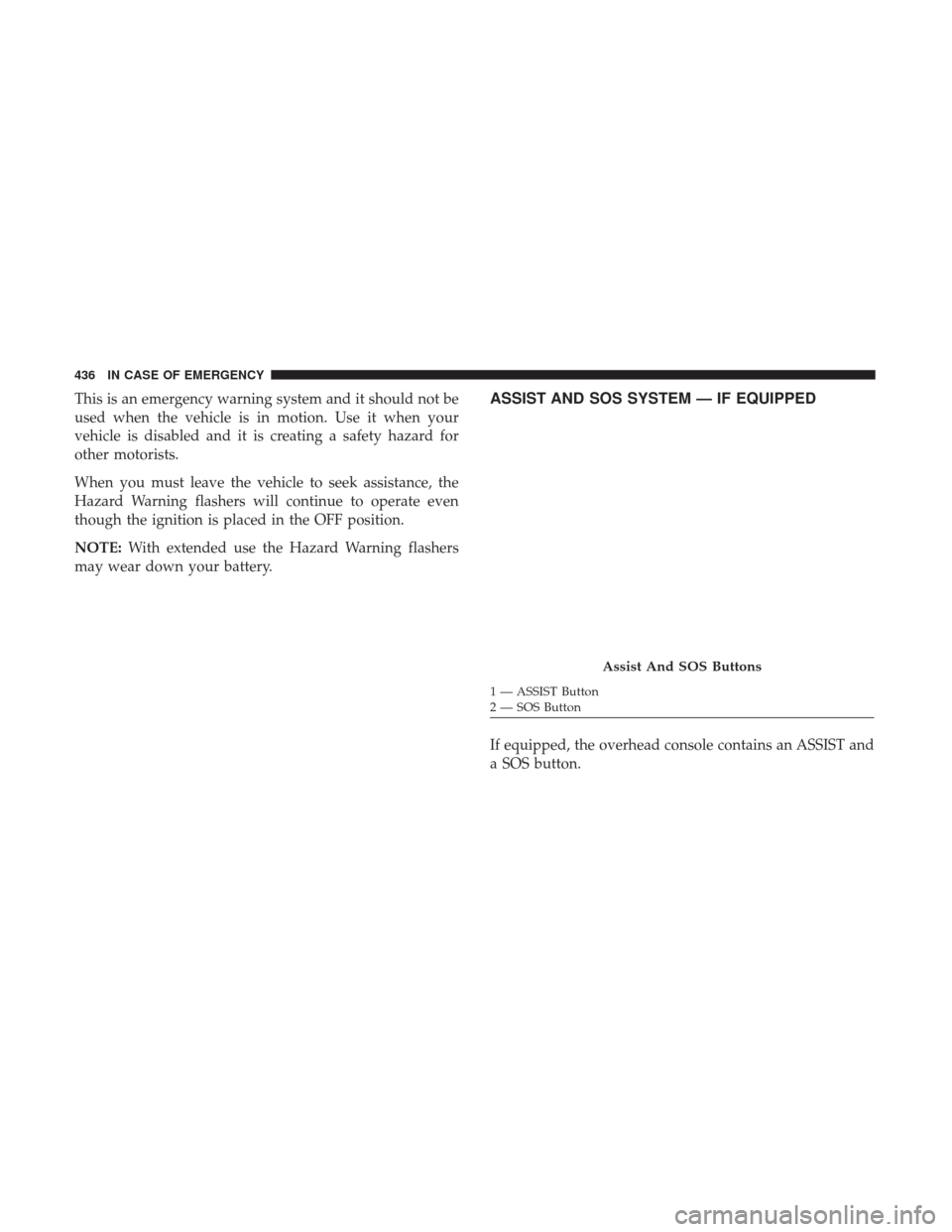
may wear down your battery.ASSIST AND SOS SYSTEM — IF EQUIPPED
If equipped, the overhead console contains an ASSIST and
a SOS button.
Assist And SOS Buttons
1 — ASSIST Button
2 — SOS Button
436 IN CASE OF EMERGENCY