2019 Peugeot Partner guide
[x] Cancel search: guidePage 115 of 312
113
Advice
An incorrectly installed child seat
compromises the child's safety in the
event of an accident.
Ensure that there is no seat belt or seat
belt buckle under the child seat, as this
could destabilise it.
Remember to fasten the seat belts or the
child seat harnesses keeping the slack
relative to the child's body to a minimum,
even for short journeys.
When installing a child seat using the seat
belt, ensure that the seat belt is tightened
correctly on the child seat and that it
secures the child seat firmly on the seat
of your vehicle. If your passenger seat is
adjustable, move it forwards if necessary.
The head restraint must be removed
before installing a child seat with a
backrest on a passenger seat.
Ensure that the head restraint is stored or
attached securely to prevent it from being
thrown around the vehicle in the event
of sharp braking. Refit the head restraint
once the child seat has been removed.Children in the front
Deactivate the front passenger airbag
when a rear ward facing child seat is
installed on the front passenger seat.
Otherwise, the child would risk being
seriously injured or killed if the airbag
were deployed.Installing a booster seat
The chest part of the seat belt must be
positioned on the child's shoulder without
touching the neck.
Ensure that the lap part of the seat belt
passes correctly over the child's thighs.
We recommend using a booster seat with
a backrest equipped with a belt guide at
shoulder level.
Additional protections
To prevent accidental opening of the doors
and rear windows, use the child lock.
Take care not to open the rear windows by
more than one third.
To protect young children from the rays
of the sun, fit side blinds on the rear
windows.
As a safety precaution, do not leave:
-
a c
hild or children alone and
unattended in a vehicle,
-
a c
hild or an animal in a vehicle
which is exposed to the sun, with the
windows closed,
-
t
he keys within reach of children inside
the vehicle.
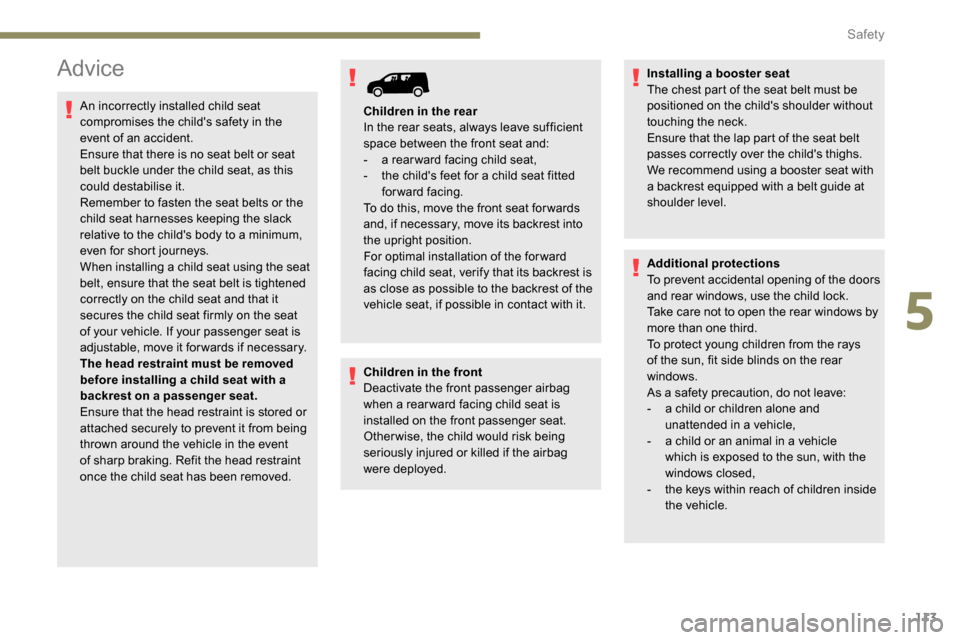
Children in the rear
In the rear seats, always leave sufficient
space between the front seat and:
-
a r
ear ward facing child seat,
-
t
he child's feet for a child seat fitted
forward facing.
To do this, move the front seat for wards
and, if necessary, move its backrest into
the upright position.
For optimal installation of the forward
facing child seat, verify that its backrest is
as close as possible to the backrest of the
vehicle seat, if possible in contact with it.
5
Safety
Page 176 of 312

174
Obser ve the maximum authorised towable
weight, indicated on your vehicle's
registration certificate, the manufacturer's
label and in the Technical data section of
this guide.
Complying with the maximum
authorised nose weight (towball)
also includes the use of accessories
(bicycle carriers, tow boxes, etc.).
Obser ve the legislation in force in the
country in which you are driving.
Towing devices
Depending on equipment, the vehicle can be
fitted with one of the following towing devices: Mounting position then towing device
reference
Type of towing device Plate fixed at the
bottom and towing
device fixed at the top
Plate fixed at the bottom and towing device fixed at the bottom
Plate+
G1 towball -
L CV std (standard)
L1
-
L
CV std (standard) L2 -
L CV cross (heavy-
duty) L1
-
L
CV cross (heavy-duty) L2
Plate +
Simple hook CL -
L
CV std (standard) L1
-
L
CV std (standard) L2
-
L
CV cross (heavy-duty) L1
-
L
CV cross (heavy-duty) L2 X
Plate +
Combined hook CK
Approval No.: E1 R55 (reference 2)
For more information on your towing
device, refer to the user guide supplied
with this equipment.Remove the quickly detachable towball
when not towing a trailer.
Practical information
Page 179 of 312
177
Load reduction mode
System which manages the use of certain
functions according to the level of charge
remaining in the battery.
When the vehicle is being driven, the load
reduction function temporarily deactivates
certain functions, such as air conditioning,
heated rear screen, etc.
The deactivated functions are reactivated
automatically as soon as conditions permit.
Roof bars/Roof rack
Recommendations
Distribute the load uniformly, taking care
to avoid overloading one of the sides.
Arrange the heaviest part of the load as
close as possible to the roof.
Secure the load firmly.
Drive gently: the vehicle will be more
susceptible to the effects of side winds
and its stability may be affected.
Regularly check the security and tight
fastening of the roof bars and racks, at
least before each trip.As a safety measure and to avoid
damaging the roof, it is essential to use
the roof bars and racks approved for your
vehicle.
Obser ve the instructions on fitting and use
contained in the guide supplied with the
roof bars and racks. In the event of loading (
not exceeding
40 cm in height) on the roof, do not
exceed the following loads:
-
T
ransverse bars on longitudinal bars:
80 kg
.
-
T
wo transverse bars bolted to the roof:
100
kg
.
-
T
hree transverse bars bolted to the
roof: 15 0
kg
.
-
A
n aluminium rack: 120
kg
.
-
A s
teel rack: 115
k g
.
If the height exceeds 40 cm, adapt the
speed of the vehicle to the profile of the
road to avoid damaging the roof bars
or the roof rack and the fixings on the
vehicle.
Be sure to refer to national legislation in
order to comply with the regulations for
transporting objects which are longer than
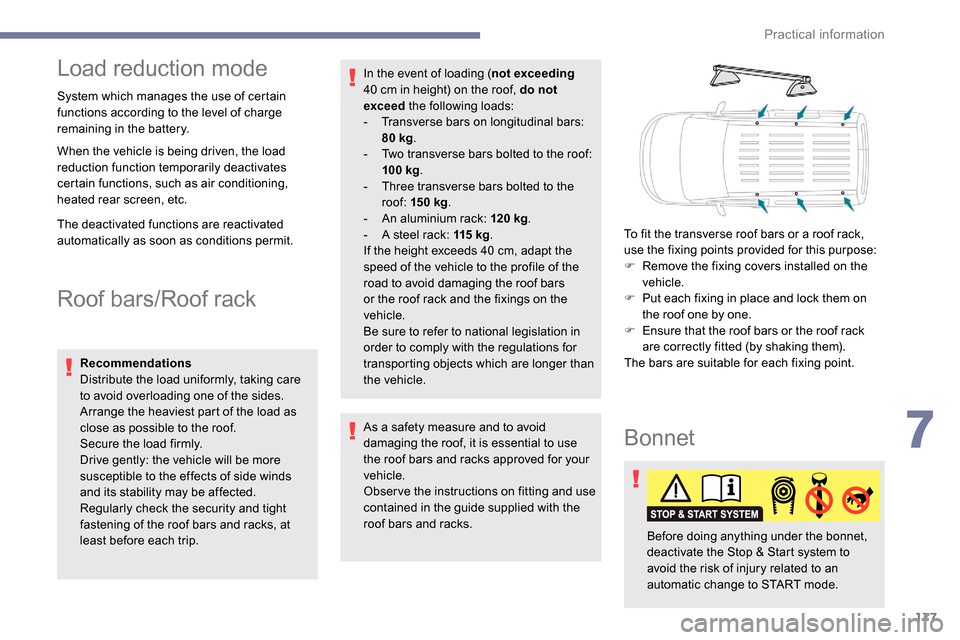
the vehicle. To fit the transverse roof bars or a roof rack,
use the fixing points provided for this purpose:
F
R
emove the fixing covers installed on the
vehicle.
F
P
ut each fixing in place and lock them on
the roof one by one.
F
E
nsure that the roof bars or the roof rack
are correctly fitted (by shaking them).
The bars are suitable for each fixing point.
Bonnet
Before doing anything under the bonnet,
deactivate the Stop & Start system to
avoid the risk of injury related to an
automatic change to START mode.
7
Practical information
Page 180 of 312

178
Engines
Petrol
Diesel
The location of the interior bonnet release
lever prevents opening of the bonnet when
the left-hand front door is shut.
When the engine is hot, handle the
exterior safety catch and the stay with
care (risk of burns), using the protected
area.
When the bonnet is open, take care not to
damage the safety catch.
Do not open the bonnet under very windy
conditions.
The cooling fan may star t after
switching off the engine: take care
with articles and clothing that might be
caught by the fan blades.
Opening
F Open the left-hand front door.F
P
ull the release lever, located at the bottom
of the door aperture, towards you.
F
L
ift the safety catch and raise the bonnet.
F
U
nclip the stay
from its housing
and place it in the
support slot to hold
the bonnet open.
Closing
F Take the stay out of the support slot.
F C lip the stay in its housing.
F
L
ower the bonnet and release it near the
end of its travel.
F
P
ull on the bonnet to check that it is fully
latched.
Because of the presence of electrical
equipment under the bonnet, it is
recommended that exposure to water
(rain, washing, etc.) be limited. These engines are examples provided as a
guide.
The locations of the dipstick and engine oil filler
cap may vary.
1.
Screenwash fluid reservoir.
2. Engine coolant reservoir.
3. Brake fluid reser voir.
4. Battery.
5. Fusebox.
6. A i r f i l t e r.
7. Engine oil dipstick.
8. Engine oil filler cap.
Practical information
Page 266 of 312

6
Information – Using the system
Press the Push To Talk button
and tell me what you'd like
after the tone. Remember you
can interrupt me at any time
by pressing this button. If you
press it again while I'm waiting
for you to speak, it'll end the
conversation. If you need to
start over, say "cancel". If you
want to undo something, say
"undo". And to get information
and tips at any time, just say
"help". If you ask to me do
something and there's some
information missing that I need,
I'll give you some examples
or take you through it step by
step. There's more information
available in "novice" mode.
You can set the dialogue mode
to "expert" when you feel
comfortable. When the voice commands are
activated, by briefly pressing the
button, help is displayed on the
touchscreen, offering various menus
and allowing you to interact with the
system by voice.
Upon selecting a menu item you have a choice
of commands.
The voice commands, with a choice
of 17 languages (Arabic, Brazilian,
Portuguese, Czech, Danish, Dutch,
English, Farsi, French, German, Italian,
Norwegian, Polish, Portuguese, Russian,
Spanish, Swedish, Turkish), are made
using the language previously chosen and
set in the system.
For some voice commands, there are
alternative synonyms.
Example: Guide to/Navigate to/Go to/...
The voice commands in Arabic for:
"Navigate to address" and "Display POI in
the city", are not available.
PEUGEOT Connect Nav
Page 273 of 312
13
Select "My destinations ".
Select the " Recent" tab.
Select the address chosen in the list to display
the " Guidance criteria ".
Press " OK" to start navigation.
Select " Position " to visualise the arrival
point geographically.
To "My home" or "My work"
Press Navigation to display the
primary page.
Press the " MENU" button to go to the
secondary page.
Select "My destinations ".
Select the " Preferred" tab.
Select " My home ".
Or Select "My work ".
Or
Select a preset favourite destination.
To a contact
Press Navigation to display the
primary page.
Press the " MENU" button to go to the
secondary page.
Navigation
Choice of a destination
To a new destination
Press Navigation to display the
primary page.
Press the " MENU" button to go to the
secondary page.
Select "Enter address ".
Select the " Country".
Enter the " City", the " Street " and the
" Number " and confirm by pressing
on the suggestions displayed.
Press " OK" to select the " Guidance
criteria ".
And/Or Select "See on map " to select the
" Guidance criteria ".
Press " OK" to start navigation.
Zoom out /zoom in using the touch buttons
or with two fingers on the screen.
In order to be able to use the navigation, it
is necessary to fill in the " City", the " Street "
and the " Number" on the virtual keyboard
or take it from the list in " Contact" or in the
" History " of addresses.
Without confirmation of the street number,
you will be guided to one end of the street.
To a recent destination
Press Navigation to display the
primary page.
Press the " MENU" button to go to the
secondary page.
.
PEUGEOT Connect Nav
Page 303 of 312

221
Hill Assist Descent Control (HADC) ....26 , 102-103Hill Descent Control ...............................102-103
Hill start assist ........................................ 124 -125
Horn ................................................................. 97
IIdentification, vehicle .................................... 217
Ignition ................ .............................. 11 9 -12 0, 29
Ignition on ...................................................... 120
Immobiliser, electronic
......................44, 47 , 120
Indicator, AdBlue
® range ................................. 31
Indicator, coolant temperature ..................28-30
Indicator, engine oil level
................................ 30
Indicator lamps, operation
................... 1
5 -16, 85
Indicator lamps, status
.................................... 15
I
ndicators, direction
........................................ 86
Inflating tyres
................................................ 183
Inflating tyres and accessories (using the kit)
................................................. 189, 191
Instrument panel
............................................. 11
Instrument panels
........................................... 29
Internet browser
.............................................. 21
JJack .........................................................191, 25
Jump starting ................................................ 204
KKey ................................................ 37, 39 , 42, 47
Key, electronic ......................................... 37, 120
Keyless Entry and Starting .................
3 7- 4 0, 42, 44 , 47- 4 8 , 11 8 -11 9
Key with remote control
......................37,
42, 44
Kit, hands-free
..................... 1
0 -11, 13 -14 , 27-2 8
Kit, temporary puncture repair
....... 18
8 -189, 191
LLabels ................................................................ 4
Labels, identification ..................................... 217
Lamps, front
........................................... 197-19 9
Lamps, parking
............................................... 87
Lamps, rear
................................................... 19 9
Lane departure warning active
............... 20,
15 3
LEDs - Light-emitting diodes
..........................87
Level, brake fluid
........................................... 18 0
Level, Diesel additive
.............................181-182
Level, engine coolant
........................28-30, 18 0
Level, engine oil
.............................. 30, 179 -18 0
Levels and checks
..............................
...178 -181
Level, screenwash fluid
...................92,
18 0 -181
Light-emitting diodes - LEDs
..........................87
Lighting
............................................................ 85
Lighting, cornering
.................................... 90 -91
Lighting, directional
......................................... 90
Lighting, guide-me home
................................88
Lighting, welcome
........................................... 88
Loading
................................................... 68, 17 7
Load reduction mode
.................................... 17 7
Load restraint
...............................
...................67
Locating your vehicle
...................................... 44
Locking
...............................
.................37, 42 , 47
Locking from the inside
.............................48-49
Low fuel level
......................................... 17
1-172
Lumbar
............................................................ 60
MMarkings, identification .................................217
Mat .................................................... 64-65, 11 8
Memorising a speed
..............................1
4 9 -15 0
Menu
............................................................... 12
Menu, main
....................................................... 4
M
enus (audio) ........................................ 4-5, 4-5
Messages
........................................................ 30
Messages, quick
............................................. 3
0
Mirror, rear view
.............................................. 58
Mirrors, door ......................... 57- 5 8, 79, 157-15 8
Misfuel prevention
......................................... 172
MP3 CD
............................................................. 9
NNumber plate lamps ...................................... 200
OObstacle detection ........................................ 160
Oil change .............................................. 17
9 -18 0
Oil consumption
..................................... 179 -18 0
Oil, engine
.............................................. 179 -18 0
On-board tools
....................................... 187-188
Opening the bonnet
...............................17 7-178
Opening the boot
............................................ 37
Opening the doors
.......................................... 37
Opening the fuel filler flap
.............................171
Overhead storage
........................................... 65
O
verload indicator
........................................... 21
.
Alphabetical index