2019 Peugeot Partner Engine compartment
[x] Cancel search: Engine compartmentPage 83 of 312
81
OK
00 00
00 00
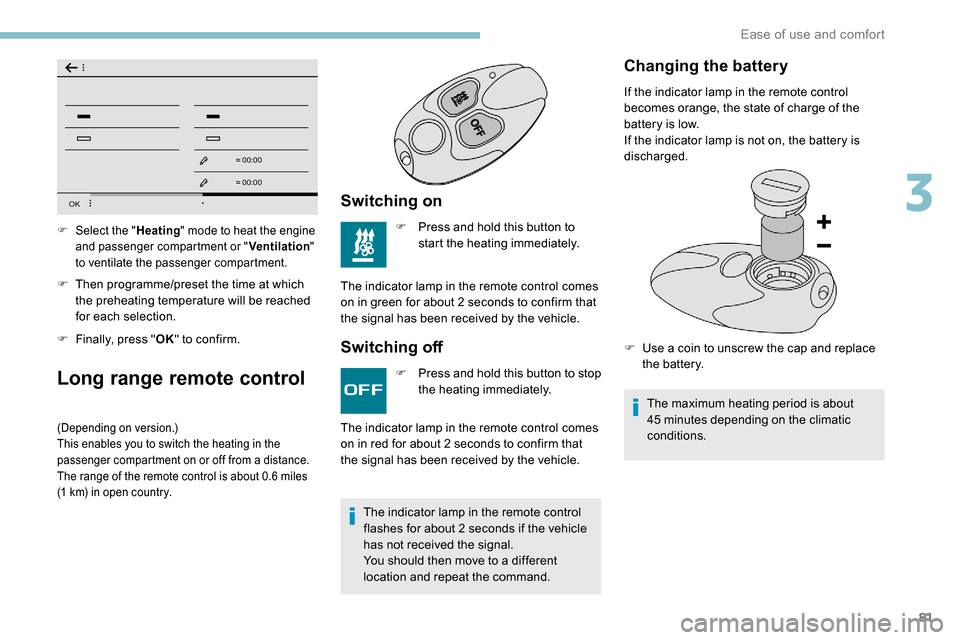
F Then programme/preset the time at which the preheating temperature will be reached
for each selection.
F
F
inally, press " OK" to confirm.
Long range remote control
(Depending on version.)
This enables you to switch the heating in the
passenger compartment on or off from a distance.
The range of the remote control is about 0.6
miles
(1
km) in open country.
Switching on
F Press and hold this button to start the heating immediately.
The indicator lamp in the remote control comes
on in green for about 2
seconds to confirm that
the signal has been received by the vehicle.
Switching off
F Select the " Heating" mode to heat the engine
and passenger compartment or " Ventilation"
to ventilate the passenger compartment.
F Press and hold this button to stop the heating immediately.
The indicator lamp in the remote control
flashes for about 2
seconds if the vehicle
has not received the signal.
You should then move to a different
location and repeat the command.
The indicator lamp in the remote control comes
on in red for about 2
seconds to confirm that
the signal has been received by the vehicle.
Changing the battery
If the indicator lamp in the remote control
becomes orange, the state of charge of the
battery is low.
If the indicator lamp is not on, the battery is
discharged.
F
U
se a coin to unscrew the cap and replace
the battery.
The maximum heating period is about
45
minutes depending on the climatic
conditions.
3
Ease of use and comfort
Page 85 of 312

83
Advice
In order for these systems to be fully effective,
follow the operation and maintenance
guidelines below:
F
T
o ensure that the air is distributed evenly,
keep the external air intake grilles at the
base of the windscreen, the nozzles, the
vents, the air outlets and the air extractor
located in the back free from obstructions.
F
D
o not cover the sunshine sensor, located
at the top of the windscreen; this is used
for regulation of the air conditioning
system.
F
O
perate the air conditioning system for
at least 5 to 10
minutes, once or twice a
month to keep it in per fect working order.
F
T
o prevent condensation or deteriorating
air quality inside the passenger
compartment, you should not deactivate
the system for too long or avoid extended
operation of the air recirculation system
when driving.
F
E
nsure that the passenger compartment
filter is in good condition and have the
filter elements replaced regularly.
If after an extended period parked in the sun, the
interior temperature is very high, first ventilate
the passenger compartment for a few moments.
Put the air flow control at a setting high enough
to quickly change the air in the passenger
compartment.
The air conditioning system does not contain
chlorine and does not present any danger to the
ozone layer.
Contains fluorinated greenhouse gas
R13 4A
Depending on version and country
of sale, the air conditioning system
contains fluorinated greenhouse gas
R13 4A .
We recommend the use of a combined
passenger compartment filter. Thanks to
its special active additive, it contributes
to the purification of the air breathed by
the occupants and the cleanliness of the
passenger compartment (reduction of allergic
symptoms, bad odours and greasy deposits).
F
T
o ensure correct operation of the air
conditioning system, you are also advised
to have it checked regularly according
to the warranty and maintenance record
recommendations.
F
I
f the system does not produce cold air,
switch it off and contact a PEUGEOT
dealer or a qualified workshop.
When towing the maximum load on a steep
gradient in high temperatures, switching off
the air conditioning increases the available
engine power and so improves the towing
ability.
The condensation created by the air conditioning
results in a discharge of water under the vehicle
when stationary which is per fectly normal.
Stop & Star t
The heating and air conditioning systems
only work when the engine is running.
To maintain a comfortable temperature
in the passenger compartment, you may
temporarily deactivate the Stop & Start
system.
For more information on Stop & Star t ,
refer to the corresponding section.
3
Ease of use and comfort
Page 133 of 312
131
Special cases: STOP mode
not available
STOP mode is not activated in certain
temporary conditions (examples: battery
charge, engine temperature, braking
assistance, ambient temperature) to assure
correct operation of the system and mainly
when:
-
t
he vehicle is on a steep slope (rising or
falling),
-
t
he driver's door is open,
-
a s
liding side door is open,
-
t
he driver's seat belt is not fastened,
-
t
he vehicle has not exceeded 6 mph
(10
km/h) since the last engine start by the
driver,
-
t
he automatic electronic parking brake is
applied or being applied,
-
t
he engine is needed to maintain a
comfortable temperature in the passenger
compartment, In this case, this indicator lamp
flashes for a few seconds, then goes
of f.
Going into engine START
mode
With a manual gearbox
, the Stop
& Start warning lamp goes off on
the instrument panel and the engine
restarts automatically when you press
the clutch pedal fully down to the floor.
With an automatic gearbox , the Stop & Start
warning lamp on the instrument panel goes off
and the engine restarts automatically when:
-
y
ou release the brake pedal with the gear
selector in position D or M ,
-
y
ou are in position N with the brake pedal
released and you move the gear selector to
position D or M,
-
y
ou engage reverse.
-
d
emisting is active,
-
t
he ambient temperature is lower than about
0°C or higher than about 35°C.
This operation is perfectly normal.
Stop & Start time counter
(minutes/seconds or hours/minutes)
If your vehicle is fitted with Stop & Start, a time
counter calculates the time spent in STOP
mode during a journey.
It resets to zero every time the ignition is
switched on.
Special cases: START
mode triggered
automatically
START mode is activated automatically in
certain temporary conditions (examples:
battery charge, engine temperature, braking
assistance, air conditioning setting) to assure
correct operation of the system and mainly
when:
-
y
ou open the driver's door,
-
y
ou open a sliding side door,
-
y
ou unfasten the driver's seat belt,
-
t
he speed of the vehicle exceeds 2 mph
(3
km/h) (depending on the engine)In this case, this indicator lamp
flashes for a few seconds, then goes
of f.
This operation is perfectly normal.
6
Driving
Page 183 of 312

181
Fluid specification
The screenwash fluid must be topped up with a
ready for use mix.
In winter (temperatures below zero), a fluid with
antifreeze must be used that is appropriate for
the prevailing conditions, in order to preser ve
the elements of the system (pump, tank, ducts,
e t c .) .
Filling with pure water is prohibited under all
circumstances (risk of freezing, limestone
deposits, etc.).
Diesel fuel additive level
(Diesel with particle filter)
The additive reser voir low level
is indicated by fixed illumination
of one of these warning lamps,
accompanied by an audible signal
and a message that the particle filter
additive level is too low.
To p p i n g u p
This additive must be topped up without delay
by a PEUGEOT dealer or a qualified workshop.
AdBlue level
An alert is triggered once the reser ve level is
reached.
To avoid the vehicle being immobilised as per
regulations, you must top up with AdBlue.
For more information on AdBlue and the SCR
system, and in particular topping it up, refer to
the corresponding section.
Checks
Unless otherwise indicated, check these
components in accordance with the
manufacturer's service schedule and according
to your engine.
Other wise, have them checked by a PEUGEOT
dealer or a qualified workshop.
12 V battery
The battery does not require any maintenance.
However, check regularly that the terminals
are correctly tightened (versions without quick
release terminals) and that the connections
are clean.
For more information on the precautions
to take before starting work on the 12 V
battery , refer to the corresponding
section. Versions equipped with Stop & Start are
fitted with a 12
V lead-acid battery of
specific technology and specification.
Its replacement should be carried out
only by a PEUGEOT dealer or a qualified
workshop.
Air filter
Depending on the environment
(e.g. dusty atmosphere) and the
use of the vehicle (e.g. city driving),
replace it twice as often if
necessary .
Passenger compartment filter
Depending on the environment
(e.g. dusty atmosphere) and the
use of the vehicle (e.g. city driving),
replace it twice as often if
necessary.
A clogged passenger compartment
filter may have an adverse effect on
the per formance of the air conditioning
system and generate undesirable odours.
7
Practical information
Page 187 of 312
185
cannot be discounted: do not inhale the fluid.
Ammonia vapour has an irritant effect on mucous
membranes (eyes, nose and throat).
Keep AdBlue® out of reach of children, in
its original container or bottle.
Procedure
Before starting the top up procedure, ensure
that the vehicle is parked on a flat and level
sur face.
In winter, check that the temperature of the
vehicle is above -11°C. If not, due to freezing,
the AdBlue
® cannot be poured into the tank.
Park your vehicle somewhere warmer for a few
hours before topping up.
In the event of an AdBlue
® breakdown,
confirmed by the message "Add AdBlue:
Starting impossible", you must top up with
at least 5
litres.
Never pour AdBlue
® into the Diesel fuel
tank. If any AdBlue
® is splashed, or if there are
any spillages on the side of the body, rinse
immediately with cold water or wipe with a
damp cloth.
If the fluid has crystallised, clean it off
using a sponge and hot water.
Access to the AdBlue® tank
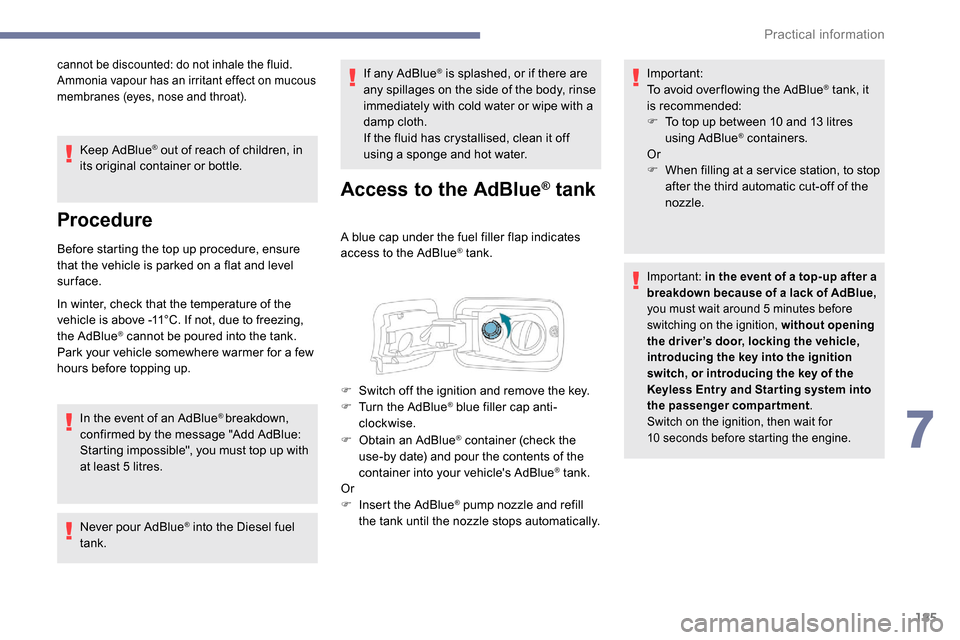
A blue cap under the fuel filler flap indicates
access to the AdBlue® tank.
F
O
btain an AdBlue
® container (check the
use-by date) and pour the contents of the
container into your vehicle's AdBlue
® tank.
Or
F
I
nsert the AdBlue
® pump nozzle and refill
the tank until the nozzle stops automatically. Important:
To avoid over flowing the AdBlue
® tank, it
i
s recommended:
F
T
o top up between 10 and 13
litres
using AdBlue
® containers.
Or
F
W
hen filling at a ser vice station, to stop
after the third automatic cut-off of the
nozzle.
Important: in the event of a top-up after a
breakdown because of a lack of AdBlue,
you must wait around 5
minutes before
switching on the ignition, without opening
the driver’s door, locking the vehicle,
introducing the key into the ignition
switch, or introducing the key of the
K
eyless Entr y and Star ting system into
the passenger compartment.
Switch on the ignition, then wait for
10
seconds before starting the engine.
F Switch off the ignition and remove the key.
F T urn the AdBlue® blue filler cap anti-
clockwise.
7
Practical information
Page 188 of 312

186
Advice on care
General recommendations on the care and maintenance of your vehicle are given in the warranty
and maintenance record.Observe the following recommendations to
avoid damaging your vehicle:
-
D
o not clean your headlamps with a dry
or abrasive cloth, nor with detergent or
solvent products. Use a sponge and
soapy water or a pH neutral product.
-
W
hen using a high-pressure washer on
stubborn dirt, avoid prolonged use on the
headlamps, the lamps and their edges to
avoid damaging their lacquer finish and
seals.
-
N
ever use an abrasive sponge to clean
persistent dirt, as this may scratch the
paint sur face. Use a soft cloth with soapy
water instead.
-
W
hen washing your vehicle, never clean
the interior with a water jet.
-
W
hen washing your vehicle in an
automatic roller-brush car wash, be sure
to lock your doors and, depending on
version, remove the key. -
N
ever use high-pressure washing to
clean the engine compartment, in order
to avoid damaging the electrical units.
-
L
iquids carried in an open vessel (e.g.
a cup or mug) could be spilt, presenting
a risk of damage on contact with the
controls in the dashboard and centre
console. Be careful.
Depending on version, in order to avoid
damaging or unpeeling the stickers on the
bodywork, you are strongly advised against
using high-pressure cleaners to wash your
vehicle. It is recommended that you wash
it using a high-flow water jet and rinse the
vehicle down using demineralised water.
Only a microfibre cloth is recommended for
wiping your vehicle; it must be clean and
used gently.
It is always preferable to have paint repairs carried out by a PEUGEOT dealer or a qualified
workshop.
Practical information
Page 205 of 312

203
Engine compartment fuses
The fusebox is placed in the engine
compartment near the battery.
Access to the fuses
F Release the two latches A.
F R emove the cover.
F
C
hange the fuse.
F
W
hen you have finished, close the cover
carefully then engage the two latches A , to
ensure correct sealing of the fusebox. Fuse
No. Rating
(A) Functions
F16 15Front foglamp.
F18 10
Right-hand main beam headlamp.
F19 10Left-hand main
beam headlamp.
F29 40Windscreen wipers.
12 V battery
Procedure for starting the engine using another
battery or charging a discharged battery.
Lead-acid starter
batteries
Batteries contain harmful substances
such as sulphuric acid and lead.
They must be disposed of in accordance
with regulations and must not, in any
circumstances, be discarded with
household waste.
Take used remote control batteries and
vehicle batteries to a special collection
point.
Protect your eyes and face before
handling the battery.
All operations on the battery must be
carried out in a well ventilated area and
away from naked flames and sources of
sparks, so as to avoid the risk of explosion
or fire.
Wash your hands afterwards.
Versions equipped with Stop & Start are
fitted with a 12
V lead-acid battery of
specific technology and specification.
Its replacement should be carried out
only by a PEUGEOT dealer or a qualified
workshop.
8
In the event of a breakdown
Page 302 of 312

220
Cruise control, dynamic with Stop function ................................ 13 6, 142-145 , 148
Cup holder
....................................................... 64
DDAB (Digital Audio Broadcasting) -
Digital radio ........................................ 6 -7, 8, 24
Date (setting)
....................................... 35, 17 , 32
Daytime running lamps
.....................85, 87 , 198
Deactivating the passenger airbag
.......10 6, 11 0
Deactivation of DSC (ESC)
.............................99
Deadlocking
.................................................... 43
Defrosting
.................................................. 58, 78
Demisting
........................................................ 78
Demisting, rear
.......................................... 57, 79
Demisting, rear screen
.............................57, 79
Diesel
..................................................... 213 -216
Dimensions
..............................
.....................208
Dipstick
................
............................30, 179 -18 0
Direction indicators
...................86 - 87, 198, 19 9
Display screen, instrument panel
...........29, 13 0
Distance Alert
.................................. 18, 15 0 -151
Doors, side-hinged
................................... 42
- 43
Driver’s attention warning
.............................159
Driving
........................................................... 115
Driving abroad ................................................. 86
Dynamic stability control (DSC)
................................. 20, 97- 9 9 , 101-102
EEarth point, remote ....................................... 17 8
EBFD ................ ............................................... 98
Economy mode
............................................. 17
6
Electric windows
............................................. 55
Electronic brake force distribution (EBFD) .....9 7- 9 8Emergency braking assistance (EBA) .......9 7- 9 8
Emergency call ............................................... 96
Emergency warning lamps
.............................97
Emissions control system, SCR
...................183
Energy economy mode
................................. 17
6
Engine
.................................................... 211-216
Engine compartment
.................................... 17
8
Engine, Diesel
..................18, 170 , 187, 213 -216
Engine, petrol
......................... 17
0, 178 , 211-212
Engines
.................................................. 210 -216
Engine self-diagnosis
..................................... 17
E
nvironment
.............................................. 46, 82
ESC (electronic stability control)
....................97
E
xtended traffic sign recognition
..................13 6
FFatigue detection .......................................... 159
Filling the AdBlue® tank ................................ 185
Filling the fuel tank ................................. 170 -172
Filter, air
........................................................ 181
Filter, Diesel fuel
........................................... 179
Filter, oil
................
......................................... 182
Filter, particle
................................... 19, 181-182
Filter, passenger compartment
..................... 181
Finisher
......................................................... 195
Fitting a wheel
........................................ 193 -195
Fitting roof bars
............................................. 17 7
Fittings, interior
............................................... 64
F
lap, fuel filler
......................................... 171-172
Flap, removable
..............................
...........70 -71
Flashing indicators
............................ 86 - 87, 19 9
Foglamp, rear
................................... 25, 85 , 19 9
Foglamps, front
........................... 85, 90 -91 , 19 9
Foglamps, rear
................................................ 85
F
olding the rear seats
............................... 63-64
Frequency (radio)
...................................... 23 -24
Fuel................................................................ 170
Fuel tank ........................................................ 171
Fusebox, engine compartment
.....................203
Fuses
..................................................... 20
1-203
GGauge, fuel............................................. 171-172
Gearbox, automatic ...............11 6, 125-132 , 182
Gearbox, electronic
...............................13 0 -132
Gearbox, manual
...........125 -126 , 13 0 -132 , 182
Gear lever, automatic gearbox
..............126 -12 9
Gear lever, manual gearbox
..................125 -126
Gear shift indicator ~ Gear efficiency indicator
...................................................... 13 0
Glove box
........................................................ 64
G . P. S .
.............................................................. 14
HHazard warning lamps ....................................97Hazard warning lamps, automatic operation ......97headlamp adjustment ..................................... 91
Headlamp adjustment ..................................... 91
Headlamp beam height
................................... 91
H
eadlamps, automatic illumination
..........86-88
Headlamps, dipped beam
.................27, 85 , 197
Headlamps, halogen
..................................... 19 6
Headlamps, intelligent beam
......27, 88-90 , 15 8
Headlamps, main beam
....................27, 85 , 198
Head restraints ................................................ 60
Head restraints, front
...................................... 64
Head restraints, rear
.................................63-64
Heating
.......................................... 75,
79 - 81, 83
Heating, additional
..............................53, 79 - 81
Heating, programmable
......................53, 79 - 81
Alphabetical index