2019 Peugeot 508 Indicator
[x] Cancel search: IndicatorPage 197 of 320

195
Operating faults
When the function is not activated,
this indicator lamp temporarily
flashing and an audible signal
indicate a Full Park Assist fault.
If the fault occurs during the use
of the system, the indicator lamp
goes off.
If the fault in the parking sensors,
indicated by this warning lamp
coming on, occurs during Full Park
Assist use, it causes the function to
deactivate.
Contact a PEUGEOT dealer or a qualified
workshop. In the event of a fault with the
power steering, this warning lamp
flashes in the instrument panel,
accompanied by a message.
You must stop as soon as it is safe
to do so.
Call on a PEUGEOT dealer or a qualified
workshop.
6
Driving
Page 208 of 320
206
Used products
Avoid prolonged contact of used oil or
fluids with the skin.
Most of these fluids are harmful to health
or indeed very corrosive.Do not discard used oil or fluids into
sewers or onto the ground.
Take used oil to a PEUGEOT dealer or a
qualified workshop and dispose of in the
containers reser ved for this purpose.
Engine oil level
The check is carried out either when
the ignition is switched on using the
oil level indicator in the instrument
panel for vehicles equipped with an
electric gauge, or using the dipstick.
To ensure that the reading is correct, your
vehicle must be parked on a level sur face
with the engine stopped for more than
30
minutes.
It is normal to top up the oil level between
two ser vices (or oil changes). PEUGEOT
recommends that you check the level, and top
up if necessary, every 3,000 miles (5,000 km).
Checking using the dipstick
The location of the dipstick is shown in the
corresponding underbonnet layout view.
F
T
ake the dipstick by its coloured grip and
pull it out completely.
F
W
ipe the end of the dipstick using a clean
non-fluffy cloth.
F
R
efit the dipstick and push fully down, then
pull it out again to make the visual check:
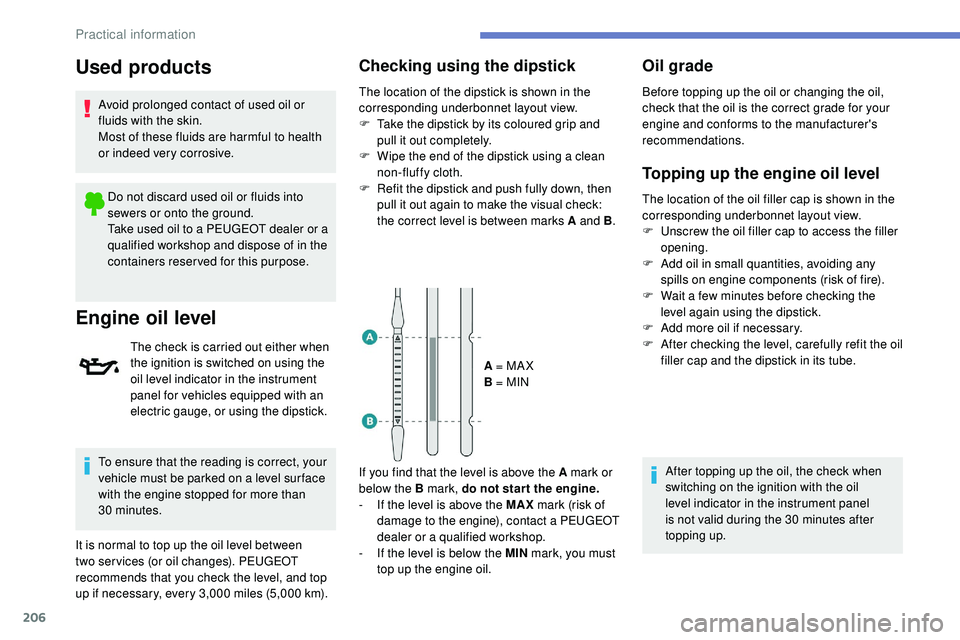
the correct level is between marks A and B .
A = MA X
B = MIN
If you find that the level is above the A mark or
below the B mark, do not star t the engine.
-
I
f the level is above the MAX mark (risk of
damage to the engine), contact a PEUGEOT
dealer or a qualified workshop.
-
I
f the level is below the MIN mark, you must
top up the engine oil.
Oil grade
Before topping up the oil or changing the oil,
check that the oil is the correct grade for your
engine and conforms to the manufacturer's
recommendations.
Topping up the engine oil level
The location of the oil filler cap is shown in the
corresponding underbonnet layout view.
F
U
nscrew the oil filler cap to access the filler
opening.
F
A
dd oil in small quantities, avoiding any
spills on engine components (risk of fire).
F
W
ait a few minutes before checking the
level again using the dipstick.
F
A
dd more oil if necessary.
F
A
fter checking the level, carefully refit the oil
filler cap and the dipstick in its tube.
After topping up the oil, the check when
switching on the ignition with the oil
level indicator in the instrument panel
is not
valid during the 30 minutes after
topping up.
Practical information
Page 209 of 320

207
Changing the fluid
Refer to the manufacturer's service schedule
for details of the inter val for this operation.
Coolant level
Check the coolant level regularly.
It is normal to top up the fluid
between two services.
The check and top-up must only be done with
the engine cold.
A low coolant level presents a risk of serious
damage to your engine.
The coolant level should be close to the "MA X"
mark but should never exceed it.
If the level is close to or below the "MIN" mark,
it is essential to top up. When the engine is hot, the temperature of the
coolant is regulated by the fan.
In addition, as the cooling system is pressurised,
wait at least one hour after switching off the
engine before carrying out any work.
To avoid the risk of scalding when you need to
top up in an emergency, wrap a cloth around
the cap and unscrew the cap by two turns to
allow the pressure to drop.
Once the pressure has dropped, remove the
cap and top up to the required level.
The cooling fan may star t after
switching off the engine: take care
with articles and clothing that might
be caught by the fan blades.
Screenwash fluid level
Top up to the required level when
necessary.
Fluid specification
The screenwash fluid must be topped up with
a
ready for use mix.
In winter (temperatures below zero), a fluid with
antifreeze must be used that is appropriate for
the prevailing conditions, in order to preser ve
the elements of the system (pump, tank, ducts,
e t c .) .
Diesel fuel additive level
(Diesel with particle filter)
The additive reser voir low level is
indicated by fixed illumination of this
warning lamp, accompanied by an
audible signal and a message that
the particle filter additive level is
too low.
To p p i n g u p
The reser voir must be topped up without delay
by a PEUGEOT dealer or a qualified workshop.
Level of AdBlue
An alert is triggered once the reser ve level is
reached.
For more information on the Indicators for
the AdBlue range, refer to the corresponding
section.
To avoid the vehicle being immobilised as per
regulations, you must top up the AdBlue tank.
Engine oil change
In order to maintain the reliability of the engine
and emissions control system, never use
additives in the engine oil.
Brake fluid level
The brake fluid level should be close
to the "MA X" mark. If it is not, check
the brake pad wear. Filling with pure water is prohibited under all
circumstances (risk of freezing, limestone
deposits, etc.).
7
Practical information
Page 212 of 320

210
Advice on care and
maintenance
Recommendations on the care and
maintenance of your vehicle are given in the
Warranty and Maintenance Record.
Headlamps and lamps
The headlamps have polycarbonate
lenses with a protective coating.
Do not clean them with a dry or abrasive
cloth, nor with detergent or solvent
products.
Use a sponge and soapy water.
The use of a high pressure jet wash for
cleaning the headlamps, lamps and their
surrounds may damage the lacquer and
seals.
Observe the recommendations on
pressure and distance for jet washing.
First clean persistent stains with a sponge
and warm soapy water.
Leather
Leather is a natural product. Appropriate
regular care and cleaning is essential for
its
durability. Refer to your vehicle's Warranty and
Maintenance Record for information on
all
the special precautions to obser ve.
AdBlue® (BlueHDi engines)
To respect the environment and ensure
compliance with the Euro 6 standard, without
adversely affecting the per formance or fuel
consumption of its Diesel engines, PEUGEOT
has taken the decision to equip its vehicles
with a system that associates SCR (Selective
Catalytic Reduction) with a Diesel particle filter
(DPF) for the treatment of exhaust gases.
SCR system
Using a fluid called AdBlue® that contains
urea, a catalytic converter turns up to 85%
of nitrogen oxides (NOx) into nitrogen and
water, which are harmless to health and the
environment.
The AdBlue
® is contained in
a
special tank holding about
17
litres. An alert system is triggered automatically once
the reser ve level is reached: you can then drive
for a further 1,500 miles (2,400
km) before the
tank is empty.
Once the AdBlue
® tank is empty, a system
r
equired by regulations prevents starting
of the engine.
If the SCR system is defective, the level of
emissions from your vehicle will no longer
meet the Euro 6 standard: your vehicle
becomes polluting.
In the event of a confirmed fault with the
SCR system, you must go to a PEUGEOT
dealer or a qualified workshop as soon
as possible: after a running distance of
685 miles (1,100
km), a system will be
triggered automatically to prevent engine
starting.
In either case, a range indicator gives you
the distance you can travel before the
vehicle is immobilised.
For more information on the Warning and
indicator lamps and associated alerts,
refer to the corresponding section.
Practical information
Page 226 of 320

224
Halogen bulbs
To ensure good quality lighting, check
that the bulb is correctly positioned in its
housing.
Front lamps
Model with "Full LED"
technology headlamps
1.Daytime running lamps/Sidelamps/
Direction indicators (LED).
2. Dipped beam headlamps (LED).
3. Main beam headlamps (LED).
4. Static cornering lamps (LED).
Do not touch the "Full LED" technology
headlamps. Risk of electrocution!
Call a PEUGEOT dealer or a qualified
workshop.
Model with halogen headlamps
1.Daytime running lamps/Sidelamps (LED).2.Main beam headlamps (H7).
3. Dipped beam headlamps (H7).
4. Direction indicators (PWY24W).
Opening of bonnet /Access to bulbs
If the engine is warm, proceed with
caution – Risk of burns!
Take care with objects or clothing that
could be caught in the blades of the
engine fan – Risk of strangulation!
After changing a bulb
When refitting, close the protective cover
very carefully to guarantee the sealing of
the lamp.
Direction indicators (model with
halogen headlamps)
Rapid flashing of the direction indicator
lamp (left or right) in the instrument panel
indicates that one of the bulbs on the
corresponding side has failed.
F
T
urn the bulb holder a quarter turn and pull
it out.
F
T
urn the bulb a quarter turn and replace it.
To refit, carry out these operations in reverse
o r d e r.
Amber coloured bulbs, such as the
direction indicators, must be replaced
by bulbs with identical colour and
specifications.
In the event of a breakdown
Page 227 of 320
225
Main beam headlamps (model
with halogen headlamps)
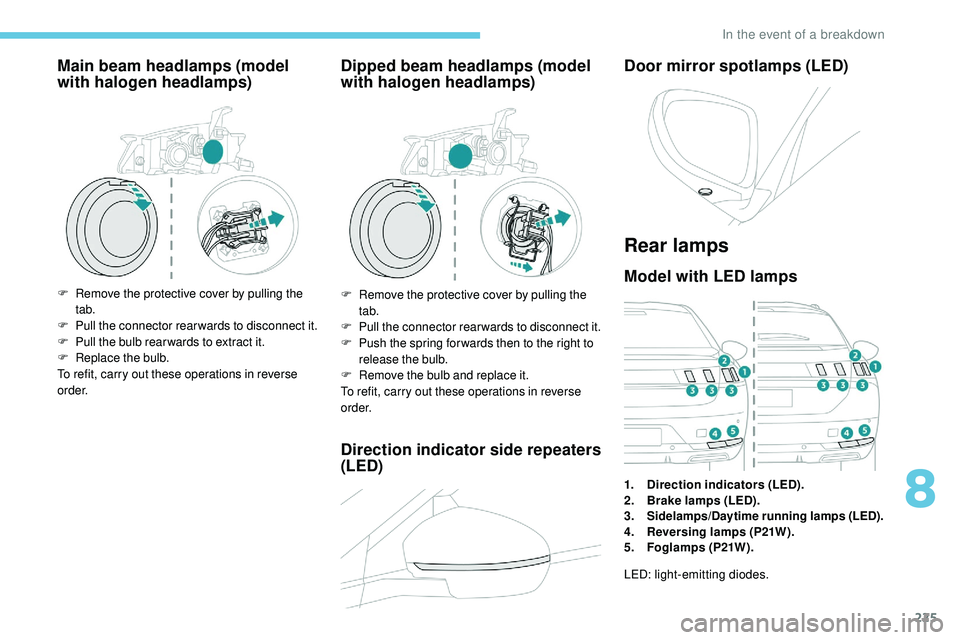
F Remove the protective cover by pulling the tab.
F
P
ull the connector rear wards to disconnect it.
F
P
ull the bulb rear wards to extract it.
F
R
eplace the bulb.
To refit, carry out these operations in reverse
o r d e r.
Dipped beam headlamps (model
with halogen headlamps)
F Remove the protective cover by pulling the tab.
F
P
ull the connector rear wards to disconnect it.
F
P
ush the spring for wards then to the right to
release the bulb.
F
R
emove the bulb and replace it.
To refit, carry out these operations in reverse
o r d e r.
Direction indicator side repeaters
(LED) Door mirror spotlamps (LED)
Rear lamps
Model with LED lamps
1.
Direction indicators (LED).
2. Brake lamps (LED).
3.
Sidelamps/Daytime running lamps (LED).4. Reversing lamps (P21W).
5. Foglamps (P21W).
LED: light-emitting diodes.
8
In the event of a breakdown
Page 228 of 320
226
Model with 3D Full LED adaptive
lamps
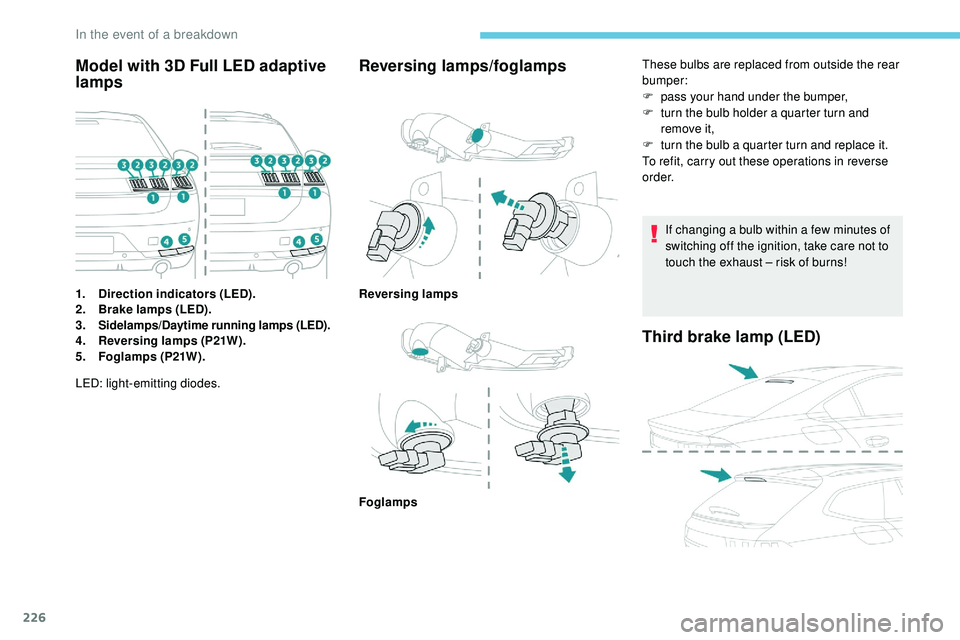
1.Direction indicators (LED).
2. Brake lamps (LED).
3.
Sidelamps/Daytime running lamps (LED).4. Reversing lamps (P21W).
5. Foglamps (P21W).
Reversing lamps/foglamps
LED: light-emitting diodes. These bulbs are replaced from outside the rear
bumper:
F
p
ass your hand under the bumper,
F
t
urn the bulb holder a quarter turn and
remove it,
F
t
urn the bulb a quarter turn and replace it.
To refit, carry out these operations in reverse
o r d e r.
If changing a bulb within a few minutes of
switching off the ignition, take care not to
touch the exhaust – risk of burns!
Reversing lamps
Foglamps
Third brake lamp (LED)
In the event of a breakdown
Page 233 of 320

231
Passenger compartment fusebox
Trailer interface unitEngine compartment fuses
The fusebox is placed in the engine
compartment near the battery.
Access to the fusesFuse N°Rating (A) Functions
F36 30 APanoramic sunroof.
F37 30 APanoramic sunroof blind.
F38 30 AElectric seats.
F39 30 AMotorised tailgate unit.
F40 25 AAdditional heating.
Fuse N° Rating (A) Functions
F36 20 ABrake lamps, reversing lamps (trailer).
F37 20 ASidelamps, direction indicators (trailer).
F38 20 AInterior lighting (caravan).
F40 2 AAudible signal (trailer). F
R
elease the two latches A.
F
R
emove the cover.
F
C
hange the fuse.
F
W
hen you have finished, close the cover
carefully then engage the two latches A ,
to
ensure correct sealing of the fusebox.
8
In the event of a breakdown