2019 MERCEDES-BENZ SL CLASS ESP
[x] Cancel search: ESPPage 62 of 330

Always secure animals properly when driv-
ing, for instance with a suitable pet carrier.
Driving safety systems
Overview of driving safety systems
In this section, you will find information aboutthe following driving safety systems:
RABS (Anti-lockBrakingSystem)(Ypage 60)
RBAS (BrakeAssistSystem) (Ypage 61)
RBrake Assist with cross-traffic function(Ypage 61)
RActive Brake Assist (Ypage 63)
RAdaptive brake lights (Ypage 65)
RESP®(ElectronicStabilityProgram)(Ypage 65)
REBD (ElectronicBrake forceDistribution)(Ypage 69)
RADAPTIVE BRAKE (Ypage 70)
RActive Brake Assist with cross-traffic func-tion (Ypage 70)
RSTEER CONTROL (Ypage 72)
Important safety notes
If you fail to adapt your driving style or if youare inattentive, the driving safety systems canneither reduce the risk of an accident noroverride the laws of physics. Driving safetysystems are merely aids designed to assistdriving.
You are responsible for maintaining the dis-tance to the vehicle in front, for vehicle speed,for braking in good time, and for staying inlane. Always adapt your driving style to suitthe prevailing road and weather conditions andmaintain a safe distance from the vehicle infront. Drive carefully.
The driving safety systems described onlywork as effectively as possible when there isadequate contact between the tires and theroad surface. Pay particular attention to theinformation regarding tires, recommendedminimum tire tread depths etc. in the "Wheelsand tires" section (Ypage 293).
In wintry driving conditions, always use wintertires (M+S tires) and if necessary, snow
chains. Only in this way will the driving safetysystems described in this section work aseffectively as possible.
ABS (Anti-lock Braking System)
General information
ABS regulates brake pressure in such a waythat the wheels do not lock when you brake.This allows you to continue steering the vehi-cle when braking.
The%ABS warning lamp in the instrumentcluster lights up when the ignition is switchedon. It goes out when the engine is running.
ABS works from a speed of about 5 mph(8 km/h), regardless of road-surface condi-tions. ABS works on slippery surfaces, evenwhen you only brake gently.
Important safety notes
iObserve the "Important safety notes" sec-tion (Ypage 60).
GWARNING
If ABS is malfunctioning, the wheels could
lock when braking. The steerability and
braking characteristics would be severely
affected. There is an increased danger of
skidding and accidents.
Drive on carefully. Have ABS checked imme-
diately at a qualified specialist workshop.
When ABS is malfunctioning, other systems,including driving safety systems, will alsobecome inoperative. Observe the informationon the ABS warning lamp (Ypage 236) anddisplay messages which may be shown in theinstrument cluster (Ypage 206).
Brakes
XIf ABS intervenes:continue to depress thebrake pedal vigorously until the braking sit-uation is over.
XTo make a full brake application:depressthe brake pedal with full force.
If ABS intervenes when braking, you will feel apulsing in the brake pedal.
60Driving safety systems
Safety
Page 67 of 330
Adaptive Brake Assist provides braking assis-tance in hazardous situations at speeds above4 mph (7 km/h). It uses radar sensor technol-ogy to assess the traffic situation.
Up to a speed of approximately 155 mph(250 km/h), Adaptive Brake Assist is capableof reacting to moving objects that havealready been detected as such at least onceover the period of observation.
Up to a speed of approximately 44 mph(70 km/h), Adaptive Brake Assist reacts tostationary obstacles.
If Adaptive Brake Assist demands particularlyhigh braking force, preventative passenger
protection measures (PRE-SAFE®) are activa-ted simultaneously (Ypage 55).
XKeep the brake pedal depressed until theemergency braking situation is over.ABS prevents the wheels from locking.
The brakes will work normally again if:
Ryou release the brake pedal
Rthere is no longer any danger of a collision
Rno obstacle is detected in front of your vehi-cle
Adaptive Brake Assist is then deactivated.
Important safety notes
GWARNING
Adaptive Brake Assist cannot always clearly
identify objects and complex traffic situa-
tions.
In such cases, Adaptive Brake Assist can:
Rintervene unnecessarily
Rnot intervene
There is a risk of an accident.
Always pay careful attention to the traffic
situation and be ready to brake. Terminate
the intervention in a non-critical driving sit-
uation.
GWARNING
Adaptive Brake Assist does not react:
Rto people or animals
Rto oncoming vehicles
Rto crossing traffic
Rwhen cornering
As a result, the Adaptive Brake Assist may
not intervene in all critical conditions. There
is a risk of an accident.
Always pay careful attention to the traffic
situation and be ready to brake.
Always adapt your speed to suit the prevail-
ing road and traffic conditions.
Due to the nature of the system, particularlycomplicated but non-critical driving conditionsmay also cause Adaptive Brake Assist to inter-vene.
If Adaptive Brake Assist is not available due toa malfunction in the radar sensor system, thebrake system remains available with full brakeboosting effect and BAS.
Adaptive brake lights
iObserve the "Important safety notes" sec-tion (Ypage 60).
If you brake sharply from a speed of more than50 km/h or if braking is assisted by BAS orBrake Assist with Cross-Traffic Assist, thebrake lamps flash rapidly. In this way, traffictraveling behind you is warned in an evenmore noticeable manner.
If you brake sharply from a speed of more than70 km/h to a standstill, the hazard warninglamps are activated automatically. If thebrakes are applied again, the brake lamps lightup continuously. The hazard warning lampsswitch off automatically if you travel fasterthan 10 km/h. You can also switch off thehazard warning lamps using the hazard warn-ing button (Ypage 111).
ESP®(Electronic Stability Program)
General notes
iObserve the "Important safety notes" sec-tion (Ypage 60).
ESP®monitors driving stability and traction,i.e. power transmission between the tires andthe road surface.
If ESP®detects that the vehicle is deviatingfrom the direction desired by the driver, one ormore wheels are braked to stabilize the vehi-cle. The engine output is also modified to keep
Driving safety systems65
Safety
Z
Page 68 of 330
the vehicle on the desired course within physi-
cal limits. ESP®assists the driver when pulling
away on wet or slippery roads. ESP®can alsostabilize the vehicle during braking.
ETS (Electronic Traction System)
iObserve the "Important safety notes" sec-tion (Ypage 60).
ETS traction control is part of ESP®.
ETS brakes the drive wheels individually if theyspin. This enables you to pull away and accel-erate on slippery surfaces, for example if theroad surface is slippery on one side. In addi-tion, more drive torque is transferred to thewheel or wheels with traction.
ETS remains active when you deactivate ESP®.
iMercedes-AMG vehicles:your vehiclemay be equipped with 20-inch tires on therear axle. After changing to 19 inch wheels,ETS may intervene noticeably earlier duringthe first few kilometers. After approximately10 km ETS will function as usual again.Information on the dimensions and types ofwheels and tires for your vehicle can befound in the "Wheel/tire combinations" sec-tion (Ypage 318).
Important safety notes
GWARNING
If ESP®is malfunctioning it will not provide
any vehicle stabilization. There is an
increased risk of skidding or of an accident.
Exercise caution when continuing to drive.
Have ESP®checked at a qualified specialist
workshop.
When towing the vehicle with the rear axle
raised, observe the notes on ESP®
(Ypage 290).
If the
Page 69 of 330

Drive programESP®modeCharacteristics
CComfort
EEconomy
ESP®onThis drive program offers the best compromisebetween traction and stability.
Select drive programEorCin difficult roadconditions such as snow and ice or on wetroads.
SSportESP®onThis drive program offers the best compromisebetween traction and stability.
S+Sport PlusESP®SportThe vehicle's own oversteering and understeer-ing characteristics are emphasized. This ena-bles a more active driving style.
This drive program requires increased driverinteraction.
Select this drive program only when road con-ditions are good, e.g. the roads are dry and theroute is clear.
Always adapt your driving style and drive program to the prevailing road and weather conditions.
Additional information for drive programs (Ypage 138).
ECO start/stop function
The ECO start/stop function switches theengine off automatically when the vehiclestops moving. The engine starts automaticallywhen the driver wants to pull away again.
ESP®remains in its previously selected status,
e.g. if ESP®was deactivated before the enginewas automatically switched off.
Deactivating/activating ESP®(except
Mercedes‑AMG vehicles)
Important safety notes
iObserve the "Important safety notes" sec-tion (Ypage 60).
You can select between the following states of
ESP®:
RESP®is activated
RESP®is deactivated
GWARNING
If you deactivate ESP®, ESP®no longer sta-
bilizes the vehicle. There is an increased risk
of skidding and an accident.
Only deactivate ESP®in the situations
described in the following.
It may be best to deactivate ESP®in the fol-lowing situations:
Rwhen using snow chains
Rin deep snow
Ron sand or gravel
Spinning the wheels results in a cutting actionwhich provides better grip.
iActivate ESP®as soon as the situations
described above no longer apply. ESP®willotherwise not be able to stabilize the vehicleif the vehicle starts to skid or a wheel startsto spin.
!Avoid spinning the driven wheels for an
extended period with ESP®deactivated. Youcould otherwise damage the drivetrain.
Driving safety systems67
Safety
Z
Page 70 of 330
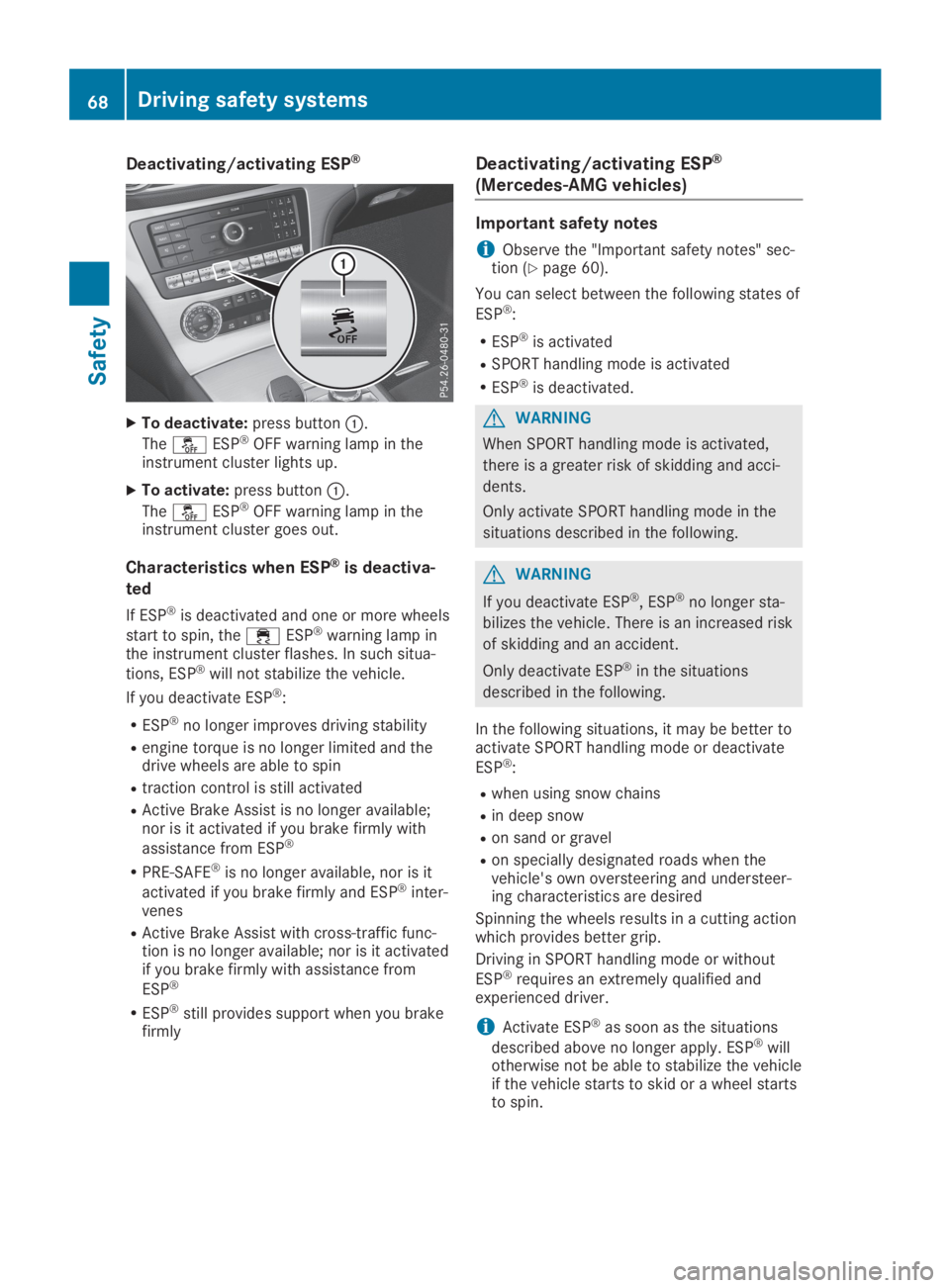
Deactivating/activating ESP®
XTo deactivate:press buttonC.
The
Page 71 of 330

!Avoid spinning the driven wheels for an
extended period with ESP®deactivated. Youcould otherwise damage the drivetrain.
Deactivating/activating ESP®
XTo activate SPORT handling mode:brieflypress buttonC.ThetSPORT handling mode warninglamp in the instrument cluster lights up. TheSPORT Handling ModeSPORT Handling Modemessage appears inthe multifunction display.
XTo deactivate SPORT handling mode:briefly press buttonC.ThetSPORT handling mode warninglamp in the instrument cluster goes out.
XTo deactivate ESP®:press buttonCuntil
the
Page 72 of 330

tics. Have the brake system checked at a
qualified specialist workshop.
Observe information regarding indicator andwarning lamps (Ypage 236) as well as displaymessages (Ypage 208).
ADAPTIVE BRAKE
iObserve the "Important safety notes" sec-tion (Ypage 60).
ADAPTIVE BRAKE enhances braking safety andoffers increased braking comfort. In additionto the braking function, ADAPTIVE BRAKE alsohas the HOLD function (Ypage 165) and hillstart assist (Ypage 129).
Active Brake Assist with cross-traffic
function
General information
Active Brake Assist with cross-traffic functioncan help you to minimize the risk of a collisionwith the vehicle in front or a pedestrian. ActiveBrake Assist with cross-traffic function canalso reduce the effects of such a collision. IfActive Brake Assist with cross-traffic functionhas detected a risk of collision, you will bewarned visually and acoustically as well as byautomatic braking.
iPay attention to the important safety notesin the "Driving safety systems" section(Ypage 60).
Active Brake Assist with cross-traffic functionis only available in vehicles with the DrivingAssistance Plus package.
For Active Brake Assist with cross-traffic func-tion to assist you when driving, the radar sen-sor system and the camera system must beoperational.
The radar sensor system and camera systemhelp Active Brake Assist with cross-trafficfunction to detect obstacles that are in thepath of your vehicle for an extended period oftime.
In addition, pedestrians in the path of yourvehicle can be detected.
Active Brake Assist with cross-traffic functiondetects pedestrians using typical characteris-
tics such as body contours and the posture ofa person standing upright.
iObserve the restrictions described in the"Important safety notes" section(Ypage 70).
Important safety notes
GWARNING
Active Brake Assist with cross-traffic func-
tion will initially brake your vehicle by a par-
tial application of the brakes if a danger of
collision is detected. There may be a colli-
sion unless you brake yourself. Even after
subsequent full application of the brakes a
collision cannot always be avoided, particu-
larly when approaching at too high a speed.
There is a risk of an accident.
Always apply the brakes yourself and try to
take evasive action, provided it is safe to do
so.
If you partially apply the brakes, the vehicle isbraked with up to 50% of the full braking force.
GWARNING
Active Brake Assist with cross-traffic func-
tion cannot always clearly identify objects
and complex traffic situations.
In such cases, Active Brake Assist with
cross-traffic function might:
Rgive an unnecessary warning and then
brake the vehicle
Rneither give a warning nor intervene
There is a risk of an accident.
Always pay particular attention to the traffic
situation and be prepared to brake, espe-
cially if Active Brake Assist with cross-traffic
function alerts you. Terminate the interven-
tion in a non-critical driving situation.
GWARNING
Active Brake Assist with cross-traffic func-
tion cannot always clearly identify people,
particularly if they are moving. Active Brake
Assist with cross-traffic function cannot
70Driving safety systems
Safety
Page 73 of 330
intervene in these cases. There is a risk of
an accident.
Always pay particular attention to the traffic
situation and be prepared to brake, espe-
cially if Active Brake Assist with cross-traffic
function alerts you.
In order to maintain the appropriate distanceto the vehicle in front and thus prevent a colli-sion, you must apply the brakes yourself.
GWARNING
Active Brake Assist with cross-traffic func-
tion does not react:
Rto small people, e.g. children
Rto animals
Rto oncoming vehicles
Rwhen cornering
As a result, Active Brake Assist with cross-
traffic function may not warn you or engage
in all critical situations. There is a risk of an
accident.
Always pay careful attention to the traffic
situation and be ready to brake.
In the event of snowfall or heavy rain, the rec-ognition can be impaired.
Recognition by the radar sensor system is alsoimpaired if:
Rthere is dirt on the sensors or anything elsecovering the sensors
Rthere is interference by other radar sources
Rthere are strong radar reflections, for exam-ple in parking garages
Ra narrow vehicle is traveling in front, e.g. amotorbike
Ra vehicle is traveling in front on a differentline
Recognition by the camera system is alsoimpaired in the event of:
Rdirt on the camera or if the camera is cov-ered
Rglare on the camera system, e.g. from thesun being low in the sky
Rdarkness
Ror if:
-pedestrians move quickly, e.g. into thepath of the vehicle
-the camera system no longer recognizes apedestrian as a person due to specialclothing or other objects
-a pedestrian is concealed by otherobjects
-the typical outline of a pedestrian is notdistinguishable from the background
Following damage to the front end of the vehi-cle, have the configuration and operation ofthe radar sensors checked at a qualified spe-cialist workshop. This also applies to collisionsat slow speeds where there is no visible dam-age to the front of the vehicle.
Following damage to the windshield, have theconfiguration and operation of the camera sys-tem checked at a qualified specialist work-shop.
Function
XTo activate or deactivate:activate ordeactivate Active Brake Assist with cross-traffic function using the on-board computer(Ypage 198).When Active Brake Assist with cross-trafficfunction is deactivated, the