2019 MERCEDES-BENZ S CLASS warning
[x] Cancel search: warningPage 36 of 578

Seat belts
Protection providedbythe seat belt
Alwaysfastenyour seat belt correctlybeforestarting a journey.A seat belt can only providethe best level of protection if it isworncorrectly.
&WARNINGRisk of injuryor death duetoincorrectlyfastened seat belt
Ifthe seat belt is notworncorrectly, it can‐not performits intended protective function.
In addition, an incorrectlyfastened seat beltcan also cause injuries,forexample, intheevent of an accident or when braking orchanging direction suddenly.
#Always ensurethat allvehicle occu‐pants havetheir seat beltsfastenedcorrectly and are sitting properly.
Always observethe instructions aboutthe cor‐rect driver's seat position and adjustingthe seat(→page 92).
In orderforthe correctlywornseat belttopro‐videthe intended level of protection, eachvehi‐cle occupant must observethefollowing infor‐mation:
RThe seat belt must not be twisted and mustfit tightly and snugly acrossthe body.
RThe seat belt must berouted acrossthe cen‐ter ofthe shoulder and as low down acrossthe hips as possible.
RThe shoulder section ofthe seat belt shouldnottouchyour necknor berouted underyour arm or behindyour back.
RAvoidwearing bulky clothing, e.g. a wintercoat.
RPushthe lap belt down asfar as possibleacrossyour hips and pull tight withthe shoul‐der section ofthe belt. Neverroutethe lapbelt acrossyour abdomen.
RNeverroutethe seat belt across sharp, poin‐ted, abrasive or fragile objects.
ROnly one person should use each seat belt atany one time. Never allowbabies andchil‐drentotravel sitting onthe lap of anothervehicle occupant.
RNever secure objects with a seat belt iftheseat belt is also being usedbyone ofthevehicle's occupants. Always observetheinstructionsfor loadingthevehicle whensecuring objects, luggage or loads(→page121).
Also ensurethat no objects, e.g. a cushion,areever placed between a person andtheseat.
The seat belts onthefollowing seats are equip‐ped with a special seat beltretractor:
Rfront-passenger seat
RRear seats
Activate or deactivatethe special seatbeltretractor (→page53).
Ifchildren are traveling inthevehicle, be suretoobservethe instructions and safety notes on"Children inthevehicle" (→page 48).
34Occupant safety
Page 37 of 578

Reduced seat belt protection
&WARNINGRisk of injuryor death duetoincorrect seat position
The seat belt does not offerthe intendedlevel of protection ifyou havenot movedtheseat backresttoan almostvertical position.
When braking or intheevent of an accident,you could slide underneaththe seat belt andsustain abdominal or neck injuries,forexam‐ple.
#Adjustthe seat properlybefore begin‐ningyour journey.
#Always ensurethatthe seat backrest isin an almostvertical position andthatthe shoulder section ofyour seat belt isrouted acrossthe center ofyour shoul‐der.
&WARNINGRisk of injuryor death whenadditionalrestraint systems are not usedfor persons with a smaller build
Persons under 5ft(1.50 m)tall cannotwearthe seat belt correctly without a suitableadditionalrestraint system.
Ifthe seat belt is notworncorrectly, it can‐not performits intended protective function.In addition, an incorrectlyfastened seat beltcan also cause injuries,forexample, intheevent of an accident or when braking orchanging direction suddenly.
#Always secure persons under 5ft(1.50 m)tall in a suitablerestraint sys‐tem.
&WARNINGRisk of injuryor death duetoblocked seat belt buckle or seat beltanchorage
Objects nexttothe front seatthat blocktheseat belt buckle orthe moving seat beltanchorage onthe front seat impairthe func‐tion ofthe EmergencyTensioning Devices.
The EmergencyTensioning Devices can,then, not function as intended andthe seatbelt can no longer providethe intended pro‐tection.
#Beforestartingthe journey,make surethatthere are no objects aroundtheseat belt buckle or betweenthe frontseat and door.
&WARNINGRisk of injuryor death duetodamaged or modified seat belts
Seat belts cannotprovide protection inthefollowing situations:
RIfthe seat belts are damaged, modified,extremelydirty, bleached or dyed
RIfthe seat belt buckle is damaged orextremelydirty
RIfthe EmergencyTensioning Devices,seat belt anchorages or seat beltretrac‐torshavebeen modified
Seat belts may be damaged in an accident,althoughthe damage may not be visible, e.g.duetosplinters ofglass.
Occupant safety35
Page 38 of 578
Modified or damaged seat belts maytear orfail, e.g. in an accident.
Modified EmergencyTensioning Devices canaccidentally trigger orfailtofunction asintended.
#Never modifythe seat belts, EmergencyTensioning Devices, seat belt ancho‐rages or seat beltretractors.
#Makesurethatthe seat belts areundamaged, notwornand clean.
#Always havethe seat beltscheckedimmediately after an accident at aqualified specialistworkshop.
Only use seat belts which havebeen approvedforyourvehiclebyMercedes-Benz.
&WARNINGRisk of injuryor death fromdeployedpyrotechnic EmergencyTen‐sioning Devices
Pyrotechnic EmergencyTensioning Devicesthat havebeen deployed are no longer opera‐tional and are unabletoperformtheir inten‐ded protective function.
#Therefore, havedeployedpyrotechnicEmergencyTensioning Devices immedi‐atelyreplaced at aqualified specialistworkshop.
Mercedes-Benzrecommendsthatyou havethevehicletowedtoaqualified specialistworkshopafter an accident.
*NOTEDamagecausedbytrappingtheseat belt
If an unused seat belt is not fullyretracted, itmay become trapped inthe door or intheseat mechanism.
#Always ensurethat an unused seat beltis fullyretracted.
Information onthe belt airbag intherearseat belt
The BELTBAGidentification indicatesthat arearseat belt is equipped with a belt airbag.
When activated,the belt airbag increasestheprotected area ofthevehicle occupant'sribcage.
&WARNINGRisk of injuryor deaththroughthe use of a non-approvedchildrestraint system
In an accident,the belt air bag may damagea non-approved or non-authorizedchildrestraint system.
As aresult,thechildrestraint system maynot be abletoprovidethe intended level ofprotection.
#Therefore, always useLATCH orLATCH-type (ISOFIX)tofasten achild seatequipped with an integratedrestraintsystem.
#Forvehicles equipped withthe optionalrear seat-belt air bags ("beltbag"), onlyuse a Mercedes-Benz approved boosterseat with integrated backrest.
#Never use an air bag equipped seat belttofasten a front orrear-facingchildseat or a non-approved booster seat.
#Please contact an authorized Mercedes-Benz Centerfor information onapprovedchildrestraint systems.
36Occupant safety
Page 40 of 578
Function oftherear seat belt buckleextender
The seat belt buckleextenderforthe outerrearseats makes it easiertofastenthe seat belt.Always ensurethatthe seat belt buckle can beextended andretracted freely.
Afterthe seat belt isfastened,the seat beltbucklereturnstoits normal position. The seatbeltthen lies tightly acrossthe lap andthoraxareas.
Releasing seat belts
#Presstherelease button inthe seat beltbuckle and guidethe seat belt back withtheseat belttongue.
Activating/deactivating seat belt adjustmentvia the multimedia system
Multimedia system:
,Vehicle.îVehicle Settings.Belt
Adjustment
#Activatesor deactivateSthe function.
Seat beltwarning functionfor the driver andfront passenger
The
Page 41 of 578

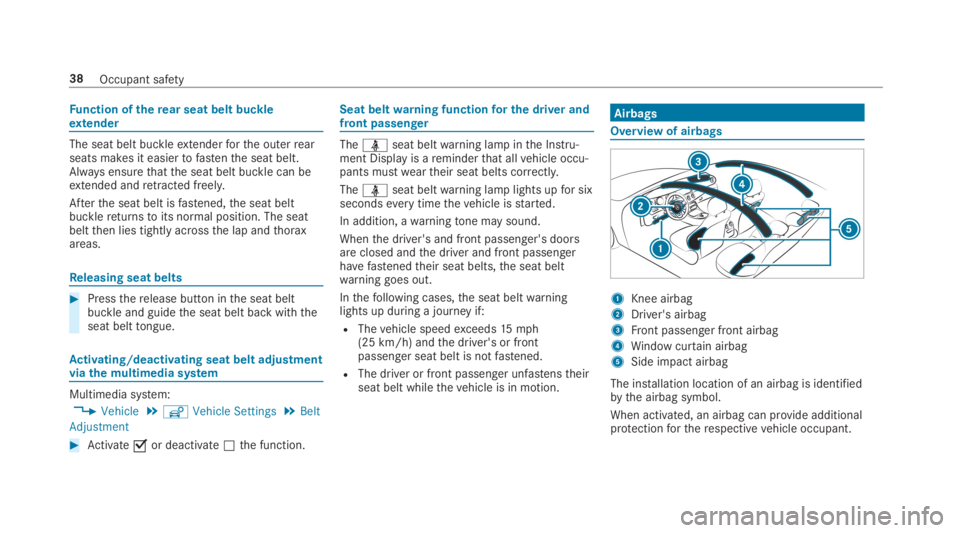
Potential protection from each airbag:
AirbagPotential protectionfor…
Knee airbag Thigh, knee and lower leg
Driver's airbag,front passengerfront airbag
Head andribcage
Window curtainairbagHead
Side impact air‐bagRibcage, also pelvisforfront seat occupants
The front passenger front airbag can only bedeployed in an accident ifthePASSENGER AIRBAG OFF indicator lamp is off. Ifthe frontpassenger seat is occupied, make sure, bothbefore and duringthe journey,thatthestatus ofthe front passenger front airbag is correct(→page43).
*NOTEImportant pointstoremember ifthe front passenger seat is unoccupied
In an accident,the components oftherestraint system may deploy unnecessarilyonthe front passenger side if:
RThere are heavy objects onthe frontpassenger seat.
RThe seat belttongue is engaged intheseat belt buckle ofthe front passengerseat andthe front passenger seat isunoccupied.
#Stowobjects in a suitable place.
#Only one person should use each seatbelt at any one time.
Cushionbag intherecliningrear seatIfthe seat backrest inclination is significant,thecushionbag provides additional occupant protec‐tion intheevent of a frontal impact. When acti‐vated,the cushionbag deploysunderthe seatcushion. This helps preventthevehicle occupantfrom slipping offthe seat cushion.
Ifyou install achildrestraint system ontherecliningrear seat, always observethe additionalnotes (→page 48).
Protectionbythe airbags
Depending onthe accident situation, an airbagmay supplementthe protection offeredbya cor‐rectlyfastened seat belt.
&WARNINGRisk of injuryor death duetoincorrect seat position
Ifyou deviate fromthe correct seat position,the air bag cannotperformits intended pro‐tective function and deployment mayevencause further injuries.
Toavoid hazardous situations, always makesurethat allvehicle occupants:
RHavetheir seat beltfastened correctly,including pregnantwomen.
RAre seated properlyandthat distancetothe air bags is as largeas possible.
RObservethefollowing information.
Occupant safety39
Page 42 of 578

#Always make surethatthere are noobjects betweenthe air bag andthevehicle occupant.
Toavoidtherisksresulting fromthe deploymentof an airbag, eachvehicle occupant mustobservethefollowing information:
RBeforestartingyour journey,adjustyour seatcorrectly;the driver's seat and front-passenger seat should be moved asfar backas possible.
When doing so, always observethe informa‐tion onthe correct driver's seat position(→page92).
ROnly holdthesteering wheelbythesteeringwheelrim. This allowsthe airbagtobe fullydeployed.
RAlways lean againstthe seat backrest whenthevehicle is in motion. Do not leanforwardsor againstthe door or side window.You mayotherwise be inthe deployment area oftheairbags.
RAlwayskeepyourfeetonthefloor. Do notputyourfeetonthe cockpit,forexample.
Yourfeetmayotherwise be inthe deploy‐ment area ofthe airbag.
RIfchildren are traveling inthevehicle,observethe additional notes (→page 48).
RAlwaysstowand secure objects correctly.
Objects inthevehicle interior may prevent anairbag from functioning correctly. Eachvehicleoccupant must always make sure ofthefollow‐ing:
RThere are no people, animals or objectsbetweenthevehicle occupants and an air‐bag.
RThere are no objects betweenthe seat, doorand door pillar (B-pillar).
RThere are no hard objects, e.g. coat hangers,hanging onthe grab handles or coat hooks.
RThere are no accessory parts, such as PNDs(PersonalNavigation Devices), mobilephones or cup holders attachedtothevehi‐cle withinthe deployment area of an airbag,e.g. onthe cockpit, on doors, side windowsor side paneling.
In addition, no connecting cable,tensioningstrap orretainingstrap may beroutedthrough or attached inthe deployment areaof an airbag. Always observethe accessorymanufacturer's installation instructions, inparticularthe information on suitable placesfor installation.
RThere are no heavy, sharp-edged or fragileobjects inthe pockets ofyour clothing.Storesuch objects in a suitable place.
Limited protection from airbags
&WARNINGRisk of injuryduetomodifi‐cationstothe airbag cover
Ifyou modifythe cover of an airbag or affixobjects such asstickerstoit,the airbag mayno longer function correctly.
#Never modifythe cover of an airbag anddo not affix objectstoit.
The installation location of an airbag is identifiedbythe AIRBAGsymbol (→page 38).
40Occupant safety
Page 43 of 578
&WARNINGRisk of injuryor death duetothe use of unsuitable seat covers
Unsuitable seat coverscan obstruct or pre‐ventthe deployment of air bags integratedintothe seats.
Consequently,the air bags cannotprotectvehicle occupants astheyare designedtodo. In addition, operation ofthe automaticfront passenger air bag shutoff may berestricted.
#You should onlyuse seat coversthathavebeen approvedforthe correspond‐ing seatsbyMercedes-Benz.
&WARNINGRisk of injuryduetomalfunc‐tions ofthe sensors inthe door paneling
Sensorstocontrolthe airbags are located inthe doors. Modifications orworknot per‐formed correctlytothe doors or door panel‐ing, aswell as damaged doors, can leadtothe function ofthe sensors being impaired.The airbags mighttherefore not functionproperlyany more.
Consequently,the airbags cannotprotectvehicle occupants astheyare designedtodo.
#Never modifythe doors or parts ofthedoors.
#Always haveworkonthe doors or doorpaneling carried out at aqualified spe‐cialistworkshop.
&WARNINGRisk of injuryduetodeployedairbag
A deployed airbag no longer has a protectivefunction and cannotprotect as intended intheevent of an accident.
#Havethevehicletowedtoaqualifiedspecialistworkshop in ordertohavethedeployed airbagreplaced.
Havedeployed airbagsreplaced immediately.
Status ofthe front passenger front airbag
Function ofthe automatic front passengerfront airbag shutoffThe automatic front passenger front airbag shut‐off is abletodetect whetherthe front passengerseat is occupiedbya person or achildrestraintsystem. The front passenger front airbag is ena‐bled or disabled accordingly.
When installing achildrestraint system onthefront passenger seat, always make sure ofthefollowing:
REnsurethatthechildrestraint system is posi‐tioned correctly (→page47).
RAlways observethechildrestraint systemmanufacturer's installation instructions.
RNever place objects, e.g. cushions, under orbehindthechildrestraint system.
RFullyretractthe seat cushion length adjust‐ment.
RThe entire base ofthechildrestraint systemmust alwaysrestonthe seat cushion ofthefront passenger seat.
Occupant safety41
Page 44 of 578

RThe backrest oftheforward-facingchildrestraint system must lie asflat as possibleagainstthe backrest ofthe front passengerseat.
RThechildrestraint system must nottouchtheroof or be put understrainbythe headrestraints.Adjustthe seat backrest inclina‐tion andthe headrestraint setting accord‐ingly.
&WARNINGRisk of injuryor death duetoobjects betweenthe sitting surface andthechildrestraint system
Objects betweenthe sitting surface andthechildrestraint system could affectthe func‐tion ofthe automatic front passenger airbagshutoff.
This couldresult inthe front passenger air‐bag not functioning as intended during anaccident.
#Do not place any objects betweenthesitting surface andthechildrestraintsystem.
#The entire base ofthechildrestraintsystem must alwaysrestonthe sittingsurface ofthe front passenger seat.
#The backrest oftheforward-facingchildrestraint system must, asfar as possi‐ble, beresting onthe seat backrest ofthe front passenger seat.
#Always comply withthechildrestraintsystem manufacturer's installationinstructions.
A person onthe front passenger seat mustobservethefollowing information:
RFasten seat belts correctly (→page34).
RSit in an almost upright seat position withtheir back againstthe seat backrest.
RSit withtheirfeetresting onthefloor, if pos‐sible.
The front passenger front airbag mayotherwisebe disabledbymistake,forexample inthefol‐lowing situations:
RThe front passenger transferstheirweightbysupportingthemselves on avehicle armrest.
RThe front passenger sits in such awaythattheirweight israised fromthe sitting sur‐face.
&WARNINGRisk of injuryor death duetodeactivated front passenger airbag
IfthePASSENGER AIRBAG OFF indicatorlamp is lit,the front passenger airbag is disa‐bled. It will not be deployed intheevent ofan accident and cannotperformits intendedprotective function.
A person inthe front passenger seat couldthen,forexample, come into contact withthevehicle interior, especially ifthe person issittingtoo closetothe cockpit.
Ifthe front passenger seat is occupied,always ensurethat:
RThe classification ofthe person inthefront passenger seat is correct andthefront passenger airbag is enabled or disa‐bled in accordance withthe person inthefront passenger seat.
42Occupant safety