2019 MERCEDES-BENZ GLC engine
[x] Cancel search: enginePage 29 of 370
Protecting the environment
General notes
HEnvironmental note
Daimler's declared policy is one of compre-
hensive environmental protection.
The objectives are for the natural resources
that form the basis of our existence on this
planet to be used sparingly and in a manner
that takes the requirements of both nature
and humanity into account.
You too can help to protect the environment
by operating your vehicle in an environmen-
tally responsible manner.
Fuel consumption and the rate of engine,
transmission, brake and tire wear are affected
by these factors:
Roperating conditions of your vehicle
Ryour personal driving style
You can influence both factors. You should
bear the following in mind:
Operating conditions:
Ravoid short trips as these increase fuel con-
sumption.
Ralways make sure that the tire pressures
are correct.
Rdo not carry any unnecessary weight.
Rremove roof racks once you no longer need
them.
Ra regularly serviced vehicle will contribute
to environmental protection. You should
therefore adhere to the service intervals.
Ralways have service work carried out at a
qualified specialist workshop.
Personal driving style:
Rdo not depress the accelerator pedal when
starting the engine.
Rdo not warm up the engine when the vehicle
is stationary.
Rdrive carefully and maintain a safe distance
from the vehicle in front.
Ravoid frequent, sudden acceleration and
braking.
Rchange gear in good time and use each gear
only up to
Page 31 of 370
vehicle occupants while driving and thisdefect has already been repaired at leasttwice and Mercedes-Benz, LLC has beeninformed in writing of the necessity of arepair.
(2) the defect or malfunction, though less seri-ous than (1) above, has already beenrepaired at least four times and Mercedes-Benz has been informed in writing of thenecessity of a repair.
(3) the vehicle cannot be used for longer than30 calendar days because of repair workresulting from this or other substantialdefects or malfunctions.
Please send your written notice to:
Mercedes-Benz USA, LLC
Customer Assistance Center
3 Mercedes Drive
Montvale, NJ 07645-0350
Maintenance
Always bring the Maintenance Booklet with youwhen taking the vehicle to an authorizedMercedes-Benz Center. Your customer serviceadvisor will enter every service into your Main-tenance Booklet on your behalf.
Roadside Assistance
The Mercedes-Benz Roadside Assistance Pro-gram offers technical help in the event of abreakdown. Calls to the toll-free Roadside Assis-tance Hotline are answered by our agents 24hours a day, 365 days a year.
1-800-FOR-MERCedes (1-800-367-6372)(USA)
1-800-387-0100 (Canada)
For additional information, refer to theMercedes-Benz Roadside Assistance Programbrochure (USA) or the "Roadside Assistance"section in the Service and Warranty Booklet(Canada). You will find both in the vehicle docu-ment wallet.
Change of address or change of own-
ership
In the event of a change of address, please sendus the "Notification of Address Change" in the
Service and Warranty Booklet or simply call theMercedes-Benz Customer Assistance Center(USA) at the hotline number1-800-FOR-MERCedes (1-800-367-6372) orCustomer Service Center (Canada) at1-800-387-0100. This will assist us in contact-ing you in a timely manner should the need arise.
If you sell your Mercedes, please leave all liter-ature in the vehicle so that it is available to thenext owner.
If you have purchased a used car, please send usthe "Notification of Used Car Purchase" in theService and Warranty Booklet or simply call theMercedes-Benz Customer Assistance Center(USA) at the hotline number1-800-FOR-MERCedes (1-800-367-6372) orCustomer Service (Canada) at 1-800-387-0100.
Vehicle operation outside the USA
and Canada
When you are abroad with your vehicle, observethe following points:
RService facilities or replacement parts maynot be readily available.
RLead-free fuel for vehicles with a catalyticconverter may not be available. Leaded fuelcan cause damage to the catalytic converter.
RThe fuel may have a considerably loweroctane number. Unsuitable fuel can causeengine damage.
Some Mercedes-Benz models are available fordelivery in Europe through our European Deliv-ery Program. For details, consult an authorizedMercedes-Benz Center or write to one of thefollowing addresses.
In the USA
Mercedes-Benz USA, LLC
European Delivery Department
One Mercedes Drive
Montvale, NJ 07645-0350
In Canada
Mercedes-Benz Canada, Inc.
European Delivery Department
98 Vanderhoof Avenue
Toronto, Ontario M4G 4C9
Service and vehicle operation29
Introduction
Z
Page 33 of 370
Diagnostics connection
The diagnostics connection is only intended forthe connection of diagnostic equipment at aqualified specialist workshop.
GWARNING
If you connect equipment to a diagnostics
connection in the vehicle, it may affect the
operation of vehicle systems. As a result, the
operating safety of the vehicle could be affec-
ted. There is a risk of an accident.
Only connect equipment to a diagnostics con-
nection in the vehicle, which is approved for
your vehicle by Mercedes-Benz.
GWARNING
Objects in the driver's footwell can restrict the
pedal travel or obstruct a depressed pedal.
The operating and road safety of the vehicle is
jeopardized. There is a risk of an accident.
Make sure that all objects in the vehicle are
stowed correctly, and that they cannot enter
the driver's footwell. Install the floormats
securely and as specified in order to ensure
sufficient clearance for the pedals. Do not use
loose floormats and do not place floormats on
top of one another.
!If the engine is switched off and equipmenton the diagnostics connection is used, thestarter battery may discharge.
Connecting equipment to the diagnostics con-nection can lead to emissions monitoring infor-mation being reset, for example. This may leadto the vehicle failing to meet the requirements ofthe next emissions test during the main inspec-tion.
Qualified specialist workshop
An authorized Mercedes-Benz Center is a quali-fied specialist workshop. It has the necessaryspecialist knowledge, tools and qualifications tocorrectly carry out the work required on yourvehicle. This is especially the case for work rel-evant to safety.
Observe the notes in the Maintenance Booklet.
Always have the following work carried out at anauthorized Mercedes-Benz Center:
Rwork relevant to safety
Rservice and maintenance work
Rrepair work
Ralterations, installation work and modifica-tions
Rwork on electronic components
Correct use
If you remove any warning stickers, you or oth-ers could fail to recognize certain dangers.Leave warning stickers in position.
Observe the following information when drivingyour vehicle:
Rthe safety notes in this manual
Rtechnical data for the vehicle
Rtraffic rules and regulations
Rlaws and safety standards pertaining to motorvehicles
Problems with your vehicle
If you should experience a problem with yourvehicle, particularly one that you believe mayaffect its safe operation, we urge you to contactan authorized Mercedes-Benz Center immedi-ately to have the problem diagnosed and recti-fied. If the problem is not resolved to your sat-isfaction, please discuss the problem again withan authorized Mercedes-Benz Center or, if nec-essary, contact us at one of the followingaddresses.
In the USA
Customer Assistance Center
Mercedes-Benz USA, LLC
3 Mercedes Drive
Montvale, NJ 07645-0350
In Canada
Customer Relations Department
Mercedes-Benz Canada, Inc.
98 Vanderhoof Avenue
Toronto, Ontario M4G 4C9
Reporting safety defects
USA only:
Operating safety31
Int roduction
Z
Page 46 of 370
Restraint system warning lamp
The functions of the restraint system arechecked after the ignition is switched on and atregular intervals while the engine is running.Therefore, malfunctions can be detected ingood time.
Theurestraint system warning lamp on theinstrument cluster lights up when the ignition isswitched on. It goes out no later than a few sec-onds after the vehicle is started. The compo-nents of the restraint system are in operationalreadiness.
A malfunction has occurred if theurestraintsystem warning lamp:
Rdoes not light up after the ignition is switchedon
Rdoes not go out after a few seconds with theengine running
Rlights up again while the engine is running
GWARNING
If the restraint system is malfunctioning,
restraint system components may be trig-
gered unintentionally or may not deploy as
intended during an accident. This can affect
for example the Emergency Tensioning
Device or the air bag. This poses an increased
risk of injury or even fatal injury.
Have the restraint system checked and
repaired in a qualified specialist workshop as
soon as possible.
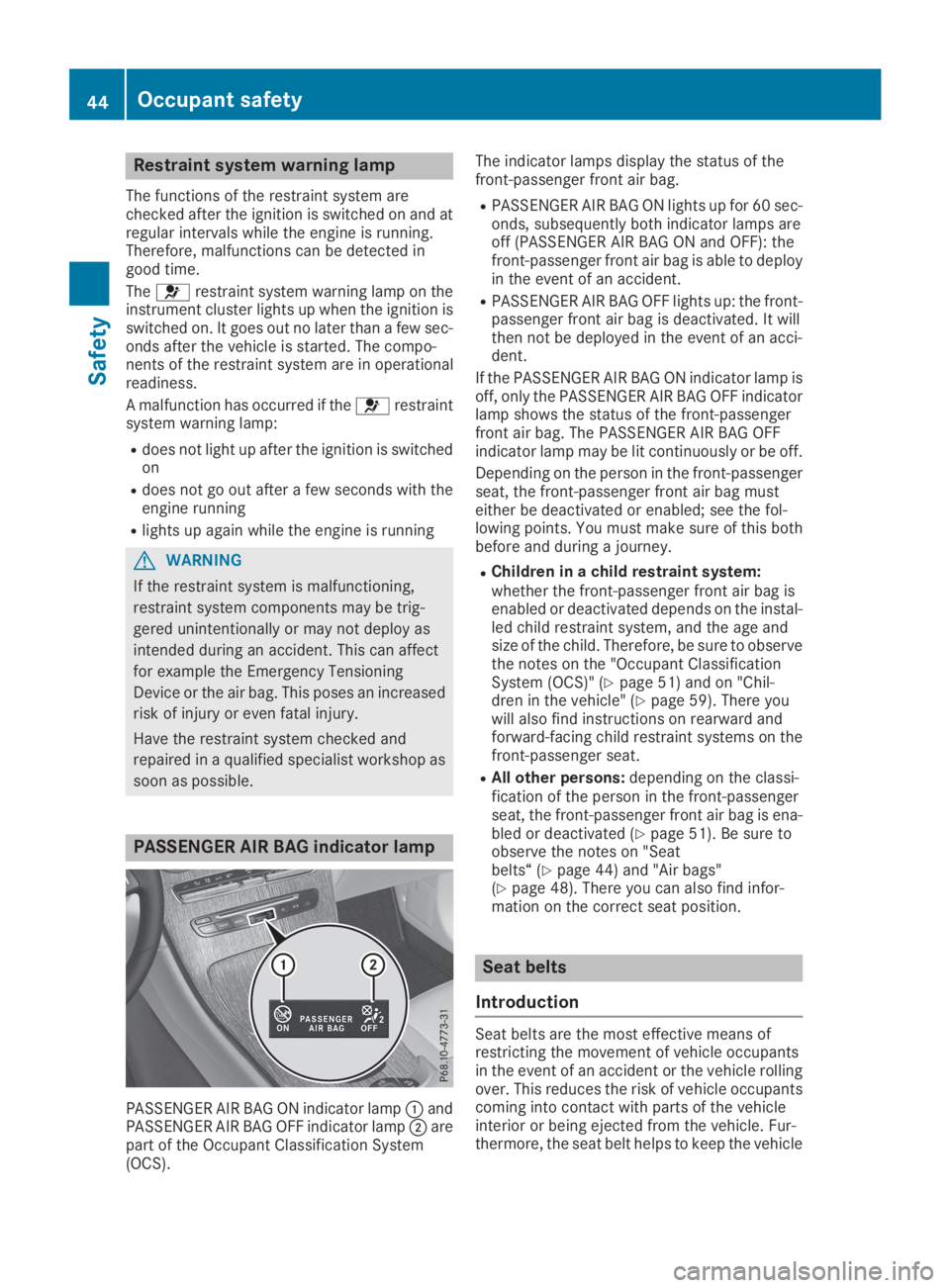
PASSENGER AIR BAG indicator lamp
PASSENGER AIR BAG ON indicator lampCandPASSENGER AIR BAG OFF indicator lampDarepart of the Occupant Classification System(OCS).
The indicator lamps display the status of thefront-passenger front air bag.
RPASSENGER AIR BAG ON lights up for 60 sec-onds, subsequently both indicator lamps areoff (PASSENGER AIR BAG ON and OFF): thefront-passenger front air bag is able to deployin the event of an accident.
RPASSENGER AIR BAG OFF lights up: the front-passenger front air bag is deactivated. It willthen not be deployed in the event of an acci-dent.
If the PASSENGER AIR BAG ON indicator lamp isoff, only the PASSENGER AIR BAG OFF indicatorlamp shows the status of the front-passengerfront air bag. The PASSENGER AIR BAG OFFindicator lamp may be lit continuously or be off.
Depending on the person in the front-passengerseat, the front-passenger front air bag musteither be deactivated or enabled; see the fol-lowing points. You must make sure of this bothbefore and during a journey.
RChildren in a child restraint system:whether the front-passenger front air bag isenabled or deactivated depends on the instal-led child restraint system, and the age andsize of the child. Therefore, be sure to observethe notes on the "Occupant ClassificationSystem (OCS)" (Ypage 51) and on "Chil-dren in the vehicle" (Ypage 59). There youwill also find instructions on rearward andforward-facing child restraint systems on thefront-passenger seat.
RAll other persons:depending on the classi-fication of the person in the front-passengerseat, the front-passenger front air bag is ena-bled or deactivated (Ypage 51). Be sure toobserve the notes on "Seatbelts“ (Ypage 44) and "Air bags"(Ypage 48). There you can also find infor-mation on the correct seat position.
Seat belts
Introduction
Seat belts are the most effective means ofrestricting the movement of vehicle occupantsin the event of an accident or the vehicle rollingover. This reduces the risk of vehicle occupantscoming into contact with parts of the vehicleinterior or being ejected from the vehicle. Fur-thermore, the seat belt helps to keep the vehicle
44Occupant safety
Safety
Page 50 of 370
The seat belt adjustment will apply a certaintightening force if any slack is detected betweenthe vehicle occupant and the seat belt. Do notgrab hold of the seat belt.
You can switch the seat belt adjustment on andoff using the multimedia system. Information onswitching the seat belt adjustment on and offcan be found in the Digital Operating Instruc-tions.
Belt warning for the driver and front
passenger
Thevseat belt warning lamp in the instru-ment cluster is a reminder that all vehicle occu-pants must wear their seat belts. It may light upcontinuously or flash. In addition, there may bea warning tone.
Regardless of whether the driver's seat belt hasalready been fastened, thevseat belt warn-ing lamp lights up for six seconds each time theengine is started. If the front doors are closedand the driver's or front-passenger seat belt hasnot been fastened, thevseat belt warninglamp lights up again after the six seconds. Assoon as the driver's and front-passenger seatbelts are fastened or a front door is openedagain, thevseat belt warning lamp goes out.
If the driver's seat belt is not fastened after theengine is started, an additional warning tone willsound. The warning tone switches off after sixseconds or once the driver's seat belt is fas-tened.
If the vehicle's speed exceeds 15 mph(25 km/h)once and the driver's and front-passenger seat belts are not fastened, a warningtone sounds. A warning tone also sounds withincreasing intensity for 60 seconds or until thedriver or front passenger have fastened theirseat belts.
If the driver or front passenger unfasten theirseat belts during the journey, the seat belt warn-ing is activated again.
Air bags
Introduction
The installation point of an air bag can be rec-ognized by the AIRBAG marking.
An air bag complements the correctly fastenedseat belt. It is no substitute for the seat belt. The
air bag provides additional protection in appli-cable accident situations.
Not all air bags are deployed in an accident. Thedifferent air bag systems function independ-ently from one another (Ypage 55).
However, no system available today can com-pletely eliminate injuries and fatalities.
It is also not possible to rule out a risk of injurycaused by an air bag due to the high speed atwhich the air bag must be deployed.
Important safety notes
GWARNING
If you do not sit in the correct seat position,
the air bag cannot protect as intended and
could even cause additional injury when
deployed. This poses an increased risk of
injury or even fatal injury.
To avoid hazardous situations, always make
sure that all of the vehicle's occupants:
Rhave fastened their seat belts correctly,
including pregnant women
Rare sitting correctly and maintain the great-
est possible distance to the air bags
Rfollow the following instructions
Always make sure that there are no objects
between the air bag and the vehicle's occu-
pants.
RAdjust the seats properly before beginningyour journey. Always make sure that the seatis in an almost upright position. The center ofthe head restraint must support the head atabout eye level.
RMove the driver's and front-passenger seatsas far back as possible. The driver's seat posi-tion must allow the vehicle to be driven safely.
ROnly hold the steering wheel on the outside.This allows the air bag to be fully deployed.
RAlways lean against the backrest while driv-ing. Do not lean forward or lean against thedoor or side window. You may otherwise be inthe deployment area of the air bags.
RAlways keep your feet in the footwell in frontof the seat. Do not put your feet on the dash-
48Occupant safety
Safety
Page 60 of 370

PRE-SAFE®takes the following measuresdepending on the hazardous situation detected:
Rthe front seat belts are pre-tensioned.
Rif the vehicle skids, the side windows and thesliding sunroof are closed.
Rvehicles with the memory function for thefront-passenger seat: the front-passengerseat is adjusted if it is in an unfavorable posi-tion.
If the hazardous situation passes without result-
ing in an accident, PRE-SAFE®slackens the belt
pre-tensioning. All settings made by PRE-SAFE®
can then be reversed.
If the seat belt pre-tensioning is not reduced:
XMove the seat backrest or seat back slightlywhen the vehicle is stationary.The seat belt pre-tensioning is reduced andthe locking mechanism is released.
The seat-belt adjustment is an integral part of
the PRE-SAFE®convenience function. Informa-tion about the convenience function can befound under "Belt adjustment" (Ypage 47).
PRE-SAFE®PLUS (anticipatory occu-
pant protection system PLUS)
Introduction
PRE-SAFE®PLUS is only available in vehicleswith the Driving Assistance package.
Using the radar sensor system, PRE-SAFE®
PLUS is able to detect that a frontal or rear-endcollision is imminent. In certain hazardous sit-
uations, PRE-SAFE®PLUS takes pre-emptivemeasures to protect the vehicle occupants.
Important safety notes
The intervention of PRE-SAFE®PLUS cannotprevent an imminent collision.
The driver is not warned about the intervention
of PRE-SAFE®PLUS.
PRE-SAFE®PLUS does not intervene:
Rif the vehicle is backing up
Rwhen the vehicle is towing a trailer and thereis a risk of a rear-end collision
When driving, or when parking or exiting a park-ing space using Active Parking Assist, PRE-
SAFE®PLUS will not apply the brakes.
Function
PRE-SAFE®PLUS intervenes in certain situa-tions if the radar sensor system detects animminent frontal or rear-end collision.
PRE-SAFE®PLUS takes the following measuresdepending on the hazardous situation detected:
Rif the radar sensor system detects that ahead-on collision is imminent, the seat beltsare pre-tensioned.
Rif the radar sensor system detects that a rear-end collision is imminent:
-the brake pressure is increased if the driverapplies the brakes when the vehicle is sta-tionary.
-the seat belts are pre-tensioned.
The PRE-SAFE®PLUS braking application is can-celed:
Rif the accelerator pedal is depressed when agear is engaged
Rif the risk of a collision passes or is no longerdetected
Rif Active Distance Assist DISTRONIC indicatesan intention to intervene
If the hazardous situation passes without result-ing in an accident, the original settings arerestored.
Automatic measures after an acci-
dent
Immediately after an accident, the followingmeasures are implemented, depending on thetype and severity of the impact:
Rthe hazard warning lamps are switched on
Rthe emergency lighting is activated
Rthe vehicle doors are unlocked
Rthe front side windows are lowered
Rvehicles with a memory function: the electri-cally adjustable steering wheel is raised whenthe driver's door is opened
Rthe engine is switched off and the fuel supplyis cut off
Rvehicles with mbrace: automatic emergencycall
58Occupant safety
Safety
Page 61 of 370
Children in the vehicle
Important safety notes
Accident statistics show that children securedin the rear seats are safer than children securedin the front-passenger seat. For this reason,Mercedes-Benz strongly advises that you installa child restraint system on a rear seat. Childrenare generally better protected there.
If a child younger than twelve years old andunder 5 ft (1.50 m) in height is traveling in thevehicle:
Ralways secure the child in a child restraintsystem suitable for Mercedes-Benz vehicles.The child restraint system must be appropri-ate to the age, weight and size of the child.
Rbe sure to observe the instructions and safetynotes in this section in addition to the childrestraint system manufacturer's installationinstructions.
Ralways observe the instructions and safetynotes on the "Occupant classification system(OCS)". (Ypage 51)
GWARNING
If you leave children unsupervised in the vehi-
cle, they could set it in motion by, for example:
Rrelease the parking brake.
Rshift the automatic transmission out of the
parking positionP.
Rstart the engine.
In addition, they may operate vehicle equip-
ment and become trapped. There is a risk of
an accident and injury.
When leaving the vehicle, always take the
SmartKey with you and lock the vehicle. Never
leave children unsupervised in the vehicle.
GWARNING
If persons, particularly children are subjected
to prolonged exposure to extreme heat or
cold, there is a risk of injury, possibly even
fatal. Never leave children unattended in the
vehicle.
GWARNING
If the child restraint system is subjected to
direct sunlight, parts may get very hot. Chil-
dren may burn themselves on these parts,
particularly on the metal parts of the child
restraint system. There is a risk of injury.
If you leave the vehicle, taking the child with
you, always ensure that the child restraint
system is not exposed to direct sunlight. Pro-
tect it with a blanket, for example. If the child
restraint system has been exposed to direct
sunlight, let it cool down before securing the
child in it. Never leave children unattended in
the vehicle.
Always ensure that all vehicle occupants havetheir seat belts fastened correctly and are sittingproperly. Particular attention must be paid tochildren.
Observe the safety notes on the seat belt(Ypage 45)and the notes on correct use of seatbelts (Ypage 46).
A booster seat may be necessary to achieveproper seat belt positioning for children over40 lbs(18 kg) until they reach a height where athree-point seat belt can be properly fastenedwithout a booster seat.
Special seatbelt retractor
GWARNING
If the seat belt is released while driving, the
child restraint system will no longer be
secured properly. The special seat belt retrac-
tor is disabled and the inertia real draws in a
portion of the seat belt. The seat belt cannot
be immediately refastened. There is an
increased risk of injury, possibly even fatal.
Stop the vehicle immediately, paying atten-
tion to road and traffic conditions. Reactivate
the special seat belt retractor and secure the
child restraint system properly.
All seat belts in the vehicle, except the driver'sseat belt, are equipped with a special seat beltretractor. When activated, the special seat beltretractor ensures that the seat belt cannotslacken once the child seat is secured.
Children in the vehicle59
Safety
Z
Page 65 of 370
You can thus avoid the risks that could arise asa result of:
Ran incorrectly categorized person in the front-passenger seat
Rdeactivating the front passenger front air bagunintentionally
Rthe unsuitable positioning of the childrestraint system, e.g. too close to the dash-board
Rearward-facing child restraint system
If circumstances require you to secure a child ina rearward-facing child restraint system on thefront-passenger seat, always make sure that thefront passenger front air bag is deactivated.Only if the PASSENGER AIR BAG OFF indicatorlamp is lit continuously (Ypage 44), is the frontpassenger front air bag deactivated.
Always observe the child restraint system man-ufacturer's installation and operating instruc-tions.
Forward-facing child restraint system
If it is absolutely necessary to install a forward-facing child restraint system on the front-passenger seat, always move the front-passenger seat as far back as possible. Fullyretract the seat cushion length. The entire baseof the child restraint system must always rest onthe seat cushion of the front-passenger seat.The backrest of the child restraint system mustlie as flat as possible against the backrest of thefront-passenger seat. The child restraint systemmust not touch the roof or be subjected to a loadby the head restraint. Adjust the angle of theseat backrest and the head restraint positionaccordingly. Always make sure that the shoul-der belt strap is correctly routed from the vehi-cle belt outlet to the shoulder belt guide on thechild restraint system. The shoulder belt strapmust be routed forward and down from the vehi-cle belt outlet. If necessary, adjust the vehiclebelt outlet and the front-passenger seat accord-ingly.
Always observe the child restraint system man-ufacturer's installation and operating instruc-tions.
Child-proof locks
Important safety notes
GWARNING
If children are traveling in the vehicle, they
could:
Ropen doors, thus endangering other people
or road users
Rexit the vehicle and be caught by oncoming
traffic
Roperate vehicle equipment and become
trapped
There is a risk of an accident and injury.
Always activate the child-proof locks and
override feature if children are traveling in the
vehicle. When leaving the vehicle, always take
the key with you and lock the vehicle. Never
leave children unattended in the vehicle.
Override feature for:
Rthe rear doors (Ypage 64)
Rthe rear side windows (Ypage 64)
GWARNING
If you leave children unsupervised in the vehi-
cle, they could set it in motion by, for example:
Rrelease the parking brake.
Rshift the automatic transmission out of the
parking positionP.
Rstart the engine.
In addition, they may operate vehicle equip-
ment and become trapped. There is a risk of
an accident and injury.
When leaving the vehicle, always take the
SmartKey with you and lock the vehicle. Never
leave children unsupervised in the vehicle.
GWARNING
If persons, particularly children are subjected
to prolonged exposure to extreme heat or
cold, there is a risk of injury, possibly even
fatal. Never leave children unattended in the
vehicle.
Children in the vehicle63
Safety
Z