2019 MERCEDES-BENZ GLC engine
[x] Cancel search: enginePage 208 of 370
When overtaking, pay particular attention to theextended length of your vehicle/trailer combi-nation.
Due to the length of the vehicle/trailer combi-nation, you require additional road space whenovertaking before you can change back to theoriginal lane.
If the automatic transmission repeatedly shiftsbetween gears on uphill or downhill gradients,shift to a lower gear.
Driving in a lower gear and at a reduced speeddecreases the risk of engine damage.
If the coolant temperature increases signifi-cantly when climate control is switched on,switch climate control off.
Coolant heat can also be dissipated by openingthe windows and switching the ventilationblower and the interior temperature to the high-est level.
Decoupling a trailer
GWARNING
If you uncouple a trailer with the overrun
brake engaged, you could trap your hand
between the vehicle and the trailer drawbar.
There is a risk of injury.
Do not uncouple a trailer if the overrun brake
is engaged.
GWARNING
Vehicles with level control:
The vehicle is lowered as soon as you discon-
nect the trailer cable. This could result in your
limbs or those of other people that are
between the vehicle body and tires or under-
neath the vehicle being trapped. There is a
risk of injury.
Make sure that nobody is in the immediate
vicinity of the wheel housings or under the
vehicle when you disconnect the trailer cable.
!Do not disconnect a trailer with an engagedoverrun brake. Otherwise, your vehicle couldbe damaged by the rebounding of the overrunbrake.
XApply the vehicle's parking brake manually.
XShift the transmission to position].
XClose all doors and the tailgate.
XSwitch off the engine.
XSecure the vehicle and trailer against rollingaway.
XRemove the trailer cable.
XRemove the safety chains, if there are any.
XUncouple the trailer.
Removing the ball coupling
XObserve the manufacturer's installationinstructions.
XPress the protective cap into the ball couplingrecess.
XMake sure that the protective cap is firmly inplace.
Observe the loading guidelines (Ypage 278)and the safety notes regarding stowage spaces(Ypage 278).
Information on cleaning and care of the trailertow hitch (Ypage 310).
Trailer power supply
!Accessories with a maximum power con-sumption of 180 W can be connected to thepermanent power supply.
You must not charge a trailer battery using thepower supply.
The trailer socket of your vehicle is equipped atthe factory with a permanent power supply.
The permanent power supply is supplied viatrailer socket pin 4.
The trailer's permanent power supply isswitched off in the event of low vehicle supplyvoltage and after six hours at the latest.
A qualified specialist workshop can providemore information about installing the trailerelectrics.
Permissible trailer loads and trailer
drawbar noseweights
Weight specifications
The gross trailer weight is calculated as theweight of the trailer plus the weight of the loadand the trailer's equipment.
206Towing a trailer
Driving and parking
Page 211 of 370
Tachometer
!Do not drive in the overrevving range, as thiscould damage the engine.
The red band in the tachometer indicates theengine's overrevving range.
The fuel supply is interrupted to protect theengine when the red band is reached.
Outside temperature display
You should pay special attention to road condi-tions when temperatures are around freezingpoint.
Bear in mind that the outside temperature dis-play indicates the temperature measured anddoes not record the road temperature.
The outside temperature display is in the multi-function display (Ypage 210).
Changes in the outside temperature are dis-played after a short delay.
Coolant temperature gage
GWARNING
Opening the hood when the engine is over-
heated or when there is a fire in the engine
compartment could expose you to hot gases
or other service products. There is a risk of
injury.
Let an overheated engine cool down before
opening the hood. If there is a fire in the
engine compartment, keep the hood closed
and contact the fire department.
!If the coolant temperature is too high, a dis-play message is shown.
If the coolant temperature display is in thearea marked in red, do not continue driving.Otherwise, the engine will be damaged.
The coolant temperature gauge is in the lowersection of the tachometer (Ypage 36).
Under normal operating conditions and at thecorrect coolant level, the display may rise to thered mark.
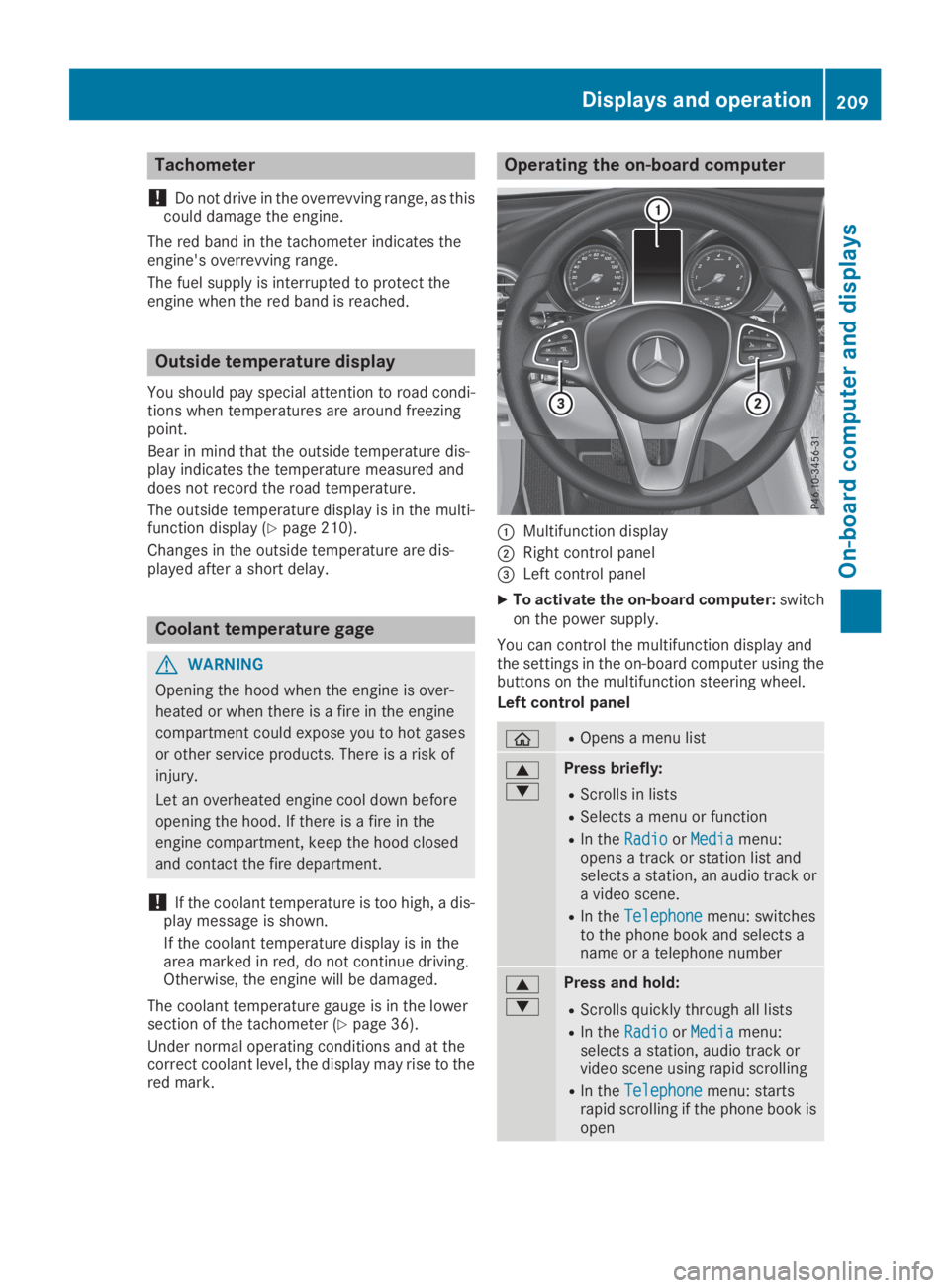
Operating the on-board computer
CMultifunction display
DRight control panel
Page 234 of 370
Display messagesPossible causes/consequences andPPSolutions
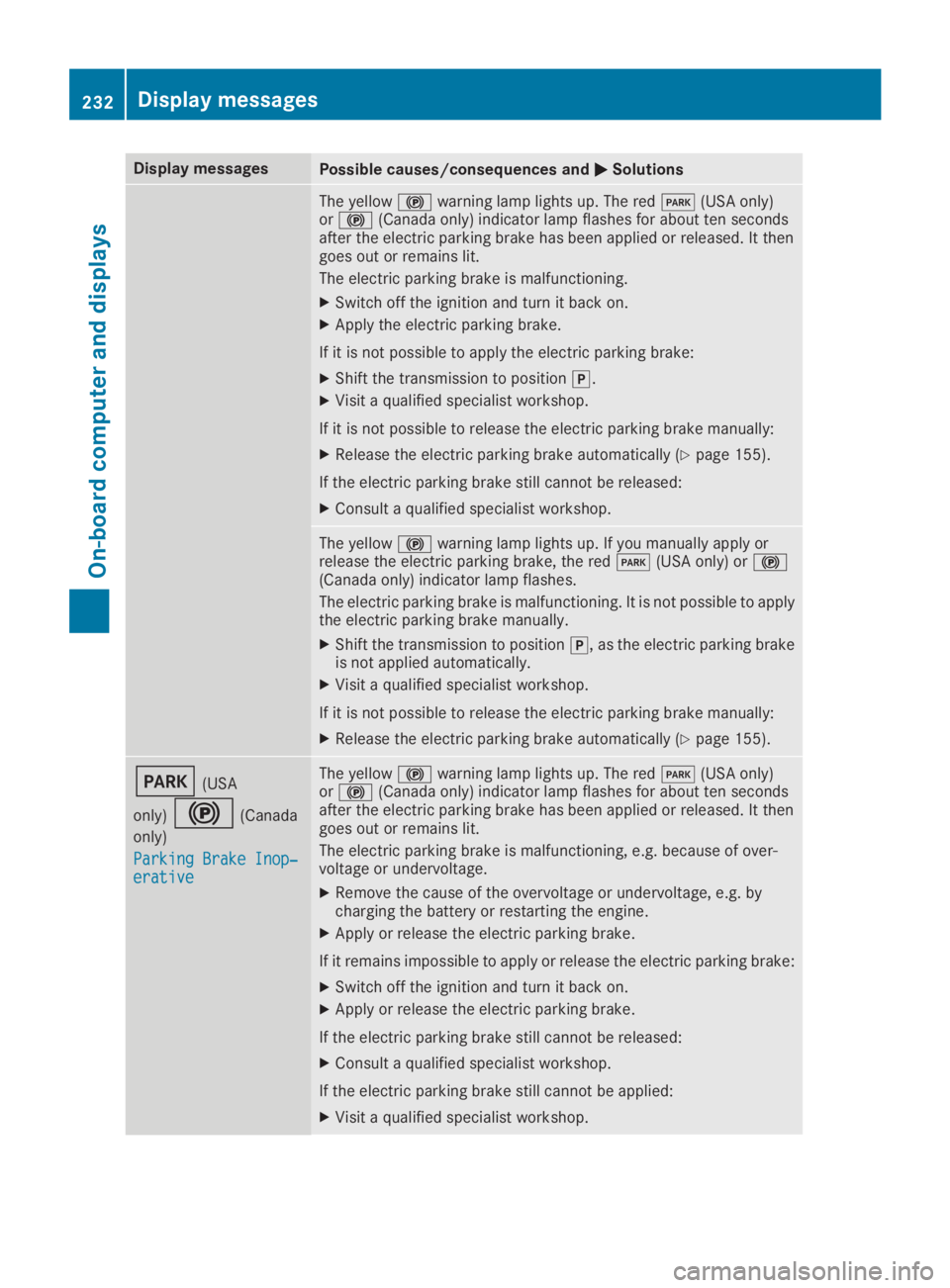
The yellow$warning lamp lights up. The redI(USA only)or$(Canada only) indicator lamp flashes for about ten secondsafter the electric parking brake has been applied or released. It thengoes out or remains lit.
The electric parking brake is malfunctioning.
XSwitch off the ignition and turn it back on.
XApply the electric parking brake.
If it is not possible to apply the electric parking brake:
XShift the transmission to position].
XVisit a qualified specialist workshop.
If it is not possible to release the electric parking brake manually:
XRelease the electric parking brake automatically (Ypage 155).
If the electric parking brake still cannot be released:
XConsult a qualified specialist workshop.
The yellow$warning lamp lights up. If you manually apply orrelease the electric parking brake, the redI(USA only) or$(Canada only) indicator lamp flashes.
The electric parking brake is malfunctioning. It is not possible to applythe electric parking brake manually.
XShift the transmission to position], as the electric parking brakeis not applied automatically.
XVisit a qualified specialist workshop.
If it is not possible to release the electric parking brake manually:
XRelease the electric parking brake automatically (Ypage 155).
I(USA
only)$(Canada
only)
Parking Brake Inop‐Parking Brake Inop‐erativeerative
The yellow$warning lamp lights up. The redI(USA only)or$(Canada only) indicator lamp flashes for about ten secondsafter the electric parking brake has been applied or released. It thengoes out or remains lit.
The electric parking brake is malfunctioning, e.g. because of over-voltage or undervoltage.
XRemove the cause of the overvoltage or undervoltage, e.g. bycharging the battery or restarting the engine.
XApply or release the electric parking brake.
If it remains impossible to apply or release the electric parking brake:
XSwitch off the ignition and turn it back on.
XApply or release the electric parking brake.
If the electric parking brake still cannot be released:
XConsult a qualified specialist workshop.
If the electric parking brake still cannot be applied:
XVisit a qualified specialist workshop.
232Displaymessages
On-b oard computer and displays
Page 235 of 370
Display messagesPossible causes/consequences andPPSolutions
The yellow$warning lamp lights up and the redI(USA only)or$(Canada only) indicator lamp flashes.
It is not possible to apply the electric parking brake manually.
XShift the transmission to position].
XVisit a qualified specialist workshop.
'(USA only)
M(Canada only)
Check Brake FluidCheck Brake FluidLevelLevel
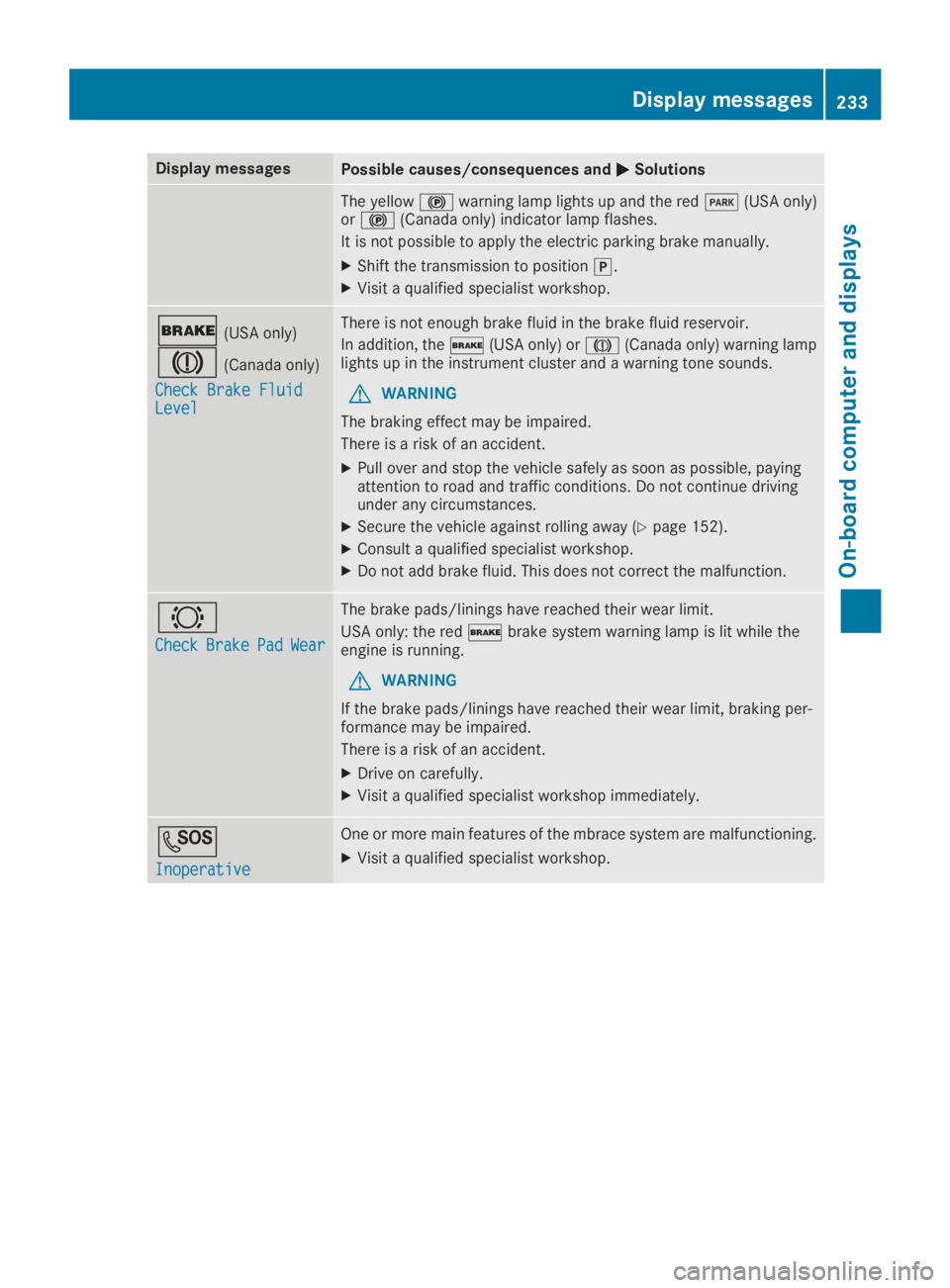
There is not enough brake fluid in the brake fluid reservoir.
In addition, the'(USA only) orM(Canada only) warning lamplights up in the instrument cluster and a warning tone sounds.
GWARNING
The braking effect may be impaired.
There is a risk of an accident.
XPull over and stop the vehicle safely as soon as possible, payingattention to road and traffic conditions. Do not continue drivingunder any circumstances.
XSecure the vehicle against rolling away (Ypage 152).
XConsult a qualified specialist workshop.
XDo not add brake fluid. This does not correct the malfunction.
&
CheckCheckBrakeBrakePadPadWearWear
The brake pads/linings have reached their wear limit.
USA only: the red'brake system warning lamp is lit while theengine is running.
GWARNING
If the brake pads/linings have reached their wear limit, braking per-formance may be impaired.
There is a risk of an accident.
XDrive on carefully.
XVisit a qualified specialist workshop immediately.
S
InoperativeInoperative
One or more main features of the mbrace system are malfunctioning.
XVisit a qualified specialist workshop.
Displaymessages233
On-b oard computer and displays
Z
Page 236 of 370
Display messagesPossible causes/consequences andPPSolutions
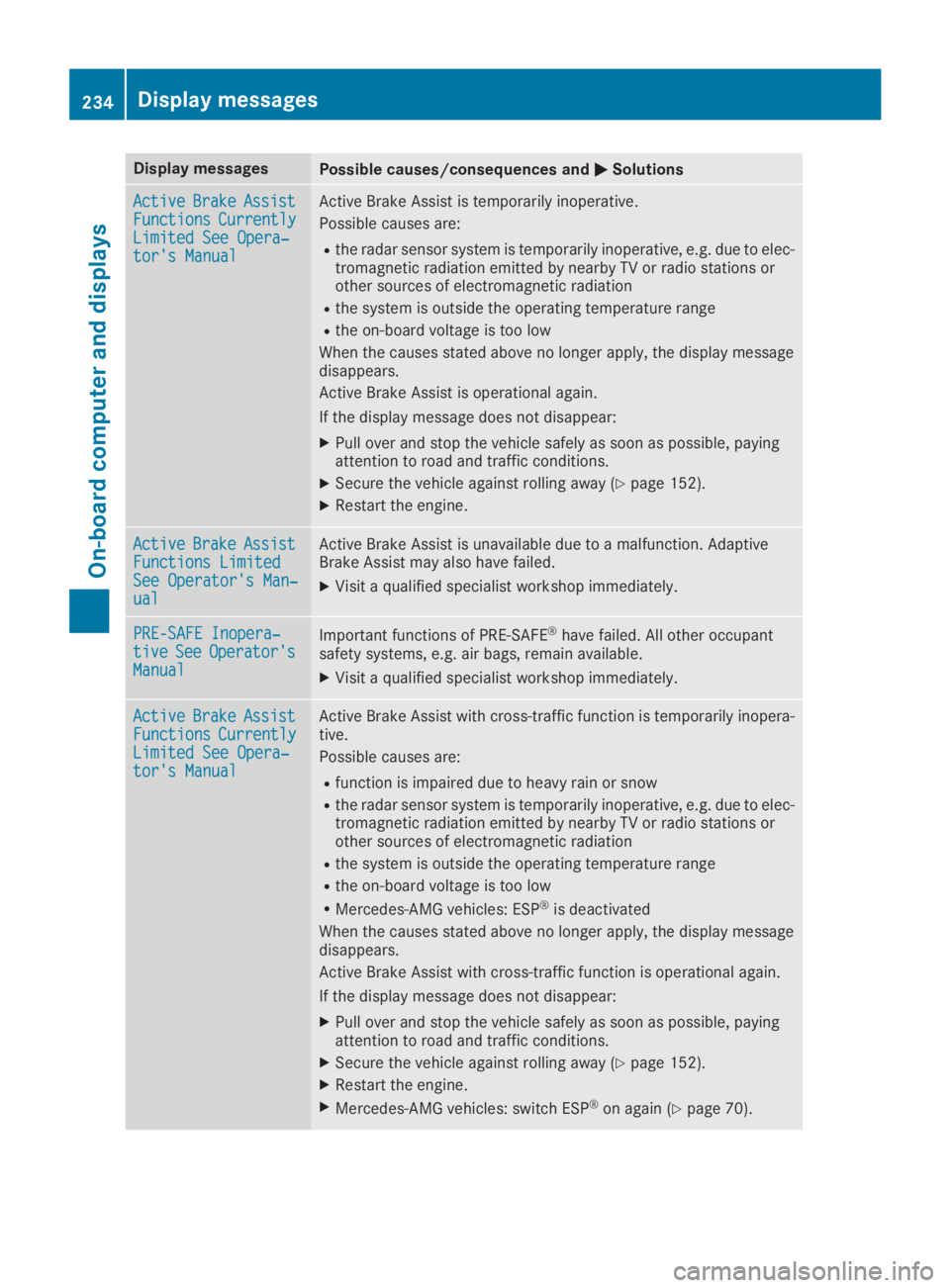
ActiveActiveBrakeBrakeAssistAssistFunctionsFunctionsCurrentlyCurrentlyLimited See Opera‐Limited See Opera‐tor's Manualtor's Manual
Active Brake Assist is temporarily inoperative.
Possible causes are:
Rthe radar sensor system is temporarily inoperative, e.g. due to elec-tromagnetic radiation emitted by nearby TV or radio stations orother sources of electromagnetic radiation
Rthe system is outside the operating temperature range
Rthe on-board voltage is too low
When the causes stated above no longer apply, the display messagedisappears.
Active Brake Assist is operational again.
If the display message does not disappear:
XPull over and stop the vehicle safely as soon as possible, payingattention to road and traffic conditions.
XSecure the vehicle against rolling away (Ypage 152).
XRestart the engine.
ActiveActiveBrakeBrakeAssistAssistFunctions LimitedFunctions LimitedSee Operator's Man‐See Operator's Man‐ualual
Active Brake Assist is unavailable due to a malfunction. AdaptiveBrake Assist may also have failed.
XVisit a qualified specialist workshop immediately.
PRE-SAFE Inopera‐PRE-SAFE Inopera‐tivetiveSeeSeeOperator'sOperator'sManualManual
Important functions of PRE-SAFE®have failed. All other occupantsafety systems, e.g. air bags, remain available.
XVisit a qualified specialist workshop immediately.
ActiveActiveBrakeBrakeAssistAssistFunctionsFunctionsCurrentlyCurrentlyLimited See Opera‐Limited See Opera‐tor's Manualtor's Manual
Active Brake Assist with cross-traffic function is temporarily inopera-tive.
Possible causes are:
Rfunction is impaired due to heavy rain or snow
Rthe radar sensor system is temporarily inoperative, e.g. due to elec-tromagnetic radiation emitted by nearby TV or radio stations orother sources of electromagnetic radiation
Rthe system is outside the operating temperature range
Rthe on-board voltage is too low
RMercedes-AMG vehicles: ESP®is deactivated
When the causes stated above no longer apply, the display messagedisappears.
Active Brake Assist with cross-traffic function is operational again.
If the display message does not disappear:
XPull over and stop the vehicle safely as soon as possible, payingattention to road and traffic conditions.
XSecure the vehicle against rolling away (Ypage 152).
XRestart the engine.
XMercedes-AMG vehicles: switch ESP®on again (Ypage 70).
234Displaymessages
On-b oard computer and displays
Page 237 of 370
Display messagesPossible causes/consequences andPPSolutions
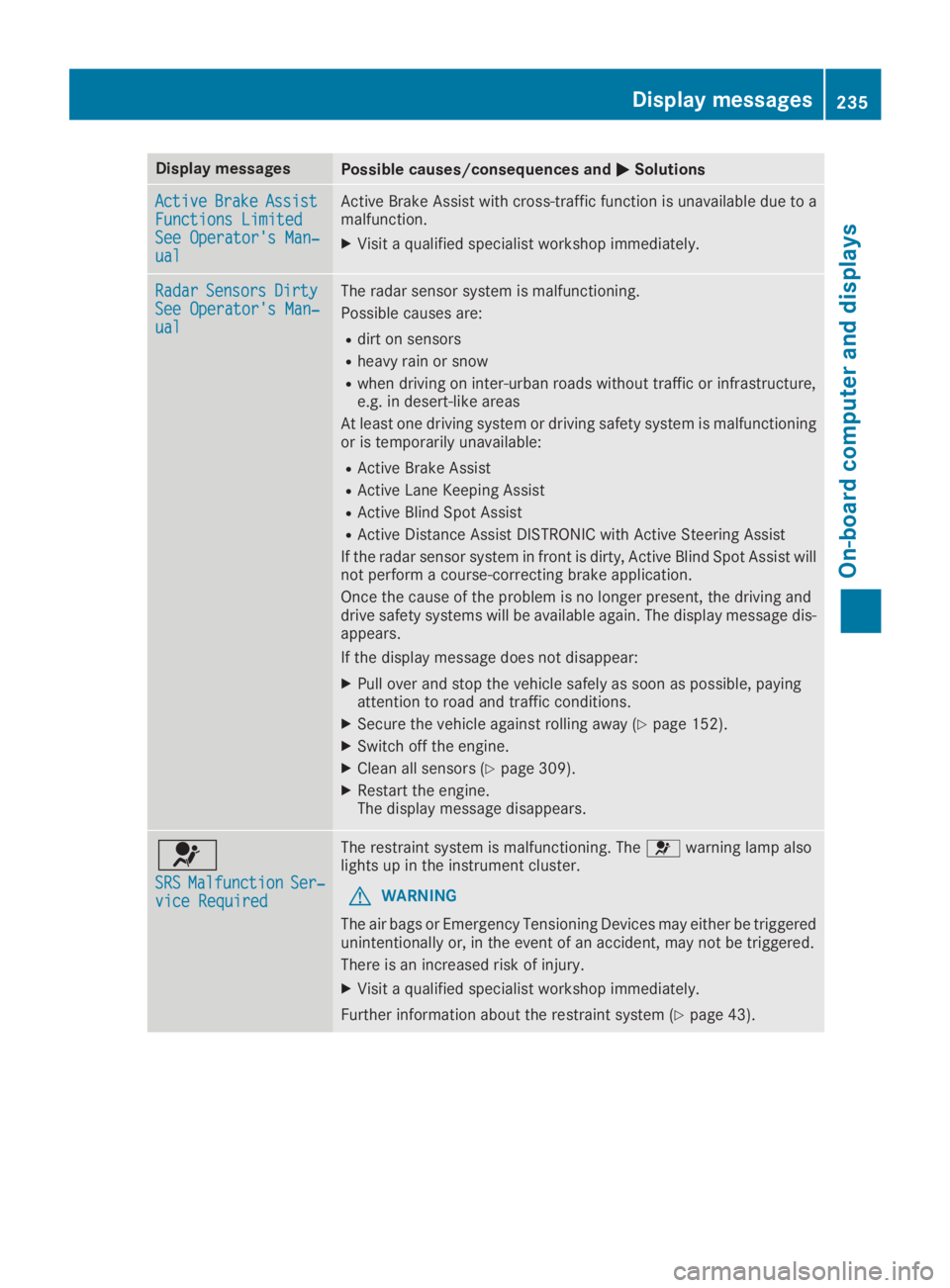
ActiveActiveBrakeBrakeAssistAssistFunctions LimitedFunctions LimitedSee Operator's Man‐See Operator's Man‐ualual
Active Brake Assist with cross-traffic function is unavailable due to amalfunction.
XVisit a qualified specialist workshop immediately.
RadarRadarSensorsSensorsDirtyDirtySee Operator's Man‐See Operator's Man‐ualual
The radar sensor system is malfunctioning.
Possible causes are:
Rdirt on sensors
Rheavy rain or snow
Rwhen driving on inter-urban roads without traffic or infrastructure,e.g. in desert-like areas
At least one driving system or driving safety system is malfunctioningor is temporarily unavailable:
RActive Brake Assist
RActive Lane Keeping Assist
RActive Blind Spot Assist
RActive Distance Assist DISTRONIC with Active Steering Assist
If the radar sensor system in front is dirty, Active Blind Spot Assist willnot perform a course-correcting brake application.
Once the cause of the problem is no longer present, the driving anddrive safety systems will be available again. The display message dis-appears.
If the display message does not disappear:
XPull over and stop the vehicle safely as soon as possible, payingattention to road and traffic conditions.
XSecure the vehicle against rolling away (Ypage 152).
XSwitch off the engine.
XClean all sensors (Ypage 309).
XRestart the engine.The display message disappears.
u
SRSSRSMalfunctionMalfunctionSer‐Ser‐vice Requiredvice Required
The restraint system is malfunctioning. Theuwarning lamp alsolights up in the instrument cluster.
GWARNING
The air bags or Emergency Tensioning Devices may either be triggeredunintentionally or, in the event of an accident, may not be triggered.
There is an increased risk of injury.
XVisit a qualified specialist workshop immediately.
Further information about the restraint system (Ypage 43).
Displaymessages235
On-b oard computer and displays
Z
Page 242 of 370
Display messagesPossible causes/consequences andPPSolutions
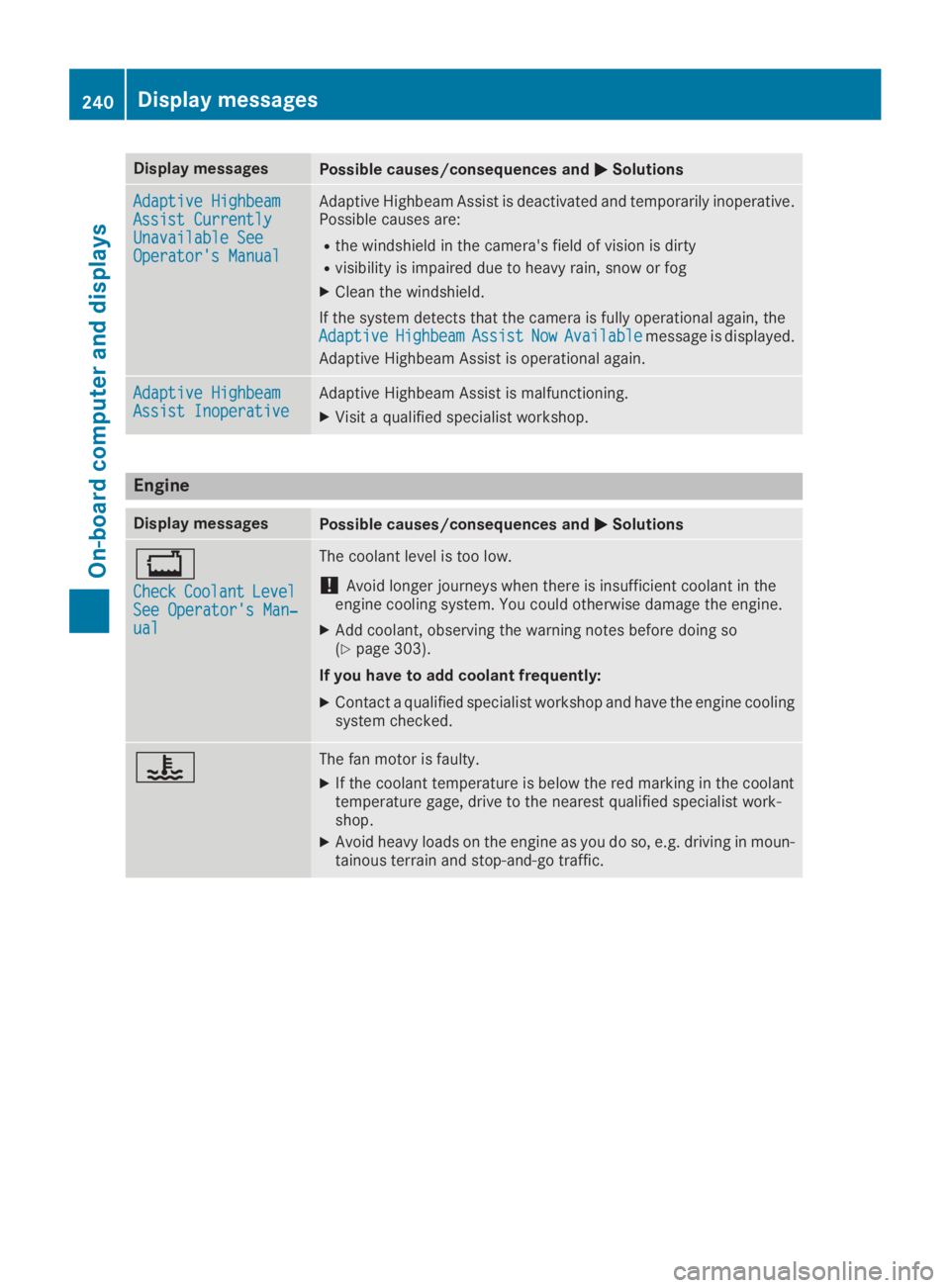
Adaptive HighbeamAdaptive HighbeamAssist CurrentlyAssist CurrentlyUnavailable SeeUnavailable SeeOperator's ManualOperator's Manual
Adaptive Highbeam Assist is deactivated and temporarily inoperative.Possible causes are:
Rthe windshield in the camera's field of vision is dirty
Rvisibility is impaired due to heavy rain, snow or fog
XClean the windshield.
If the system detects that the camera is fully operational again, theAdaptiveAdaptiveHighbeamHighbeamAssistAssistNowNowAvailableAvailablemessage is displayed.
Adaptive Highbeam Assist is operational again.
Adaptive HighbeamAdaptive HighbeamAssist InoperativeAssist InoperativeAdaptive Highbeam Assist is malfunctioning.
XVisit a qualified specialist workshop.
Engine
Display messagesPossible causes/consequences andPPSolutions
Page 244 of 370
Display messagesPossible causes/consequences andPPSolutions
=
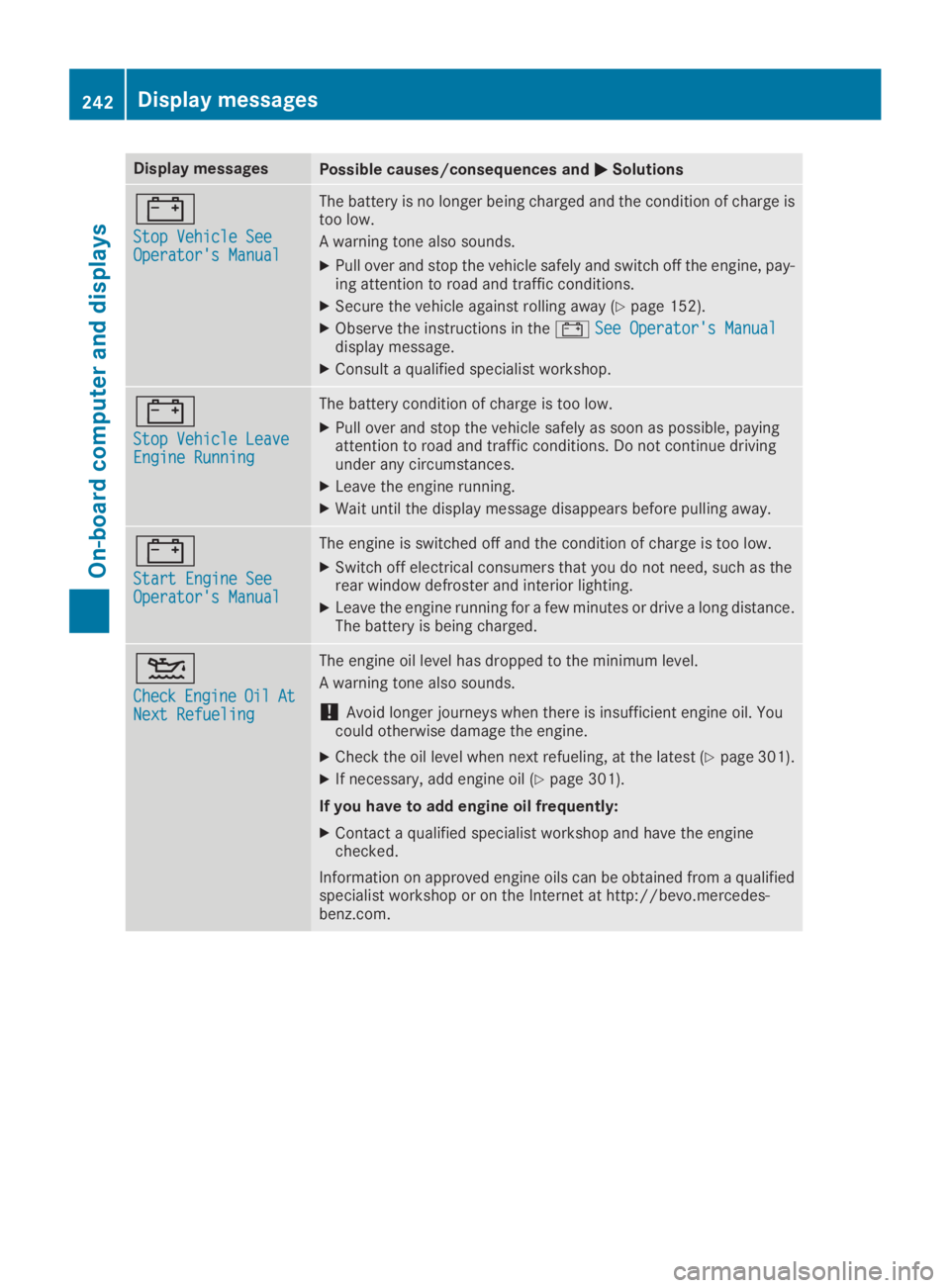
Stop Vehicle SeeStop Vehicle SeeOperator's ManualOperator's Manual
The battery is no longer being charged and the condition of charge istoo low.
A warning tone also sounds.
XPull over and stop the vehicle safely and switch off the engine, pay-ing attention to road and traffic conditions.
XSecure the vehicle against rolling away (Ypage 152).
XObserve the instructions in the=See Operator's ManualSee Operator's Manualdisplay message.
XConsult a qualified specialist workshop.
=
Stop Vehicle LeaveStop Vehicle LeaveEngine RunningEngine Running
The battery condition of charge is too low.
XPull over and stop the vehicle safely as soon as possible, payingattention to road and traffic conditions. Do not continue drivingunder any circumstances.
XLeave the engine running.
XWait until the display message disappears before pulling away.
=
Start Engine SeeStart Engine SeeOperator's ManualOperator's Manual
The engine is switched off and the condition of charge is too low.
XSwitch off electrical consumers that you do not need, such as therear window defroster and interior lighting.
XLeave the engine running for a few minutes or drive a long distance.The battery is being charged.