2019 MASERATI QUATTROPORTE mirror
[x] Cancel search: mirrorPage 294 of 396
Traffic Sign Assist – TSA
(optional) TSA detects traffic signs through the
use of a forward-facing digital camera
mounted on windshield, behind the
rear-view mirror. TSA assists the driver
by displaying on the instrument cluster
detected speed limits and traffic signs
with a restriction indicated by an
additional sign (e.g. in snow
conditions). TSA also uses the data of
the navigation system, in order to
provide information to the driver in all
cases in which the camera is not able
to detect the traffic signs that are
present on the road where the car is
travelling.
Some examples of these are: due to
low visibility, light reflection, damaged
traffic signs, traffic signs in wrong
position like rotated or fallen poles.
NOTE:
• Overtaking restriction signs are not
displayed by the TSA system.
• TSA provides a visual warning to the
driver when he/she unintentionally
reaches the maximum speed limit
allowed or when it exceeds the set
“Sensitivity” value. • The performance of TSA depends on
the update degree of navigation
system’s maps.
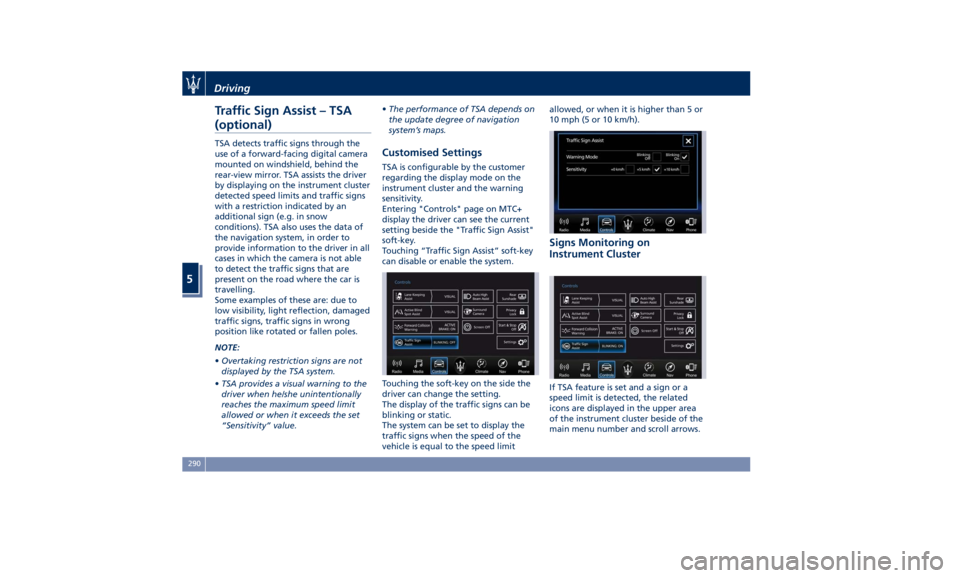
Customised Settings TSA is configurable by the customer
regarding the display mode on the
instrument cluster and the warning
sensitivity.
Entering "Controls" page on MTC+
display the driver can see the current
setting beside the "Traffic Sign Assist"
soft-key.
Touching “Traffic Sign Assist” soft-key
can disable or enable the system.
Touching the soft-key on the side the
driver can change the setting.
The display of the traffic signs can be
blinking or static.
The system can be set to display the
traffic signs when the speed of the
vehicle is equal to the speed limit allowed, or when it is higher than 5 or
10 mph (5 or 10 km/h).
Signs Monitoring on
Instrument Cluster
If TSA feature is set and a sign or a
speed limit is detected, the related
icons are displayed in the upper area
of the instrument cluster beside of the
main menu number and scroll arrows.Driving
5
290
Page 313 of 396
Driving Conditions Before the Trip Check the following at regular
intervals and always before long trips:
• tire pressure and condition;
• levels of fluids and lubricants;
• conditions of the windshield wiper
blades;
• clean the glass on the external light
and all other glass surfaces;
• proper operation of the indicator
lights and of the external lights.
CAUTION!
It is however advisable to perform
these checks at least every 600 mi
(1000 km) and always following the
maintenance schedule reported in
section “Maintenance and Care”.
Before you drive:
•
adjust seat position, steering wheel,
adjustable pedals (if equipped with)
and rearview mirrors in order to
have the best driving position;
• ensure that nothing (mat covers,
etc.) is obstructing the pedals
movement; • carefully arrange and secure any
objects in the trunk, to prevent them
from moving forward in case of
sudden stops;
• avoid heavy meals before a trip. A
light snack helps keep your reflexes
sharp. In particular, avoid drinking
alcohol.
WARNING!
Passengers must only travel seated in
the vehicle seats, with the seat belts
fastened. Always check that the driver
and all passengers have the seat belts
correctly fastened.
Safe Driving Although the vehicle is equipped with
active and passive safety devices, the
driver's conduct is always a decisive
factor for road safety.
Some simple rules for traveling safely
in different conditions are listed
below. Some of them will probably
already sound familiar but, in any
case, it would be useful to read them
carefully.
Driving at Night
The main guidelines to follow when
driving at night are set out below. • Drive carefully. Night conditions
demand more focus and attention.
• Reduce your speed, especially on
roads with no streetlights.
• Stop at early signs of drowsiness.
Continuing to drive would be a risk
for yourself and for others. Have a
rest before continuing your trip.
• Keep the vehicle at a greater
distance from vehicles in front of
you than you would during the day:
it is difficult to assess the speed of
other vehicles when you only see the
lights.
• Use the high beams only outside of
densely-populated areas and when
you are sure that they will not
disturb other drivers.
• When another vehicle is
approaching, switch from high
beams (if on) to low beams.
• Keep lights and headlights clean.
• Outside of densely-populated areas,
beware of animals crossing the road.
Driving in the Rain
Rain and wet roads are dangerous. On
a wet road all maneuvers are more
difficult since wheel grip on the road
is significantly reduced. This means
that braking distances increase
considerably and road grip decreases.Driving
5
309
Page 350 of 396
time. Then move the lid
automatically, using the buttons on
the lid itself, performing a complete
cycle of opening and closing.
• Initialize the climate control system
by activating the system and pressing
the “AUTO” control as described in
chapter “Air Conditioning Controls”
in section “Dashboard Instruments
and Controls”.
• Turn on the MTC+ and set the date
and time (see “MTC+ Settings” in
section “Dashboard Instruments and
Controls”).
• Lift, release and lift again the lever
on the central console to initialize
the electric parking brake. Following
this operation the
warning light
on the instrument cluster will turn
off.
• For correct activation of the
approach lights on the external
mirrors, press at least once the tilt
button on the driver's door panel so
that the door mode recognizes the
mirrors position.
• If the car is equipped with power
sunshades on rear door windows,
carry out the self learning cycle
described on chapter “Power
Sunshades on Rear Door Windows”
in section “Before Starting”. CAUTION!
• Every time the battery is
reconnected, wait at least 30 seconds
with the ignition switch turned to
RUN before starting the engine, in
order to allow the electronic system
that manages the motor-driven
throttles to run a self-learning cycle.
At the same time, you can run the
date and time set up procedure for
the MTC+.
• Every time the battery is reconnected
the warning light
flash for about
10 seconds and then go off.
WARNING!
California Proposition 65
Operating, servicing and maintaining
a passenger vehicle or off-road vehicle
can expose you to chemicals including
such as, engine exhaust, carbon
monoxide, phthalates and lead, that
which are known to the State of
California to cause cancer and birth
defects or other reproductive harm. To
minimize exposure, avoid breathing
exhaust, do not idle the engine except
as necessary, service your vehicle in a
well-ventilated area and wear gloves or wash your hands frequently when
servicing your vehicle. For more
information go to:
www.P65Warnings.ca.gov/passenger-
vehicle
Useful Advice to Extend
Battery Life When parking the vehicle, make sure
that the doors, front, rear lids and
flaps are properly closed. All interior
lights should be off.
When the engine is turned off, do not
keep the connected devices switched
on for a long time (such as radio,
hazard warning flashers, fan, etc.).
CAUTION!
If the battery charge remains below
50% for a long period of time, it will
be damaged due to sulfation; its
performance and starting power will
be reduced and it will be more subject
to freezing.
We recommend you to have the
battery
charge condition
checked,
preferably at the beginning of the cold
season, to prevent the electrolyte from
freezing.
This check should be carried out more
frequently if the vehicle is used mainlyMaintenance and Care
7
346
Page 358 of 396

Ref. Type Function
49 Mini – 10A Internal
temperature
sensor, internal
mirror and HALF
50 – –
51 Mini – 25A Rear seat and
steering wheel
heater module
52 – –
53 Mini – 25A Rear seat vented
module
54 Mini – 7,5A Blind Spot
module
55 – –
56 Mini – 7,5A Blower front
HVAC coil relay
57 Mini – 7,5A Blower rear
HVAC coil relay
58 – –
59 Mini – 10A SDC module,
transmission
lever, ASBM, rear
tunnel stack
switch
60 Mini – 10A SDC module Ref. Type Function
61 Mini – 25A Front console
power outlet and
cigar lighter
62 Mini – 7,5A Front HVAC
module
63 Mini – 20A Blower rear
HVAC
64 Mini – 10A Wi-fi, rear HVAC
module
65 Mini – 10A Intelligent
battery sensor
66 Mini – 10A Wi-fi, RSE
67 Mini – 7,5A USB charge
outlet, sunroof
68 Mini – 20A Rear sunshade
module
69 Mini – 25A Rear console
power outlet and
cigar lighter
70 Mini – 10A Front HVAC
module and
Parking Aid
Module (PAM)Fuse Box under the Dashboard This box is located in an internal area
that can be accessed only by removing
the glove compartment on the
dashboard left side. Considering the
complexity of this operation, we
recommend having the fuses replaced
by an Authorized Maserati Dealer .
The table points out the position as
featured in the figure, the type and
function of the fuses in the box under
the dashboard.
Ref. Type Function
1 Mini – 7,5A Cluster module,
CSS, SGW and
DSRC - Japan
version
2 Mini – 15A Cluster module,
clock
3 Mini – 10A DSRC and DTV
system (Japan
version only)
4 Mini – 5A E-call
5 Mini – 7,5A Security Gateway
6 Mini – 25A Radio
7 Mini – 10A Column software
module, CSS, USB
auxiliary portMaintenance and Care
7
354
Page 360 of 396

CAUTION!
It is not possible replace a single LED
of the headlight cluster: we
recommend that you contact an
Authorized Maserati Dealer for the
replacement of the entire headlight
cluster.
Tail-Light Clusters The lights are arranged as follows:
1 Position light guide LED.
2 Stop light LED.
3 Side-marker LED.
4 Turn signal LED.
5 Reverse LED.
6 Reflectors.
7 Rear fog LED. CAUTION!
It is not possible replace a single LED
of the tail-light cluster, we recommend
that you contact an Authorized
Maserati Dealer for the replacement
of the entire cluster.
Light Clusters Replacement All lights in the front and rear clusters
and those integrated in the exterior
mirrors are LED powered and cannot
be replaced individually.
Contact an Authorized Maserati
Dealer to locate the correct parts and
replace them.
License Plate Lights To replace the license plate light bulb
(C 5W): • use a screwdriver positioned at the
indicated point to lever out the light
fixing frame;
• replace the pressure-fitted bulb;
• refit the bulb holder inserting first
the electrical connector side and
then pressing on the other side to
hook up the clip.
Interior Lights Lamps inside the glove box
compartments of the dashboard andMaintenance and Care
7
356
Page 366 of 396
Glass Surfaces
All glass surfaces should be cleaned on
a regular basis with any commercial
household-type glass cleaner.
Never use an abrasive type cleaner.
Use caution when cleaning the inside
rear window equipped with electric
defrosters. Do not use scrapers or
other sharp instrument that may
scratch the elements.
When cleaning the rearview mirror,
spray cleaner on the towel or rag that
you are using. Do not spray cleaner
directly on the mirror.
Labels can be peeled off after soaking
with warm water.
When cleaning is performed, keep all
metal objects at a safe distance from
the window.
Cleaning Headlights
Your vehicle has plastic headlights that
are lighter and less susceptible to
stone breakage than glass headlights.
Plastic is not as scratch-resistant as
glass and therefore different lens
cleaning procedures must be followed.
To minimize the possibility of
scratching the lenses and reducing
light output, avoid wiping with a dry
cloth. To remove road dirt, wash with
a mild soap solution followed by
rinsing. Do not use abrasive cleaning
components, solvents, steel wool or
other aggressive material to clean the
lenses.
Condensation and Fogging on the
Light Clusters
With cold or humid climates, after a
driving rain or after cleaning the car,
the surface of the front and rear light
clusters could fog and/or form
condensate drops on the inside. This is
a natural phenomenon due to the
temperature and humidity differences
between the lens internal and external
surface, which nevertheless does not
indicate a fault and does not
compromise the regular operation of
the lights. The fogging/condensate
disappears when switching on the
lights, starting from the centre of the
diffuser and gradually going to the
edges.
Moldings and Aluminum Trims
• For cleaning moldings and aluminum
trims, avoid the use of acidic or
alkaline cleaning agents that can
destroy the protecting surface
treatment.
• After washing aluminum trim with
warm water, apply the cleaning
agent with a clean tissue or a soft
sponge on the surface. Do not use any other equipment such as
brushes, steel wool, abrasives or any
other equipment for cleaning.
• After cleaning, please rinse the
aluminum trim with a lot of clear
water.
• While cleaning in the car, please
make sure that the moldings and
aluminum trims only get in contact
with soft brushes or textiles.
Engine Compartment
At the end of each winter season,
carefully wash the engine
compartment, remembering to avoid
directing the jet of water for too long
on the electric parts.
To perform this operation, you must
contact an Authorized Maserati
Dealer .
Pre-Short Drop Function When in a car wash, if the driver keeps
the RKE Transmitter in his/her pocket,
or in any place outside the vehicle
within 3.3 ft (1 m) distance, the front
windows will perform a pre-short
drop. This is a shorter drop compared
to the normal short drop performed by
the “Passive Entry” function when you
grab the door handle to enter the
vehicle.Maintenance and Care
7
362
Page 384 of 396

Dimensions Wheel base 124.84 in (3171 mm)
Total length 207.32 in (5266 mm)
Width without mirrors 76.69 in (1948 mm)
Width with mirrors 82.63 in (2099 mm)
Front track (*) 64.13 ÷ 64.25 in (1629 ÷ 1632 mm)
Rear track (*) 64.29 ÷ 64.88 in (1633 ÷ 1648 mm)
Front overhang 38.30 in (973 mm)
Rear overhang 44.17 in (1122 mm)
Height (*) 57.87 ÷ 58.42 in (1470 ÷ 1484 mm)
Boot compartment volume 18.7 cu. ft. (530 l)
(*) Variable size according to the motorization, the tire size and the optional installed.Features and Specifications
8
380
Page 390 of 396

Handholds and Cloth Hooks ..... .136
Hazard Warning Flashers ....... .315
Head Restraints ...............98
Highway Assist - HAS ......... .284
HomeLink ................. .143
Security ................. .146
Troubleshooting Tips ........ .146
Using HomeLink ........... .146
Hood
Hood Operation .............57
Trunk Lid and Hood Ajar
Indicators .................57
HSA (Hill Start Assist) ......... .250
Identification Labels ............19
Illuminated Entry/Exit ...........30
Immobilizer (Sentry Key) .........26
Indicator Lights
Air Bag Warning Light .........90
TFT Display: Menus and Settings .157
TFT Display: Warning/Indicator
Lights of Set Modes/Functions. . .170
Warning and Indicator Lights on
Analog Instrument ......... .153
Infotainment System
Main Menu Bar on MTC+
Display ................. .178
Manual Controls and Devices . . .177
Personalized the Main Menu Bar.179
Instrument Cluster ........... .152
Interior Components ...........94
Interior Maintenance and Care. . . .363
Interiors Features ............ .130 iPad Holder ................ .137
iPod Connection ............. .135
Jump Start Procedure ......... .324
KeyFob ....................25
Key Fob Battery Replacement ....35
Preventing Inadvertent Locking of
key fob RKE Transmitter Inside the
Vehicle ...................43
Replacement ...............27
Requiring and setting Additional
Key Fobs ..................34
Unlock the Vehicle with Key fob . .33
Keys .......................24
Lane Departure Warning (LDW) . . .271
Level Checks ............... .337
Adding Washer Fluid ........ .339
Brake Fluid Level Check ...... .338
Engine Coolant Level Check . . . .337
Engine Oil Level Check ....... .337
Fluid Level Check for Coolant
Transmission System ........ .341
Transmission Oil Check ....... .341
Lights
.................... .116
Automatic
Headlights ....... .118
Automatic
High Beam ....... .119
Bulb Replacement .......... .355
Cargo Lamps ............. .126
Dome Lights .............. .125
DRL, Daytime Running Lights . . .119
Fog Lights ............... .121 Full-LED Headlight with Cornering
Function ................ .119
Headlight Time Delay ....... .118
High Beam and Flashing ..... .122
Interior Lights ............. .123
Light Switch .............. .116
Multifunction Lever ......... .121
Turn Signals .............. .121
Loading the Vehicle
Loading with Rear Seatback . . . .140
Vehicle Load Carrying Capacity . .139
Main- and Submenu .......... .158
Maintenance ..................5
A/C System Maintenance ..... .357
Air Bag System Maintenance ....72
Bodywork Maintenance and
Care ................... .360
Emissions Inspection and
Maintenance Programs ...... .332
Interior Maintenance and Care . .363
Maintenance Procedures ..... .334
Periodic Maintenance ....... .331
Scheduled Maintenance Service .328
Scheduled Service Plan ....... .329
Wheels Maintenance ........ .358
Map Pockets ............... .136
Maserati Roadside Assistance
Program ...................16
Messages on Main Display Area . . .157
MIL (Malfunction Indicator Light) . .153
Mirrors ................... .113
External Mirrors ........... .113Index
9 386