2019 MASERATI LEVANTE steering
[x] Cancel search: steeringPage 255 of 436
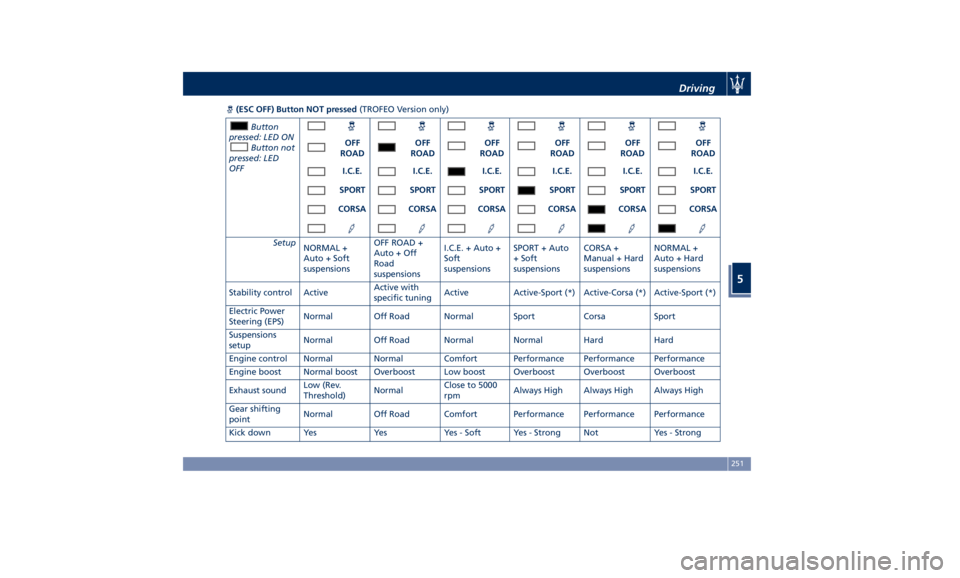
(ESC OFF) Button NOT pressed (TROFEO Version only)
Button
pressed: LED ON
Button not
pressed: LED
OFF OFF
ROAD OFF
ROAD OFF
ROAD OFF
ROAD OFF
ROAD OFF
ROAD
I.C.E. I.C.E. I.C.E. I.C.E. I.C.E. I.C.E.
SPORT SPORT SPORT SPORT SPORT SPORT
CORSA CORSA CORSA CORSA CORSA CORSA
Setup
NORMAL +
Auto + Soft
suspensions OFF ROAD +
Auto + Off
Road
suspensions I.C.E. + Auto +
Soft
suspensions SPORT + Auto
+ Soft
suspensions CORSA +
Manual + Hard
suspensions NORMAL +
Auto + Hard
suspensions
Stability control Active Active with
specific tuning Active Active-Sport (*) Active-Corsa (*) Active-Sport (*)
Electric Power
Steering (EPS) Normal Off Road Normal Sport Corsa Sport
Suspensions
setup Normal Off Road Normal Normal Hard Hard
Engine control Normal Normal Comfort Performance Performance Performance
Engine boost Normal boost Overboost Low boost Overboost Overboost Overboost
Exhaust sound Low (Rev.
Threshold) Normal Close to 5000
rpm Always High Always High Always High
Gear shifting
point Normal Off Road Comfort Performance Performance Performance
Kick down Yes Yes Yes - Soft Yes - Strong Not Yes - Strong Driving
5
251
Page 257 of 436
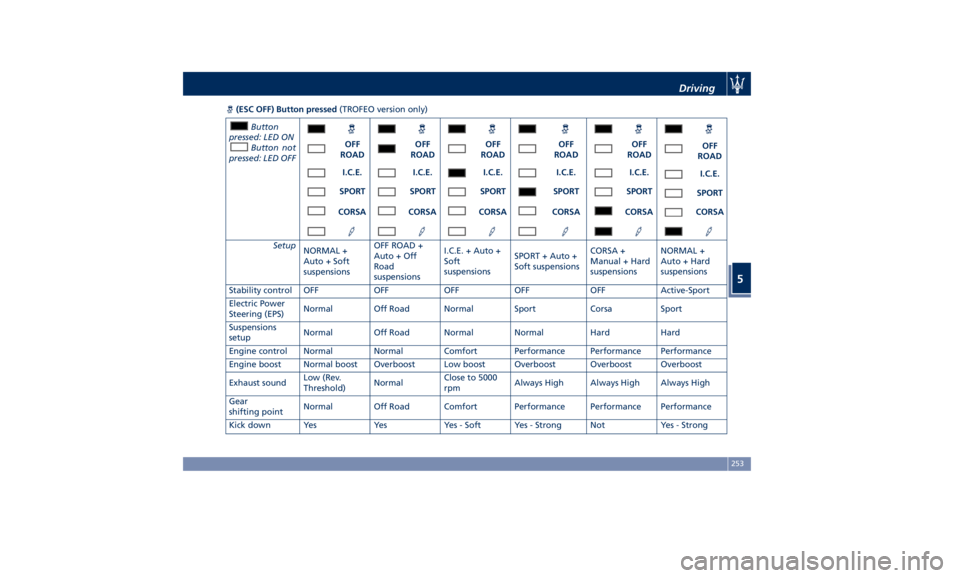
(ESC OFF) Button pressed (TROFEO version only)
Button
pressed: LED ON
Button not
pressed: LED OFF OFF
ROAD OFF
ROAD OFF
ROAD OFF
ROAD OFF
ROAD OFF
ROAD
I.C.E. I.C.E. I.C.E. I.C.E. I.C.E.
I.C.E.
SPORT SPORT SPORT SPORT SPORT
SPORT
CORSA CORSA CORSA CORSA CORSA CORSA
Setup
NORMAL +
Auto + Soft
suspensions OFF ROAD +
Auto + Off
Road
suspensions I.C.E. + Auto +
Soft
suspensions SPORT + Auto +
Soft suspensions CORSA +
Manual + Hard
suspensions NORMAL +
Auto + Hard
suspensions
Stability control OFF OFF OFF OFF OFF Active-Sport
Electric Power
Steering (EPS) Normal Off Road Normal Sport Corsa Sport
Suspensions
setup Normal Off Road Normal Normal Hard Hard
Engine control Normal Normal Comfort Performance Performance Performance
Engine boost Normal boost Overboost Low boost Overboost Overboost Overboost
Exhaust sound Low (Rev.
Threshold) Normal Close to 5000
rpm Always High Always High Always High
Gear
shifting point Normal Off Road Comfort Performance Performance Performance
Kick down Yes Yes Yes - Soft Yes - Strong Not Yes - Strong Driving
5
253
Page 259 of 436
To deactivate the drive mode, press
the same button again: the LED will
turn off and the display will show the
message indicating that
(ESC OFF)
drive mode is off and ESC system is
active.
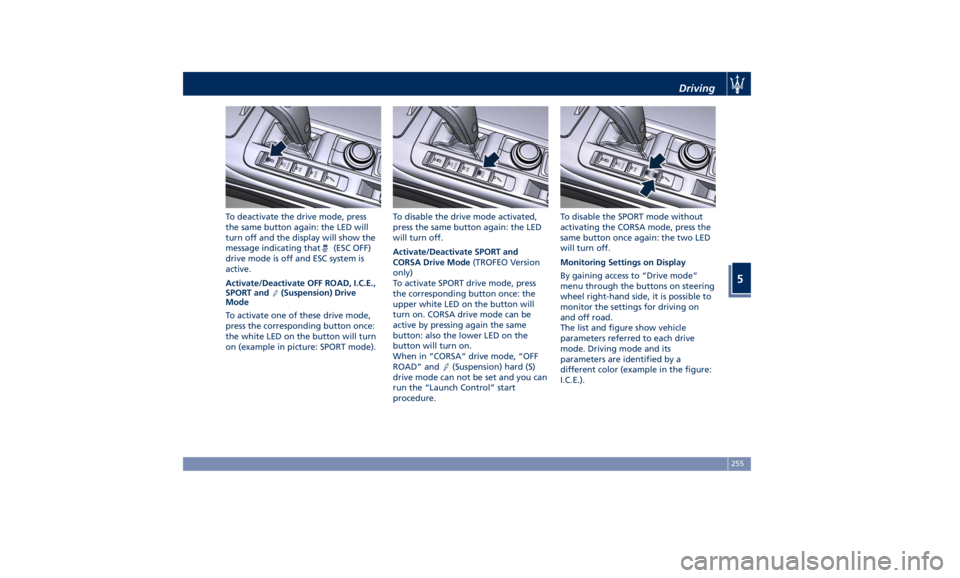
Activate/Deactivate OFF ROAD, I.C.E.,
SPORT and
(Suspension) Drive
Mode
To activate one of these drive mode,
press the corresponding button once:
the white LED on the button will turn
on (example in picture: SPORT mode). To disable the drive mode activated,
press the same button again: the LED
will turn off.
Activate/Deactivate SPORT and
CORSA Drive Mode (TROFEO Version
only)
To activate SPORT drive mode, press
the corresponding button once: the
upper white LED on the button will
turn on. CORSA drive mode can be
active by pressing again the same
button: also the lower LED on the
button will turn on.
When in “CORSA” drive mode, “OFF
ROAD” and
(Suspension) hard (S)
drive mode can not be set and you can
run the “Launch Control” start
procedure. To disable the SPORT mode without
activating the CORSA mode, press the
same button once again: the two LED
will turn off.
Monitoring Settings on Display
By gaining access to “Drive mode”
menu through the buttons on steering
wheel right-hand side, it is possible to
monitor the settings for driving on
and off road.
The list and figure show vehicle
parameters referred to each drive
mode. Driving mode and its
parameters are identified by a
different color (example in the figure:
I.C.E.).Driving
5
255
Page 264 of 436
the position of the vehicle with little
suspension movements to ensure a
proper appearance.
Display Messages
After shifting selector to change
position, a pop-up message will
indicate for 5 seconds when set
position has been reached (after
pneumatic suspension system
intervention that might last up to 30
seconds).
This type of message will be displayed
only if the option to view all
pneumatic suspension system messages
was set (For further details, refer to
“MTC+ Settings” in section
“Dashboard Instruments and
Controls”).
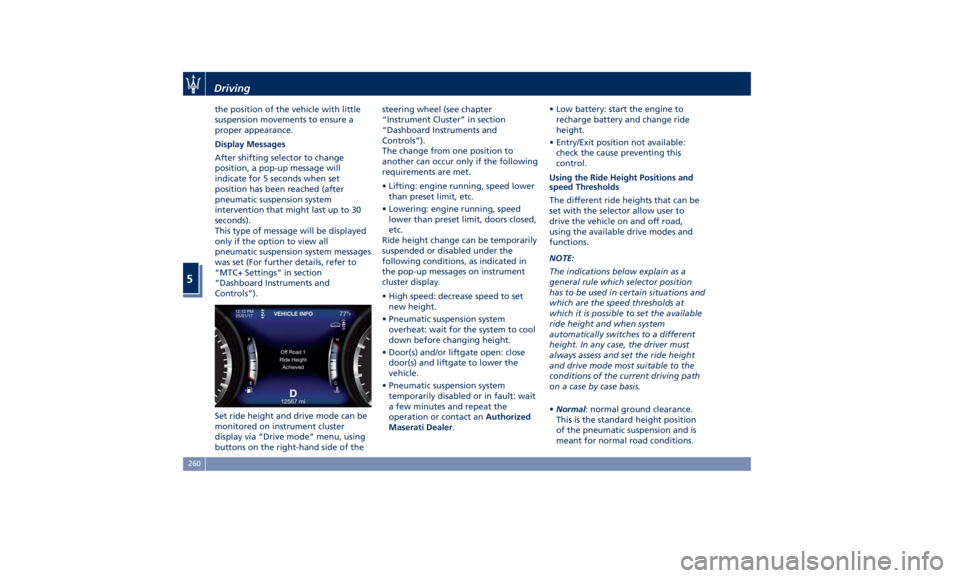
Set ride height and drive mode can be
monitored on instrument cluster
display via “Drive mode” menu, using
buttons on the right-hand side of the steering wheel (see chapter
“Instrument Cluster” in section
“Dashboard Instruments and
Controls”).
The change from one position to
another can occur only if the following
requirements are met.
• Lifting: engine running, speed lower
than preset limit, etc.
• Lowering: engine running, speed
lower than preset limit, doors closed,
etc.
Ride height change can be temporarily
suspended or disabled under the
following conditions, as indicated in
the pop-up messages on instrument
cluster display.
• High speed: decrease speed to set
new height.
• Pneumatic suspension system
overheat: wait for the system to cool
down before changing height.
• Door(s) and/or liftgate open: close
door(s) and liftgate to lower the
vehicle.
• Pneumatic suspension system
temporarily disabled or in fault: wait
a few minutes and repeat the
operation or contact an Authorized
Maserati Dealer . • Low battery: start the engine to
recharge battery and change ride
height.
• Entry/Exit position not available:
check the cause preventing this
control.
Using the Ride Height Positions and
speed Thresholds
The different ride heights that can be
set with the selector allow user to
drive the vehicle on and off road,
using the available drive modes and
functions.
NOTE:
The indications below explain as a
general rule which selector position
has to be used in certain situations and
which are the speed thresholds at
which it is possible to set the available
ride height and when system
automatically switches to a different
height. In any case, the driver must
always assess and set the ride height
and drive mode most suitable to the
conditions of the current driving path
on a case by case basis.
• Normal : normal ground clearance.
This is the standard height position
of the pneumatic suspension and is
meant for normal road conditions.Driving
5
260
Page 267 of 436

Launch Control Sequence
NOTE:
• All the above mentioned conditions
must be verified in order to activate
"Launch Control" performance start
procedure.
• During “Launch Control” ACC, FCW
and HAS (if equipped) are
temporarily disabled.
• Each step displayed on the
instrument cluster has a time out
approximately of 5 seconds.
• With brake pedal pressed and
steering wheel straight, pull "–" left
paddle. The instrument cluster shows
the "Launch Control" engaged page.
• To confirm the procedure, pull again
the "–" paddle down. To abort the
procedure, pull "+" right paddle. • To confirm the "Launch Control"
sequence, press full the brake pedal
as indicated in the message on the
instrument cluster.
• With brake pedal pressed full, press
full the accelerator pedal as
indicated in the message on the
instrument cluster.
• Release brake pedal. The launch of
the vehicle starts with ESC that
manages the maximum performance and engine torque calibrated to
maximize performance.
During the acceleration phase the
“Launch Control” symbol appears at
the top right of the TFT display.Driving
5
263
Page 271 of 436
Traction Downhill When descending mountains or hills,
use Hill Descent Control (HDC) to
avoid repeated heavy braking (for
further details, refer to “Brake and
Stability Control System” in this
section).
When descending mountains or hills,
repeated braking can cause brake
fade with loss of braking power. Avoid
repeated heavy braking and
downshift the transmission whenever
possible in order to cool down the
brakes.
Warnings and Tips for Off-road
Driving When driving off-road, using the “OFF
ROAD” drive mode which is specific
for this use.
Before driving, always make sure that
the vehicle reached the ride height set
through the selector.
When driving, always:
• limit driving speed as much as
possible to tackle bends, bumpy
sections and slopes;
• increase visual control in front and
on the sides of the vehicle to quickly
spot any obstacles in your path
(potholes, branches, etc.); Always consider these tips further to
your experience gained in off-road
driving.
After Driving Off-road Off-road operation puts more stress
on your vehicle than does most
on-road driving. After going off-road,
it is always a good idea to check for
damage. That way you can get any
problems taken care of right away and
have your vehicle ready when you
need it.
• Completely inspect the underbody of
your vehicle. Check tires, body
structure, steering, suspension, and
exhaust system for damage.
• Inspect the radiator for mud and
debris that might decrease sinking
effect and clean as required.
• Check for accumulations of plants or
brush in underbody. These things
could be a fire hazard if they get in
contact with the exhaust system.
• After extended operation in mud,
sand, water, or similar dirty
conditions, have all parts that got in
contact with mud, sand and water
inspected and cleaned as soon as
possible. WARNING!
Abrasive material in any part of the
brakes may cause excessive wear or
unpredictable braking operation. Do
not drive if braking system is not
efficient: get your brakes checked and
cleaned as necessary by an
Authorized Maserati Dealer.
• If you experience unusual vibration
after
driving in mud, slush or similar
conditions, check the wheels and
suspension linkages for impacted
material. Impacted material can
cause wheel imbalance and affect
suspension response. Removing it
will correct the situation.Driving
5
267
Page 273 of 436
CAUTION!
The main function of the EPB is to
allow safe parking of the vehicle,
therefore it must only be applied
when the vehicle is already stationary.
If the EPB is used while the vehicle is
moving and decelerating until a speed
lower of 3 mph (5 km/h) and, in
particular, until complete stop
(typically in a sudden brake), it is
necessary to have the EPB system
checked by an Authorized Maserati
Dealer .
WARNING!
• Always hold the brake pedal pressed
during engagement or
disengagement of the parking
brake.
• The EPB command activation while
running generates a deceleration of
the vehicle with strong deceleration
(Dynamic Braking). It is therefore
recommended to use this feature
only in case of emergency. The
stability of the car is guaranteed by
the action of the activated ESC
system. • It is advisable to keep the "Auto
Apply" function always active (On)
so that the vehicle is properly
secured with electric parking brake.
Deactivating Automatic
Operation The automatic engagement function
can be deactivated/reactivated by
selecting the menu item “Vehicle
settings” through the switch on the
right side of the steering wheel (refer
to “Instrument Cluster” in section
“Dashboard Instruments and
Controls”).
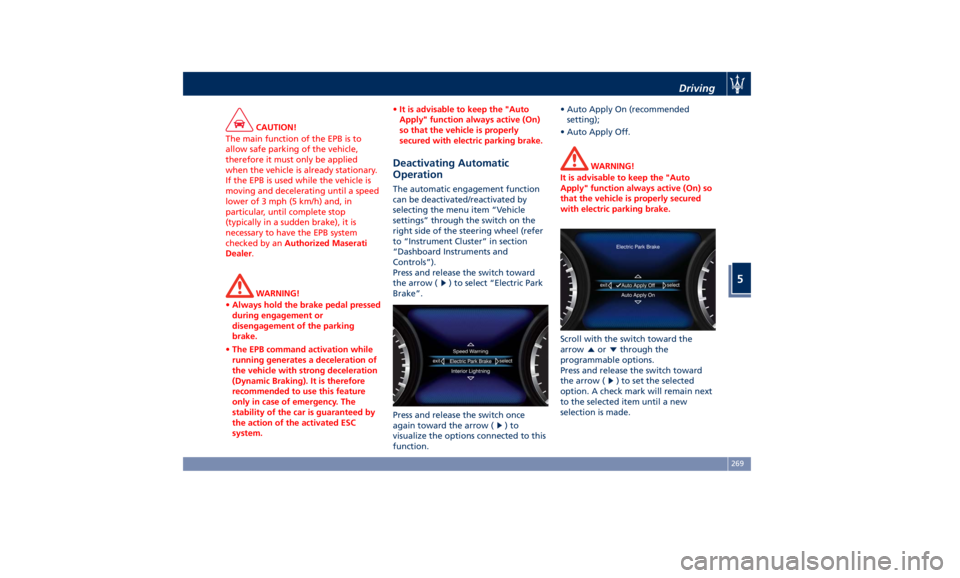
Press and release the switch toward
the arrow (
) to select “Electric Park
Brake”.
Press and release the switch once
again toward the arrow (
)to
visualize the options connected to this
function. • Auto Apply On (recommended
setting);
• Auto Apply Off.
WARNING!
It is advisable to keep the "Auto
Apply" function always active (On) so
that the vehicle is properly secured
with electric parking brake.
Scroll with the switch toward the
arrow
or through the
programmable options.
Press and release the switch toward
the arrow (
) to set the selected
option. A check mark will remain next
to the selected item until a new
selection is made.Driving
5
269
Page 277 of 436

Brake and Stability
Control System The vehicle is equipped with an
Electronic Stability Control System
(ESC), which helps to maintain
directional control in the event of loss
of grip of the tires. The system is able
to detect potentially dangerous
situations for the stability of the
vehicle and automatically sets the
brakes on all four wheels in a
differentiated manner, in order to
provide a torque settlement of the
vehicle.
ESC includes the following subsystems:
• ABS (Anti-lock Braking System);
• EBD (Electronic Brake-force
Distribution);
• TCS (Traction Control System);
• BAS (Brake Assist System);
• BTO (Brake Throttle Override);
• HSA (Hill Start Assist);
• ROM (Roll-Over Mitigation);
• TSM (Trailer Sway Mitigation);
• HDC (Hill Descent Control).
WARNING!
• These systems cannot prevent the natural laws of physics from
affecting the vehicle, nor can they
increase traction, braking or steering
efficiency beyond that afforded by
the condition of the vehicle brakes
and tires.
• These systems cannot prevent
collisions, including those resulting
from excessive speed in turns,
following another vehicle too
closely, or hydroplaning.
• The capabilities of a vehicle
equipped with these systems must
never be exploited in a reckless or
dangerous manner that could
jeopardize the driver’s and the
passenger’s safety or the safety of
others.
Electronic Stability Control
(ESC) This system enhances directional
control and stability of the vehicle
under various driving conditions. The
ESC corrects over steering and under
steering of the vehicle by applying the
brake to the appropriate wheel.
Engine power may also be reduced to
assist in counteracting the conditions
of instability and maintain the right
direction. The system is also able to
reduce the engine power. Through sensors fitted on the vehicle,
the ESC system detects the driver’s
chosen direction comparing it to the
one maintained while running. In case
of discrepancy between the required
trajectory and the current one, the
ESC system brakes the appropriate
wheel to counteract over or under
steering.
• Oversteer - when the vehicle is
turning more than appropriate for
the steering wheel position.
• Understeer - when the vehicle is
turning less than appropriate for the
steering wheel position.
The ESC system has two available
operating modes:
ESC on
This is the normal ESC operating
mode. At each start-up of the vehicle,
the ESC system is set in this mode and
should be used for most driving
conditions. The ESC should only be
turned off for specific reasons as
pointed out in the following
paragraphs.
ESC off
The “ESC off” mode is aimed for a
more spirited driving experience but
also purposeful for driving in sand, or
gravel. The current mode disables the
TCS portion of the ESC and raises theDriving
5
273