2019 Hyundai Tucson Tire rotation
[x] Cancel search: Tire rotationPage 435 of 546

7
Maintenance
7
Maintenance
Engine Compartment .............................................7-3
Maintenance Services ...........................................7-4
Owner's Responsibility .....................................................7-4
Owner Maintenance Precautions..................................7-4
Owner Maintenance ..............................................7-5
Owner Maintenance Schedule .......................................7-6
Scheduled Maintenance Services........................7-8
Normal Maintenance Schedule
(Nu 2.0 GDI, Theta 2.4 GDI) .............................................7-9
Maintenance Under Severe Usage Conditions
(Nu 2.0 GDI, Theta 2.4 GDI)...........................................7-12
Severe Driving Conditions .............................................7-13
Explanation Of Scheduled Maintenance
Items ......................................................................7-14
Engine Oil ..............................................................7-17
Checking the Engine Oil Level .....................................7-17
Checking the Engine Oil and Filter .............................7-18
Engine Coolant .....................................................7-19
Checking the Engine Coolant Level ............................7-19
Changing Engine Coolant ..............................................7-22
Brake Fluid ............................................................7-23
Checking the Brake Fluid Level ...................................7-23
Washer Fluid .........................................................7-24
Checking the Washer Fluid Level................................7-24
Parking Brake .......................................................7-24
Checking the Parking Brake .........................................7-24
Air Cleaner ............................................................7-25
Filter Replacement ..........................................................7-25
Climate Control Air Filter ....................................7-27
Filter Inspection ...............................................................7-27
Wiper Blades.........................................................7-29
Blade Inspection ..............................................................7-29
Blade Replacement .........................................................7-29
Battery...................................................................7-33
For Best Battery Service ..............................................7-34
Battery Recharging ........................................................7-34
Reset Features.................................................................7-35
Tires and Wheels .................................................7-36
Tire Care ............................................................................7-36
Recommended Cold Tire Inflation Pressures ...........7-37
Check Tire Inflation Pressure ......................................7-38
Tire Rotation.....................................................................7-38
Wheel Alignment and Tire Balance ............................7-39
Tire Replacement ............................................................7-40
Wheel Replacement ........................................................7-41
7
Page 472 of 546
7-38
Maintenance
Check Tire Inflation Pressure
Check your tires, including the spare
tire, once a month or more.
How to check
Use a good quality tire pressure
gauge to check tire pressure. You
can not tell if your tires are properly
inflated simply by looking at them.
Radial tires may look properly inflat-
ed when they are under-inflated.
Remove the valve cap from the tire
valve stem. Press the tire gauge firm-
ly onto the valve to get a pressure
measurement. If the cold tire inflation
pressure matches the recommended
pressure on the tire label located on
the driver's side center pillar or in this
manual. No further adjustment is
necessary. If the pressure is low, add
air until you reach the recommended
pressure. Make sure to put the valve
caps back on the valve stems.
Without the valve cap, dirt or mois-
ture could get into the valve core and
cause air leakage. If a valve cap is
missing, install a new one as soon as
possible.If you overfill the tire, release air by
pushing on the metal stem in the
center of the tire valve. Recheck the
tire pressure with the tire gauge. Be
sure to put the valve caps back on
the valve stems. Without the valve
cap, dirt or moisture could get into
the valve core and cause air leakage.
If a valve cap is missing, install a new
one as soon as possible.
Tire Rotation
To equalize tread wear, HYUNDAI
recommends that the tires be rotated
according to the maintenance sched-
ule or sooner if irregular wear devel-
ops.
During rotation, check the tires for
correct balance.
When rotating tires, check for uneven
wear and damage. Abnormal wear is
usually caused by incorrect tire pres-
sure, improper wheel alignment, out-
of-balance wheels, severe braking or
severe cornering. Look for bumps or
bulges in the tread or side of the tire.
Replace the tire if you find any of
these conditions. Replace the tire if
fabric or cord is visible. After rotation,
be sure to bring the front and rear tire
pressures to specification and check
lug nut tightness (proper torque is
79~94 lbf·ft [11~13 kgf·m]).
Page 473 of 546
7-39
7
Maintenance
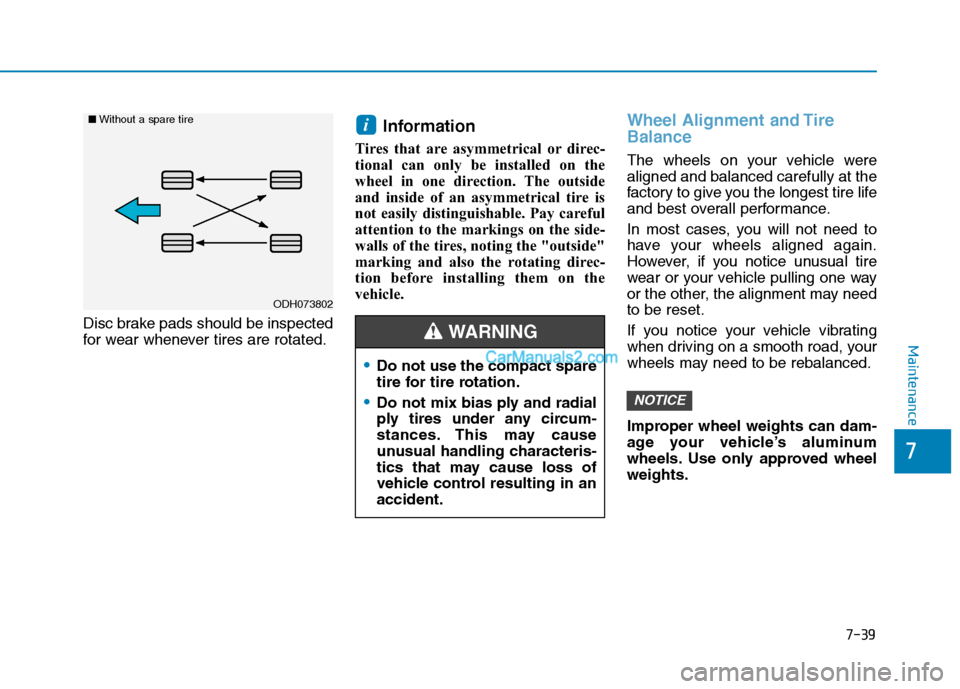
Disc brake pads should be inspected
for wear whenever tires are rotated.
Information
Tires that are asymmetrical or direc-
tional can only be installed on the
wheel in one direction. The outside
and inside of an asymmetrical tire is
not easily distinguishable. Pay careful
attention to the markings on the side-
walls of the tires, noting the "outside"
marking and also the rotating direc-
tion before installing them on the
vehicle.
Wheel Alignment and Tire
Balance
The wheels on your vehicle were
aligned and balanced carefully at the
factory to give you the longest tire life
and best overall performance.
In most cases, you will not need to
have your wheels aligned again.
However, if you notice unusual tire
wear or your vehicle pulling one way
or the other, the alignment may need
to be reset.
If you notice your vehicle vibrating
when driving on a smooth road, your
wheels may need to be rebalanced.
Improper wheel weights can dam-
age your vehicle’s aluminum
wheels. Use only approved wheel
weights.
NOTICE
i
Do not use the compact spare
tire for tire rotation.
Do not mix bias ply and radial
ply tires under any circum-
stances. This may cause
unusual handling characteris-
tics that may cause loss of
vehicle control resulting in an
accident.
WARNING
ODH073802
■Without a spare tire
Page 483 of 546
7-49
7
Maintenance
Snow Tires
If you equip your car with snow tires,
they should be the same size and
have the same load capacity as the
original tires. Snow tires should be
installed on all four wheels; other-
wise, poor handling may result. Snow
tires should carry 4 psi (28 kPa)
more air pressure than the pressure
recommended for the standard tires
on the tire label on the driver’s side of
the center pillar, or up to the maxi-
mum pressure shown on the tire
sidewall, whichever is less. Do not
drive faster than 75 mph (120 km/h)
when your vehicle is equipped with
snow tires.
Radial-Ply Tires
Radial-ply tires provide improved
tread life, road hazard resistance and
smoother high speed ride. The radi-
al-ply tires used on this vehicle are of
belted construction, and are selected
to complement the ride and handling
characteristics of your vehicle.
Radial-ply tires have the same load
carrying capacity, as bias-ply or bias
belted tires of the same size, and use
the same recommended inflation
pressure. Mixing of radial-ply tires
with bias-ply or bias belted tires is
not recommended. Any combina-
tions of radial-ply and bias-ply or bias
belted tires when used on the same
vehicle will seriously deteriorate
vehicle handling. The best rule to fol-
low is: Identical pairs of radial-ply
tires should always be used as a set
for the front tires and a set for the
rear tires.Longer wearing tires can be more
susceptible to irregular tread wear. It
is very important to follow the tire
rotation interval in this chapter to
achieve the tread life potential of
these tires. Cuts and punctures in
radial-ply tires are repairable only in
the tread area, because of sidewall
flexing. Consult your tire dealer for
radial-ply tire repairs.
Do not mix bias ply and radial
ply tires under any circum-
stances. This may cause unusu-
al handling characteristics that
may cause loss of vehicle con-
trol resulting in an accident.
WARNING
Page 545 of 546

I-10
Theft-Alarm System .......................................................3-20
Tilt Steering/Telescope Steering .....................................3-22
Tire Pressure Monitoring System (TPMS) .......................6-8
Changing a Tire with TPMS ......................................6-12
Check Tire Pressure......................................................6-8
Low Tire Pressure LCD Display with
Position Indicator ....................................................6-10
Low Tire Pressure Telltale..........................................6-10
Tire Pressure Monitoring System.................................6-9
TPMS Malfunction Indicator .....................................6-11
Tire Specification and Pressure Label ............................8-12
Tires and Wheels .....................................................7-36, 8-6
All Season Tires .........................................................7-48
Check Tire Inflation Pressure .....................................7-38
Low Aspect Ratio Tires ..............................................7-50
Radial-Ply Tires ..........................................................7-49
Recommended Cold Tire Inflation Pressures.............7-37
Snow Tires ..................................................................7-49
Summer Tires .............................................................7-48
Tire Care .....................................................................7-36
Tire Maintenance ........................................................7-41
Tire Replacement........................................................7-40
Tire Rotation...............................................................7-38
Tire Sidewall Labeling ...............................................7-41
Tire Terminology and Definitions ..............................7-45Tire Traction ...............................................................7-41
Wheel Alignment and Tire Balance ...........................7-39
Wheel Replacement....................................................7-41
Towing ............................................................................6-21
Emergency Towing.....................................................6-23
Removable Towing Hook...........................................6-22
Tie-down Hook...........................................................6-25
Towing Service ...........................................................6-21
Trailer Towing...............................................................5-130
Driving with a trailer ................................................5-133
If you decide to pull a trailer....................................5-130
Maintenance when trailer towing .............................5-136
Trailer towing equipment .........................................5-132
Trip Computer ...............................................................3-103
USB Charger .................................................................3-162
Vehicle Certification Label .............................................8-11
Vehicle Identification Number (VIN) .............................8-11
Vehicle Load Limit .......................................................5-138
Tire Loading Information Label...............................5-139
Vehicle Stability Management (VSM)............................5-39
Index
U
V
T