2019 Hyundai Tucson check engine light
[x] Cancel search: check engine lightPage 337 of 685

5-13
Driving your vehicle
5
- Vehicle with manual transaxleButton Position Action Notes
ON
Press the Engine Start/Stop button whilst it
is in the ACC position without depressing
the clutch pedal.
The warning lights can be checked before
the engine is started. Do not leave the Engine Start/Stop button in
the ON position when the engine is not run-
ning to prevent the battery from discharging.
START
To start the engine, depress the clutch and
brake pedals and press the Engine Start/
Stop button with the shift lever in neutral. If you press the Engine Start/Stop button
without depressing the clutch pedal, the
engine does not start and the Engine
Start/Stop button changes as follows:
OFF
→
ACC →ON →OFF or ACC
TLe UK 5.qxp 5/10/2018 12:19 PM Page 13
Page 339 of 685

5-15
Driving your vehicle
5
- Vehicle with automatic transaxle / dual clutch transmissionButton Position Action Notes
ON
Press the Engine Start/Stop button whilst it
is in the ACC position without depressing
the brake pedal.
The warning lights can be checked before
the engine is started. Do not leave the Engine Start/Stop button in
the ON position when the engine is not run-
ning to prevent the battery from discharging.
START
To start the engine, depress the brake pedal
and press the Engine Start/Stop button with
the shift lever in the P (Park) or in the N
(Neutral) position.
For your safety, start the engine with the
shift lever in the P (Park) position. If you press the Engine Start/Stop button
without depressing the brake pedal, the
engine does not start and the Engine
Start/Stop button changes as follows:
OFF
→
ACC →ON →OFF or ACC
TLe UK 5.qxp 5/10/2018 12:19 PM Page 15
Page 356 of 685
5-32
Driving your vehicle• The dual clutch transmission givesthe driving feel of a manual
transaxle, yet provides the ease of
a fully automatic transaxle. Unlike
a traditional automatic transaxle,
the gear shifting can be felt (and
heard) on the dual clutch transmis-
sion
- Think of it as an automaticallyshifting manual transaxle.
- Shift into Drive range and get fully automatic shifting, similar to a
conventional automatic transaxle. • Dual clutch transmission adopts
dry-type dual clutch, which is dif-
ferent from torque converter of
automatic transaxle, and shows
better acceleration performance
during driving. But, initial launch
might be little bit slower than
Automatic Transaxle.
• Gear shifts are sometimes more noticeable than a conventional
automatic transmission and a light
vibration during launching can be
felt as the transmission speed is
matched with the engine speed.
This is a normal condition of the
dual clutch transmission.
• The dry-type clutch transfers torque and provides a direct driv-
ing feeling which may feel different
from a conventional automatic
transaxle with a torque converter.
This may be more noticeable when
starting from a stop or low vehicle
speed.
• When rapidly accelerating at low vehicle speed, engine could rev at
high rpm depending on vehicle
drive condition.
To reduce the risk of serious
injury or death:
•ALWAYS check the surround-
ing areas near your vehicle for
people, especially children,
before shifting a vehicle into
D (Drive) or R (Reverse).
•Before leaving the driver’s
seat, always make sure the
shift lever is in the P (Park)
position, then set the parking
brake, and place the ignition
switch in the LOCK/OFF posi-
tion. Unexpected and sudden
vehicle movement can occur
if these precautions are not
followed.
•Do not use the engine brake
(shifting from a high gear to
lower gear) rapidly on slip-
pery roads. The vehicle may
slip causing an accident.
(Continued)
(Continued)
•To avoid damage to your
transaxle, do not try to accel-
erate in R (Reverse) or any for-
ward gear position with the
brakes on.
•When stopped on slope, do
not hold the vehicle with
accelerator pedal. Use the
service brake or the parking
brake.
WARNING
TLe UK 5.qxp 5/10/2018 12:20 PM Page 32
Page 370 of 685

5-46
Driving your vehicleCheck the Parking
Brake Warning Light
by placing the ignition
switch to the ON posi-
tion (do not start the
engine).
This light will be illuminated when the
parking brake is applied with the igni-
tion switch in the START or ON posi-
tion.
Before driving, be sure the parking
brake is released and the Brake
Warning Light is OFF. If the Parking Brake Warning Light
remains on after the parking brake is
released whilst engine is running,
there may be a malfunction in the
brake system. Immediate attention is
necessary.
If at all possible, cease driving the
vehicle immediately. If that is not pos-
sible, use extreme caution whilst
operating the vehicle and only con-
tinue to drive the vehicle until you
can reach a safe location.
Electronic Parking Brake
(EPB) (if equipped)
Applying the parking brake
OTLE058015R
OTLE058224R
■
Type A
■Type B
TLe UK 5.qxp 5/10/2018 12:21 PM Page 46
Page 372 of 685

5-48
Driving your vehicle
• Automatic transaxle/Dual clutch transmission vehicle
1. Start the engine.
2. Fasten the driver's seat belt.
3. Close the driver's door, engine bonnet and tailgate.
4. Depress the accelerator pedal whilst the shift lever is in R
(Rear), D (Drive) or Sports mode.
Make sure the Parking Brake
Warning light goes off.
Information
• For your safety, you can engage the EPB even though the Engine Stop/
Start button is in the OFF position,
but you cannot release it.
• For your safety, depress the brake pedal and release the parking brake
manually with the EPB switch when
you drive downhill or when backing
up the vehicle.
Information - Manual trans-mission
A vehicle towing a trailer on a hill or
on an incline may slightly roll back-
wards when starting the vehicle. To
prevent the situation follow the below
instructions.
1. Depress the clutch pedal and select a gear.
2. Keep pulling up the EPB switch.
3. Depress the accelerator pedal and slowly release the clutch pedal.
4. If the vehicle starts off with enough driving power release the EPB
switch.
Do not follow the above procedure
when driving on a flat level ground.
The vehicle may suddenly move for-
ward. • If the parking brake warning
light is still on even though the
EPB has been released, we rec-
ommend that the system be
checked by a HYUNDAI autho-
rised repairer.
• Do not drive your vehicle with the EPB applied. It may cause
excessive brake pad and brake
rotor wear.NOTICEi
i
TLe UK 5.qxp 5/10/2018 12:21 PM Page 48
Page 375 of 685
5-51
Driving your vehicle
5
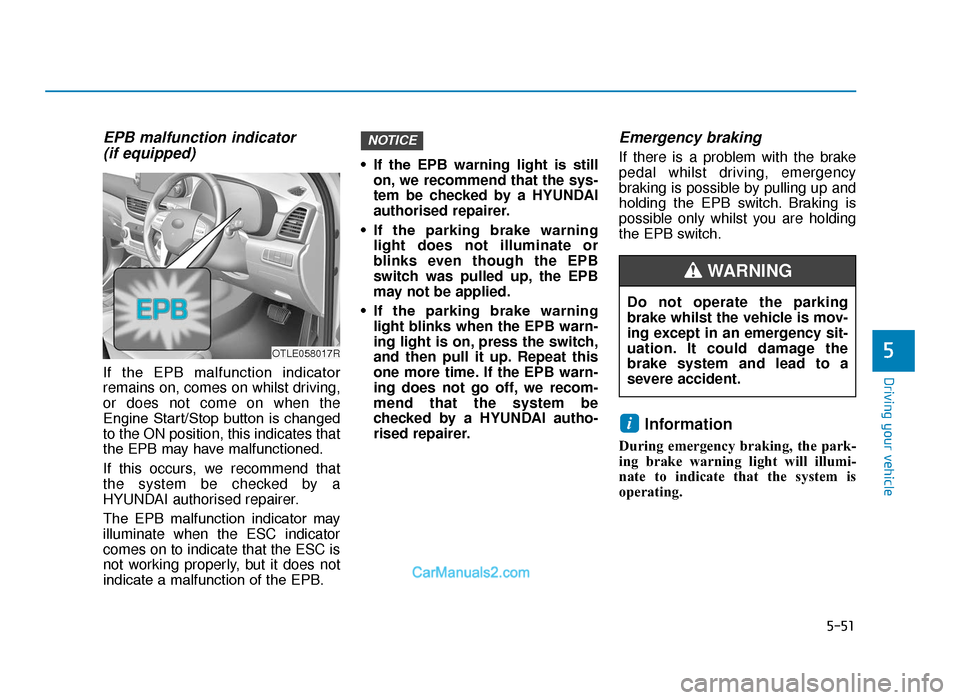
EPB malfunction indicator (if equipped)
If the EPB malfunction indicator
remains on, comes on whilst driving,
or does not come on when the
Engine Start/Stop button is changed
to the ON position, this indicates that
the EPB may have malfunctioned.
If this occurs, we recommend that
the system be checked by a
HYUNDAI authorised repairer.
The EPB malfunction indicator may
illuminate when the ESC indicator
comes on to indicate that the ESC is
not working properly, but it does not
indicate a malfunction of the EPB. • If the EPB warning light is still
on, we recommend that the sys-
tem be checked by a HYUNDAI
authorised repairer.
• If the parking brake warning light does not illuminate or
blinks even though the EPB
switch was pulled up, the EPB
may not be applied.
• If the parking brake warning light blinks when the EPB warn-
ing light is on, press the switch,
and then pull it up. Repeat this
one more time. If the EPB warn-
ing does not go off, we recom-
mend that the system be
checked by a HYUNDAI autho-
rised repairer.
Emergency braking
If there is a problem with the brake
pedal whilst driving, emergency
braking is possible by pulling up and
holding the EPB switch. Braking is
possible only whilst you are holding
the EPB switch.
Information
During emergency braking, the park-
ing brake warning light will illumi-
nate to indicate that the system is
operating.
i
NOTICE
OTLE058017R
Do not operate the parking
brake whilst the vehicle is mov-
ing except in an emergency sit-
uation. It could damage the
brake system and lead to a
severe accident.
WARNING
TLe UK 5.qxp 5/10/2018 12:21 PM Page 51
Page 378 of 685
5-54
Driving your vehicle
Information
• The Auto Hold does not operatewhen:
- The driver's seat belt is unfastenedand driver's door is opened
- The engine bonnet is opened
- The tailgate is opened
- The shift lever is in P (Park)
- The EPB is applied
• For your safety, the Auto Hold auto- matically switches to EPB when:
- The driver's seat belt is unfastenedand driver's door is opened
- The engine bonnet is opened with the shift lever is in D (Drive)
- The tailgate is opened with the shift lever is in R (Reverse)
- The vehicle stops for more than 10 minutes
- The vehicle stands on a steep slope
- The vehicle moves several times (Continued)(Continued)
In these cases, the brake warning
light comes on, the AUTO HOLD
indicator changes from green to
white, and a warning sound and a
message will appear to inform you
that EPB has been automatically
engaged. Before driving off again,
press foot brake pedal, check the
surrounding area near your vehicle
and release parking brake manually
with the EPB switch.
• If the AUTO HOLD indicator changes to yellow, the Auto Hold is not work-
ing properly. We recommend that you
contact a HYUNDAI authorised
repairer.
• Whilst operating Auto Hold, you may hear mechanical noise.
However, it is normal operating
noise.
i
To prevent, unexpected and sud-
den vehicle movement, ALWAYS
press your foot on the brake
pedal to cancel the Auto Hold
before you:
- Drive downhill.
- Drive the vehicle in R (Reverse).
- Park the vehicle.
WARNING
TLe UK 5.qxp 5/10/2018 12:22 PM Page 54
Page 382 of 685
5-58
Driving your vehicle
When you drive on a road having
poor traction, such as an icy road,
and apply your brakes continu-
ously, the ABS will be active con-
tinuously and the ABS warning
light ( ) may illuminate. Pull
your car over to a safe place and
turn the engine off.
Restart the engine. If the ABS
warning light is off, then your ABS
system is normal.
Otherwise, you may have a prob-
lem with your ABS system. We
recommend that you contact a
HYUNDAI authorised repairer as
soon as possible.
Information
When you jump start your vehicle
because of a drained battery, the ABS
warning light ( ) may turn on at the
same time. This happens because of
the low battery voltage. It does not
mean your ABS is malfunctioning.
Have the battery recharged before
driving the vehicle.
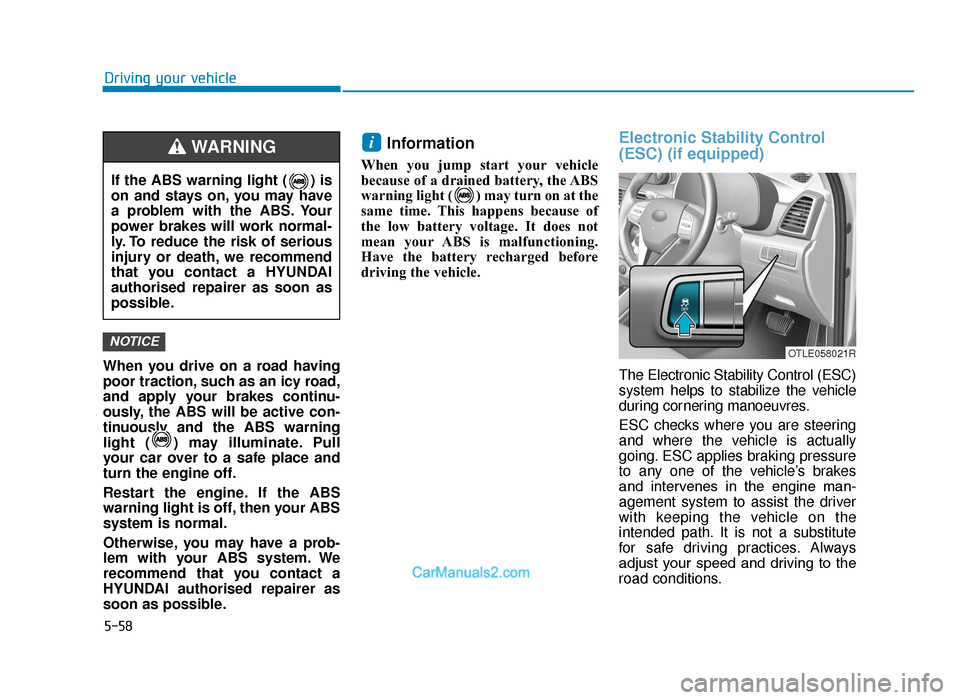
Electronic Stability Control
(ESC) (if equipped)
The Electronic Stability Control (ESC)
system helps to stabilize the vehicle
during cornering manoeuvres.
ESC checks where you are steering
and where the vehicle is actually
going. ESC applies braking pressure
to any one of the vehicle’s brakes
and intervenes in the engine man-
agement system to assist the driver
with keeping the vehicle on the
intended path. It is not a substitute
for safe driving practices. Always
adjust your speed and driving to the
road conditions.
i
NOTICE
If the ABS warning light ( ) is
on and stays on, you may have
a problem with the ABS. Your
power brakes will work normal-
ly. To reduce the risk of serious
injury or death, we recommend
that you contact a HYUNDAI
authorised repairer as soon as
possible.
WARNING
OTLE058021R
TLe UK 5.qxp 5/10/2018 12:22 PM Page 58