Page 7 of 546

F7
Introduction
F
F UU EELL RR EEQQ UUIIRR EEMM EENN TTSS
NOTICE indicates a situation
which, if not avoided, could result
in vehicle damage. Your new vehicle is designed to
obtain maximum performance with
UNLEADED FUEL, as well as mini-
mize exhaust emissions and spark
plug fouling.
Your new vehicle is designed to use
only unleaded fuel having an octane
number ((R+M)/2) of 87 (Research
Octane Number 91) or higher. (Do not
use methanol blended fuels)
To prevent damage to the engine
and engine components, never
add any fuel system cleaning
agents to the fuel tank other thanwhat has been specified.
Consult an authorized HYUNDAI
dealer for additional information.
Gasoline containing alcohol or
methanol
Gasohol, a mixture of gasoline and
ethanol (also known as grain alco-
hol) are being marketed along with orinstead of leaded or unleaded gaso-
line. For example, "E15" is a gasohol
comprised of 15% ethanol and 85%
gasoline. Do not use gasohol containing more than 15% ethanol, and do not use
gasoline or gasohol containing any
methanol. Either of these fuels may
cause drivability problems and dam-age to the fuel system, engine controlsystem and emission control system.
Discontinue using gasohol of any
kind if drivability problems occur.
NOTICE
NOTICE
CAUTION indicates a hazardous
situation which, if not avoided,could result in minor or moder-
ate injury.
CAUTION
•Do not "top off" after the noz-
zle automatically shuts offwhen refueling.
Always check that the fuel cap
is installed securely to pre-
vent fuel spillage in the eventof an accident.
WARNING
Page 24 of 546
H13
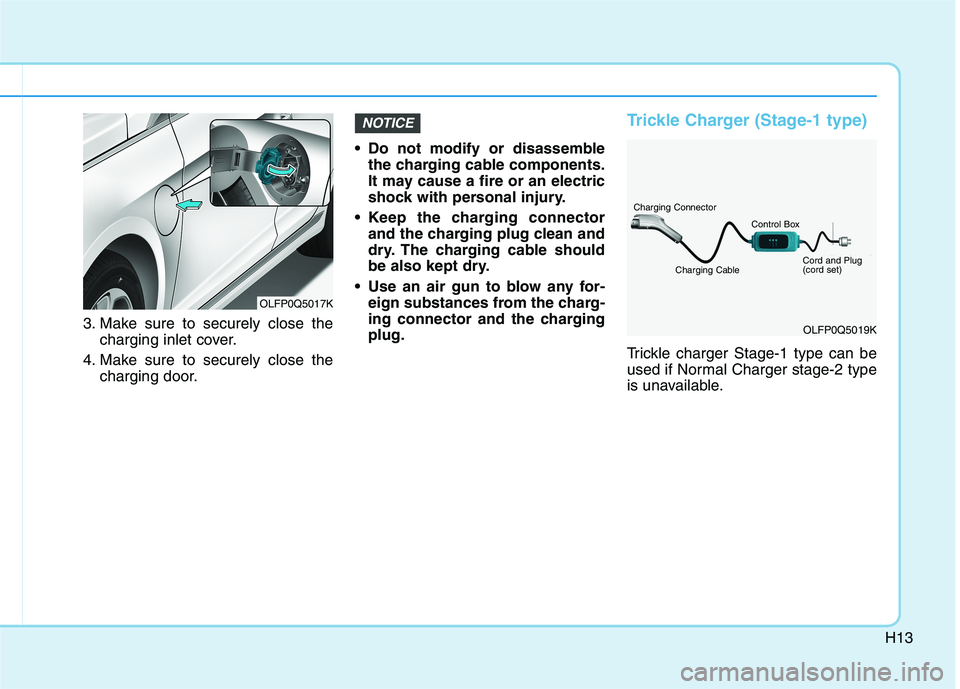
3. Make sure to securely close thecharging inlet cover.
4. Make sure to securely close the charging door. Do not modify or disassemble
the charging cable components.
It may cause a fire or an electric
shock with personal injury.
Keep the charging connector and the charging plug clean and
dry. The charging cable should
be also kept dry.
Use an air gun to blow any for- eign substances from the charg-
ing connector and the chargingplug.
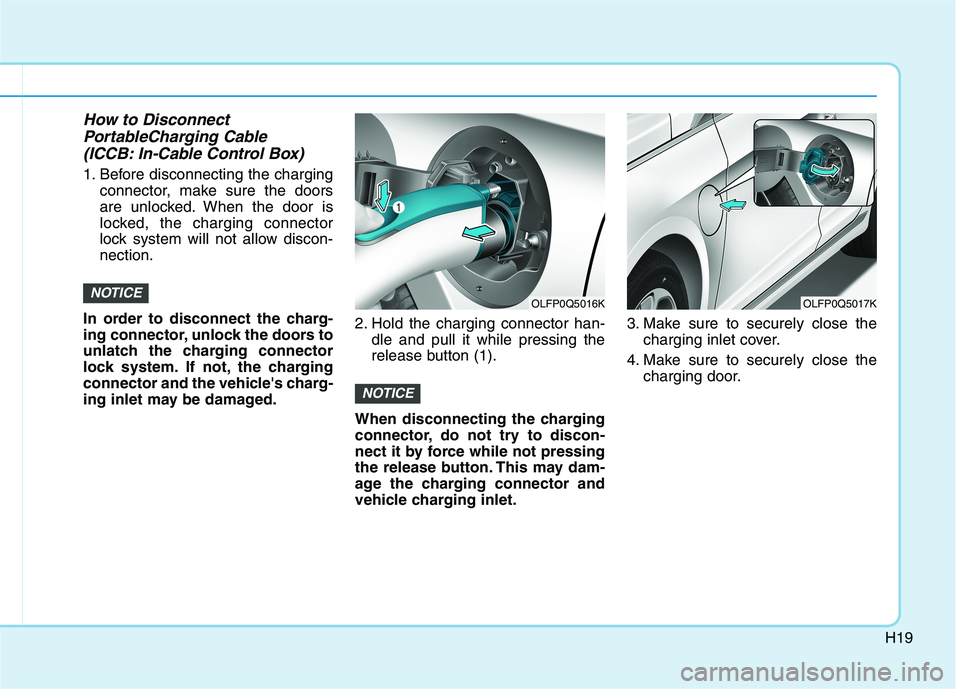
Trickle Charger (Stage-1 type)
Trickle charger Stage-1 type can be
used if Normal Charger stage-2 type
is unavailable.
NOTICE
OLFP0Q5019K
Charging Connector
Charging Cable
Control Box
Cord and Plug (cord set)
OLFP0Q5017K
Page 30 of 546
H19
How to DisconnectPortableCharging Cable
(ICCB: In-Cable Control Box)
1. Before disconnecting the charging connector, make sure the doors
are unlocked. When the door is
locked, the charging connector
lock system will not allow discon-nection.
In order to disconnect the charg-
ing connector, unlock the doors to
unlatch the charging connector
lock system. If not, the charging
connector and the vehicle's charg-
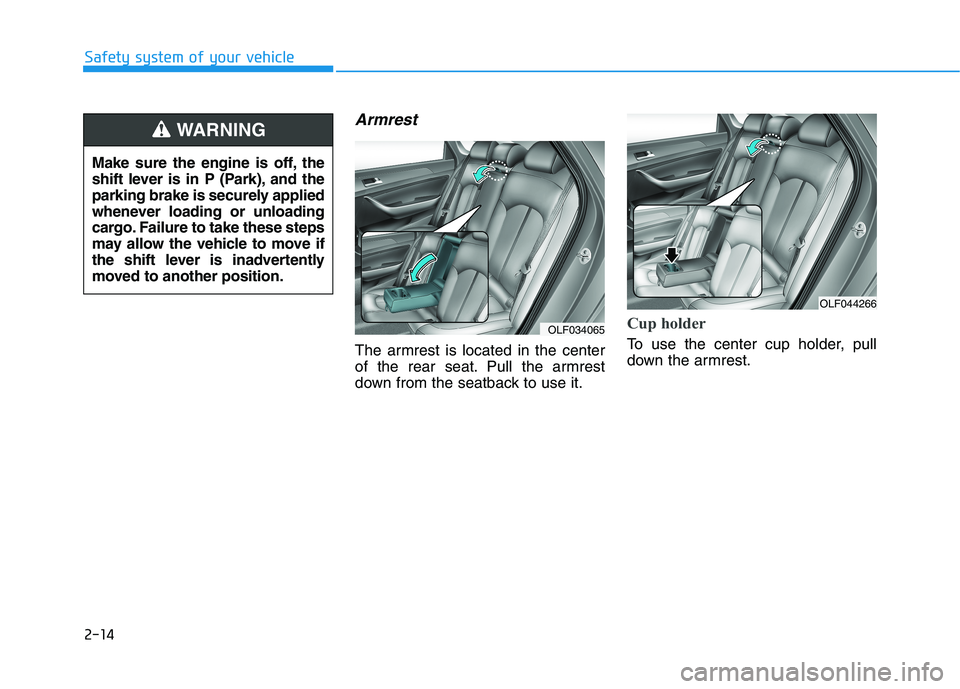
ing inlet may be damaged. 2. Hold the charging connector han-
dle and pull it while pressing the
release button (1).
When disconnecting the charging
connector, do not try to discon-
nect it by force while not pressing
the release button. This may dam-
age the charging connector and
vehicle charging inlet. 3. Make sure to securely close the
charging inlet cover.
4. Make sure to securely close the charging door.
NOTICE
NOTICEOLFP0Q5016KOLFP0Q5017K
Page 58 of 546
H47
Information
Clean the air intake for the hybrid
battery with a dry cloth on a regular
basis.If an accident occursi
For your safety, do not touch
high voltage cables, connec-
tors and package modules.
High voltage components are
orange in color.
Exposed cables or wires may
be visible inside or outside of
the vehicle. Never touch the
wires or cables, because it
can cause an electrical shock,
injury or death may occur.
Any gas or electrolyte leakage
from your vehicle is not only
poisonous but also flamma-
ble. Upon witnessing one of
those, open the windows, and
remain a safe distance from
the vehicle out of the road.
Immediately contact an author-
ized HYUNDAI dealer and advise
them that a hybrid vehicle is
involved.
(Continued)
WARNING
(Continued)
Do not put any objects into
the air intake of the hybrid
battery. Doing so may cause
loss of air-intake volume to
the hybrid battery. When the
air intake is blocked with any
objects, immediately contact
your HYUNDAI dealer.
Never place a container of liq-
uid on or near the air intake. If
the liquid spills, the hybrid
battery located in the trunk
may be damaged.
Secure all loads in the trunk
to prevent them from being
tossed about before driving. If
a sharp or heavy loads
impacts or pierce the interior
trunk wall, the hybrid battery
system may be damaged,
deteriorating its performance.
Page 79 of 546
2-13
Safety system of your vehicle
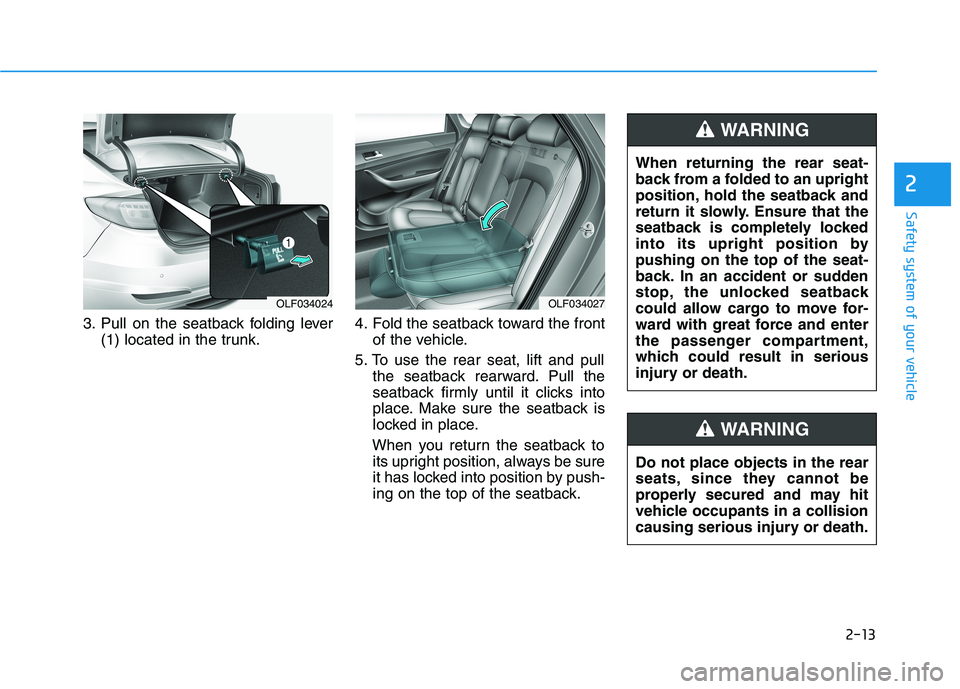
3. Pull on the seatback folding lever(1) located in the trunk. 4. Fold the seatback toward the front
of the vehicle.
5. To use the rear seat, lift and pull the seatback rearward. Pull the
seatback firmly until it clicks into
place. Make sure the seatback is
locked in place.
When you return the seatback to its upright position, always be sure
it has locked into position by push-
ing on the top of the seatback.
2
OLF034024OLF034027 When returning the rear seat-
back from a folded to an upright
position, hold the seatback and
return it slowly. Ensure that the
seatback is completely locked
into its upright position bypushing on the top of the seat-
back. In an accident or sudden
stop, the unlocked seatback
could allow cargo to move for-
ward with great force and enter
the passenger compartment,
which could result in serious
injury or death.
WARNING
Do not place objects in the rear
seats, since they cannot be
properly secured and may hit
vehicle occupants in a collision
causing serious injury or death.
WARNING
Page 80 of 546
2-14
Safety system of your vehicle
Armrest
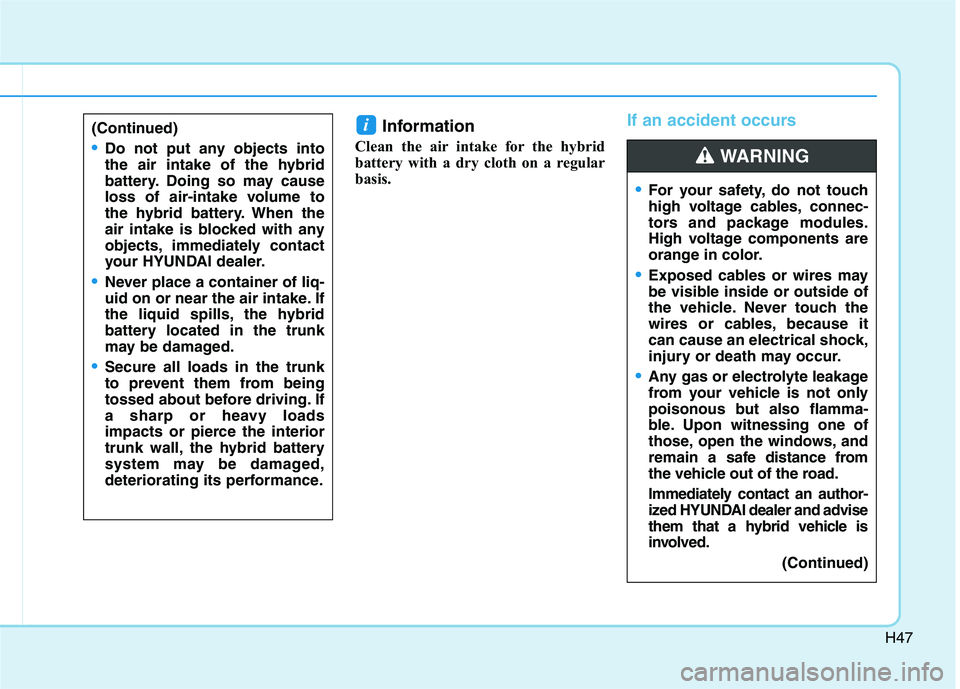
The armrest is located in the center
of the rear seat. Pull the armrest
down from the seatback to use it.
Cup holder
To use the center cup holder, pull
down the armrest.
Make sure the engine is off, the
shift lever is in P (Park), and the
parking brake is securely applied
whenever loading or unloading
cargo. Failure to take these steps
may allow the vehicle to move if
the shift lever is inadvertently
moved to another position.
WARNING
OLF034065
OLF044266
Page 81 of 546
2-15
Safety system of your vehicle
Carrying long/narrow cargo (if equipped)
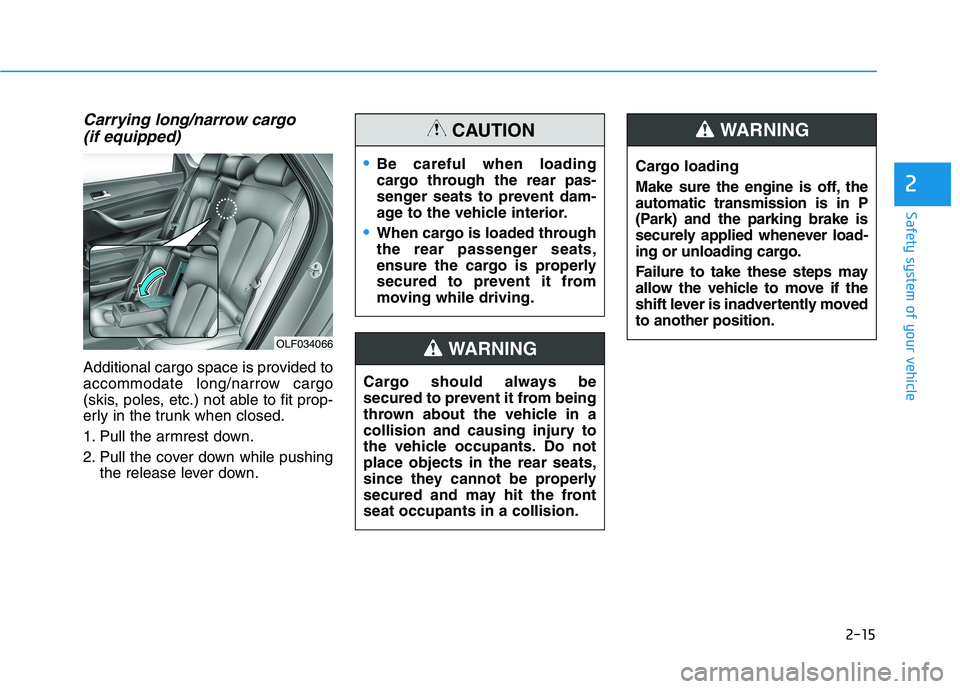
Additional cargo space is provided to
accommodate long/narrow cargo
(skis, poles, etc.) not able to fit prop-
erly in the trunk when closed.
1. Pull the armrest down.
2. Pull the cover down while pushing the release lever down.
2
Cargo should always be
secured to prevent it from being
thrown about the vehicle in a
collision and causing injury to
the vehicle occupants. Do notplace objects in the rear seats,
since they cannot be properly
secured and may hit the frontseat occupants in a collision.
WARNING
Be careful when loading
cargo through the rear pas-
senger seats to prevent dam-
age to the vehicle interior.
When cargo is loaded through
the rear passenger seats,
ensure the cargo is properly
secured to prevent it from
moving while driving.
CAUTION
OLF034066 Cargo loading
Make sure the engine is off, the automatic transmission is in P
(Park) and the parking brake is
securely applied whenever load-
ing or unloading cargo.
Failure to take these steps may
allow the vehicle to move if the
shift lever is inadvertently movedto another position.
WARNING
Page 90 of 546

2-24
Safety system of your vehicle
This section describes how to use the
seat belts properly. It also describessome of the things not to do when
using seat belts.
Seat Belt Safety Precautions
Always fasten your seat belt and
make sure all passengers have fas-
tened their seat belts before starting
any trip. Air bags are designed tosupplement the seat belt as an addi-
tional safety device, but they are not
a substitute. Most counties require all
occupants of a vehicle to wear seat
belts.
SSEE AA TT BB EELLTT SS
Seat belts must be used by ALL
passengers whenever the vehi-
cle is moving. Take the followingprecautions when adjustingand wearing seat belts:
ALWAYS properly restrain
children under age 13 in therear seats.
(Continued)
WARNING
(Continued)
NEVER allow children to ride
in the front passenger seat. If
a child age 13 or older must be
seated in the front seat, move
the seat as far back as possi-
ble and properly restrain themin the seat.
NEVER allow an infant or child
to be carried on an occupant’slap.
NEVER ride with the seatback
reclined when the vehicle is
moving.
Do not allow children to share a seat or seat belt.
Do not wear the shoulder belt
under your arm or behind your
back.
Always wear both the shoul-
der portion and lap portion ofthe lap/shoulder belt.
Do not use the seat belt if it is
twisted. A twisted seat belt
will not protect you properlyin an accident.
(Continued)
(Continued)
Do not use a seat belt if the
webbing or hardware is dam-
aged.
Do not latch the seat belt into
the buckles of other seats.
NEVER unfasten the seat belt
while driving. This may cause
loss of vehicle control result-ing in an accident.
Make sure there is nothing in
the buckle interfering with the
seat belt latch mechanism.
This may prevent the seat belt
from fastening securely.
No modifications or additions
should be made by the user
which will either prevent the
seat belt adjusting devices
from operating to remove
slack, or prevent the seat belt
assembly from being adjusted
to remove slack.