2019 HYUNDAI SONATA HYBRID heating
[x] Cancel search: heatingPage 391 of 546
5-101
Driving your vehicle
5
Information
The ESC system must be turned OFF
before rocking the vehicle.
If you are still stuck after rocking
the vehicle a few times, have the
vehicle pulled out by a tow vehicle
to avoid engine overheating, pos-
sible damage to the transmission,
and tire damage. See "Towing" in
chapter 6.Smooth cornering
Avoid braking or gear changing in
corners, especially when roads are
wet. Ideally, corners should always
be taken under gentle acceleration.
Driving at night
Night driving presents more hazards
than driving in the daylight. Here are
some important tips to remember:
Slow down and keep more dis- tance between you and other vehi-
cles, as it may be more difficult tosee at night, especially in areas
where there may not be any street
lights.
Adjust your mirrors to reduce the glare from other driver's head-
lamps.
Keep your headlamps clean and properly aimed. Dirty or improperly
aimed headlamps will make it
much more difficult to see at night.
Avoid staring directly at the head- lamps of oncoming vehicles. You
could be temporarily blinded, and it
will take several seconds for your
eyes to readjust to the darkness.
NOTICE
i
Page 409 of 546
6-7
What to do in an emergency
6
If your engine coolant temperature
gauge indicates overheating, you
experience a loss of power, or hear
loud pinging or knocking, the engine
may be overheating. If this happens,
you should:
1. Turn ON the hazard warning flash-er, pull off the road and stop as
soon as it is safe to do so.
2. Place the shift lever in P (Park) and set the parking brake.
3. Make sure that there is no hotsteam gushing out of the engine
compartment. When it is safe to
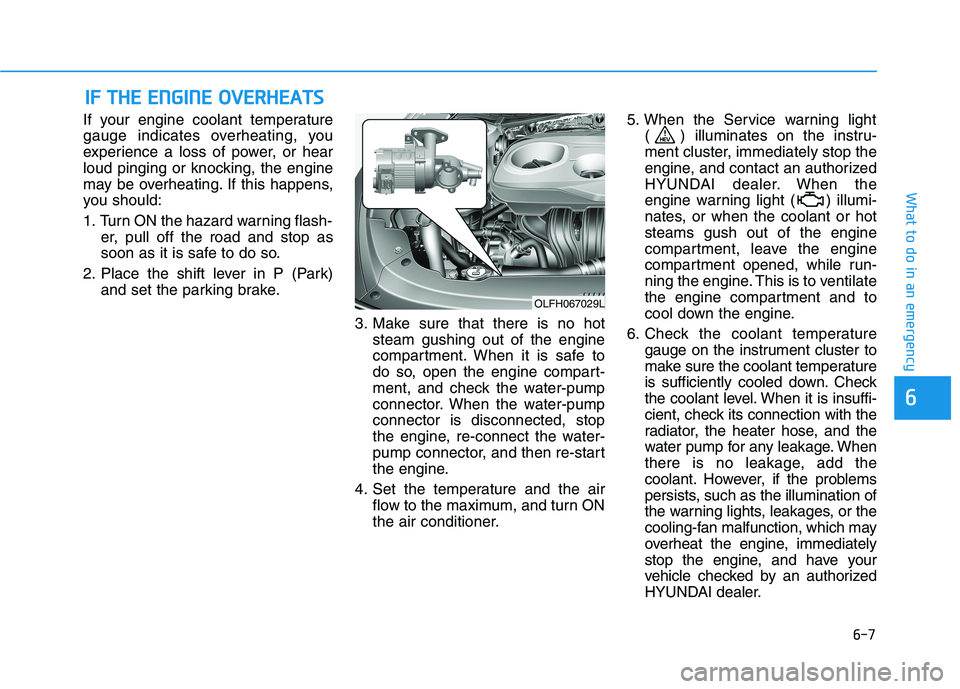
do so, open the engine compart-
ment, and check the water-pump
connector. When the water-pumpconnector is disconnected, stop
the engine, re-connect the water-
pump connector, and then re-start
the engine.
4. Set the temperature and the air flow to the maximum, and turn ON
the air conditioner. 5. When the Service warning light
( ) illuminates on the instru-
ment cluster, immediately stop the
engine, and contact an authorized
HYUNDAI dealer. When the
engine warning light ( ) illumi-
nates, or when the coolant or hotsteams gush out of the engine
compartment, leave the engine
compartment opened, while run-
ning the engine. This is to ventilate
the engine compartment and to
cool down the engine.
6. Check the coolant temperature gauge on the instrument cluster to
make sure the coolant temperature
is sufficiently cooled down. Check
the coolant level. When it is insuffi-
cient, check its connection with the
radiator, the heater hose, and the
water pump for any leakage. When
there is no leakage, add the
coolant. However, if the problems
persists, such as the illumination of
the warning lights, leakages, or the
cooling-fan malfunction, which may
overheat the engine, immediately
stop the engine, and have your
vehicle checked by an authorized
HYUNDAI dealer.
IIFF TT HH EE EE NN GGIINN EE OO VVEERR HH EEAA TTSS
OLFH067029L
Page 410 of 546

6-8
What to do in an emergency
7. If you cannot find the cause of theoverheating, wait until the engine
temperature has returned to nor-
mal. Then, if coolant has beenlost, carefully add coolant to the
reservoir to bring the fluid level in
the reservoir up to the halfway
mark.
8. Proceed with caution, keeping alert for further signs of overheat-
ing. If overheating happens again,
call an authorized HYUNDAI deal-
er for assistance.
Serious loss of coolant indi-cates a leak in the cooling sys-
tem and should be checked as
soon as possible by an author-
ized HYUNDAI dealer.
CAUTION
The electric motor for
the cooling fan may
continue to operate
or start up when theengine is not running
and can cause serious injury.
Keep hands, clothing and tools
away from the rotating fan
blades of the cooling fan.
WARNING
Your vehicle is equipped with a pres-
surized coolant
reserve tank. NEVER
remove the coolant
reserve tank cap or the radiatordrain plug while the engine and
radiator are HOT. Hot coolant
and steam may blow out under
pressure, causing serious
injury.
Turn the engine off and wait
until the engine cools down.
Use extreme care when remov-
ing the coolant reserve tank
cap. Wrap a towel or thick rag
around it, and turn it counter-
clockwise slowly to release
some of the pressure from the
system. Step back while thepressure is released.
When you are sure all the pres-
sure has been released, contin-ue turning the cap counter-
clockwise to remove it.
WARNING
Page 437 of 546
6-35
What to do in an emergency
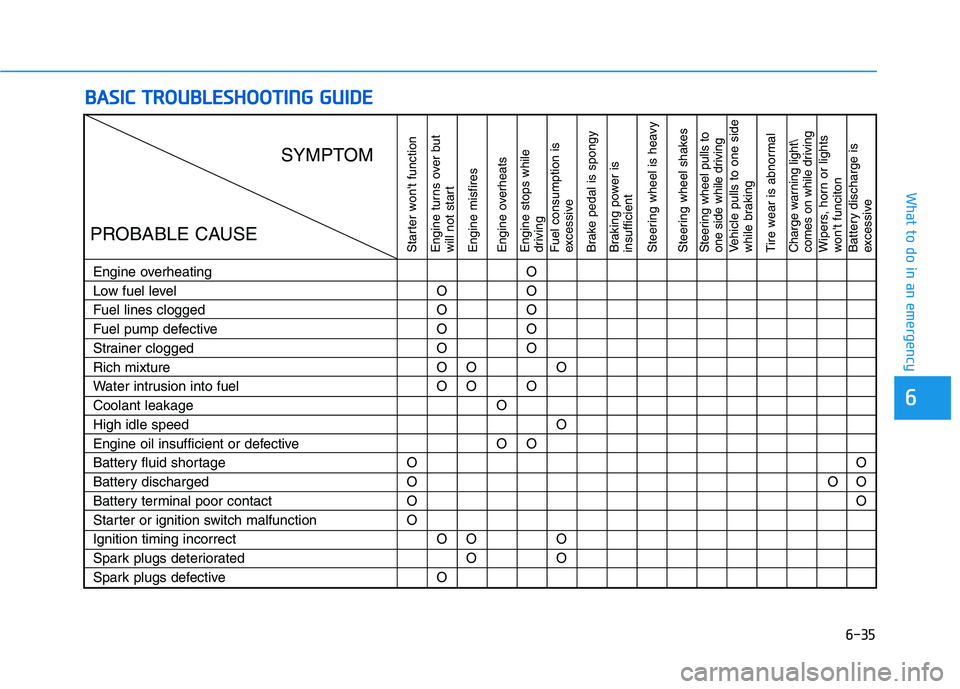
BBAA SSIICC TT RR OO UUBBLLEE SSHH OO OOTTIINN GG GG UU IIDD EE
6
Starter won't function
Engine turns over but
will not start Engine misfires
Engine overheats Engine stops while
driving Fuel consumption is
excessive
Brake pedal is spongy
Braking power is insufficient
Steering wheel is heavy
Steering wheel shakesSteering wheel pulls to
one side while drivingVehicle pulls to one side
while braking
Tire wear is abnormalCharge warning light\
comes on while drivingWipers, horn or lights
won't funciton
Battery discharge is
excessive
Engine overheating
Low fuel levelFuel lines clogged
Fuel pump defective
Strainer cloggedRich mixture
Water intrusion into fuelCoolant leakageHigh idle speed
Engine oil insufficient or defective
Battery fluid shortage
Battery discharged
Battery terminal poor contact
Starter or ignition switch malfunctionIgnition timing incorrect
Spark plugs deteriorated
Spark plugs defective OOOOOOOOOO O O
O O O O
O OO OOOO O O
OO O O
O
OOO
SYMPTOM
PROBABLE CAUSE
Page 461 of 546

7-23
7
Maintenance
Changing engine coolant
Have coolant changed by an author-
ized HYUNDAI dealer according tothe Maintenance Schedule at the
beginning of this chapter.
To prevent damage to engine
parts, put a thick towel around the
radiator cap before refilling the
coolant to prevent the coolant
from overflowing into engine
parts, such as the generator.
Checking the hybrid starter &
generator (HSG) belt
Have the hybrid starter & generator (HSG) belt inspected or replacedaccording to the Maintenance
Schedule in this chapter by an
authorized HYUNDAI dealer.
NOTICE
HHYY BBRRIIDD SS TT AA RRTTEERR && GG EENN EERR AA TTOO RR (( HH SSGG )) BB EELLTT
Turn the vehicle off while you
inspect the engine or hybrid
starter & generator (HSG)
belt. Otherwise it may result in
serious injury.
Keep hands, clothing etc.
away from the hybrid starter &
generator (HSG) belt.
WARNING
When the HSG belt is worn out
or damaged, replace the belt.
Otherwise, it may cause engine
overheating or battery dis-
charge.
CAUTIONDo not use engine coolant or
antifreeze in the washer fluid
reservoir.
Engine coolant can severely
obscure visibility when sprayed
on the windshield and may
cause loss of vehicle controlresulting in an accident.
Engine coolant may also cause
damage to paint and body trim.
WARNING
Page 539 of 546

I-2
Accessing your vehicle .....................................................3-3
Immobilizer System .....................................................3-8
Smart Key.....................................................................3-3
Air bag - advanced supplemental restraint system .........2-47 Additional Safety Precautions ....................................2-69
Air Bag Warning Labels.............................................2-70
How Does the Air Bag System Operate? ...................2-53
Occupant Classification System (OCS) .....................2-58
SRS Care ....................................................................2-68
What to Expect After an Air Bag Inflates ..................2-57
Where Are the Air Bags? ...........................................2-49
Why Didn't My Air Bag Go Off in a Collision?........2-63
Air cleaner.......................................................................7-26
Filter replacement .......................................................7-26
Air conditioning system....................................................8-5
Appearance care..............................................................7-78 Exterior care ...............................................................7-78
Interior care ................................................................7-84
Automatic climate control system ................................3-119
Automatic heating and air conditioning ...................3-120
Manual heating and air conditioning .......................3-121
System maintenance .................................................3-131
System operation ......................................................3-129 Automatic Emergency Braking (AEB)...........................5-67
AEB front radar sensor ..............................................5-72
AEB warning message and system control................5-69
Limitations of the system ...........................................5-75
System malfunction ....................................................5-73
System setting and activation .....................................5-67
Automatic transmission ..................................................5-12 Automatic transmission operation..............................5-12
Good driving practices ...............................................5-17
Parking........................................................................5-17
Basic troubleshooting guide ...........................................6-35
Battery .............................................................................7-32 Battery recharging ......................................................7-33
For best battery service ..............................................7-33
Reset features .............................................................7-34
Before driving ...................................................................5-4
Before entering the vehicle ..........................................5-4
Before starting ..............................................................5-4
Blind Spot Detection system (BSD) ...............................5-45 BSD (Blind Spot Detection) / LCA (Lane Change Assist) .....................................5-46
Limitations of the system ...........................................5-52
RCTA (Rear Cross Traffic Alert) ...............................5-49
Brake fluid ......................................................................7-24 Checking the brake fluid level ...................................7-24
Index
A
B