2019 HYUNDAI ELANTRA SPORT lights
[x] Cancel search: lightsPage 394 of 534
6-5
What to do in an emergency
6
InformationAn inappropriately disposedbattery can be harmful to the
environment and human
health. Dispose of the battery
according to your local law(s)
or regulations. To prevent damage to your vehi-
cle:
• Only use a 12-volt power supply
(battery or jumper system) to
jump start your vehicle.
Do not attempt to jump start your vehicle by push-starting.
Jump starting procedure
1. Position the vehicles close enough that the jumper cables will reach,
but do not allow the vehicles totouch.
2. Avoid fans or any moving parts in the engine compartment at all
times, even when the vehicles are
turned off.
3. Turn off all electrical devices such as radios, lights, air conditioning,
etc. Put the vehicles in P (Park)
and set the parking brakes. Turn
both vehicles OFF.
NOTICE
i
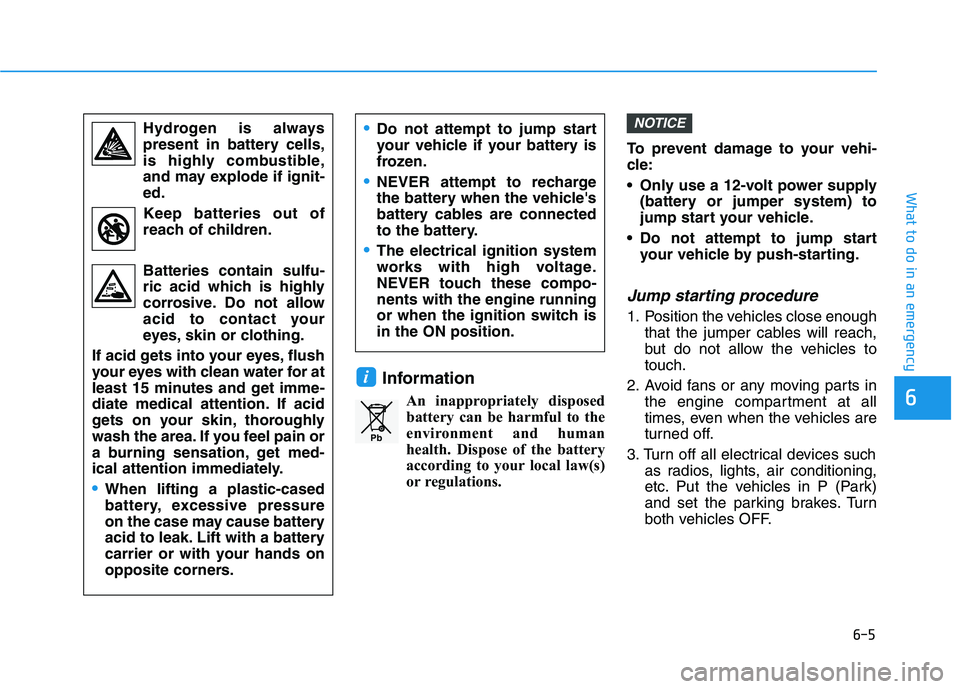
Hydrogen is alwayspresent in battery cells,
is highly combustible,
and may explode if ignit-ed.
Keep batteries out of
reach of children. Batteries contain sulfu-
ric acid which is highly
corrosive. Do not allow
acid to contact your
eyes, skin or clothing.
If acid gets into your eyes, flush
your eyes with clean water for at
least 15 minutes and get imme-
diate medical attention. If acid
gets on your skin, thoroughly
wash the area. If you feel pain or
a burning sensation, get med-
ical attention immediately.
When lifting a plastic-cased
battery, excessive pressure
on the case may cause battery
acid to leak. Lift with a battery
carrier or with your hands on
opposite corners.
Do not attempt to jump start
your vehicle if your battery is
frozen.
NEVER attempt to recharge
the battery when the vehicle's
battery cables are connected
to the battery.
The electrical ignition system
works with high voltage.
NEVER touch these compo-nents with the engine running
or when the ignition switch isin the ON position.
Pb
Page 424 of 534
6-35
What to do in an emergency
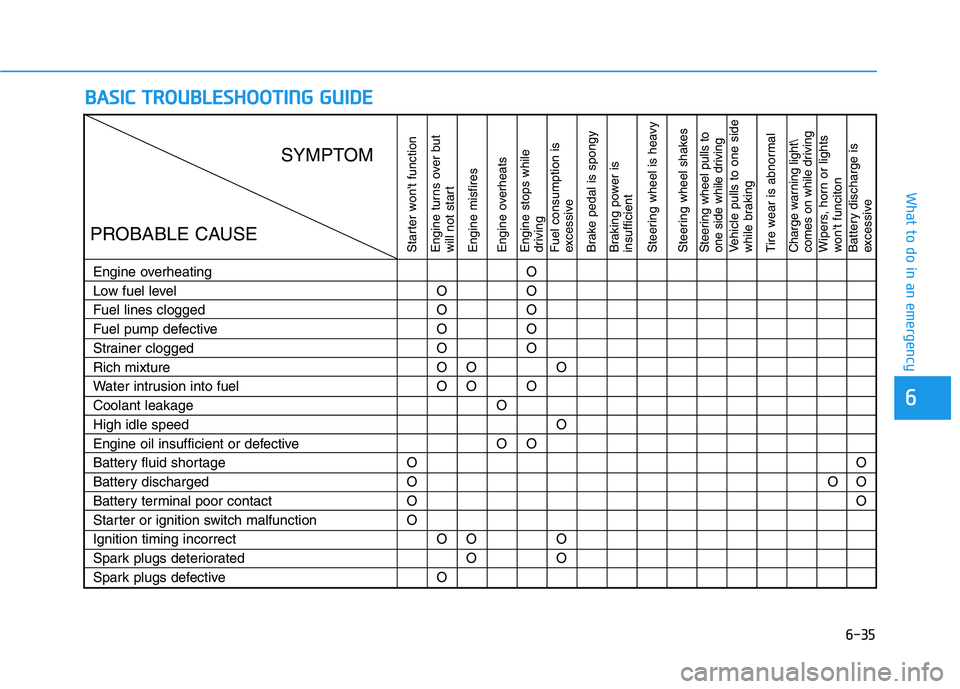
BBAA SSIICC TT RR OO UUBBLLEE SSHH OO OOTTIINN GG GG UU IIDD EE
6
Starter won't function
Engine turns over but
will not start Engine misfires
Engine overheats Engine stops while
driving Fuel consumption is
excessive
Brake pedal is spongy
Braking power is insufficient
Steering wheel is heavy
Steering wheel shakesSteering wheel pulls to
one side while drivingVehicle pulls to one side
while braking
Tire wear is abnormalCharge warning light\
comes on while drivingWipers, horn or lights
won't funciton
Battery discharge is
excessive
Engine overheating
Low fuel levelFuel lines clogged
Fuel pump defective
Strainer cloggedRich mixture
Water intrusion into fuelCoolant leakageHigh idle speed
Engine oil insufficient or defective
Battery fluid shortage
Battery discharged
Battery terminal poor contact
Starter or ignition switch malfunctionIgnition timing incorrect
Spark plugs deteriorated
Spark plugs defective OOOOOOOOOO O O
O O O O
O OO OOOO O O
OO O O
O
OOO
SYMPTOM
PROBABLE CAUSE
Page 425 of 534
6-36
What to do in an emergency
Starter won't function
Engine turns over but
will not start Engine misfires
Engine overheats Engine stops while
driving Fuel consumption is
excessive
Brake pedal is spongy
Braking power is insufficient
Steering wheel is heavy
Steering wheel shakesSteering wheel pulls to
one side while drivingVehicle pulls to one side
while braking
Tire wear is abnormalCharge warning light\
comes on while drivingWipers, horn or lights
won't funciton
Battery discharge is
excessive
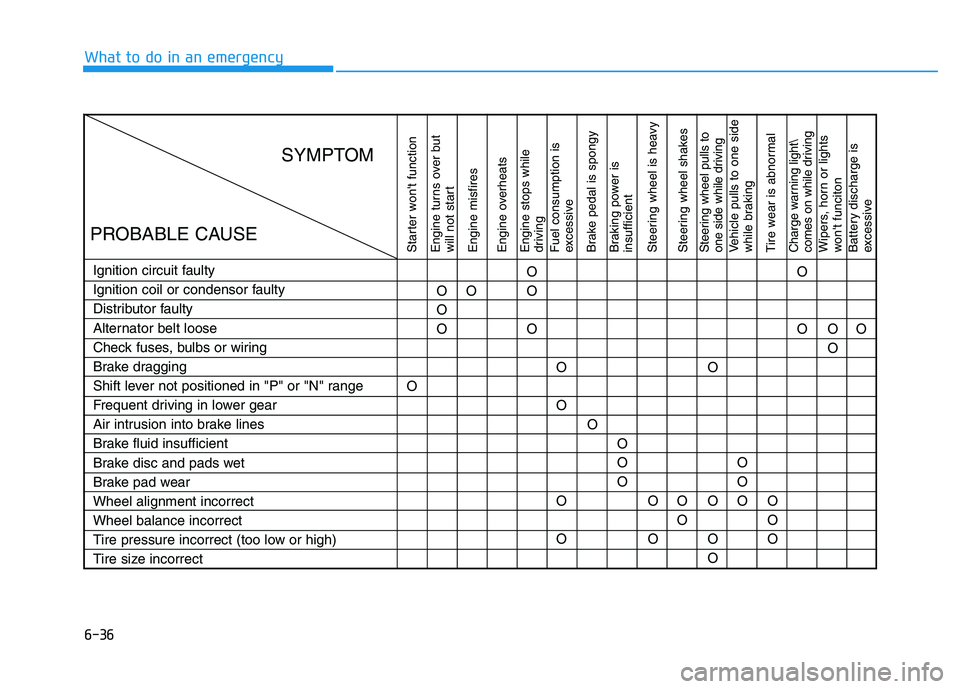
Ignition circuit faulty
Ignition coil or condensor faulty
Distributor faulty
Alternator belt loose
Check fuses, bulbs or wiring
Brake dragging
Shift lever not positioned in "P" or "N" range
Frequent driving in lower gear
Air intrusion into brake lines
Brake fluid insufficient
Brake disc and pads wet
Brake pad wearWheel alignment incorrectWheel balance incorrect
Tire pressure incorrect (too low or high)
Tire size incorrectO
O OO
O
OOOO O OO O O O O O
OOOO
OOO O
O O O
OO O O O O
O
SYMPTOM
PROBABLE CAUSE
Page 431 of 534
7-6
Maintenance
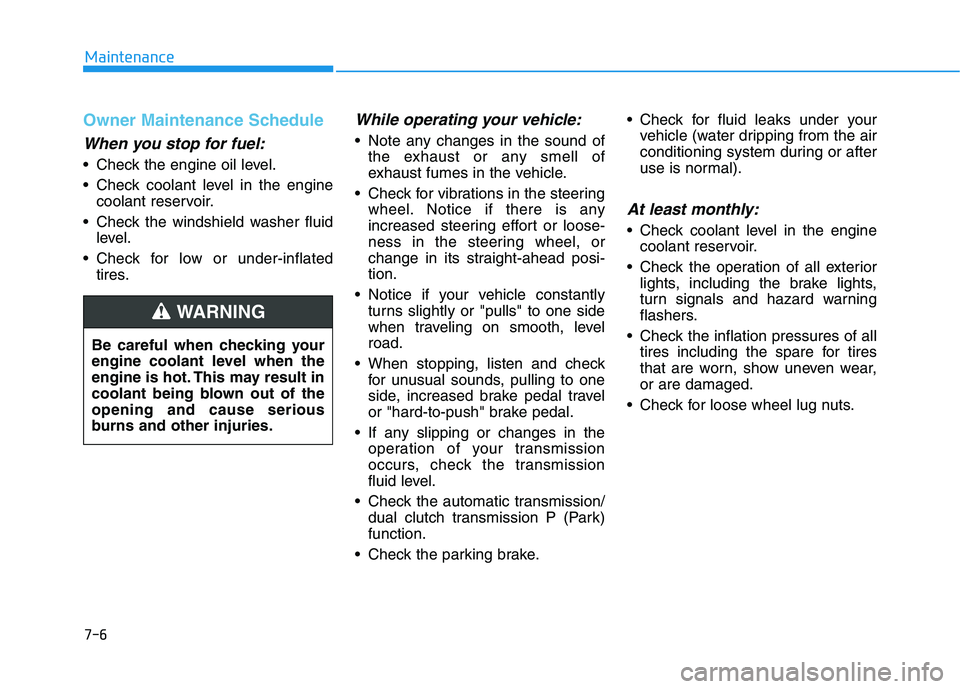
Owner Maintenance Schedule
When you stop for fuel:
Check the engine oil level.
Check coolant level in the enginecoolant reservoir.
Check the windshield washer fluid level.
Check for low or under-inflated tires.
While operating your vehicle:
Note any changes in the sound ofthe exhaust or any smell of
exhaust fumes in the vehicle.
Check for vibrations in the steering wheel. Notice if there is any
increased steering effort or loose-
ness in the steering wheel, or
change in its straight-ahead posi-tion.
Notice if your vehicle constantly turns slightly or "pulls" to one side
when traveling on smooth, levelroad.
When stopping, listen and check for unusual sounds, pulling to one
side, increased brake pedal travel
or "hard-to-push" brake pedal.
If any slipping or changes in the operation of your transmission
occurs, check the transmission
fluid level.
Check the automatic transmission/ dual clutch transmission P (Park)function.
Check the parking brake. Check for fluid leaks under your
vehicle (water dripping from the air
conditioning system during or after
use is normal).
At least monthly:
Check coolant level in the enginecoolant reservoir.
Check the operation of all exterior lights, including the brake lights,
turn signals and hazard warning
flashers.
Check the inflation pressures of all tires including the spare for tires
that are worn, show uneven wear,or are damaged.
Check for loose wheel lug nuts.
Be careful when checking your
engine coolant level when the
engine is hot. This may result in
coolant being blown out of theopening and cause serious
burns and other injuries.
WARNING
Page 478 of 534
7-53
7
Maintenance
FFUU SSEE SS
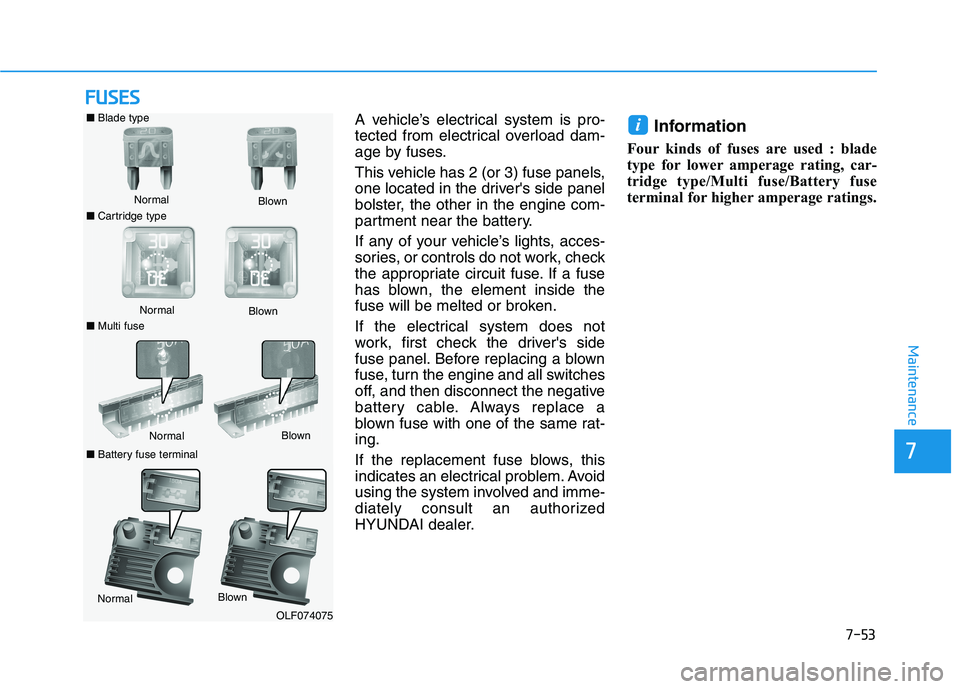
A vehicle’s electrical system is pro-
tected from electrical overload dam-
age by fuses.
This vehicle has 2 (or 3) fuse panels,
one located in the driver's side panel
bolster, the other in the engine com-
partment near the battery.
If any of your vehicle’s lights, acces-
sories, or controls do not work, check
the appropriate circuit fuse. If a fuse
has blown, the element inside the
fuse will be melted or broken.
If the electrical system does not
work, first check the driver's side
fuse panel. Before replacing a blown
fuse, turn the engine and all switches
off, and then disconnect the negative
battery cable. Always replace a
blown fuse with one of the same rat-ing.
If the replacement fuse blows, this
indicates an electrical problem. Avoid
using the system involved and imme-
diately consult an authorized
HYUNDAI dealer. Information
Four kinds of fuses are used : blade
type for lower amperage rating, car-
tridge type/Multi fuse/Battery fuse
terminal for higher amperage ratings.i■ Blade type
Normal
■ Cartridge type Blown
Normal
Blown
■ Multi fuse
Normal Blown
■
Battery fuse terminal
Normal Blown
OLF074075
Page 500 of 534
7-75
7
Maintenance
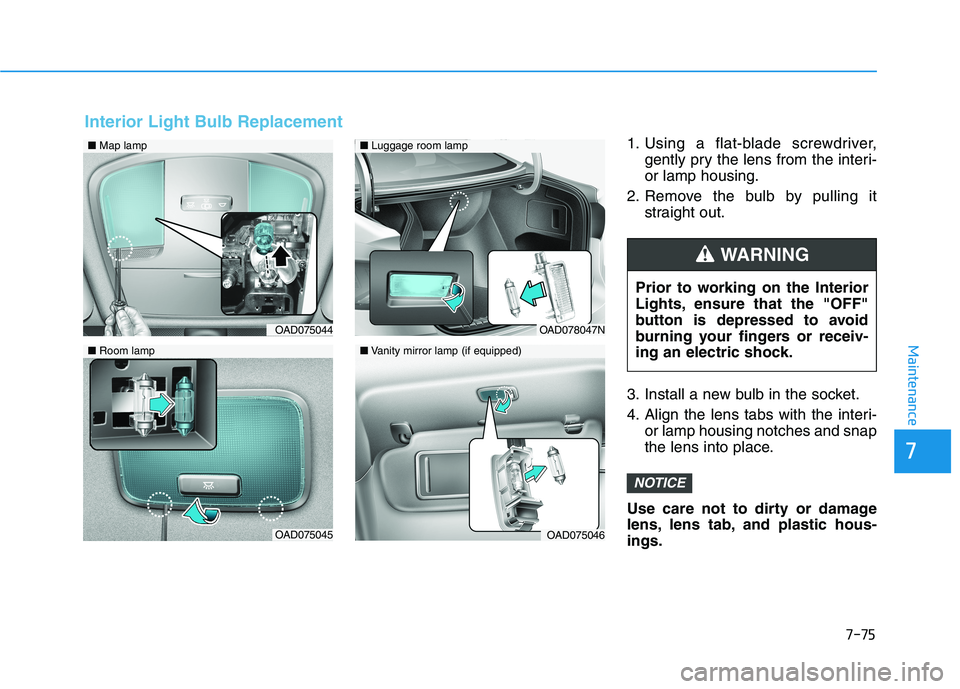
1. Using a flat-blade screwdriver,gently pry the lens from the interi- or lamp housing.
2. Remove the bulb by pulling it straight out.
3. Install a new bulb in the socket.
4. Align the lens tabs with the interi- or lamp housing notches and snap
the lens into place.
Use care not to dirty or damage
lens, lens tab, and plastic hous-ings.
NOTICE
■ Map lamp
OAD075044
OAD075045
■Luggage room lamp
■Vanity mirror lamp (if equipped)
OAD078047N
OAD075046
■ Room lamp
Interior Light Bulb Replacement
Prior to working on the Interior
Lights, ensure that the "OFF"
button is depressed to avoid
burning your fingers or receiv-
ing an electric shock.
WARNING
Page 528 of 534
I-5
Exterior Features .............................................................3-45
Fuel Filler Door ..........................................................3-52
Hood ...........................................................................3-45
Smart Trunk ................................................................3-49
Trunk ..........................................................................3-46
Exterior Lights ..............................................................3-101
Exterior Overview.............................................................1-2
Floor Mat Anchor(s) .....................................................3-152
Forward Collision Avoidance (FCA) system..................5-74 FCA Sensor ................................................................5-79
FCA Warning Message and System Control..............5-76
Limitations of the System ..........................................5-82
System Malfunction ...................................................5-80
System Setting and Activation ...................................5-74
Forward Collision Avoidance (FCA) system (with HYUNDAI smart sense) ....................................5-87
FCA Sensor (Front Radar/Front Camera) ..................5-92
FCA Warning Message and System Control..............5-90
Limitations of the System ..........................................5-96
System Malfunction ...................................................5-94
System Setting and Activation ...................................5-87
Front Seats ........................................................................2-6
Fuel Filler Door ..............................................................3-52 Fuses ...............................................................................7-53
Engine Compartment Panel Fuse Replacement .........7-56
Fuse/Relay Panel Description ....................................7-59
Instrument Panel Fuse Replacement ..........................7-54
Gauges.............................................................................3-57
Glove Box .....................................................................3-144
Hazard Warning Flasher ...................................................6-2
Head Restraints ...............................................................2-15
Headlamp Replacement ..................................................7-65
Heated Steering Wheel ...................................................3-24
High Mounted Stop Light Replacement .........................7-74
Hill-Start Assist Control (HAC) .....................................5-50
Hood................................................................................3-45
Horn ................................................................................3-25
I
Index
F
G
H
Page 529 of 534
I-6
If the Engine Overheats ....................................................6-7
If the Engine Will not Start...............................................6-4
If the Engine Doesn't Turn Over or Turns Over Slowly ....................................................6-4
If the Engine Turns Over Normally but Doesn't Start ..............................................................6-4
If you Have a Flat Tire .....................................................6-9 With Spare Tire ............................................................6-9
With Tire Mobility Kit (TMK) - Type A ...................6-16
With Tire Mobility Kit (TMK) - Type B ...................6-23
Ignition Switch..................................................................5-6 Engine Start/Stop Button ..............................................5-9
Key Ignition Switch .....................................................5-6
Immobilizer System ........................................................3-11
Important Safety Precautions............................................2-2 Air Bag Hazards ...........................................................2-2
Always Wear Your Seat Belt ........................................2-2
Control Your Speed ......................................................2-3
Driver Distraction.........................................................2-2
Keep Your Vehicle in Safe Condition ..........................2-3
Restrain All Children....................................................2-2
In Case of an Emergency While Driving .........................6-3
If the Engine Stalls at a Crossroad or Crossing ...........6-3
If the Engine Stalls While Driving...............................6-3
If you Have a Flat Tire While Driving.........................6-3
Inside Rearview Mirror...................................................3-26 Instrument Cluster...........................................................3-55
Gauges ........................................................................3-57
Instrument Cluster Control .........................................3-57
LCD Display Messages ..............................................3-75
Transmission Shift Indicator ......................................3-62
Warning and Indicator lights ......................................3-63
Instrument Panel Overview ..............................................1-5
Interior Care ....................................................................7-81
Interior Features ............................................................3-146 Clock ........................................................................3-151
Clothes Hanger .........................................................3-151
Cup Holder ...............................................................3-146
Floor Mat Anchor(s) .................................................3-152
Power Outlet.............................................................3-148
Sunvisor ....................................................................3-147
USB Charger ............................................................3-151
Wireless Cellular Phone Charging System ..............3-149
Interior Light Bulb Replacement ....................................7-75
Interior Lights ...............................................................3-108
Interior Overview..............................................................1-4
Jump Starting ....................................................................6-4
Key Ignition Switch ..........................................................5-6
Index
I
J
K